Castle of Gesualdo: A Feudal Stronghold and Renaissance Court in Italy


Site at a Glance
- Rating
- 4.4
- Popularity
- Low
- Country
- Italy
- Primary era
- Early Modern
- External website
- Open
- Eras represented
- Medieval, Early Modern, Modern
- Civilizations
- Kingdom of Naples, Kingdom of the Two Sicilies, Lombard, Spanish
- Site type
- Military
- Remains
- Castle
On this page7 sections
History
The Castle of Gesualdo is a feudal stronghold in Gesualdo, Italy, whose origins are associated with the Lombard period and the early medieval era. It commanded the Gesualdo family’s feudal possessions and later became the residence of Prince Carlo Gesualdo, the Italian composer who lived from 1566 to 1613 and became an important early figure in modern polyphonic music.
Lombard and Early Medieval Origins
The castle’s beginnings remain debated. One tradition places its construction in the seventh century, when Romuald I, Duke of Benevento, faced a threat from the Byzantine emperor Constans II. According to this account, Romuald ordered his tutor Sessualdo, also known as Gesualdo, to build a fortress in a naturally defensible position. The settlement that grew around it was said to have taken the name Gesualdo from Sessualdo.
A second theory dates the castle to the ninth century and attributes its construction to Radelchi I, Prince of Benevento, who supposedly established it to defend the southern frontier of his territory. The earliest documented information, however, comes from the twelfth century, during Norman rule. The first recorded lord was Guglielmo d’Altavilla, whose family retained the fief for five centuries.
Warfare and Renaissance Transformation
The stronghold was besieged by the forces of Ferrante d’Aragona, Ferrante I, the Aragonese king of Naples, on 12 October 1461. Ferrandino, his son and successor, Ferdinand II of Naples, later sent troops who sacked the castle on 4 June 1496.
In the late sixteenth century, Carlo Gesualdo undertook a complete renovation. The work transformed the fortress into a Renaissance court and introduced new structures, including a theatre. Its strategic military function ended in 1594, as the complex assumed a more residential and courtly role.
Later Damage, Alteration, and Restoration
The castle was altered and restored repeatedly over the following centuries. The 1694 Irpinia and Basilicata earthquake affected the complex, and Sanfedist troops stripped it in 1799. These forces were associated with the late-eighteenth-century movement that fought to restore Bourbon rule in southern Italy.
By 1855 the castle stood in ruins and passed to the Caccese family. They modified the structure, created additional rooms, rebuilt the façade, and connected the castle with Piazza Neviera. The 1980 earthquake then caused severe damage. Recovery and restoration began in 2000 but remain incomplete. The property is now held by the Municipality of Gesualdo and the Province of Avellino.
Remains
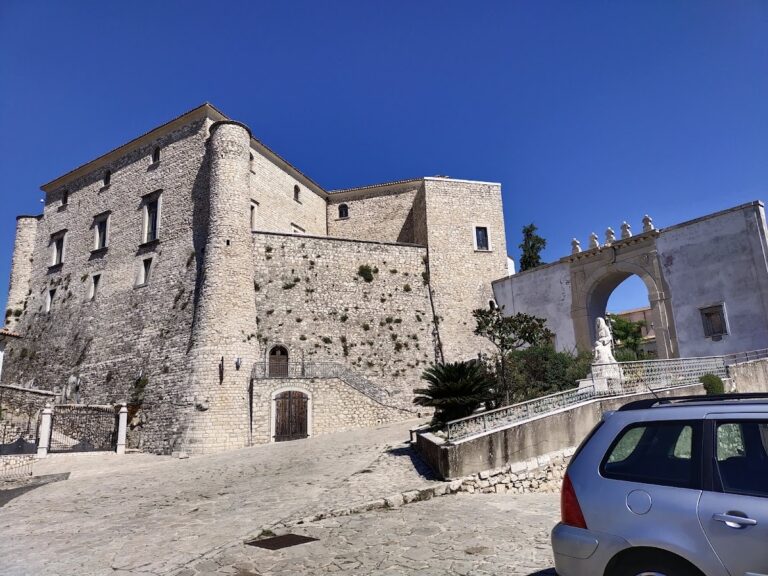
The Castle of Gesualdo occupies a hilltop at approximately 667 metres above sea level. Built of rubble stone, it consists of a fortified enclosure defined by four large circular towers, curtain walls, and ravelins, which are detached fortifications placed outside the main walls to protect their approaches. A central courtyard organizes the interior of the enclosure.
Fortified Enclosure
The four circular towers form the principal defensive elements of the castle, while the curtain walls join them into a continuous enclosure. The surrounding ravelins extend the defensive arrangement beyond the main walls, and the central courtyard provides the internal focus of the fortress. The late sixteenth-century renovation added a theatre within the broader transformation from military stronghold to Renaissance court.
Interiors and Later Alterations
The exterior façade reflects nineteenth-century architectural forms introduced during the Caccese family’s alterations. Inside, the surviving fabric preserves traces of Gothic art alongside Renaissance architectural elements. Later work added iron railings, created further rooms, remade the façade, and established the physical connection with Piazza Neviera. The 1980 earthquake left the complex profoundly damaged, and its restoration remains unfinished.