Albertis Castle: A Neo-Gothic Villa-Castle in Genoa, Italy


Site at a Glance
- Rating
- 4.6
- Popularity
- Medium
- Country
- Italy
- Primary era
- Modern
- External website
- Open
- Eras represented
- Medieval, Early Modern, Modern
- Civilizations
- Genoese, Italian
- Site type
- Domestic
- Remains
- Castle
On this page10 sections
History
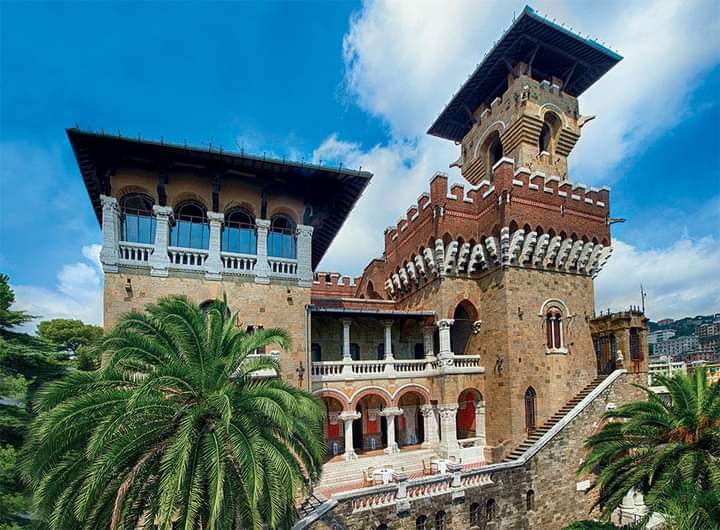
Albertis Castle is a historic residence in Genoa, Italy, built by the seafarer Enrico Alberto d’Albertis as his home between 1886 and 1892 in the nineteenth-century Gothic Revival style. Rising on Montegalletto in the Castelletto district, it was conceived as a villa-castle, a residence combining the domestic character of a villa with castle-like forms. Its inauguration in 1892 formed part of celebrations for the four-hundredth anniversary of Christopher Columbus’s discovery of the Americas, and it was described as Genoa’s first villa-castle.
Fortified foundations and construction
The residence was built over earlier defensive works. Fourteenth-century fortifications occupied the height and were strengthened in the sixteenth century, when a medieval square tower was replaced by a bastion incorporated into the later complex. The location had long been regarded as strategically important. During the War of the Austrian Succession, a conflict involving European powers in the eighteenth century, Genoese civilians in 1747 hauled cannons up the Monte Galletto fortifications toward Pietraminuta and fired on retreating Austrian forces.
Construction continued from 1886 to 1892 under the supervision of the architect Alfredo d’Andrade. Engineers Graziani and Francesco Parodi, together with the sculptors Allegro and Marc’Aurelio Crotta, contributed to the building and its decoration. The design drew on several historical traditions, including medieval Genoese architecture, Aosta Valley castles, Florentine palaces, and Hispano-Moorish forms.
From private residence to museum
Enrico Alberto d’Albertis died in 1932 and left the castle and his collections to the City of Genoa. After years of partial abandonment, the property underwent a substantial restoration campaign that adapted it for public use. The work opened the sixteenth-century bastion and created additional exhibition space. During the 1970s, the park had also been used as a café chantant, an entertainment venue with live musical or theatrical performances.
Since 2004, Albertis Castle has housed the Museum of World Cultures and the Museum of Peoples’ Music. The building remains in use as a museum, combining its history as a residence and fortified site with the collections assembled by d’Albertis and his cousin Luigi Maria d’Albertis.
Remains
Albertis Castle stands on Montegalletto above Genoa, with an open view toward the Ligurian Sea. The five-floor building is Neo-Gothic in form, but its design combines medieval references with architectural elements associated with Aosta Valley castles, Florentine palaces, and Hispano-Moorish buildings. Medieval Genoese details include allusions to the Embriaci Tower and the multi-light windows of Palazzo San Giorgio.
Castle and fortified foundations
The sixteenth-century bastion
The castle incorporates a sixteenth-century bastion, a projecting fortification designed to strengthen a defensive wall and provide artillery positions. During restoration, its earth fill was cleared, exposing the internal masonry and recovering architectural components of the complex. The opened area now also provides exhibition space. At the bastion’s geometric apex, a former roof covering was replaced with a glass structure, bringing the medieval remains, Renaissance masonry spaces, and the castle’s later battlements and tower into view together.
The medieval tower remains
Basal remains of a tower from the earlier medieval circuit of walls survive within the castle’s foundations. The square medieval tower had been superseded by the later bastion, while the castle’s Neo-Gothic battlements and tower form part of the later architectural composition. The surviving masonry therefore brings together defensive construction from the medieval and Renaissance periods with the nineteenth-century residence.
Collections and interiors
Travel and ethnographic collections
The museum collections include ethnographic and archaeological materials gathered during the travels of Enrico Alberto d’Albertis and Luigi Maria d’Albertis in Africa, the Americas, New Guinea, and Oceania. Among them are weapons from Sudan and the Zambezi region, Chinese spears, European halberds, and craft objects made by Indigenous Canadian and North American peoples of the plains. These include buffalo and deer leather objects decorated with porcupine quills, as well as material connected with the Maya civilization of Honduras.
Nautical and musical displays
The interiors also contain ship and yacht models, nautical instruments, photographs, and volumes from Enrico d’Albertis’s personal library. Two ship models represent the Violante and the Corsaro, vessels used by him. The Museum of Peoples’ Music displays musical instruments from around the world, while the statue Colombo giovinetto by Giulio Monteverde forms part of the castle’s artistic contents.