Castello di Malgrate: A Medieval Fortification in Italy


Site at a Glance
- Rating
- 4.3
- Popularity
- Low
- Country
- Italy
- Primary era
- Medieval
- External website
- Open
- Eras represented
- Medieval, Early Modern
- Civilizations
- Holy Roman Empire
- Site type
- Military
- Remains
- Castle
On this page12 sections
History
Castello di Malgrate is a medieval fortification in Italy, located at Malgrate, a hamlet of Villafranca in Lunigiana, Tuscany. Important fortified structures already stood at Malgrate in the twelfth century, while the castle was first documented in 1351. Its development is associated with Bernabò Malaspina, whose family branch, the Malaspina dello Spino Fiorito, controlled the district for more than two centuries.
Malaspina lordship
The castle formed part of the fief of Niccolò I Malaspina, Marquis of Filattiera. His territory included the fortified settlements of Malgrate and Filetto, the settlements of Cunale and Casola, and the villages of Orturano, Irola, Mocrone, and Gragnana. In the division of this inheritance among Niccolò’s five sons, recorded in 1351, Malgrate was assigned to Bernabò Malaspina. The construction of the castle and the development of the village are associated with this transfer.
Bernabò’s descendants governed Malgrate amid disputes with subjects and neighboring feudal lords, invasions, and pressure on the dynasty’s political independence. Their position was also affected by the struggle between Florence and Milan for control of Lunigiana, a historical region in the upper Magra valley that is now divided between parts of Tuscany and Liguria.
Wars between Florence and Milan
During the fifteenth-century wars between Duke Filippo Maria Visconti of Milan and the Republic of Florence, the Bernabò branch changed its allegiance from Florence to Milan. Florence, supported by inhabitants who rebelled against the marquisate, occupied the castle for three years.
The Malaspina recovered their fief after the Peace of Ferrara in 1433 and an act of submission to Florence. Filippo Maria Visconti, angered by the restoration, sent troops against Malgrate in 1445. The attack damaged the castle and destroyed its fortifications.
Later owners and transformation
In 1615, Cesare II Malaspina, heavily indebted and without male heirs, sold the fief to the Ducal Chamber of Milan. The chamber retained it for twenty-six years before selling it in 1641 to the Ariberti family of Cremona. After a structural revision, the Ariberti transformed the fortress from a military installation into a bourgeois residence.
When the Ariberti family became extinct, Malgrate passed in 1745 to the Freganeschi family of Milan, related to the Ariberti through the female line. The Freganeschi retained control until the period of the French Revolution. During the nineteenth century, the castle was dismantled and stripped of its possessions, leaving it almost entirely ruined.
Restoration and heritage status
The castle was later acquired as state property and completely consolidated and restored through European Union Structural Funds and the Special Project Castelli della Lunigiana. It is designated Italian national heritage.
Remains
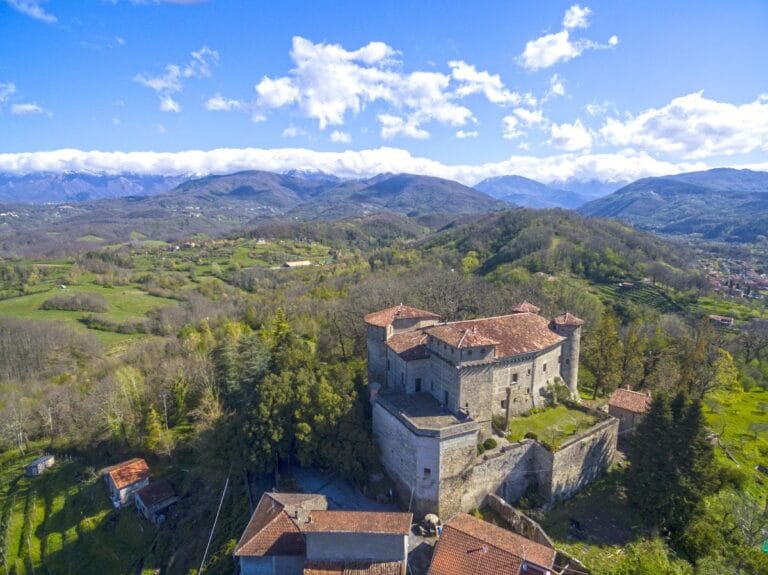
Castello di Malgrate stands on a hill overlooking the Bagnone valley. The Bagnone is a tributary of the Magra River, and the site lies within the historical region of Lunigiana. Its surviving arrangement combines a rectangular medieval core with later trapezoidal walls. A moat precedes the entrance, where a small bridge replaced an earlier drawbridge. The enclosure has crenellations, a wall-walk running along the top of the defensive wall, and guard passages around the full perimeter. Buttresses with small arches reinforce the walls.
Western defensive structures
Circular tower
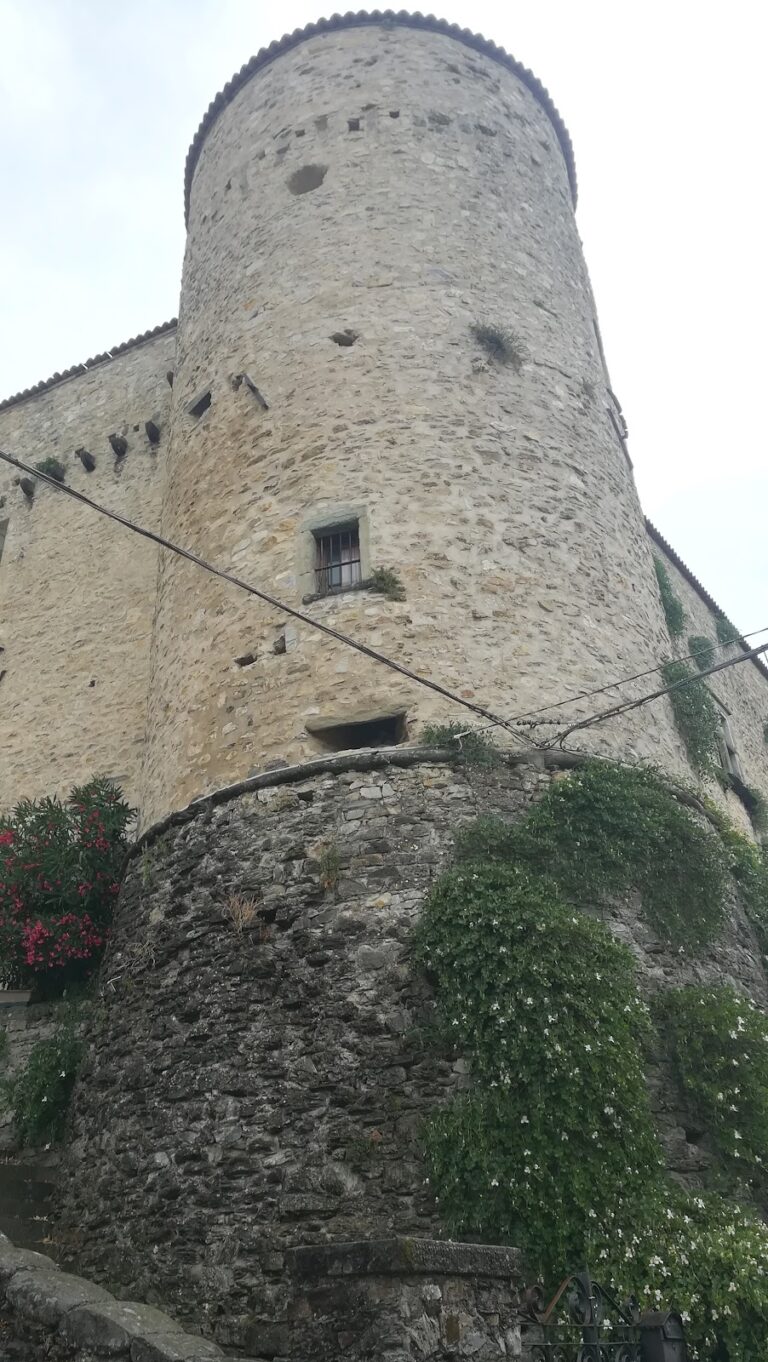
On the western side stands a probably twelfth-century circular tower more than 25 metres high. It is attached to a fortified rectangular structure and contains six vaulted rooms placed one above another. Trapdoors and retractable stairs connect the rooms, while the upper projection rests on projecting stone corbels. The tower was suited to defense by dropping projectiles from above.
Central keep
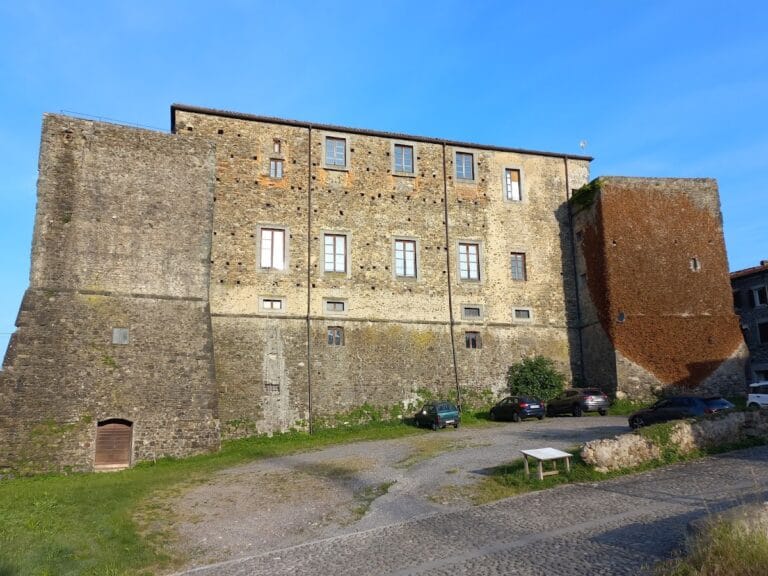
Beside the circular tower are the remains of the central keep, the principal fortified tower and residential stronghold of the castle. It served as the feudal lord’s residence and probably had three storeys arranged around an internal courtyard.
Walls and access
Fifteenth-century defenses
Large loopholes for projectile weapons, including bows and crossbows, survive from the fifteenth century. They formed part of the castle’s defensive system during the period of conflict between Milan and Florence.
Village gate
The gate giving access to the village was created by Giuseppe Malaspina in 1566. It is joined to the eastern side of the castle walls and belongs to the later development of the fortified settlement.
Nearby sites