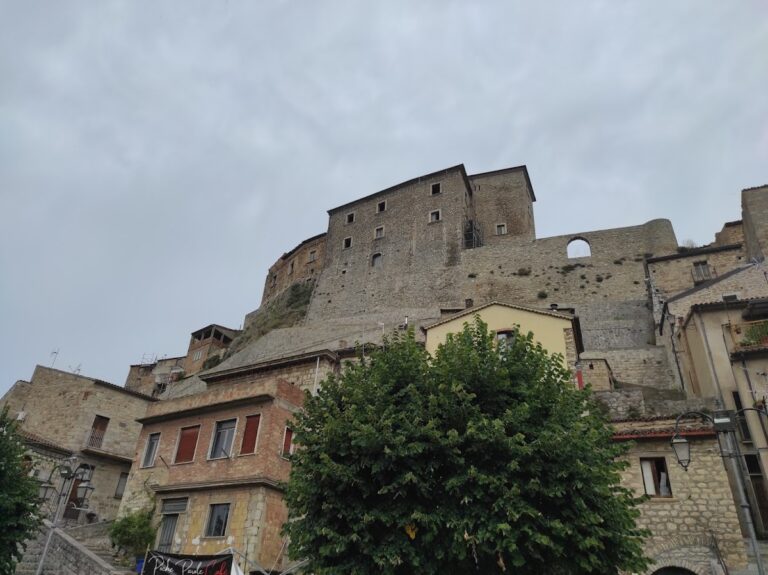
Castello di Monteserico: A Norman Medieval Castle in Italy


Site at a Glance
- Rating
- 4.6
- Popularity
- Low
- Country
- Italy
- Primary era
- Medieval
- Eras represented
- Medieval, Early Modern
- Civilizations
- Kingdom of Naples, Norman
- Site type
- Military
- Remains
- Castle
On this page8 sections
History
Castello di Monteserico is a medieval castle in Italy, near Genzano di Lucania, whose central nucleus and donjon were built by the Normans during the eleventh century. Standing near the ancient Via Appia, the hill occupied a strategic position in the history of southern Italy and was later adapted for royal administration, aristocratic ownership, and sheep transhumance.
Early settlement and Byzantine frontier
The hill was inhabited as early as the ninth century BC. In the early medieval period, the site probably served as a Byzantine garrison. The Byzantines were the eastern Roman imperial authorities who controlled parts of southern Italy, while the Lombards were an earlier Germanic ruling population in the region. In 942, a Lombard army led by Guaimaro II, Duke of Salerno, and Landolfo, Duke of Benevento, confronted Byzantine forces commanded by the archistrategos Anastasius near the castle.
Monteserico also formed part of a wider military landscape during the advance of Muslim forces in southern Italy. Saracens had sacked Grumento in 872, occupied Abriola and Pietrapertosa in 907, established themselves at Tricarico, and, according to Lupo Protospata, occupied Matera in 994. Around the turn of the first millennium, the site was probably fortified by Otto II, a tenth-century Holy Roman Emperor, during his advance toward Calabria.
Norman and imperial administration
The Byzantine garrison was defeated by the Normans on 3 September 1041 at the Battle of Montepeloso, an engagement through which Norman forces advanced their power in southern Italy. The battle probably took place at Serra della Battaglia, in the Monteserico area at the foot of the hill and within the Basentello valley. The Annales Barenses refer to the Norman forces as coming from the castle of Siricolo. The present castle’s central nucleus, including its donjon, belongs to this Norman period, and Robert Guiscard probably stayed at Monteserico during his advance toward Calabria.
Frederick II assigned the complex as a residence for the magister massarium Apuliae, an official responsible for royal sheep-rearing estates in Apulia. Monteserico also appears in the Statutum de reparatione castrorum, a statute regulating the maintenance of castles and other fortified properties. Under this arrangement, nearby communities were required to contribute to the upkeep of designated fortifications, while responsibility for the local domus, or fortified residence, of Monte Serico was assigned to its inhabitants.
Feudal, royal, and aristocratic ownership
In the thirteenth century, Monteserico belonged to Goffredo de Monte Selicola, who was succeeded by his son Raynaldo in 1275. At the beginning of the fourteenth century, its lady was Aquilina. At her request, Roberto II, bishop of Acerenza, issued the decree founding the Monastery of the Poor Clares at Genzano on 2 May 1321, under the dedication of Santa Maria Annunziata. The Poor Clares are the female contemplative branch of the Franciscan religious tradition.
The estate later passed to the Sanseverino family and, in 1348, to Francesco del Balzo. In 1443, the castle became part of the royal demesne, meaning property held directly by the Crown. Between the fifteenth and sixteenth centuries, the settlement of Monteserico on the plateau in front of the castle disappeared, although the castle itself remained inhabited.
Ferdinand the Catholic granted Monteserico to Isabella of Aragon, Duchess of Milan, on 7 June 1507. After Isabella’s death, Emperor Charles V granted the fief to her daughter Bona Sforza, Queen of Poland. In 1557, Monteserico reverted to the Crown. The Genoese Grimaldi family held the castle in 1603, followed by the Doria family in 1613. In 1642, Tappia, Marquis of Belmonte and regent high magistrate, exercised recognized jurisdiction over it.
Pastoral use and modern ownership
From the beginning of the eighteenth century, the Royal Sheep-Drive Customs of Apulia included use of the castle in the lease of the Monteserico sheep station. This institution regulated the seasonal movement and leasing of sheep flocks in southern Italy. The complex was equipped with an oven, a bakery, and a mill for this pastoral economy.
The Barons Dell’Agli-Cetti bought the castle in 1857 and sold it to the Cafiero family in 1875. After the First World War, Lieutenant Gandini acquired part of the Cafiero estate and the castle. Following its renovation, the building hosted Lyda Borelli, a star of silent film. The property later passed to the Di Chio family of Spinazzola and is now owned by the Municipality of Genzano di Lucania. The restored castle is recognized as Italian national heritage.
Remains
Hilltop layout and early remains
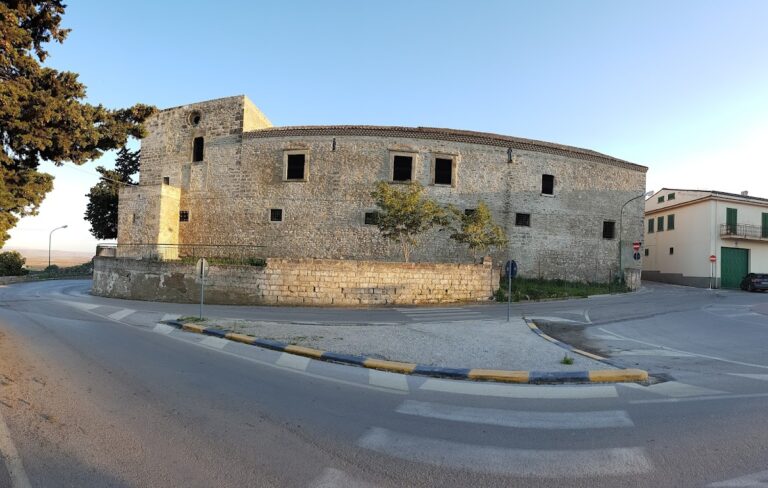
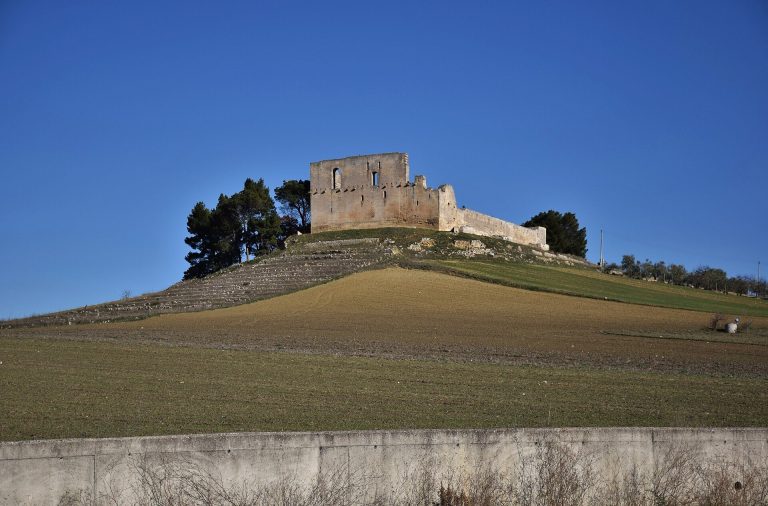
Castello di Monteserico is a medieval fortified complex on a hill near the Via Appia. Its central nucleus is formed by the donjon, a tower-like stronghold dating from the Norman period, while general construction belongs to the eleventh century. The former settlement of Monteserico occupied the plateau in front of the castle. Excavations on the western slope revealed a settlement and a pre-Roman necropolis, placing the castle within a landscape used for habitation and burial long before the medieval structure was built.
Two tombs of Lombard warriors were found near the Basentello stream in 1902. They date from the tenth century and provide physical evidence associated with the Lombard presence in the area during the period of conflict with Byzantine forces.
Sheep-station installations
Later pastoral use altered the practical facilities of the complex. As part of the Monteserico sheep station, the castle contained an oven, a bakery, and a mill. These installations supported the estate’s role within the Royal Sheep-Drive Customs of Apulia. The complex is currently restored.