Bodfeld: A Medieval Royal Hunting Lodge in Germany
Site at a Glance
- Rating
- 3.7
- Popularity
- Very Low
- Country
- Germany
- Primary era
- Medieval
- Eras represented
- Medieval
- Civilizations
- Unclassified
- Site type
- Domestic
- Remains
- Palace
On this page10 sections
History
Bodfeld is a medieval royal hunting lodge in Germany, located near Elbingerode in the Harz. Established for rulers of the Ottonian period, it was a Königspfalz, a travelling royal residence used for hunting, administration, assemblies, or ceremony rather than as a permanent capital. Bodfeld later supported the administration of central Harz ore mining, which helped sustain the authority of the Ottonian and Salian dynasties.
Ottonian and Salian royal residence
Surviving records name at least 17 occasions when kings or emperors stayed at Bodfeld while hunting. Henry I, also known as Henry the Fowler, visited several times and fell ill there in 935. His son Otto I described Bodfeld as a hunting lodge in 936 and stayed there at least three times. Otto II visited four times, while Otto III spent at least 14 days there in 991 with his grandmother Adelheid and returned in 995.
The lodge continued to serve the Salian rulers, the dynasty that followed the Ottonians in the German kingdom. Conrad II stayed once, and Henry III visited at least four times. Henry III issued his last document at Bodfeld on 28 September 1056. He died there on 5 October after a seven-day illness, in the presence of the pope and numerous imperial princes. Henry IV became King of the Romans at Bodfeld in 1056.
Changing interpretations of the site
By the end of the thirteenth century, the royal hunting lodge had fallen out of use, and its precise location was no longer remembered. Interest revived in the late nineteenth century when Paul Höfer identified Bodfeld with the Königsburg near Königshütte, a fortified hilltop site above the meeting of the Warme and Kalte Bode. C. Schuchhardt supported that interpretation in 1924 but had abandoned it by 1931.
In 1933, Paul Grimm argued that the Königsburg had been built after the age of the Saxon kings, partly because excavations had not produced red pottery. He instead placed Bodfeld near the abandoned village of Lüttgen-Bodfeld, where the church of St. Andrew had been uncovered in the nineteenth century, although he did not claim to have fixed the exact location. Carl Erdmann challenged Höfer’s identification in 1940, and Friedrich Stolberg also concluded that the Königsburg was not directly connected with the royal lodge.
Infrared aerial photography and archaeological study of excavated stone artefacts later supported the presence of an Ottonian royal lodge on the Schloßkopf. The identification of that site specifically as Bodfeld remains a possibility rather than an absolute certainty. Heinz A. Behrens subsequently combined archaeological and geo-electric investigations, a method that detects buried structures through subsurface electrical properties, to reconstruct the wider site.
Territory and associated places
Bodfeld was also the name of an extensive forest area, chiefly south of Elbingerode. Henry II ceded the forest to Gandersheim Abbey in 1009 as part of an exchange. A 1319 enfeoffment letter from Abbess Sophia of Gandersheim places its extent from Braunlage in the west to Elbingerode in the northeast and to Stiege and Beneckenstein in the south.
The lodge has been associated with other Saxon hunting residences, including Siptenfelde, and with the nearby Königsstieg, or King’s Path. A hunting house mentioned in 1483 and 1531 was probably connected with Bodfeld. The site may also have been linked to Erdfeld, a village named in a 1343 deed of the Count of Regenstein. Erdfeld stood about 1.5 kilometres away on the old Halberstadt Military Road before being abandoned in the late Middle Ages in favour of nearby Elbingerode.
Carl Erdmann argued from Henry I’s written records that the king owned Bodfeld. He also maintained that the residence did not have the full political character of a formal royal palace, since rulers staying there did not use it for major church festivals as they did at Quedlinburg, Magdeburg, and Goslar.
Remains
Schloßkopf setting and archaeological evidence
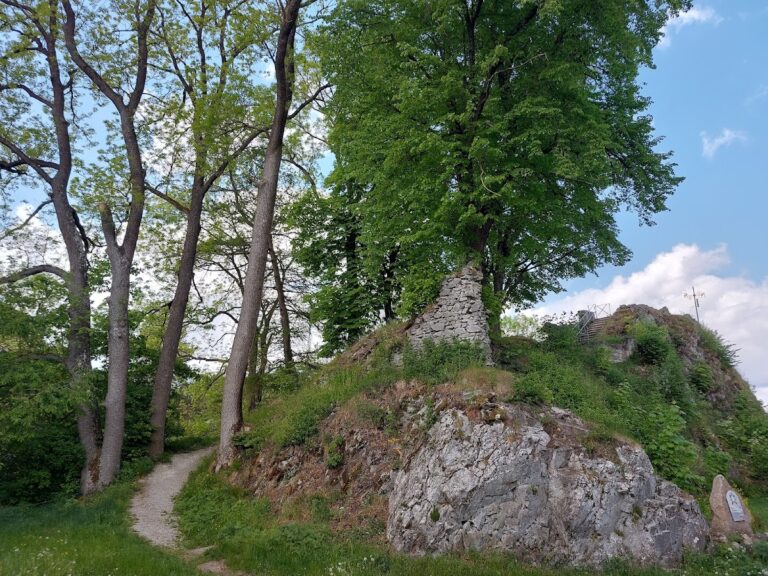
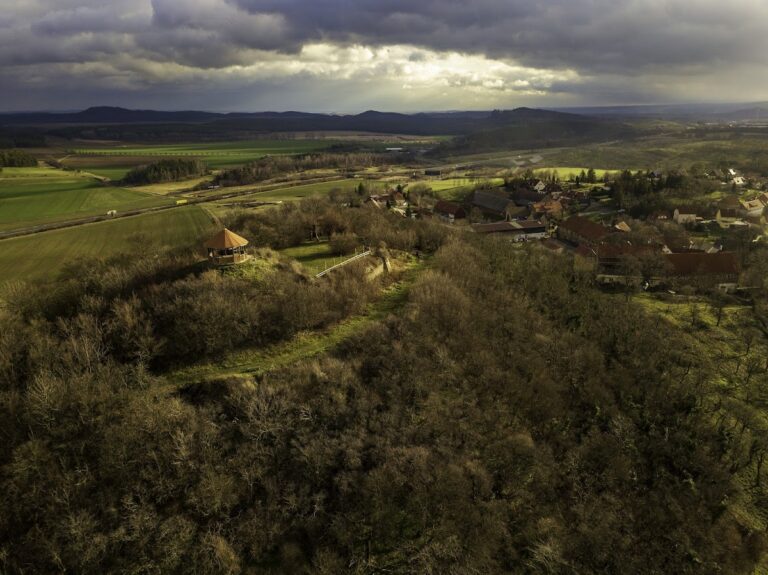
The suspected remains lie on the Schloßkopf, a hill spur north of Elbingerode above the upper Teufelsbach in the Drecktal valley. The River Bode is approximately four to five kilometres away. That distance is compatible with the medieval use of Bodfeld as the name of a wider territory rather than only a place beside the river from which the name derived.
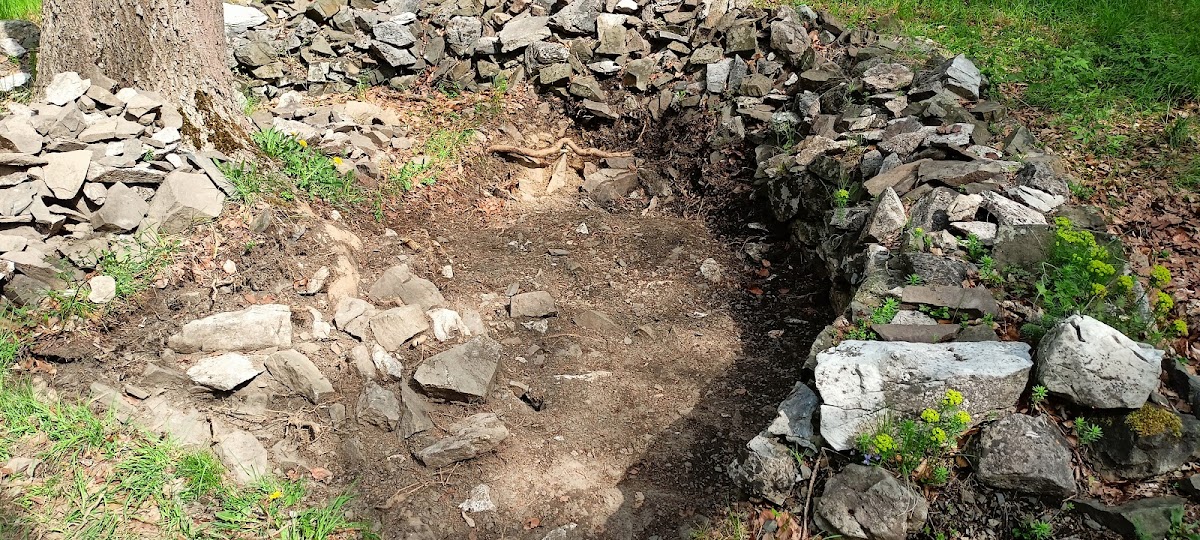
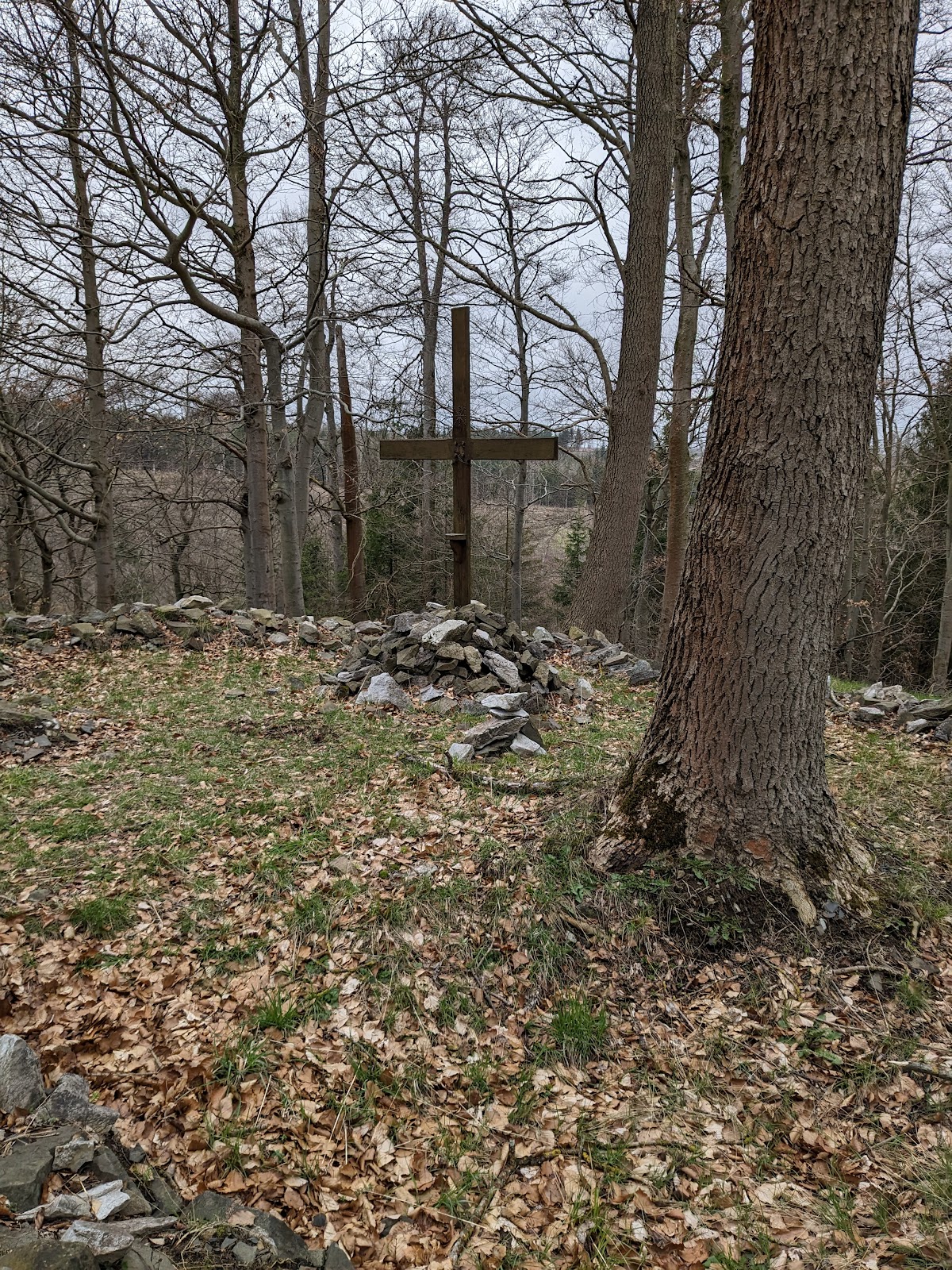
The hill-spur setting resembles the form associated with royal lodges of the period. The proposed design has been compared with the royal residence at Grone, associated with Henry I, and with Saxon hunting lodges such as Siptenfelde. Infrared aerial photography, archaeological surveys, excavated stone artefacts, and geo-electric investigations provide the basis for interpreting the site as the possible Ottonian lodge.
Defensive and residential layout
Walls, towers, and entrance
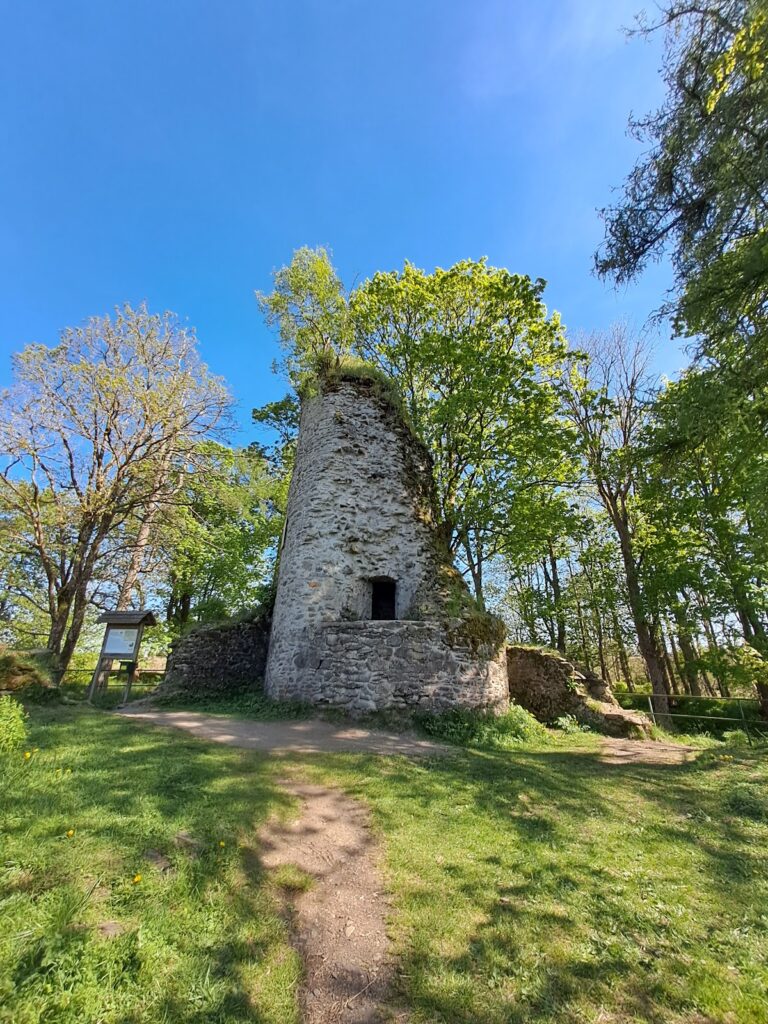
The reconstructed complex was extensive and defensible. Its proposed defensive works include stone walls along two sides, two round towers, and a gatehouse. Together these features define a fortified enclosure on the hill spur and form part of the interpretation that the site was a substantial royal residence rather than an isolated hunting shelter.
Halls, chapel, and residences
The proposed internal buildings include a chapel, a great hall, a second assembly hall, and additional residential buildings. These structures would have provided spaces for worship, royal gatherings, and accommodation within the lodge. Their identification belongs to the reconstruction of the possible Bodfeld complex, rather than to a completely certain identification of every surviving building.
Lüttgen-Bodfeld
Lüttgen-Bodfeld was considered in earlier attempts to locate the royal lodge. The former village included the church of St. Andrew, which was uncovered in the nineteenth century. It remains part of the history of Bodfeld’s identification, while the archaeological interpretation of the lodge itself centres on the Schloßkopf.