Burg Schwarzenburg (Oberpfalz): A Medieval Hilltop Castle in Germany


Site at a Glance
- Rating
- 4.6
- Popularity
- Low
- Country
- Germany
- Primary era
- Medieval
- External website
- Open
- Eras represented
- Medieval, Early Modern
- Civilizations
- Holy Roman Empire, Kingdom of Bohemia
- Site type
- Military
- Remains
- Castle
On this page15 sections
History
Burg Schwarzenburg (Oberpfalz) is a medieval hilltop castle in Germany, near Rötz, founded during the eleventh century and Romanesque in its earliest surviving form. Also known as Schwarzwihrberg or Schwarzwihr, it occupied a strategic position above the Schwarzach valley and later became the administrative centre of the Schwarzenburg lordship.
The Schwarzenburg family and the early castle
The first known reference to Schwarzenburg dates from between 1048 and 1060, when Heinricus de Swarcenburg was recorded as the monastery bailiff of St. Emmeram and of the church of Regensburg. This office indicates the high standing of the Schwarzenburg family as Edelfreie, medieval nobles who were not originally dependent ministerials of a territorial lord.
The earliest phase of the castle has not survived. It may have had a predecessor on the nearby Alter Schwarzwihrberg, although this remains unproved, or the first installation may have been a wooden castle dating from the tenth century. The oldest surviving parts of the present complex were built around 1100. Berthold II of Schwarzenburg, known from about 1122 to 1147 or 1148, or his father, may have commissioned them. Berthold later failed to return from the Second Crusade with King Conrad III.
Friedrich I of Schwarzenburg, archbishop of Cologne from 1100 to 1131, was the most prominent member of the family. A near-contemporary account written around 1160 states that he came from Schwarzenburg and that his niece Margarete was born there. Margarete married Count Adolf of Saffenberg around 1122, an event also recorded in an original charter dated 18 July 1134.
Dynastic transfers and the later Schwarzenburg lords
The older line of Schwarzenburg nobles ended with Berthold II. The castle probably then passed through Duke Henry of Mödling of the Babenberg dynasty to the Staufer emperor Frederick I Barbarossa. A charter dated 26 September 1212 recalls transfers to the Babenbergs after 1148 and to Frederick, although these stages have no separate documentary proof.
On 26 September 1212, King Frederick II transferred Schwarzenburg to King Ottokar I Přemysl of Bohemia. The keep and the younger residential building in the main castle were probably erected under their rule. From 1240, the castle was again associated with a Schwarzenburg lord, but this family was probably unrelated to the earlier line. Its members were Bohemian ministerials, service nobles who held administrative and military roles for rulers.
After the Bavarian territorial division of 1255, the lordship belonged to the Wittelsbach duchy of Lower Bavaria. The family’s decline began around 1300. In 1307, Duke Stephen I of Lower Bavaria pledged Rötz and the castle to Konrad of Chamerau, although the Schwarzenburg family continued to live there until 1317. The line ended with Bertha of Schwarzenburg in 1391.
Leuchtenberg rule and fifteenth-century fortification
Following another territorial division in 1331, the lordship came under Duke Henry XV of Natternberg. The following year he sold Schwarzenburg, Rötz, and Waldmünchen to Landgrave Ulrich of Leuchtenberg for 3,000 pounds of Regensburg pfennigs. Ulrich was required to spend 400 pounds of the same currency on the castle.
The Leuchtenbergs held the Schwarzenburg, Rötz, and Waldmünchen lordship, apart from a pledge to Georg Auer of Stockenfels between 1364 and 1367, until about 1404. They then sold it to Amalia Kagerin of Störnstein and her sons, Hinczik and Hans Pflugk of Rabenstein.
Under Hinczik Pflugk, his son Sebastian, and his grandson Hinczik the Younger, the lordship expanded its rights and importance. All three men held important administrative positions as officials of Cham. Building work valued at 600 gulden took place between 1439 and 1460, probably strengthening the defences against Hussite attacks from Bohemia. The Hussites, followers of the religious reformer Jan Hus, mounted military campaigns that affected the region.
In 1433, Schwarzenburg served as the assembly point for an army commanded by Hinczik Pflugk. The force defeated a Hussite army at the Battle of Hiltersried, preventing its advance into Lower Bavaria.
Heinrich von Plauen and the Palatinate takeover
In 1495, Hinczik the Younger’s heirs sold the lordship to Heinrich von Plauen, Burgrave of Meissen, for 36,000 gulden. Heinrich held the castle until 1505 and commissioned extensive building work costing 4,000 gulden. He then sold it to his brother-in-law Heinrich von Guttenstein-Vrtba, a Bohemian nobleman. The sale deed is dated 6 February 1506, although Heinrich was already identified as owner on 9 January 1505.
On 30 July 1505, the settlement of the Landshut War of Succession, a Bavarian dynastic conflict that reorganized territories in the region, transferred the lordship from Lower Bavaria to the Electoral Palatinate’s Younger Palatinate. Duke Frederick II of the Palatinate renounced claims to reacquire it and granted the lordship to Heinrich von Guttenstein-Vrtba as free property, while retaining a five-year right to use the castle.
Heinrich repeatedly used the strongly fortified castle as a base for raids. In 1509, the Swabian League tested its structural strength by firing on it. The result was unsatisfactory, and Heinrich sold the castle and the entire lordship in October 1509 to Louis V and his brother Frederick II of the Palatinate before the league could besiege it.
Administrative seat and destruction
The Wittelsbachs restored Schwarzenburg in 1514 and made it the seat of an official administering the Palatinate district office of Rötz, also called the County of Schwarzenburg. Officials remained at the castle until 1542, when they moved to the former service yard at Bauhof. In the middle of the seventeenth century, the administration moved again, this time to the town castle of Rötz.
After the officials left, the castle was probably maintained only provisionally. Swedish forces destroyed it in 1634 during the Thirty Years’ War, the major European conflict fought from 1618 to 1648. Local residents subsequently used the ruined buildings as a source of stone.
Today, the ruin is protected as an architectural monument and is also registered as an archaeological monument covering the archaeological evidence within the medieval castle area. The outer castle is used as a tribune during castle festivals, while the main castle contains a seasonally operated shelter and beer garden. These are modern uses of the surviving site rather than continuations of its medieval functions.
Remains
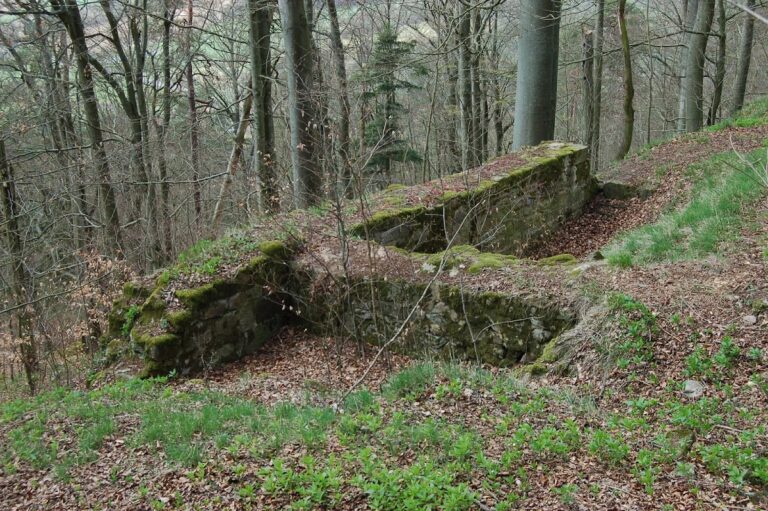
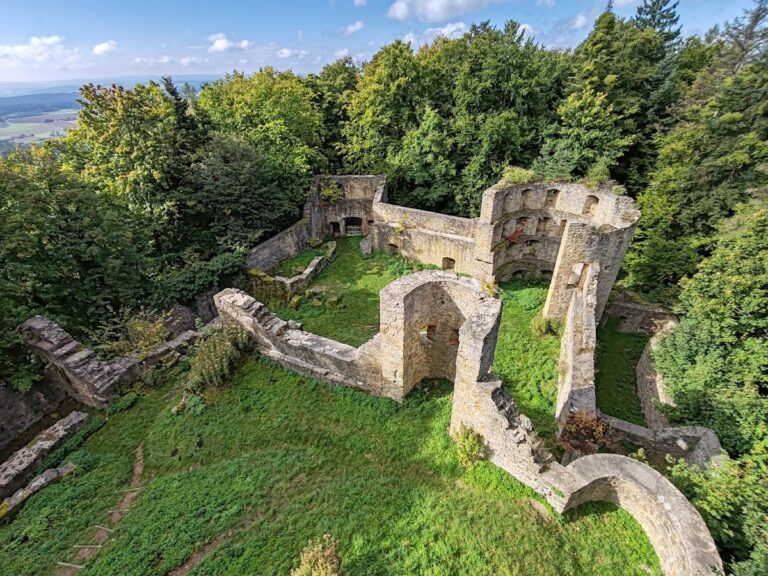
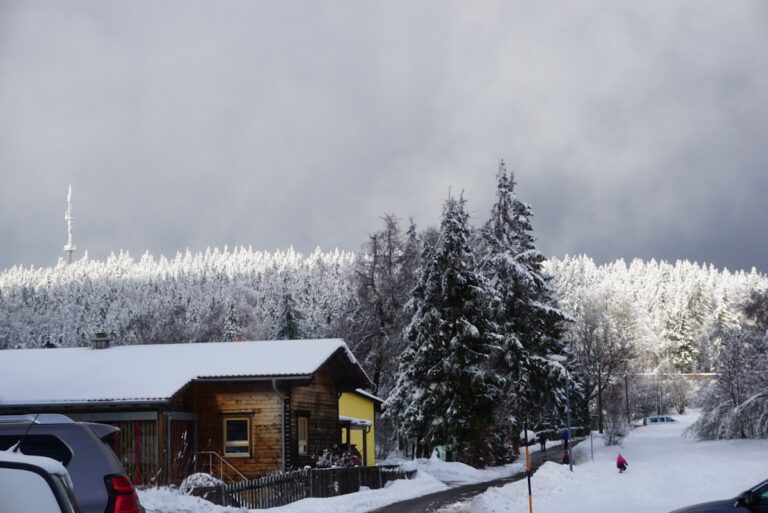
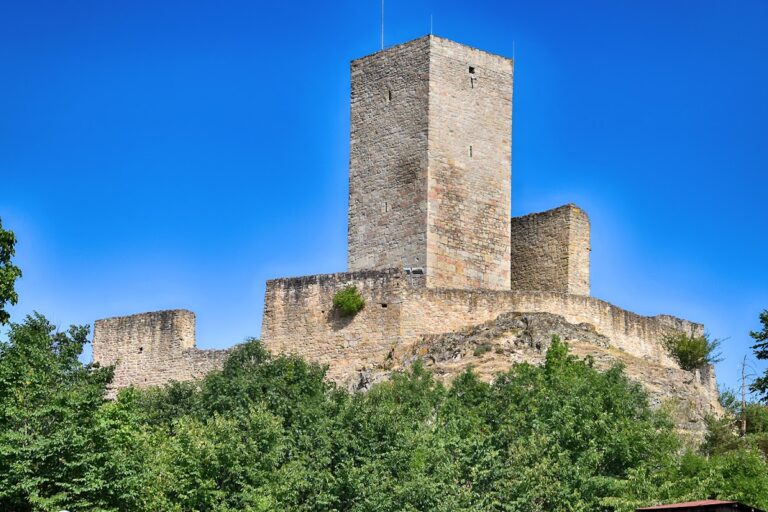
Burg Schwarzenburg is a two-part hilltop fortress on the wooded, rocky summit of the Schlossberg, 706 metres above sea level. The summit is the highest point of the Schwarzwihrberg, a small hill group at the southeastern end of the ridge above the Schwarzach valley and the Eixendorf reservoir. The ruin stands about 270 metres above the valley. Its original complex had a Romanesque core and used bossed ashlar blocks, regular ashlar, and rubble stone.
Main castle
Early buildings and chapel
The oldest surviving elements date from around 1100. They include the remains of the castle chapel, a probably tower-shaped residential building immediately to its south, and sections of the curtain wall, the enclosing defensive wall. In the eastern corner of the lower castle, beside the eastern bastion, stands the remains of a tower with an adjoining residential building.
Keep and defensive walls
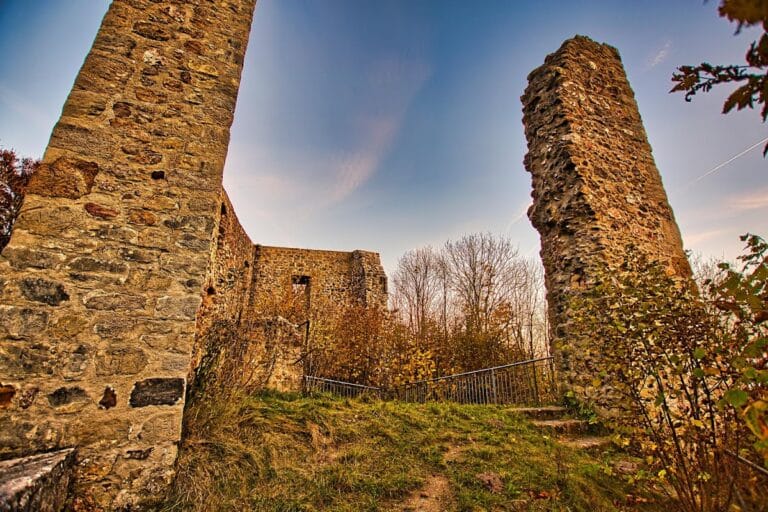
The principal landmark is the 15-metre-high keep, which survives as an accessible observation tower. Extensive wall remains also survive from a battery tower, the upper-castle gate, and the curtain wall. Together with the keep, these fragments show the defensive and residential organization of the main castle, while the limited chapel remains preserve evidence of its religious function.
Outer castle and later defences
Fifteenth-century towers
Three surviving semicircular towers were probably built between 1439 and 1460. One stands beside the tower-shaped residential building in the main castle, another is incorporated into the western bastion, and the third stands beside the surviving inner gate of the outer castle. A second tower may have stood on the opposite side of that gate, but its existence is uncertain.
Artillery fortifications
Around 1500, the castle was enlarged with three powerful bastions, projecting fortifications designed to allow defensive fire along adjoining walls. The works also included a rounded artillery tower, an outer gate for the outer castle, and a masonry-lined neck ditch cut across the approach to the fortified summit. These additions formed part of the major construction campaign commissioned by Heinrich von Plauen.
Surviving modern uses
The battery tower now stores stage props and serves as a changing room during modern castle festivals. A shelter within the castle area accommodates about 60 people and operates seasonally from 1 April to 31 October.
Totentruhe legend
In the forest near the castle lies a large granite block whose natural shape resembles a coffin. Called the Totentruhe, or “Coffin Chest,” it is associated with a local legend. The story says that the stone contains the treasures of the destroyed castle and is guarded by a castle maiden resting inside it.