Castle of Monti: A Medieval Fortress in Lunigiana


Site at a Glance
- Rating
- 4.3
- Popularity
- Low
- Country
- Italy
- Primary era
- Medieval
- External website
- Open
- Eras represented
- Medieval
- Civilizations
- Holy Roman Empire
- Site type
- Military
- Remains
- Castle
On this page10 sections
History
The Castle of Monti is a medieval fortress in Italy, in Monti, a local subdivision of Licciana Nardi in Tuscany’s Lunigiana region. Its construction is generally placed between the late eleventh and early twelfth centuries, possibly on the site of an eleventh-century fortification associated with the House of Este. The castle is securely documented from 1275, and its development extended across the eleventh to fifteenth centuries.
A fortress on the medieval routes
The castle was probably established as a military roadblock at the meeting point of important routes. One route ran from Lucca through the Tea Pass, while the Strata Lizane connected Emilia and lands beyond the Apennines with the Lunigiana valley and the middle Magra Valley. Other routes linked the Serchio Valley with the Magra and continued through the Brattello Pass toward Veleia and Piacenza. The castle and the Pieve of Santa Maria of Venelia arose at this crossing, while the earlier settlement of Venelia lay below the hill.
During the early Middle Ages, the territory between the Taverone and Civiglia streams belonged to the Counts of Moregnano. Monti became the property of the Malaspina family of Villafranca in 1355. At the beginning of the fifteenth century, Simone and Nicola Malaspina governed it as an independent fief, a territory ruled by a lord under a larger political authority.
Malaspina rule and repeated transfers
The fief was repeatedly divided and transferred among the marquises of Olivola, Monti, Lusuolo, and especially Villafranca. For a short period, it formed part of a jurisdiction that also included Licciana, Panicale, now Licciana Nardi, Bastia, Terrarossa, Podenzana, and Suvero. These changes reflected the fragmented political structure of Lunigiana, where related branches of noble families held neighboring territories.
In 1449, Galeotto di Campofregoso and Genoese forces attacked and conquered the castle. The Campofregoso were a ruling family of Genoa, and their control lasted fourteen years. The fortress then returned to the Malaspina, who enlarged it and strengthened its walls. It later belonged to a Malaspina branch descended from the Obertenghi lineage.
Sixteenth- and seventeenth-century changes
In 1524, Giovanni de’ Medici, known as Giovanni delle Bande Nere, assaulted the castle during a military training exercise in Lunigiana. Giovanni was a condottiero, or professional military commander, from the Medici family, and his troops had been recruited largely at Castiglione del Terziere. He captured the marquis Spinetta Malaspina, although the castle subsequently returned to Malaspina control.
By 1638, poor government and the severe reduction of the fief through successive divisions had weakened its political position. The inhabitants then voluntarily placed the territory under the rule of the Grand Duchy of Tuscany.
From noble residence to protected heritage
The 1920 earthquake of Garfagnana and Lunigiana heavily damaged the castle. Extensive restoration later transformed the fortress into a stately residential residence. It is privately owned and inhabited, and it forms part of Italy’s protected cultural heritage. The current owner is Niccolò Malaspina.
The name Monti derives from a medieval expression for extensive pasturelands, rather than from the presence of especially high mountains. The castle also preserves layers of local historical memory. In 1930, Carlo Caselli stayed there as a guest of the marquis Torquato Malaspina and described interiors with a great hall, library, armory, picture gallery, game rooms, and other strongly feudal features. He also recorded a ghost tradition concerning the spirit of Moroello Malaspina, animated armor, and the voice of Spinetta Malaspina at the moment of his capture.
Remains
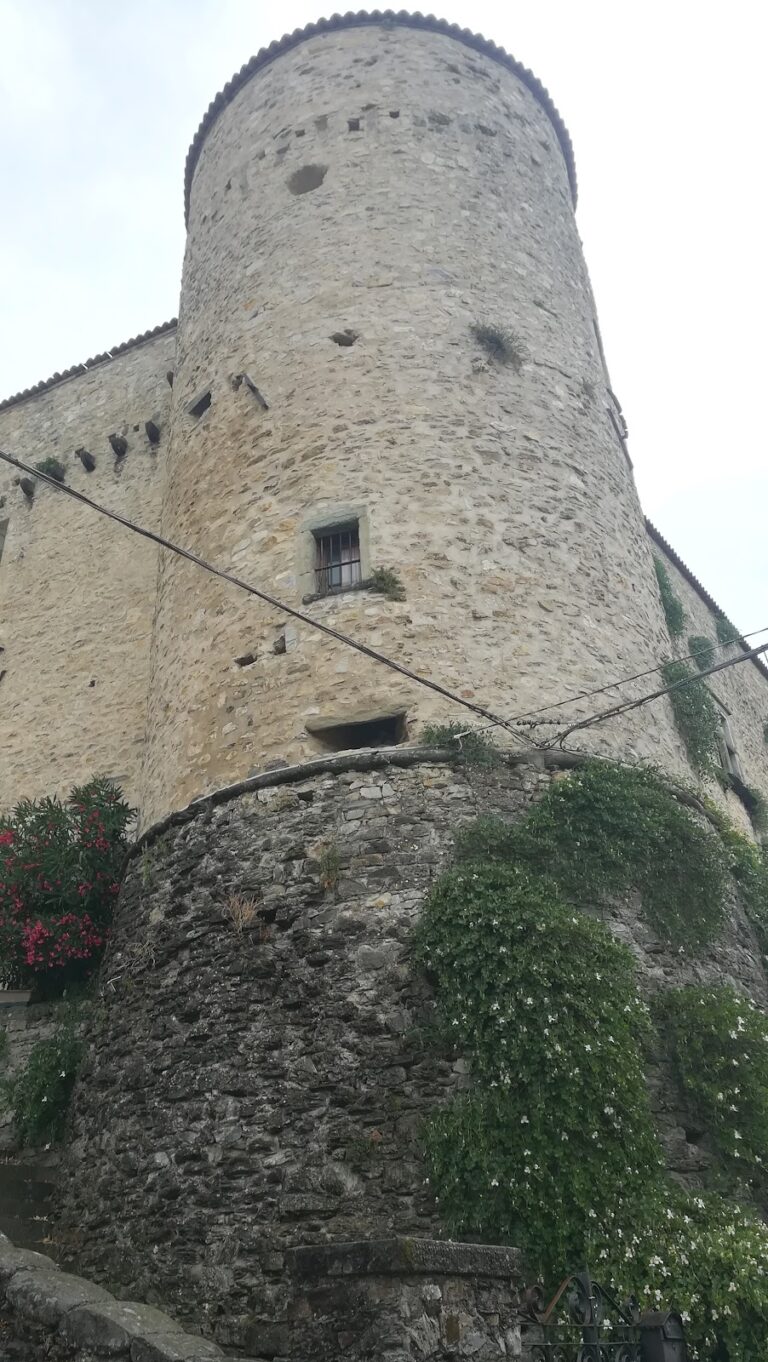
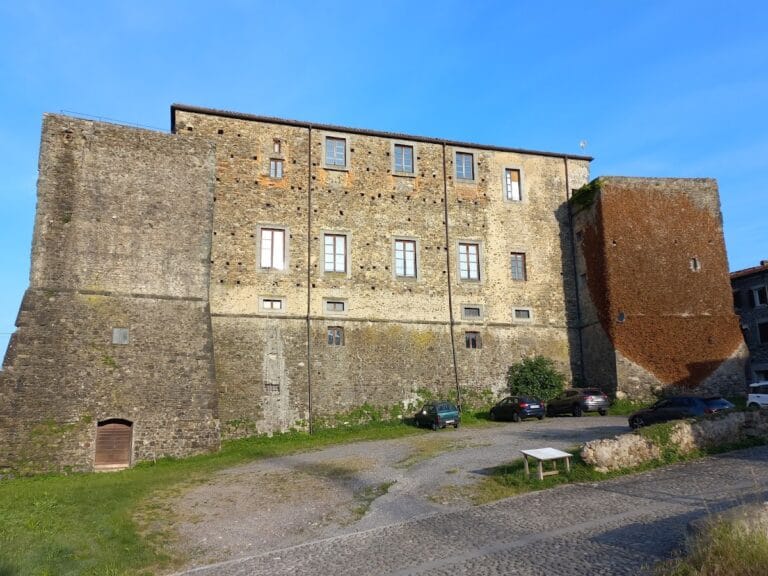
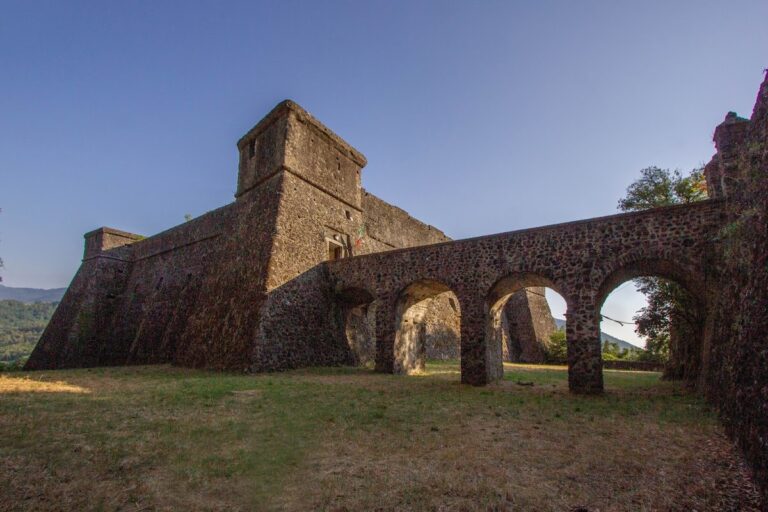
The castle stands on a hill on the right bank of the Taverone stream, near the former settlement of Venelia and its historic rural parish church, the Pieve of Santa Maria of Venelia. Centuries-old holm oaks surround the hill. The fortress has an irregular rectangular plan, with a massive square tower on the northwestern side and circular towers of differing sizes at the corners of the enclosure. Built of stone, it combines surviving medieval defensive elements with later residential interiors.
Walls and corner towers
The enclosure is defined by stone walls and towers arranged around the irregular rectangular plan. The square tower retains stone corbels that supported a projecting defensive apparatus. Its upper edge carries Ghibelline crenellations, the notched wall tops traditionally associated in medieval Italy with supporters of the Holy Roman Emperor. The crenellations were altered so that the roof could rest on them, but their form remains visible.
Entrance tower
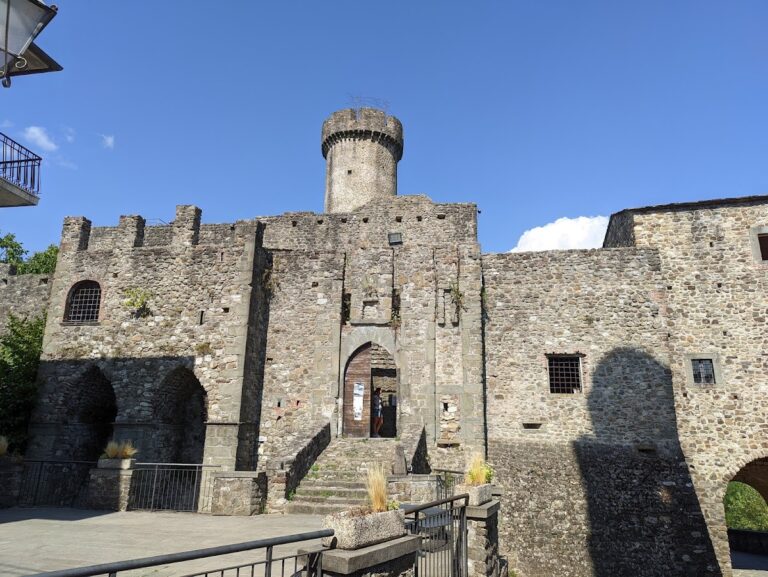
The principal tower contains the entrance gate. Narrow loopholes allowed defenders to use weapons from within the walls, while fittings for a drawbridge survive at the gateway. A guardhouse overlooked and monitored the entrance. These elements show how access through the principal tower was controlled as part of the fortress’s defensive arrangement.
Courtyard and residential rooms
A courtyard on the north side was almost certainly the former parade ground. Enclosure walls once protected it, although those walls have disappeared. Stone steps beside the entrance lead to the courtyard. The residential phase included a great hall, library, armory, picture gallery, game rooms, and a seventeenth-century chamber. The library and armory were damaged during incursions involving thefts, while one interior room retains a stone fireplace.
Venelia I stele
For decades, the castle housed the Venelia I stele, an upright prehistoric stone monument of the type associated with Lunigiana. Niccolò Malaspina later deposited it with the Museum of Lunigunian Statue-Stelae. Its former presence in a castle room connects the fortress with the archaeological heritage of the surrounding Venelia area.