Veiros Castle (Castelo de Veiros): A Medieval Fortress in Portugal



Site at a Glance
- Rating
- 3.9
- Popularity
- Low
- Country
- Portugal
- Primary era
- Medieval
- Eras represented
- Medieval, Early Modern
- Civilizations
- Portuguese
- Site type
- Military
- Remains
- Castle
On this page12 sections
History
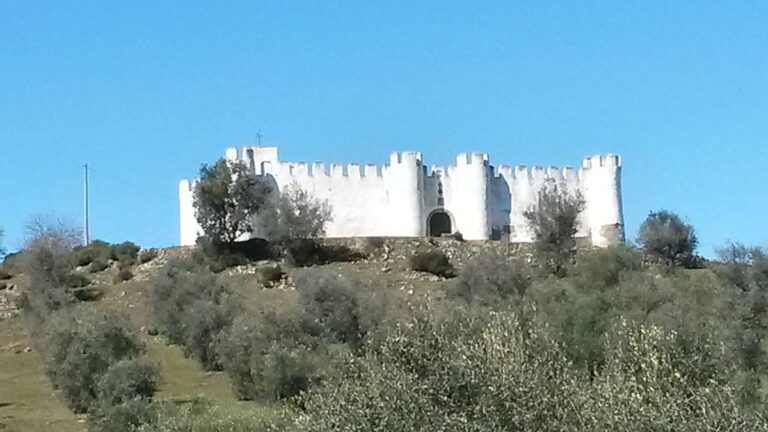
Veiros Castle, known locally as Castelo de Veiros, is a medieval fortress in Portugal, in the village of Veiros in the municipality of Estremoz. Built and administered within the sphere of the Order of Avis, it occupied a steep, rocky hill and formed part of a defensive network that also included Monforte, Campo Maior, and Ouguela.
Early occupation and the Order of Avis
The hill may have been occupied by a Roman settlement, perhaps reflected in an earlier place name, Valerius. During the Christian Reconquest, the long process by which Christian kingdoms expanded into territories ruled by Muslim powers in Iberia, Veiros was taken by the forces of Afonso II in 1217. The settlement was reportedly placed in the charge of the Order of Avis, a Portuguese military-religious order involved in the conquest and administration of fortified sites, under its master Fernão Anes.
The precise date when the castle was founded is unknown. Its creation was probably broadly contemporary with the Order of Avis fortresses at Alandroal and Noudar. In 1299, Martim Fernandes held command at Veiros while serving as the order’s sixth master.
The keep and the fourteenth century
Work on the castle’s keep, the principal fortified tower of a medieval castle, began on 20 May 1308, during the reign of King Dinis and the mastership of Lourenço Afonso. Two stone inscriptions preserve details of the project, including the name of Pero Abrolho, the master builder, the laying of the first foundation stone, and the involvement of Dinis and Queen Elisabeth.
Veiros also became associated with the origins of the House of Braganza, a major Portuguese dynastic family. Afonso, the eighth Count of Barcelos and later the first Duke of Braganza, was born at Veiros in either 1377 or 1380, during the reign of King Fernando. He was an illegitimate son of the master of Avis and Inês Pires Esteves, whose father, Pêro Esteves, known as “the Bearded,” is buried in Veiros at the Church of Our Lady of Mileu.
Castilian forces attacked Veiros and its castle in 1381. The assault took place during a period of conflict between Portugal and Castile, adding a military episode to the fortress’s role within the region’s frontier defenses.
Damage, rebuilding, and warfare
An earthquake in 1531 caused extensive damage to the castle. Reconstruction followed under King João III, altering the fortification during the sixteenth century. The enclosure also acquired the Clock Tower, whose bell tower is believed to date from this period.
The castle was again drawn into conflict during the Restoration War, the seventeenth-century struggle through which Portugal regained independence from the Spanish Habsburg monarchy. In 1662, troops commanded by John of Austria attacked Veiros. The keep was then being used as a gunpowder store, and it exploded during the assault. Veiros was occupied again in 1665 by forces under the Marquis of Caracena.
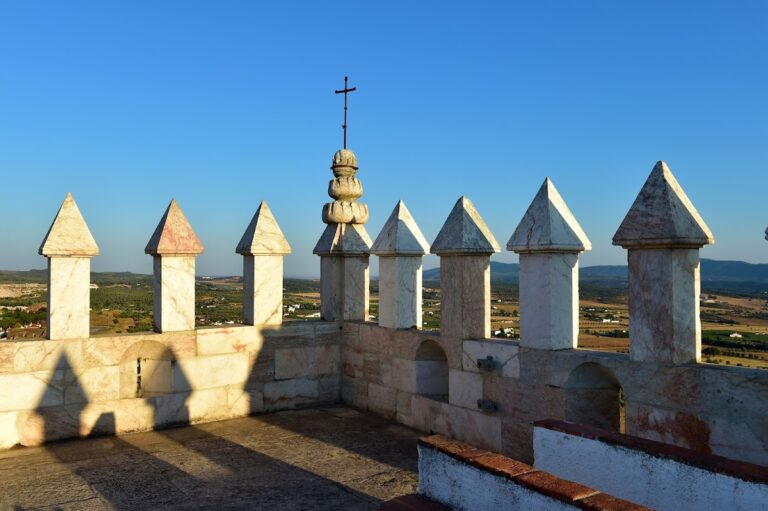
Following these events, the War Council of King Alfonso VI ordered improvements to the defenses. A new parapet obstructed the medieval crenellations, the alternating raised sections and openings along the top of a defensive wall.
Municipal change and conservation
Veiros remained the seat of a municipality until that municipality was abolished in 1855. In 1895, the settlement became part of the municipality of Estremoz. Public restoration of the castle took place in 1939, followed by further work carried out by the Municipality of Estremoz between 1998 and 2000 under the Global Intervention Plan for the Rural Center of Veiros.
Castelo de Veiros was classified as a Property of Public Interest by a decree published on 18 July 1957. The castle is privately owned, while the parish council of Veiros holds the key for daily visits.
Remains
The fortified enclosure
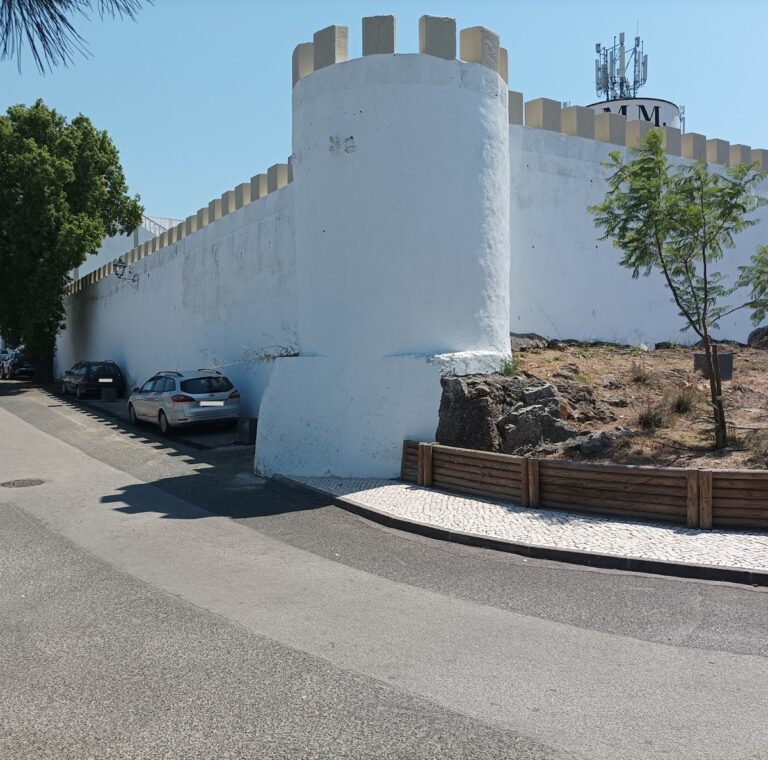
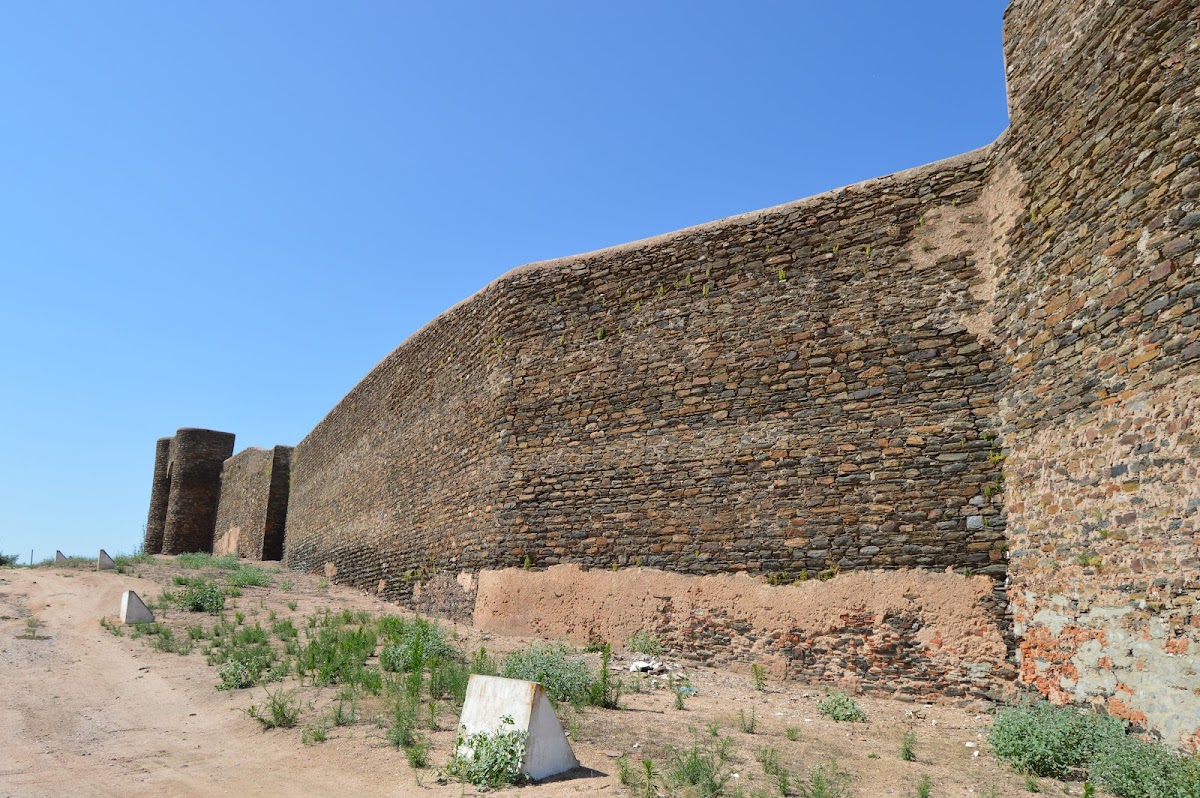
Veiros Castle occupies a rocky hill within a trapezoidal enclosure. Its walls are approximately two metres thick and consist mainly of schist masonry, with granite ashlar and marble masonry used for secondary elements. A wall-walk, or passage along the top of a defensive wall, follows the perimeter. The original fortification was supported by nine projecting towers, while eight towers survive today.
Gates and towers
Four gates once opened toward the cardinal directions. The south, west, and north gates remain. The northern entrance has a pointed arch and a broader opening than the other surviving gates. Six of the remaining towers are semicircular and frame these three entrances. Two further towers defend the northern wall, one circular in plan and the other square.
Keep inscriptions
A marble ashlar slab lies in the parade ground. It originally stood above the entrance to the keep and carries two epigraphic inscriptions, texts carved or fixed onto durable material to preserve an event or dedication. They relate to the building campaign begun in 1308, name Pero Abrolho as master builder, and state that Lourenço Afonso ordered the work. One inscription was positioned beside a Cross of Avis.
Buildings within the enclosure
Clock Tower
The Clock Tower forms part of the castle complex. Its bell tower is believed to date from the sixteenth century, the period when the fortress was rebuilt after the earthquake of 1531.
Church of Saint Salvador
The enclosure contains the parish church dedicated to Saint Salvador. Built in the late sixteenth century, it replaced an earlier church dating from the thirteenth century and adds a later religious layer to the fortified site.