Hume Castle: A Border Fortress and Warning Beacon in Scotland

Site at a Glance
- Rating
- 4.6
- Popularity
- Low
- Country
- United Kingdom
- Primary era
- Early Modern
- External website
- Open
- Eras represented
- Medieval, Early Modern
- Civilizations
- British, Kingdom of Scotland
- Site type
- Military
- Remains
- Castle
On this page10 sections
History
Hume Castle is a heavily modified fortress in Scotland, United Kingdom, dating from the late twelfth or early thirteenth century and associated with the powerful Hume, or Home, family. Its first stone fortifications are attributed to William de Home, and its position above the village of Hume later supported both military defence and the border beacon system.
The Home family and the medieval fortress
William de Home, the son of Sir Patrick de Greenlaw, acquired the Home lands in the early thirteenth century through his marriage to his cousin Ada, daughter of Patrick I, Earl of Dunbar. Taking the surname Home from the estate, he is thought to have established the first stone defences at the site. The family later served as Wardens of the Eastern March, the frontier district along the English border, and rose to become the Lords Home and Earls of Home.
Hume was the only castle in the Borders to escape Robert Bruce’s scorched-earth policy in 1313. This policy involved the deliberate destruction of fortifications and resources that could assist an enemy. In 1460, James II of Scotland and his queen, Mary of Gueldres, stayed at Hume while James conducted the siege of English-held Roxburgh Castle. The king was killed during that operation when an early bombard, a large gun used to attack fortified positions, exploded.
Conflict with the English crown
In August 1515, Regent Albany captured Hume during his campaign against the Home family. Lord Home and the Lord Chamberlain recovered it on 26 August, taking Albany’s captain prisoner. Lord Home then deliberately damaged his own stronghold by pulling down its walls and blocking the well.
Before artillery became widespread, Hume was regarded as almost impregnable. During the Rough Wooing, the series of sixteenth-century Anglo-Scottish wars in which England sought to force a marriage alliance between the young Mary, Queen of Scots, and Henry VIII’s son, the castle fell to the forces of Lord Protector Somerset in 1547. George Home, 4th Lord Home, was wounded at the Battle of Pinkie, while his son Alexander was captured. After determined resistance led by Mariotta, or Marion, Haliburton, Lady Home, the garrison surrendered and an English force occupied the castle.
Sir Edward Sutton became captain of Hume and received its keys on 22 September 1547 from Andrew Home, Commendator of Jedburgh and Restennet. The English made limited efforts to strengthen the defences on the advice of military engineer William Ridgeway. Work was restricted because the local stone was unsuitable, while usable limestone from Roxburgh lay too far away. At the time of the surrender, 78 Scots were inside the castle. Its armament included two batard culverins, one saker, three brass falconets, and eight other iron guns. An inventory made later in December listed 21 cannons, including four fowlers, together with 40 hand-guns.
Recapture and renewed fighting
Hume nearly changed sides in February 1548 when members of its Spanish mercenary garrison planned to rob Captain Pelham and defect. Loyal soldiers lit the castle beacon, allowing Sir John Ellerker’s men to arrest those involved. One man was killed while attempting to escape, six were due to be hanged, and the two leaders reached Scotland.
In December 1548, the young Alexander Home, 5th Lord Home, recaptured Hume with help from his brother Andrew. An insider admitted seven Scots, while an eighth man entered during the night. Edward Sutton was blamed for the loss of the castle and remained a prisoner after the war. The Earl of Shrewsbury was asked to arrange his release in exchange for French hostages.
Regent Arran thanked John Home of Cowdenknowes for helping recover the fortress. Henry II of France appointed Baron de Fourquevaux as its governor, but an English attempt to retake Hume in February 1549 failed. Lady Home returned in March and complained about the behaviour of the French and Spanish garrison toward villagers in the surrounding area.
Guns abandoned at the English fort of Lauder were hauled by oxen to Hume. In February 1558, Mary of Guise ordered 320 oxen to remove them from the castle, after which they were taken to the fort at Eyemouth.
The Marian Civil War and later decline
Around 1570, during the Marian Civil War and an English incursion into Scotland, Hume was besieged by the Earl of Sussex. The Marian Civil War was the conflict of 1567 to 1573 between supporters of Mary, Queen of Scots, and supporters of her son James VI. The defenders capitulated within twelve hours when faced with superior numbers and artillery.
Agnes Gray, Lady Home, had sheltered Anne Percy, Countess of Northumberland, an English refugee, at Hume and Fast Castle. Regent Morton later gave Agnes Gray money to maintain Hume’s garrison for James VI. During the seventeenth century, however, the castle ceased to serve as a habitable fortress. The Earls of Home established other residences, first at Dunglass Castle and, by 1611, at the Hirsel.
Hume finally fell to Cromwell’s forces in 1651 during the Wars of the Three Kingdoms, the interconnected civil and religious conflicts that affected England, Scotland, and Ireland in the mid-seventeenth century. After Oliver Cromwell’s forces captured Edinburgh Castle, Colonel George Fenwick besieged Hume with two regiments. Colonel John Cockburn, the Scottish governor, initially refused to surrender, but gave way after bombardment. Cockburn and his men were granted quarter for life and withdrew, while Fenwick dismantled the fortifications.
Folly, beacon, and preservation
In the early eighteenth century, Hume and its surrounding lands passed to the Earls of Marchmont, a wealthier cadet branch of the Home family. By then the castle had been reduced almost to ground level. Before his death in 1794, Hugh Hume-Campbell, 3rd Earl of Marchmont and 3rd Lord Polwarth, rebuilt the remains as a folly, a picturesque reconstruction intended mainly for ornamental effect, using the foundations of the former curtain walls.
During the Napoleonic Wars, the reconstructed castle resumed its role as a warning beacon. On the night of 31 January 1804, a Berwickshire Volunteers sergeant mistook charcoal-burners’ fires on nearby Dirrington Great Law for an invasion signal. Hume’s beacon set off the lighting of border beacons to the west, and about 3,000 volunteers mobilized in the incident later known as the Great Alarm.
Hume served as a lookout post during the Second World War and was intended to become a resistance base if Germany invaded. The state acquired the castle in 1929. A restoration programme carried out by the Berwickshire Civic Society in 1985, with Scottish Office funding, preceded its reopening to the public in 1992. In 2006, the Civic Society transferred the castle to a charitable trust associated with the Clan Home Association under the auspices of Historic Scotland.
Hume remains regarded as the spiritual home of many Homes and Humes in Scotland and abroad. It is protected as a nationally important monument, with Scheduled Ancient Monument status and Category A listed-building status.
Remains
The reconstructed enclosure
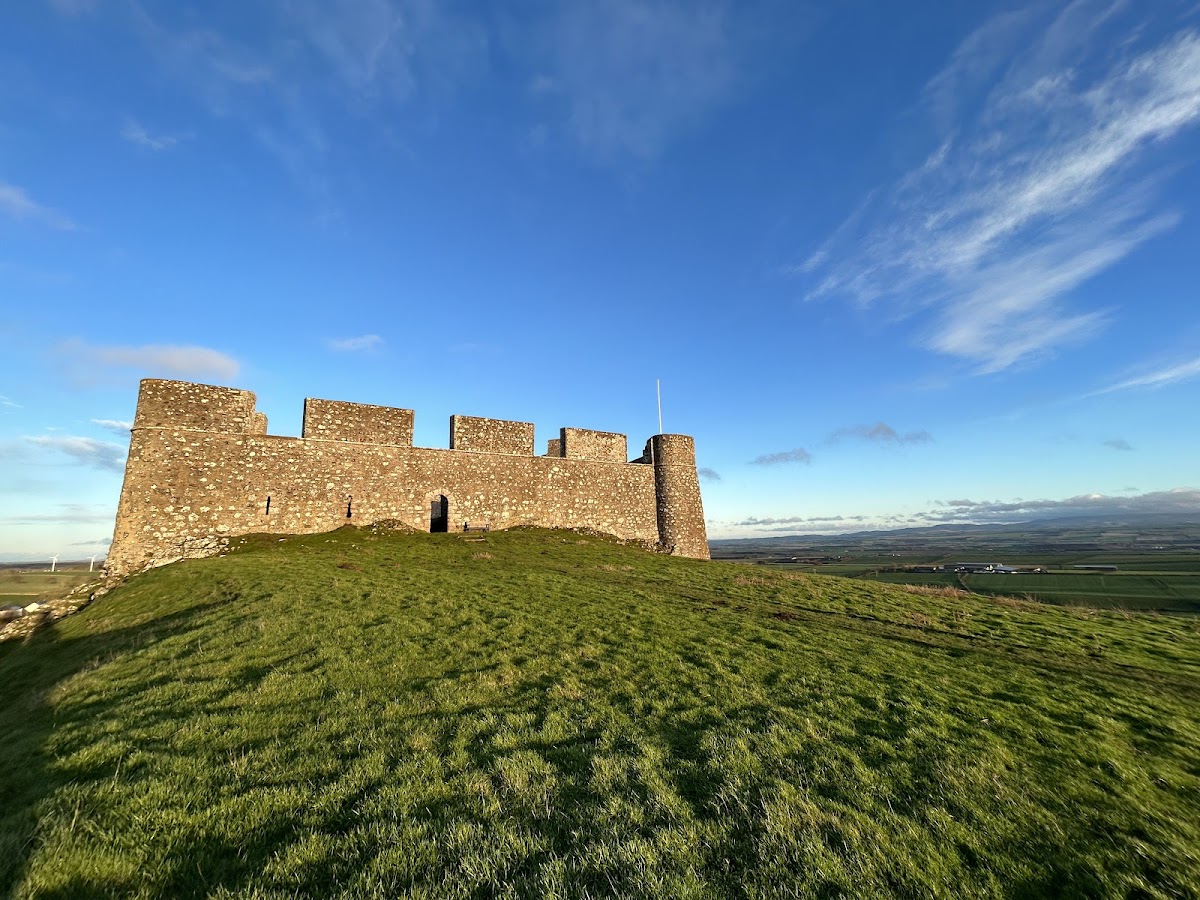
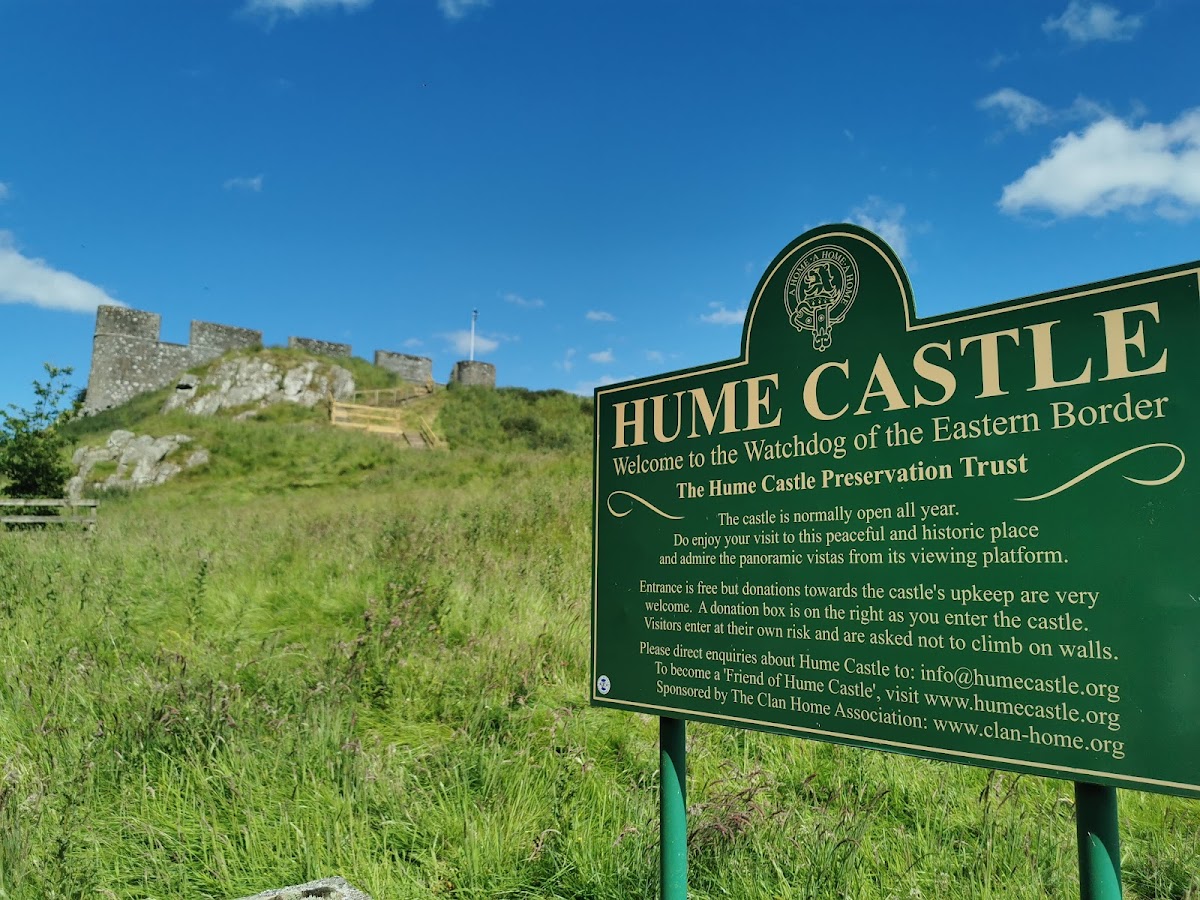
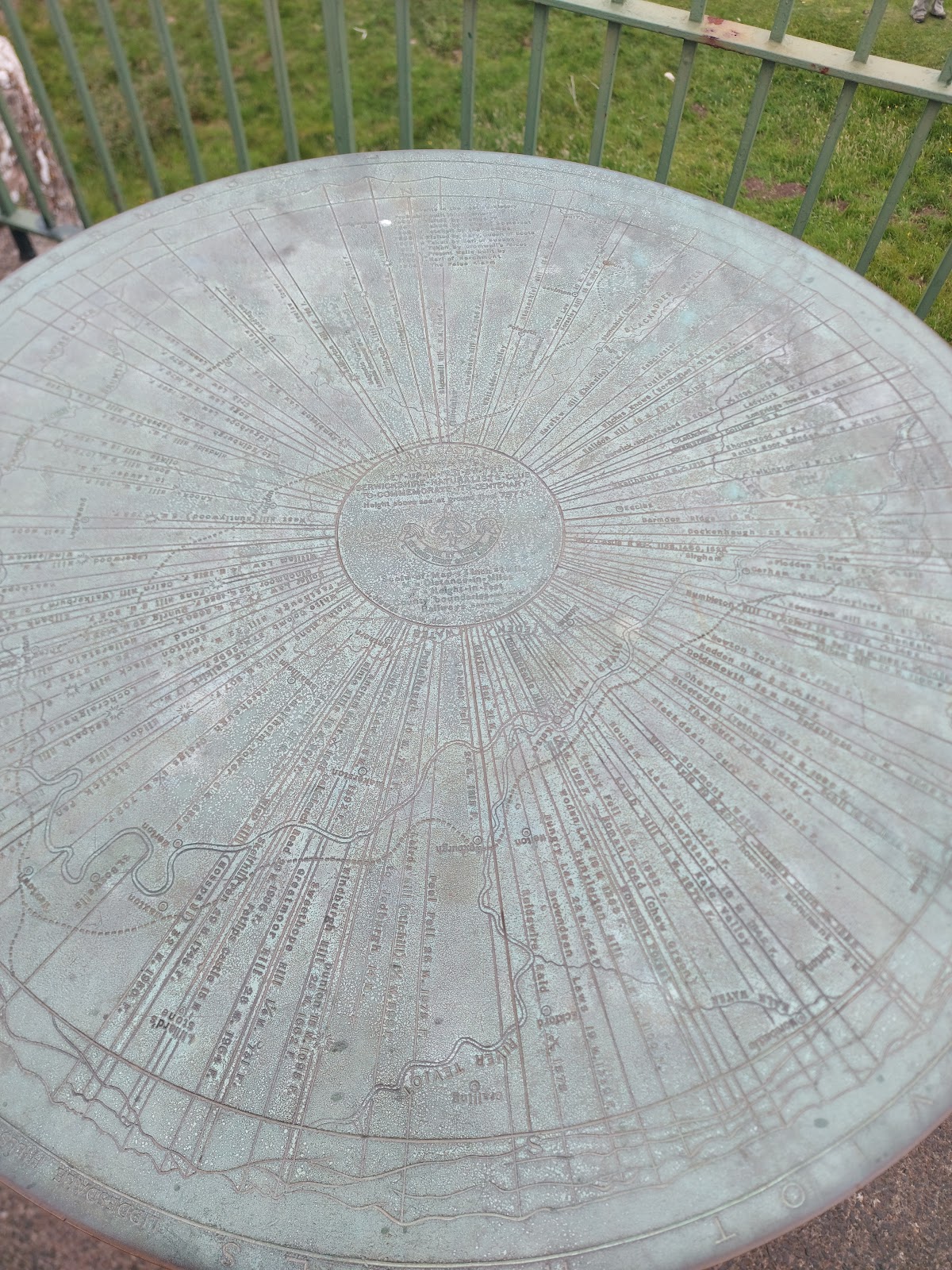
The castle occupies a prominent height above the village of Hume, with views across the Merse toward the English border at Carter Bar. Its elevated setting helped it function as both a defensive stronghold and a warning beacon. The original fortress was a castle of enceinte, a fortified enclosure whose main defensive walls surround the internal buildings and courtyard. Its plan was an irregular square or rectangle, an arrangement unusual in southern Scotland but more familiar in the western Highlands.
Most of the visible structure belongs to the eighteenth-century rebuilding. Massive curtain walls, the continuous outer walls of a fortified enclosure, were reconstructed on the earlier foundations. Their upper edges carry exceptionally large crenellations, the raised and indented parapets associated with fortified buildings, although these features were designed to be picturesque rather than practically defensive. The rebuilt walls have a relatively even, unbroken surface, while their form preserves the general shape and extent of the earlier outer enclosure.
Medieval remains within the later structure
Part of the medieval central keep survives in ruin within the later reconstruction. The keep was the principal fortified tower or central stronghold of the castle. Remnants of other medieval buildings, towers, foundations, and outworks, meaning additional defences placed beyond the main fortifications, have also been identified. These remains preserve evidence of the earlier fortress within the later walls, even though the original foundations are not visibly exposed beneath the reconstructed structure.
Stonework, weapons, and the beacon
Stone formed the principal building material. The difficulties faced by the English in 1547 remain part of the castle’s physical history, since the local stone was considered unsuitable for extensive strengthening and suitable limestone from Roxburgh was too distant. The guns and hand-guns held at Hume during the English occupation show the range of artillery associated with the fortress, from large culverins and a saker to smaller falconets, fowlers, iron guns, and handheld firearms.
The beacon formed part of a wider border warning system and was used in both the medieval period and the Napoleonic Wars. Its later roles as a wartime lookout and intended resistance base continued the site’s military and communications functions after the castle had ceased to operate as a habitable fortress.