Maglaj Fortress: A Medieval and Ottoman Defensive Stronghold


Site at a Glance
- Rating
- 4.6
- Popularity
- Low
- Country
- Bosnia and Herzegovina
- Primary era
- Early Modern
- Eras represented
- Medieval, Early Modern
- Civilizations
- Kingdom of Bosnia, Ottoman
- Site type
- Military
- Remains
- Castle
On this page7 sections
History
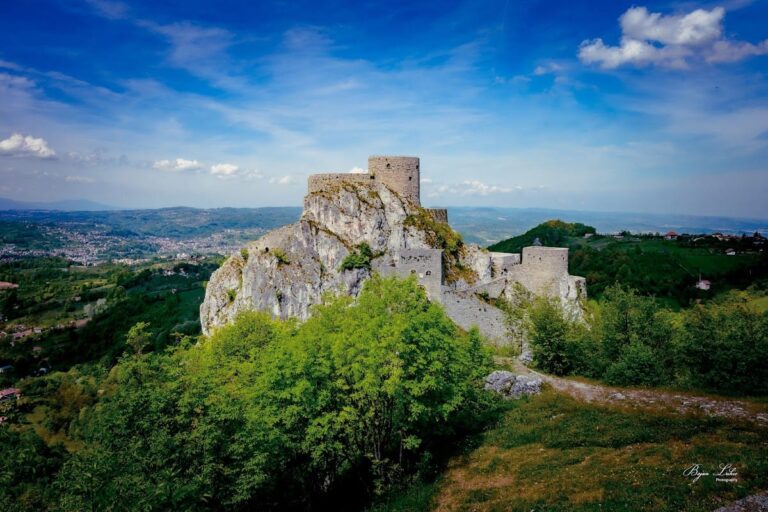
Maglaj Fortress is a medieval defensive stronghold in Bosnia and Herzegovina, built no later than the fourteenth century on a steep igneous rock above the right bank of the Bosna River. It became the nucleus of a settlement and later the center of a nahija, a small Ottoman administrative district comprising a town and surrounding settlements. This role helped sustain the fortress over many centuries.
Medieval Town and Fortress
Maglaj developed as a substantial medieval town during the fourteenth and fifteenth centuries. The fortress passed through several building phases, with numerous smaller and larger alterations extending over at least six centuries. Despite these changes, it retained its medieval core. Its position above the river and on rugged high ground gave the stronghold an important defensive function in the Bosna River valley.
Ottoman Transformation
As cannon fire became more effective, the medieval settlement increasingly changed into an early modern fortress. The appearance visible today was established chiefly during the Ottoman period, particularly in the eighteenth century. The fortress continued to serve mainly as a center for defending the internal security of the nahija. Substantial repairs took place in 1782, while later interventions were more limited and partial.
Abandonment and Conservation
Maglaj Fortress lost its military importance in 1878 and was abandoned as a military-defensive relic. Without inhabitants or regular supervision, its fabric deteriorated more rapidly. In 1962, the Institute for the Protection of Cultural Monuments of the Socialist Republic of Bosnia and Herzegovina and the Maglaj Municipal Assembly supported detailed archaeological investigation and remedial conservation. The Old Maglaj Fort architectural ensemble received recognition as a Category II immovable cultural monument and National Monument of Bosnia and Herzegovina on 31 August 2005.
Remains
The fortress is a large castle complex positioned approximately 182 metres above sea level on a steep igneous rock above the right bank of the Bosna River. Its surviving features reflect both the medieval defensive arrangement and the later Ottoman transformation of the stronghold.
Medieval Approach and Defences
The medieval fortress included a defensive tower and was approached from the west, rather than from the north as today. The original route began south of the fortress at Zagrađe and climbed across a high rock. Cut into the rock, the approach road was approximately 2.5 to 3 metres wide. Quarrying after the Second World War partly destroyed it.
The exposed approach left an attacker’s right side unprotected. On the steep ground above the Bosna River, this favored the defenders, who could cover the entrance with arrow fire from the battlements. The route and its relationship to the elevated rock illustrate how the medieval fortress used the terrain as part of its defensive system.
Clock Tower
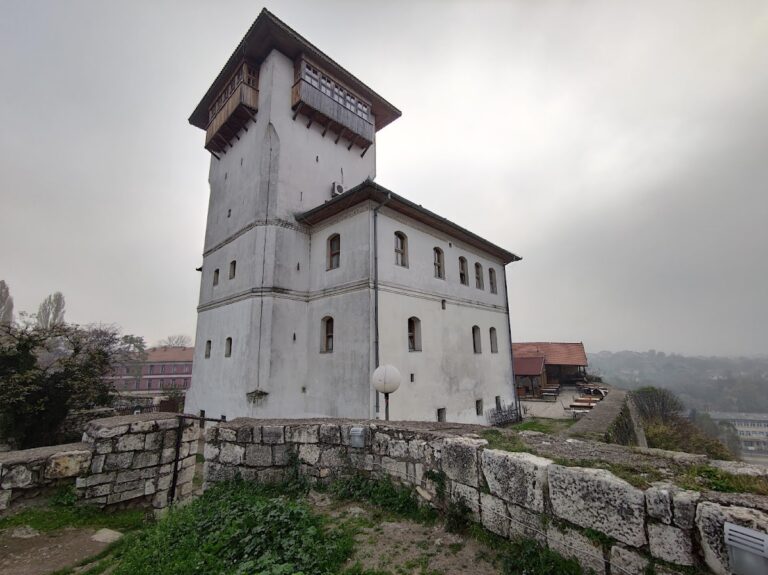
A well-preserved sahat-kula, an Ottoman public timekeeping tower, stands in the forecourt of the old fortress. It was built on a cliff, so its front side rises higher than the opposite side. The tower has a square plan with sides measuring 3.07 metres. Its front elevation is 17.10 metres high, while the opposite side measures 14.77 metres.
An engraving gives the tower’s construction date as 17 October 1697. Its clock struck the hours according to Central European time. In 1955, the clock towers at Sarajevo and Prusac used Turkish time, while those at Foča, Maglaj, and Tešanj used Central European time.