Castle of Alcanede: A Medieval Fortress in Portugal

Site at a Glance
- Rating
- 4.2
- Popularity
- Low
- Country
- Portugal
- Primary era
- Medieval
- Eras represented
- Classical, Medieval
- Civilizations
- Portuguese, Roman
- Site type
- Military
- Remains
- Castle
On this page12 sections
History
The Castle of Alcanede is a fortified site in Alcanede, Portugal, whose origins reach back to a prehistoric settlement on a hilltop. The Romans later strengthened and enlarged the fortified settlement, which they captured in 49 BC. The site was subsequently occupied by the Alans and the Moors before becoming part of the expansion of Portuguese rule during the Christian Reconquista.
From Roman occupation to Portuguese conquest
During the Christian Reconquista, forces loyal to Count Henry took the castle in 1091, but Muslim forces recovered it. King Afonso Henriques, the first king of Portugal, later conquered Alcanede during the Portuguese campaigns against Santarém and Lisbon. He issued a charter intended to attract new settlers and consolidate the community around the stronghold.
Before 1163, Gonçalo Mendes de Sousa, Afonso Henriques’ chief steward and the castle’s first recorded governor, rebuilt and enlarged the walled enclosure. He also organized and populated the settlement, giving the site a more firmly established role within the expanding Portuguese kingdom.
Military orders and royal administration
Alcanede became connected with several medieval military-religious orders, institutions that combined religious obligations with the administration and defense of fortified territories. King Sancho I donated the castle to the Knights Templar in 1187. A papal bull issued in 1201 associated the castle and settlement with the Order of Calatrava, a military order active in the Iberian Peninsula.
The Almohad incursion of 1171, led by Caliph Abu Yaqub Yusuf I, placed the settlement and castle on alert. Later, under the Order of Avis, the surrounding population expanded and major structures of the castle were built, including the keep, the principal fortified tower. The patrimony of Alcanede eventually passed to the Order of Avis under King Denis, and by 1318 the castle’s title had been transferred to that order.
In 1370, during the reign of King Ferdinand, the men of Alcanede were exempted from labor on the castle of Santarém on the condition that they maintained Alcanede’s walls. During the political crisis of 1383–1385, which followed the end of the direct line of Portuguese kings and led to the establishment of a new ruling dynasty, Alcanede supported the Master of Avis, the head of the Order of Avis. Its governor, Álvaro Vasques, joined Portuguese forces operating in Castile and died while voluntarily reconnoitring a ford of the Douro River.
Prosperity, damage, and decline
A new charter issued by King Manuel I in 1514 marked a period of prosperity for the town. Manuel also financed part of the work on the castle and the parish church, although the extent of these interventions is unknown.
An earthquake on 28 February 1531 severely damaged the castle and began a long decline. Its military function and strategic importance diminished, while neither the Crown nor the Order of Avis showed substantial interest in rebuilding it. The castle was consequently abandoned.
Ruins and restoration
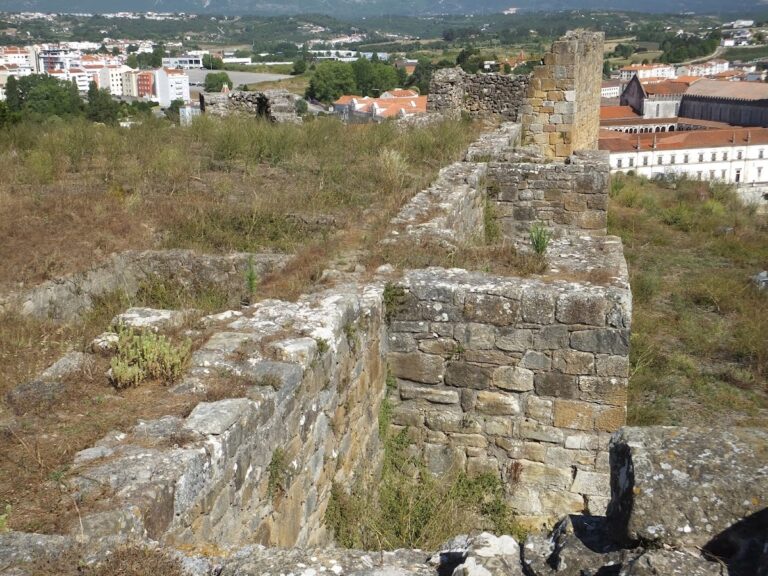
By 1936, the castle was almost completely ruined. Only a few disintegrating sections of the curtain walls and two corners remained. Restoration and consolidation began in 1941, following the surviving remains. Work on the walls, towers, and barbican continued from 1944 to 1949, with further consolidation in 1954 and 1973, including repairs to the wall parapets.
The castle was classified as a Property of Public Interest in 1943. Ownership belongs to the Portuguese Republic. Responsibility for the property passed to the Portuguese Institute for Architectural Patrimony in 1992, then to the Regional Directorate for Culture of Lisbon and the Tagus Valley in 2007, with that transfer confirmed in 2009. The Directorate-General for Cultural Heritage is the operator.
Remains
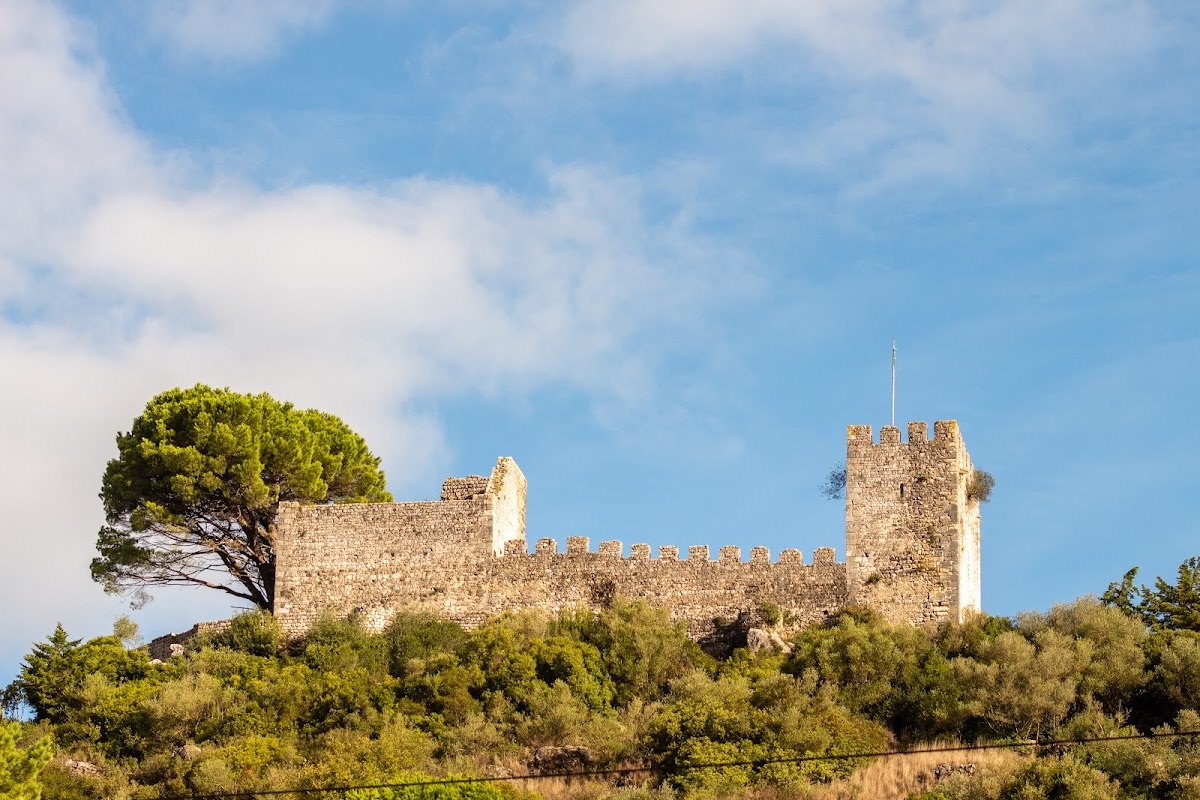
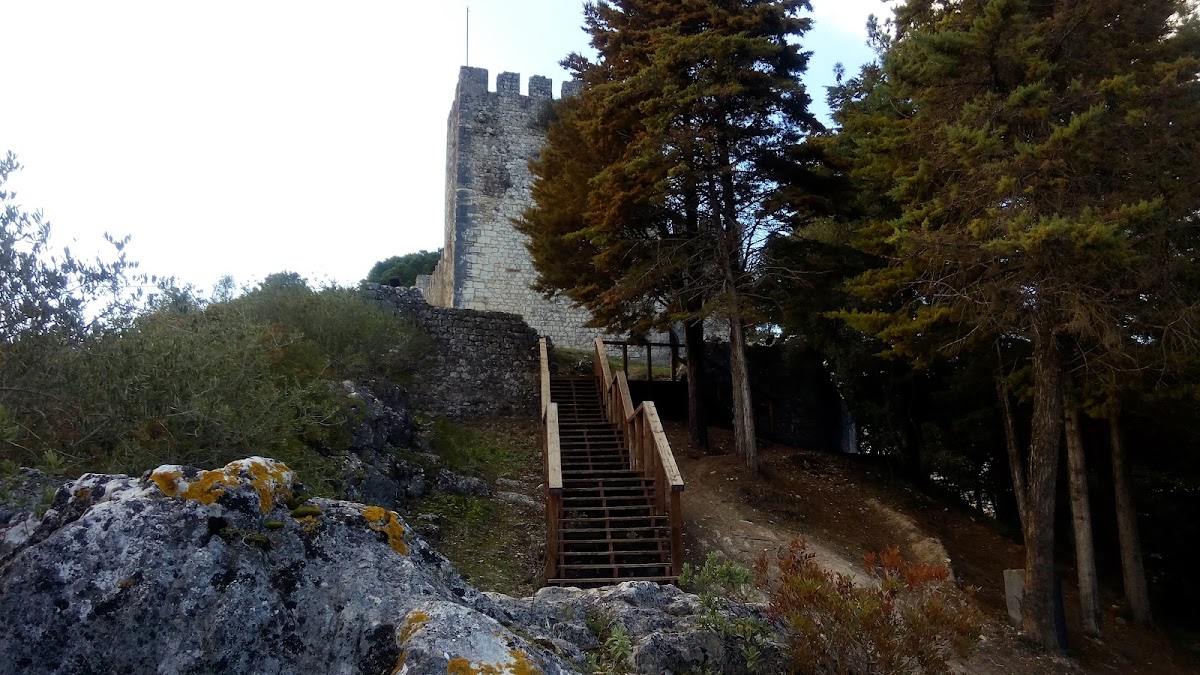
The Castle of Alcanede occupies an isolated rural position on the top of a hill surrounded by dense vegetation. Its principal structures face east. An approximately oval enclosure surrounds the parade ground, with walls defining the castle’s main internal space. Opposite the keep, a tower reinforces the enclosing walls. The surviving and restored fabric combines masonry and brick and includes curtain walls, towers, a barbican, internal rooms, a staircase, and a vaulted ceiling within one of the towers.
Enclosure and defensive works
Curtain walls and towers
The curtain walls form the approximately oval boundary around the parade ground. Their surviving and reconstructed sections are built in masonry and brick. Towers reinforce the enclosure, including the tower positioned opposite the keep. Twentieth-century work re-erected parts of the walls and several towers, while later consolidation included repairs to the parapets, the raised protective edges along the tops of the walls.
Barbican
A barbican, an advanced defensive enclosure or gateway protecting an entrance, forms part of the castle’s defensive system. It belongs to the group of walls and towers restored during the campaigns carried out between 1944 and 1949.
Keep and internal spaces
Keep
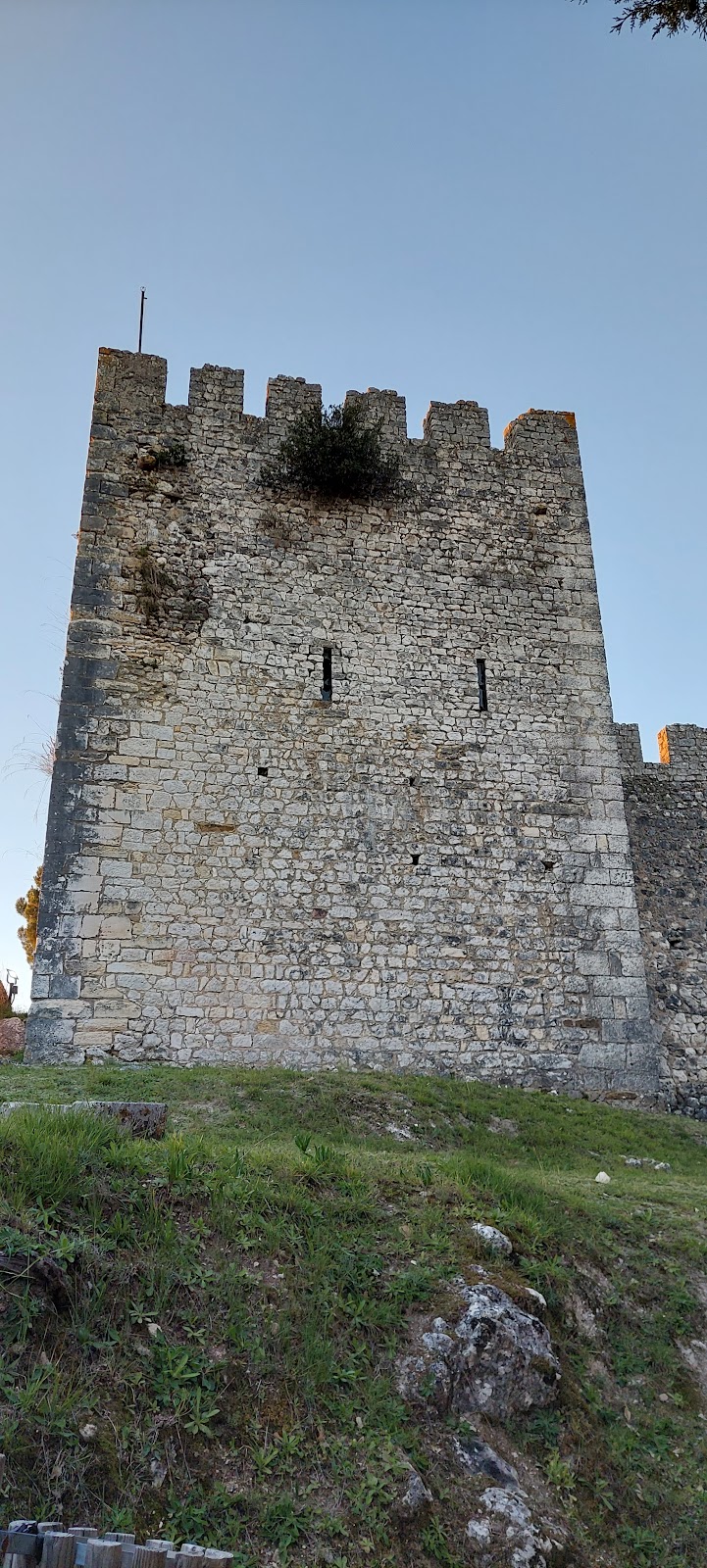
The keep was constructed during the period of the Order of Avis. It is crowned by merlons, the raised sections between openings along a battlement. As the principal fortified tower, it forms the major vertical element of the castle’s defensive layout.
Rooms and water storage
The castle contains a cistern, internal rooms, ancillary structures, and a staircase. A vaulted ceiling survives within the tower. The twentieth-century restoration also reconstructed internal spaces to approximate the castle’s late-medieval form, bringing together the surviving fabric and rebuilt elements within the enclosure.
Nearby sites