Habsburg-Lothringen Castle in Magyaróvár: A Hungarian Fortress and Agricultural Academy
Site at a Glance
- Rating
- 4.5
- Popularity
- Medium
- Country
- Hungary
- Primary era
- Medieval
- External website
- Open
- Eras represented
- Medieval, Early Modern, Modern
- Civilizations
- Habsburg, Hungarian
- Site type
- Military
- Remains
- Castle
On this page12 sections
History
Habsburg-Lothringen Castle in Magyaróvár is a historic castle complex in Hungary that developed from a medieval Hungarian county stronghold into a sixteenth-century artillery fortress and later an agricultural academy. Its listed construction date is 1364, although earlier Roman-period buildings and an earlier medieval castle occupied the site.
Medieval county stronghold
After the foundation of the Hungarian Kingdom, King Stephen I established an early castle on the low elevation now known as Király Hill. Stephen I was the first king of Hungary and organized much of the kingdom’s medieval county administration. The castle became the center of Moson, serving as a fortified administrative base for the county.
This early stronghold used timber palisades, earth-filled walls divided into compartments, and residential buildings for county officials. The Mongol invasion of 1241–1242, a large-scale attack that encouraged the construction and strengthening of stone fortifications across Hungary, changed the site’s strategic context. The castle’s role was subsequently taken over by a stone fortress held by a private landowner.
In the early fourteenth century, the Kőszegi kindred seized the castle, but the army of Charles Robert, also known as Charles I of Hungary, recovered it. Several aristocratic owners followed. Among them were the Lackfi barons, who gradually enlarged the walls and buildings.
Habsburg frontier fortress
From the sixteenth century, the castle’s principal concern was defense against the rapidly advancing Ottoman forces. In 1529, Habsburg military command abandoned the surrounding area. After Vienna was successfully defended, the region was recognized as essential to a buffer zone protecting the Austrian lands.
Between 1530 and 1544, the castle-palace was rebuilt to designs by the Italian military engineer Gian Maria del Napoli. The medieval core was surrounded by artillery bastions, projecting fortifications designed to hold firearms and direct defensive fire along the walls and ditches. The town received separate fortifications, whose water-filled ditches were connected to the nearby Mosoni-Danube.
The fortress endured several major political and military crises. In 1605, the hajduks serving István Bocskai failed to capture it. In 1619, its garrison opened the gates to the army of Gábor Bethlen, prince of Transylvania, without an artillery assault. In 1683, the garrison capitulated to the large Ottoman army commanded by Kara Mustafa during its advance toward the siege of Vienna.
Academy and modern conservation
During the anti-Habsburg uprising led by Francis II Rákóczi between 1703 and 1711, the territory remained under firm imperial military control. The fortress later lost its military importance, and the defensive works around the growing settlement were demolished during the eighteenth century.
In 1818, the surviving inner castle became the home of the Royal Agricultural Academy of Magyaróvár. Its institutional successor is the Faculty of Agricultural and Food Sciences of Széchenyi István University, which continues to use the historic complex for teaching. The inner castle had received an additional second floor in 1810, before the academy took possession.
A modern renovation under the National Castle Programme restored the exterior surroundings and façades, while parts of the historic castle were reconstructed and conserved. The work also introduced cultural and visitor-related functions. The renovated complex was handed over on June 8, 2021.
Remains
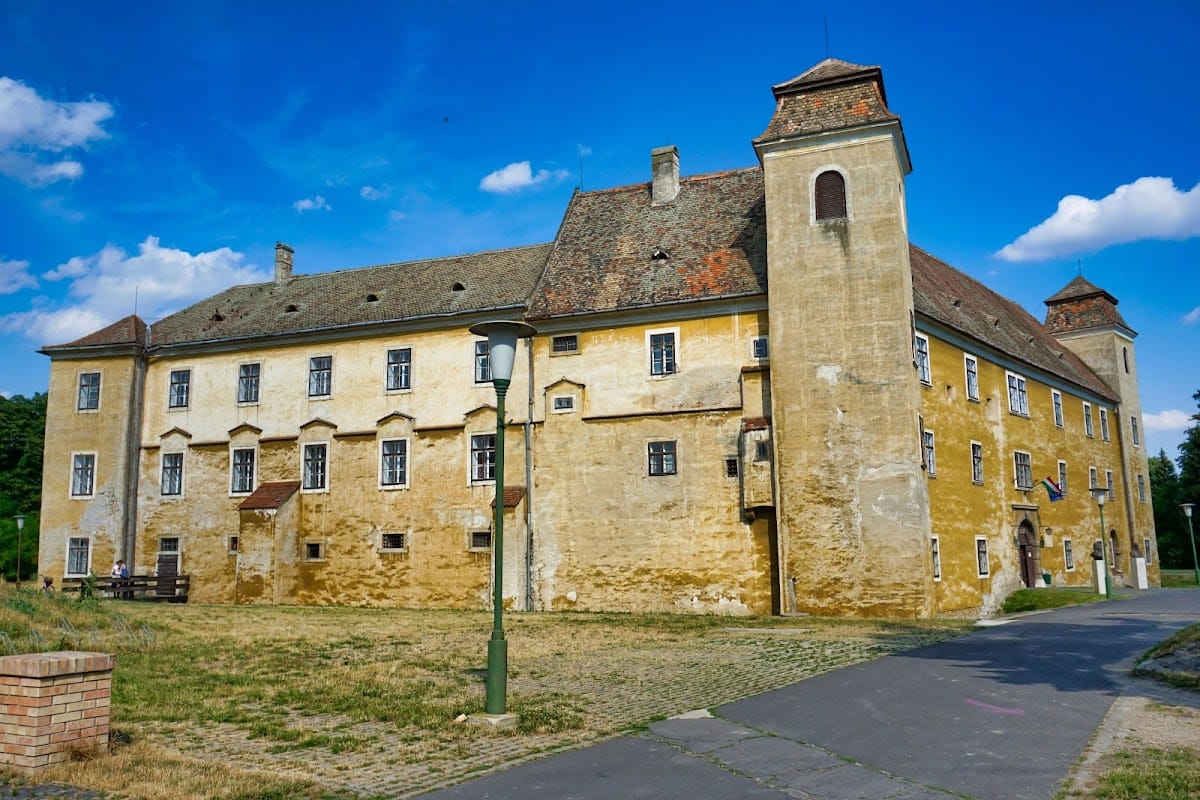
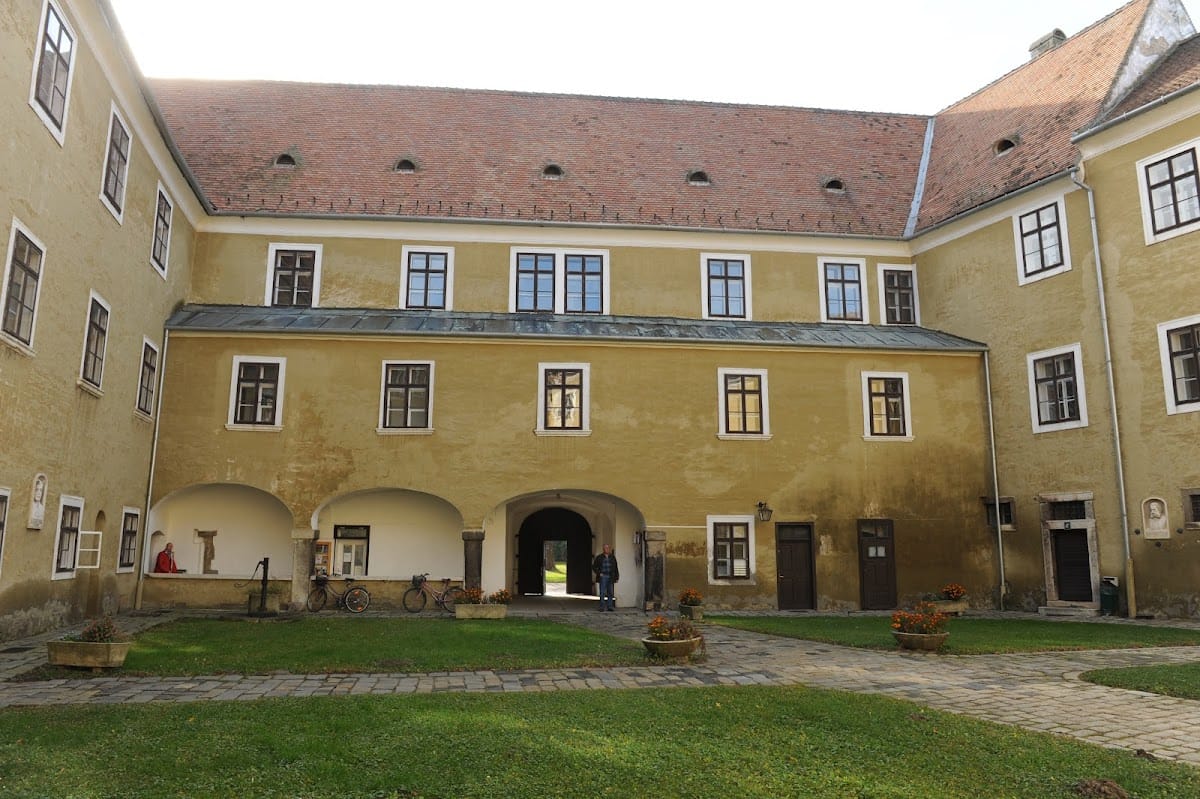
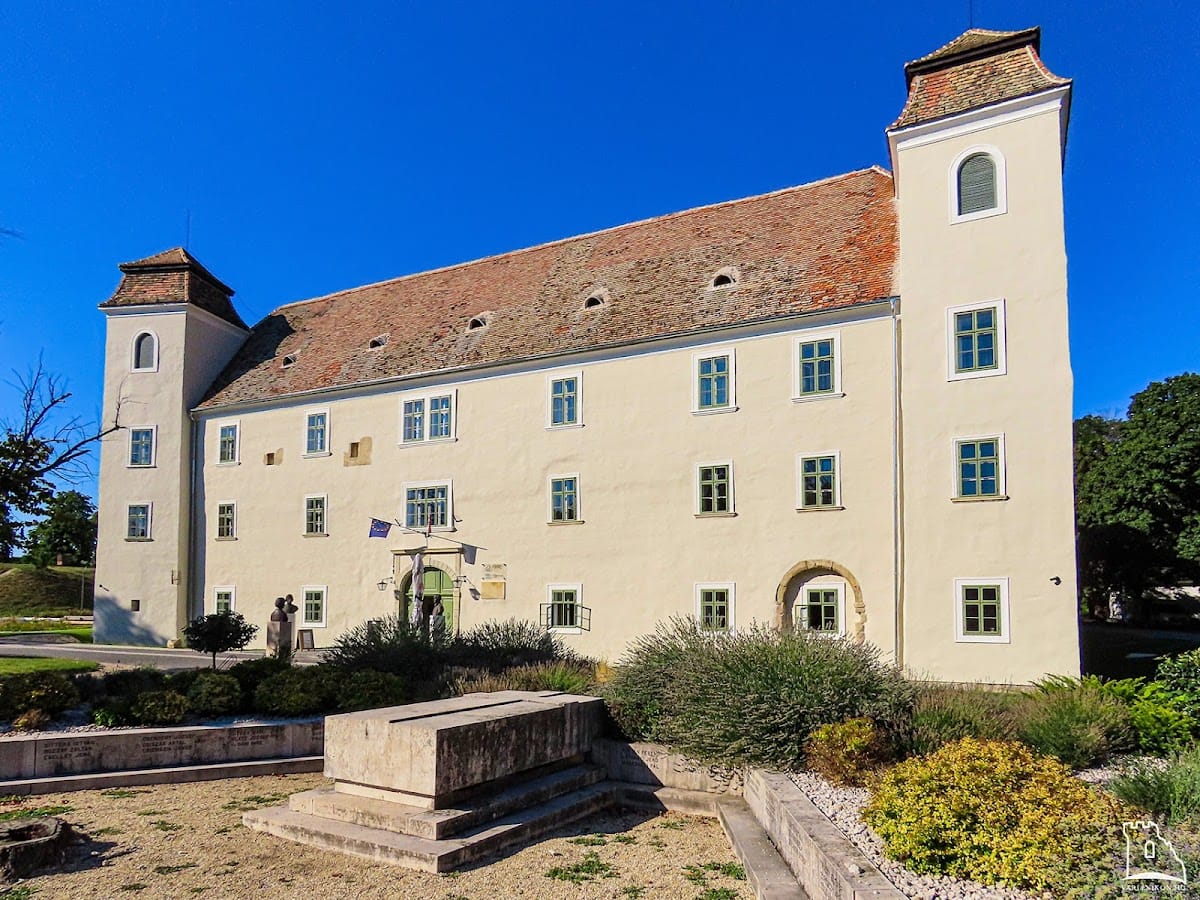
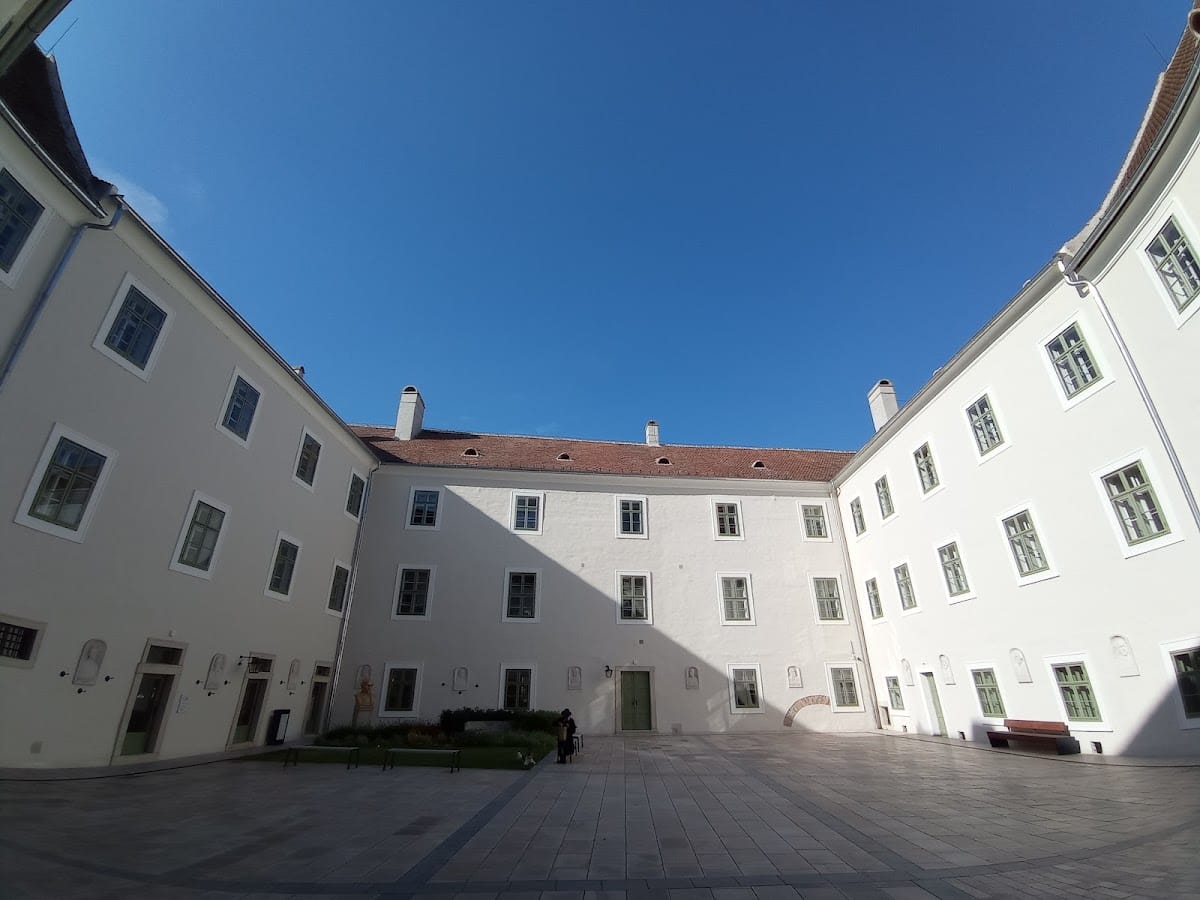
The surviving castle forms an irregular quadrilateral of two-story wings enclosing an internal courtyard. The inner castle is the principal surviving part of the former fortress, while the sixteenth-century defensive system is represented in the site’s historical layout and surviving elements associated with the castle entrance. The building combines medieval foundations and fabric with later alterations, including the additional upper floor constructed in 1810.
Castle buildings and entrance
Inner castle
The inner castle is arranged as connected wings around a central courtyard. Four corner towers originally marked the corners of the building, and two remain visible. The other two were incorporated into the added second floor, changing the appearance of the upper part of the complex while retaining elements of its earlier form.
Western gate tower
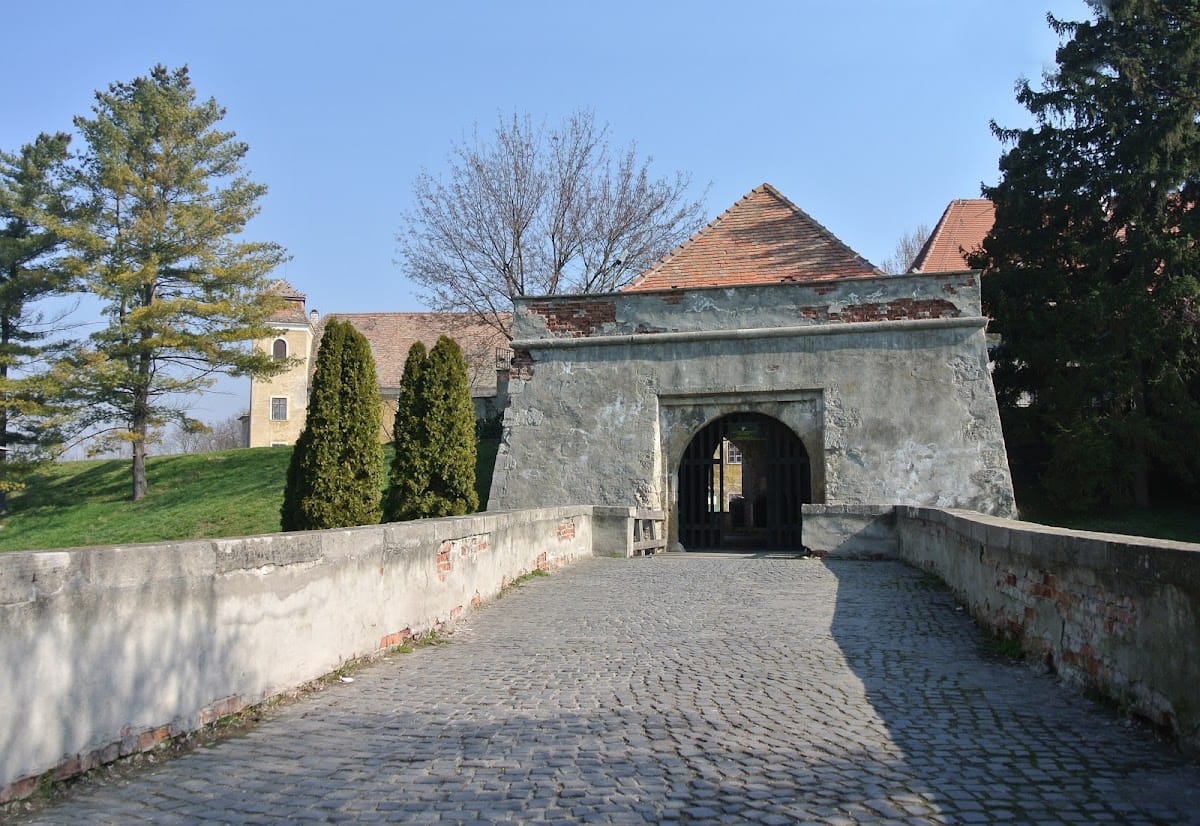
A western gate tower and a bridge provide the principal architectural approach to the castle. A statue of the Hungarian writer István Fekete, made by Ferenc Trischler, stands on the bridge. The castle walls also contain visible Roman tombstones, linking the surviving complex with the earlier Roman-period occupation of the site.
Memorials and commemorative features
Agricultural academy memorials
A series of reliefs commemorates notable professors of the agricultural academy. The courtyard also contains a memorial bench and a bust of Nikolaus Lenau, the nineteenth-century German-language poet who studied at the academy in 1822 and 1823.
Public monuments
Monuments commemorating the two World Wars and the Hungarian Revolution of 1956 stand in front of the castle. Together with the academy memorials, they preserve the complex’s connection with both institutional memory and later Hungarian history.
Current uses of the complex
Following the 2021 renovation, the courtyard was adapted as a reception and events area. Exhibition spaces were created on the ground floor, along with a museum shop, a screening room, and an educational workshop. Rooms in the complex continue to serve teaching, and part of the building houses a museum.