Barroux Castle: A Medieval Fortress and Renaissance Residence in France


Site at a Glance
- Rating
- 4.3
- Popularity
- Medium
- Country
- France
- Primary era
- Medieval
- External website
- Open
- Eras represented
- Medieval, Early Modern
- Civilizations
- Papal States
- Site type
- Military
- Remains
- Castle
On this page10 sections
History
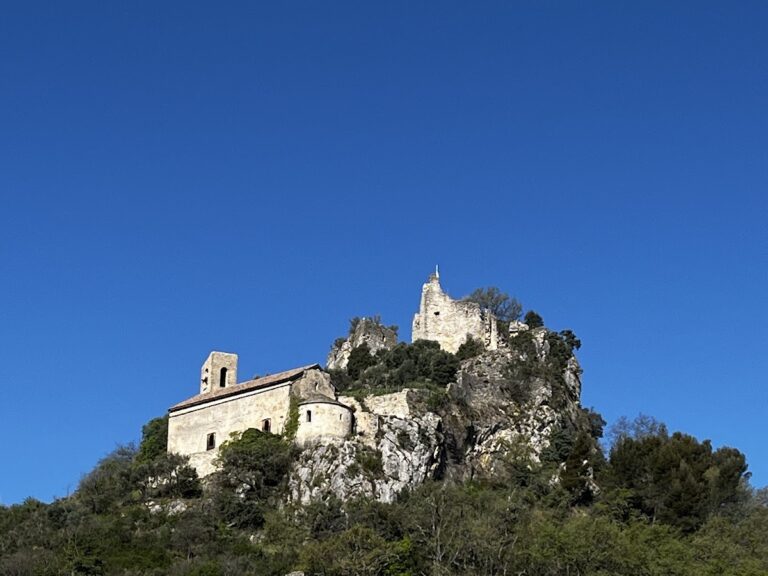
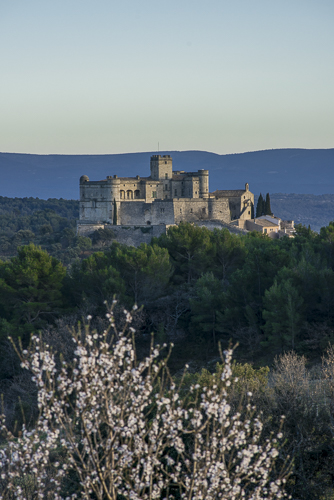
Barroux Castle is a former medieval seigneurial fortress in Le Barroux, France, built in the twelfth century to protect the Comtat plain from incursions by Saracens and Italians. From its creation, it served as the seat of the Les Baux family, a powerful medieval noble lineage in Provence. The site stands within the village on a rocky promontory between the western foothills of Mont Ventoux and the Dentelles de Montmirail.
Medieval lordship
The site first belonged to the Principality of Orange and later became part of the domain of the Counts of Toulouse. In 1274, it became a fief of the Comtat Venaissin, a territory in Provence under papal authority, administered under the authority of the Apostolic Chamber, the papacy’s central financial and administrative institution. Before the eighteenth century, ownership passed through the families of Budos, Ricavi, Peyre, Cardaillac, Rovigliasc, Pelletier de Gigondas, Joannis, and Moret.
Renaissance transformation
In 1536, the castle passed to the Rovigliasc, Counts of La Celle in Piedmont, as settlement of a debt. They rebuilt and embellished the fortress, giving it the character of a refined Renaissance residence. The Renaissance was a European cultural period associated in architecture with classical forms, elaborate residential design, and carefully finished stonework.
The castle became involved in the French Wars of Religion, a series of conflicts between Catholics and French Protestants. In 1563, Barthélémy Bellon surrendered it to the Huguenots, French Protestants associated with the Reformed tradition, without fighting. Catholic forces besieged and recaptured the castle later that year, although the fighting caused no major damage.
Artillery defenses and decline
Between 1680 and 1690, the stronghold was enlarged with an inner courtyard and new ramparts built according to techniques associated with Vauban, the military engineer whose principles emphasized strengthened walls, controlled approaches, and artillery-based defenses. The expanded complex included numerous gunports, openings through which artillery could fire, and seven bronze artillery pieces. At the end of the eighteenth century, the fortress, its ravelin, and the sanctuary of Notre-Dame de la Brune remained in very good condition.
In 1791, Revolutionary troops occupying the castle caused various forms of damage after burning the lord’s possessions in the public square. The building was then abandoned and used as a stone quarry for more than 150 years. By the end of the 1920s, it had fallen into ruin.
Rebuilding and preservation
André Vayson de Pradenne purchased the ruins in 1929 and began rebuilding the castle at his own expense. He died accidentally in 1939, when the work was nearly complete, and construction stopped. During the Second World War, German troops occupied the castle as an observation post. In August 1944, after Resistance fighters attacked German troops below the village on the road to Malaucène, German forces entered the castle in reprisal. They mistakenly interpreted bedding and other traces left in the building as evidence that the Resistance had occupied it, although these remains came from their own former quarters. The Germans set the castle on fire, and it burned for ten days.
Restoration was suspended for more than fifteen years, while the doors were walled up as a precaution. Work resumed in the 1960s with financial support from Dr. Mouliérac-Lamoureux. In 1983, the association Friends of Barroux Castle assumed responsibility for preserving the site. In 2020, the Vayson de Pradenne family brought the privately owned castle into compliance with regulations for establishments open to the public and initiated a rehabilitation project. The castle was listed in the supplementary inventory of historic monuments by an order of 9 December 1920 and classified as a historic monument by an order of 27 May 1963.
Remains
Setting and overall layout
Barroux Castle occupies a rocky promontory in the center of Le Barroux, between Mont Ventoux’s western foothills and the Dentelles de Montmirail. Its original medieval arrangement centered on a keep enclosed by walls. Later additions created a larger defensive complex with expanded ramparts, an inner courtyard, a ravelin, and the sanctuary of Notre-Dame de la Brune, a Christian devotional site dedicated to the Virgin Mary.
Fortress and defensive works
The masonry complex combines surviving medieval elements with the reconstructed form produced during the twentieth-century rebuilding. Its expanded defenses include ramparts fitted with multiple gunports and an external ravelin, a fortification placed in front of a main wall or gate to help protect it from attack. Seven bronze artillery pieces belonged to the fortress in the late seventeenth century. The castle’s defensive purpose remains legible in the arrangement of its walls and artillery openings.
Renaissance residence
The sixteenth-century rebuilding gave the castle a Renaissance character. Corner towers were added to its silhouette, and the walls were fitted with mullioned windows, windows divided by vertical stone sections. Sculpted stonework reflects the building’s residential refinement, while the fortified enclosure preserves its earlier military character.
Chapel and painted decoration
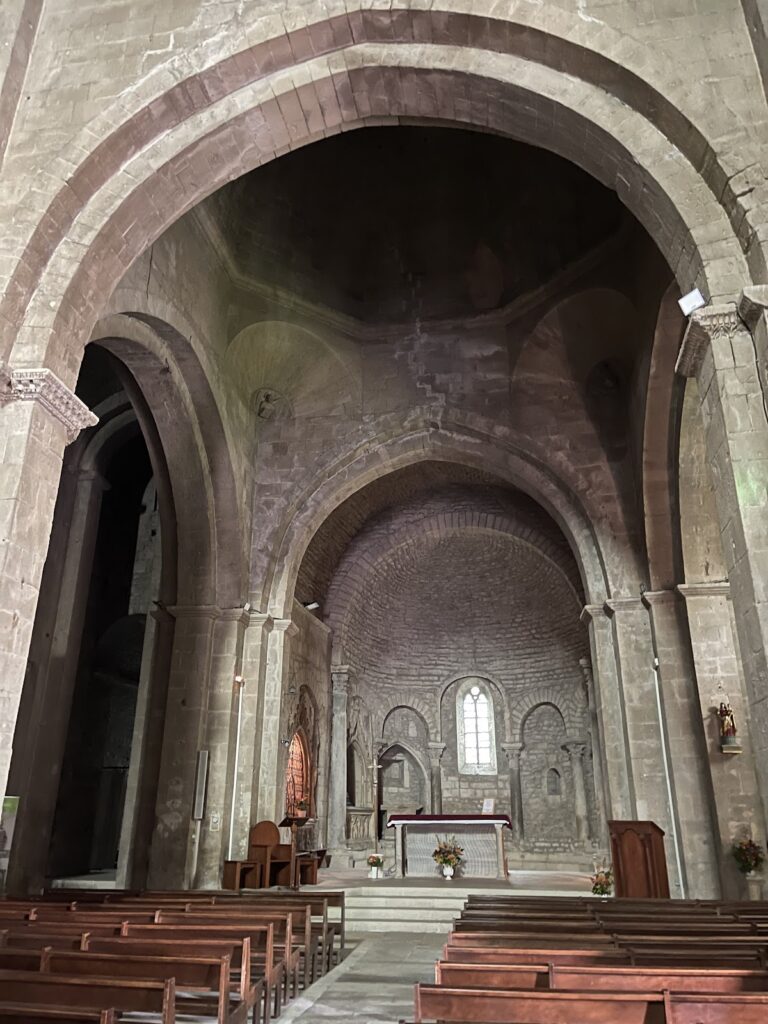
The complex includes a chapel decorated with eighteenth-century wall paintings. It forms part of the castle’s wider group of religious and defensive structures, alongside the sanctuary of Notre-Dame de la Brune.