Castle of Sperlinga: A Rock-Cut Medieval Fortress in Italy


Site at a Glance
- Rating
- 4.6
- Popularity
- Medium
- Country
- Italy
- Primary era
- Medieval
- External website
- Open
- Eras represented
- Bronze Age, Medieval
- Civilizations
- Norman
- Site type
- Military
- Remains
- Castle
On this page12 sections
History
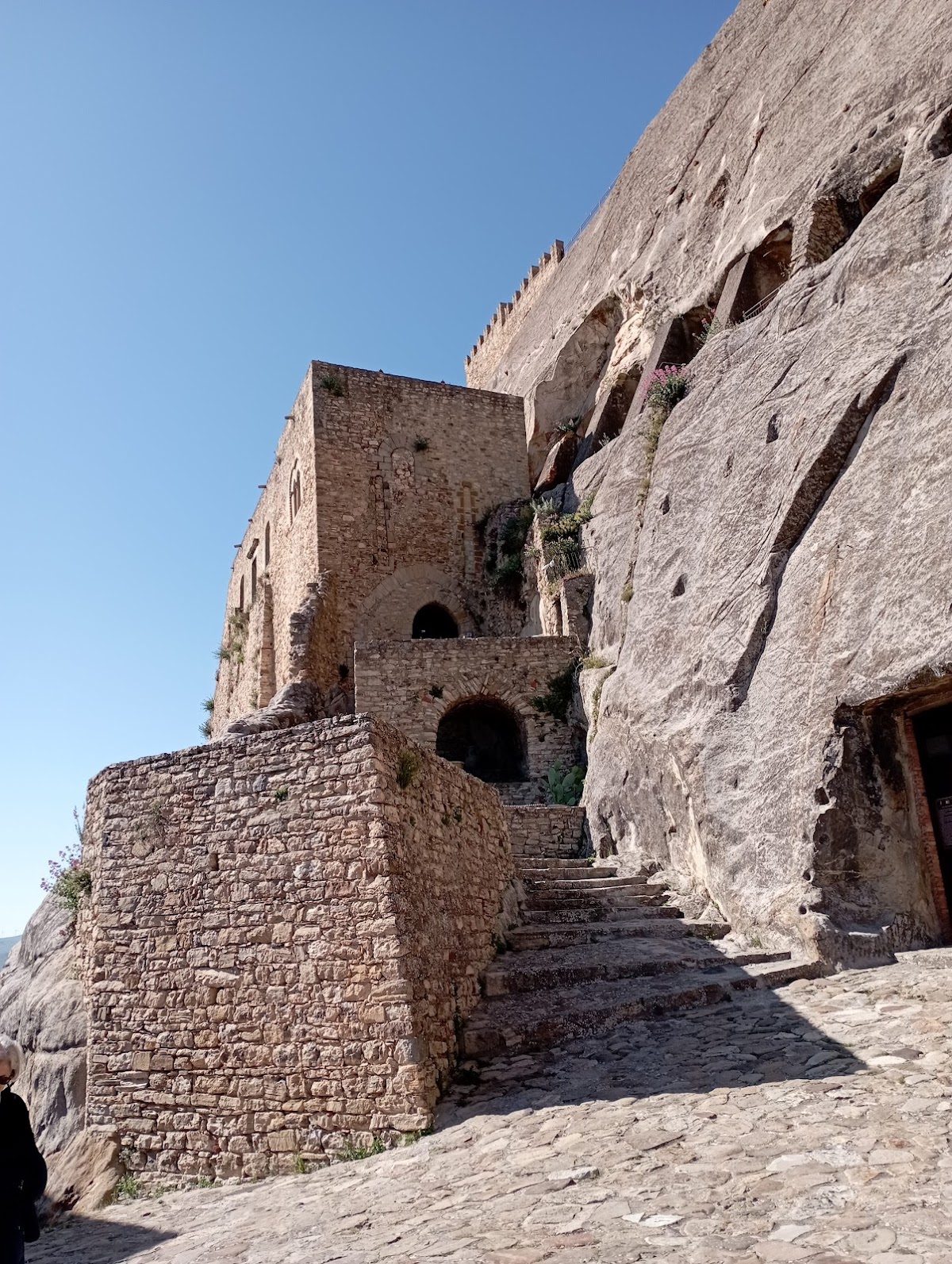
Castle of Sperlinga is a medieval military fortress in Italy, built under Norman rule between the late eleventh and early twelfth centuries on a sandstone rock above the town of Sperlinga in Sicily. Its defensive role and rock-cut construction shaped the history of the settlement, especially during the Sicilian Vespers, the 1282 revolt against the Angevin rulers of Sicily that brought Aragonese intervention to the island.
Early foundations and Norman rule
The rocky base had been used long before the medieval castle. Indigenous Sicilian populations excavated caves in the stone as funerary spaces, and these caves are associated with sacred temple complexes dating back approximately 4,000 years. Medieval construction began during the period when the Normans established rule in Sicily. Documents concerning Sperlinga and its castle exist from 1080, while the baron Rubeo Russo is recorded as an owner in 1132.
The Sicilian Vespers and the Angevin siege
Sperlinga did not join the 1282 rebellion against Charles of Anjou, the Angevin ruler whose forces controlled Sicily. Angevin soldiers took refuge in the castle and resisted an Aragonese siege for nearly thirteen months. Local inhabitants supplied the garrison with food, while Petro de Lemanno, then the castle’s owner, waited unsuccessfully for Angevin relief.
Led by Petro de Lemanno, the surviving soldiers eventually reached Calabria, where Charles of Anjou granted them fiefs. An inscription carved on two stones of the pointed arch in the castle’s first chamber recalls the episode with the motto, “What the Sicilians decided, Sperlinga alone refused.” The castle’s strategic defensive function is dated as ending in 1283.
Noble ownership and the growth of the settlement
After the conflict, ownership passed to the Ventimiglia family, a Sicilian noble house that held the fief for more than two centuries. Royal tracks crossed the territory and linked it with Messina, Palermo, Mount Altesina, and Enna. A commercial centre developed around the castle and served the surrounding area.
On 29 August 1597, Giovanni Forti Natoli, also known as Gianforte Natoli, purchased the castle from Giovanni Ventimiglia, Prince of Castelbuono, for 30,834 feudi, a monetary unit used in the Kingdom of Sicily. In 1626, King Philip IV elevated the barony to a principality for Natoli and his descendants and granted the privilege of establishing settlements there. The Natoli family’s ownership included Francesco Natoli e Orioles.
The castle was acquired by the Oneto family, Dukes of San Silvestro, in 1658, and the family became Dukes of Sperlinga in 1666. The Natoli family retained the title of Princes of Sperlinga after the sale. Giovanni Stefano Oneto, invested with the ducal title, commissioned Villa Sperlinga in Palermo. The castle passed to his son Domenico Oneto e Spatafora in 1680 and, in 1698, to Domenico’s childless brother Francesco Oneto e Spatafora.
Modern ownership and interpretation
Ownership passed to the family of Baron Nunzio Nicosia in 1862. In 1973 the castle was transferred to the Municipality of Sperlinga for a reportedly symbolic price of 1,000 lire and was subsequently converted into a museum. The restored complex remains municipally owned and is used for museum purposes.
The castle also entered modern cultural history through the visit of the Dutch artist Maurits Cornelis Escher, who came to Sperlinga in 1932 and produced a drawing of a cave in the castle. On 27 July 1943, a battle between Allied and German forces took place at Sperlinga Castle.
Remains
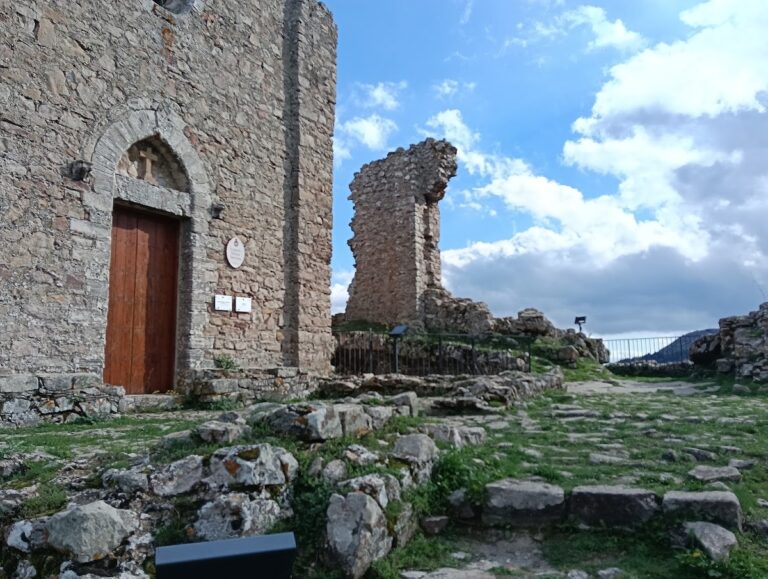
The surviving fortress occupies a rocky mass above Sperlinga and is formed principally from sandstone. Rather than consisting entirely of conventional masonry rooms, the complex was excavated directly into the hard stone, which is described as a single monolith. Its restored remains stand above much older caves and include military spaces, a tower, a chamber associated with Prince Natoli, an inscription recalling the Sicilian Vespers, and installations connected with measuring sunlight and time.
Rock-cut remains
Ancient funerary caves
The caves beneath the castle were cut into the rock by indigenous Sicilian populations for funerary use. Their association with sacred temple complexes extends back approximately 4,000 years. These excavated spaces form the ancient foundation of the site beneath the later fortress.
Medieval fortress chambers
The medieval castle’s rooms and other spaces were carved directly into sandstone. A tower forms part of the complex, and a window is associated with the room of Prince Natoli. The first chamber has a pointed arch whose two stones carry the inscription recalling Sperlinga’s refusal to join the Sicilian revolt and its assistance to the Angevin garrison. Many rooms formerly had elaborate interior decoration, while the present complex is restored.
Astronomical installations
Solstice arrangements
Some excavated parts of the castle were designed for astronomical functions. Their arrangement regulated the penetration of sunlight at the winter and summer solstices, linking the form of the rock-cut complex with observations of the annual movement of the sun.
Sundial silo
A silo containing twelve niches served as a sundial or as an installation for measuring time. It forms part of the castle’s specialized rock-cut features and adds an astronomical function to the military and funerary uses represented elsewhere in the complex.