Montjuïc Castle: Barcelona’s Historic Military Fortress



Site at a Glance
- Rating
- 4.4
- Popularity
- Very High
- Country
- Spain
- Primary era
- Early Modern
- Eras represented
- Early Modern
- Civilizations
- Spanish
- Site type
- Military
- Remains
- Castle
On this page16 sections
History
Montjuïc Castle is a former military fortress in Barcelona, Spain, built and repeatedly reshaped by Catalan, Spanish, and French military authorities from the seventeenth century onward. Its present defensive form developed through eighteenth-century reconstruction and follows a star-shaped system associated with Vauban-style fortification. Occupying the summit of Montjuïc, the castle has played roles in warfare, military rule, political repression, and the public commemoration of those executed there.
Before the fortress
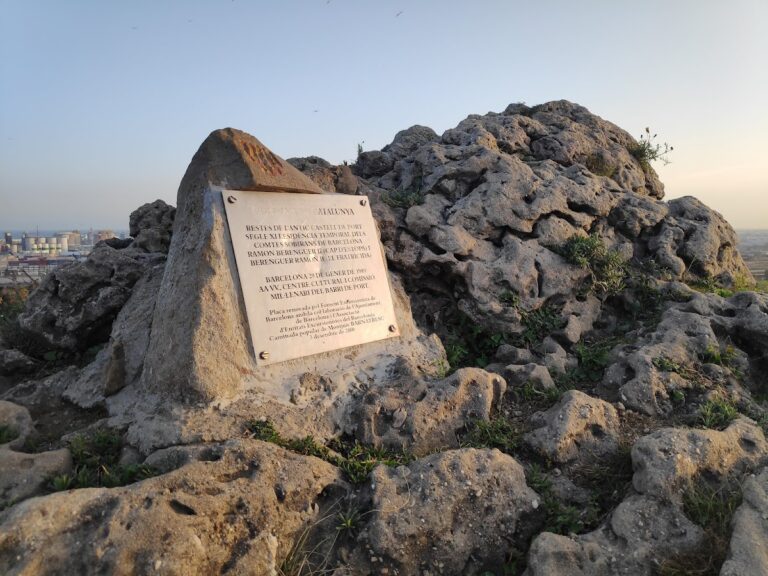
A medieval signal or watchtower stood on the summit before the castle. Its purpose was to warn Barcelona of approaching ships by means of signals. The name Montjuïc has been linked to the Latin expressions Mons Judaicus, meaning “Jewish Mountain,” and Mons Jovicus, meaning “Mount of Jupiter.” The first association refers to a Jewish cemetery on the mountain, in use from at least the ninth to the fourteenth century. The cemetery was abandoned after the destruction of Barcelona’s Jewish quarter in 1391.
The seventeenth-century forts
The first military fortification on Montjuïc was constructed in thirty days during the War of the Reapers, the Catalan revolt against the authority of Philip IV of Spain. This temporary quadrilateral earthwork resisted Castilian troops commanded by Pedro Fajardo de Zúñiga y Requesens, Marquis of Los Vélez, at the Battle of Montjuïc on 26 January 1641. French engineers strengthened the position with stonework later that month.
By 1643 the first fort had deteriorated and was demolished. A replacement completed by 1651 consisted of two square enclosures, bastions at their extremities, and an outer palisade. The Montjuïc tercio, a historic Spanish military formation combining infantry units under formal command, was stationed there. The fort became a royal possession in 1652 and was transformed into a castle in 1694. The new castle occupied the level summit, while the earlier fort remained within it as an internal redoubt, a smaller enclosed defensive work positioned inside a larger fortress.
The War of the Spanish Succession
Montjuïc Castle changed hands repeatedly during the War of the Spanish Succession, the European conflict of 1701 to 1714 over the Spanish monarchy. Catalan forces supported Archduke Charles, while Philip V represented the Bourbon claim. Charles Mordaunt, Lord Peterborough, captured the castle for the Catalan side on 17 September 1705. Philip V recovered it on 25 April 1706, despite resistance from 700 redcoats commanded by Arthur Chichester, Lord Donegall. Catalan forces retook it on 12 May, but the castle returned to Bourbon control on 12 September 1714, when Barcelona surrendered under the fifth article of the capitulations imposed by the Duke of Berwick.
The eighteenth-century reconstruction
In 1751, the military engineer Juan Martín Cermeño demolished the old 1640 fort and reshaped the fortress. He added service buildings and cisterns, including one intended for drinking water, and excavated the deep ditch around the stronghold. The defensive arrangement reflected principles associated with Sébastien Le Prestre, Marquis of Vauban, the leading French military engineer of the seventeenth century. Vauban-style fortification used projecting bastions and carefully arranged artillery positions to improve fire along the walls and reduce vulnerable areas.
Further works between 1779 and 1799 doubled the accommodation capacity. Kitchens and stoves were added for 3,000 places, and the fortress was equipped with at least 120 artillery pieces. With minor later changes, Montjuïc Castle retained the form established during this period. In the late eighteenth century, it also served as one of the observation points used in triangulations measuring the terrestrial meridian through Dunkirk, Paris, and Barcelona. These measurements contributed to determining the length of the metre.
French occupation and attacks on Barcelona
French imperial troops occupied the castle on 29 February 1808 under Colonel Floresti. The Spanish garrison offered no resistance because the Captain General of Catalonia had been ordered by the court to receive the French forces peacefully. The occupation continued until 28 May 1814.
The fortress was later used against Barcelona during periods of political unrest. In 1842, during the regency of Espartero, its guns bombarded the city to suppress a revolutionary uprising. General Prim ordered another bombardment in 1843, directed against the shipyards and walls. In 1856, batteries at Montjuïc, the Ciutadella, and the shipyards again shelled Barcelona during the repression of an uprising.
Prison, repression, and executions
From the late nineteenth century, Montjuïc Castle became a prison for people subjected to political and social repression. Workers involved in the anarchist violence of the 1890s were detained there, and prisoners were tortured during the Montjuïc process, a series of trials of anarchist suspects notorious for the severity of its proceedings. The castle also held detainees arrested during Tragic Week.
The educator Francesc Ferrer i Guàrdia, regarded as the founder of the Modern School, was executed at the castle on 13 October 1909 after being held responsible for the unrest. In 1919, more than 3,000 workers were imprisoned there because of the La Canadenca labor conflict.
During the Spanish Civil War, the fortress served as a military and political prison, as well as a place of trials and executions. General Manuel Goded and other military rebels were executed there on 12 August 1936, followed by further executions on 26 August. After the war, Francoist authorities continued to use Montjuïc as a military prison. More than 4,000 Republican and Catalan nationalist prisoners were executed there during the Franco period.
Lluís Companys, president of the Generalitat of Catalonia, was imprisoned at the castle, subjected to a summary military trial, and executed on 15 October 1940. The Generalitat is Catalonia’s autonomous government institution. Companys’s imprisonment and execution made Montjuïc a central site in the memory of Francoist political repression.
From military prison to municipal centre
Montjuïc Castle remained a military prison until 1960, when it was ceded to Barcelona while army oversight continued. After three years of adaptation work, a military museum was inaugurated by Francisco Franco on 24 June 1963. The enclosure had passed to the city, but the museum initially remained separate from full municipal control.
The castle was transferred fully to Barcelona in 2007 and 2008. The city removed Franco’s equestrian statue in April 2008, and the military museum closed permanently on 24 May 2009. Its collections were catalogued and transferred to municipal museums or, where they belonged to the Ministry of Defence, to Girona. A Centre for International Peace began operating at the castle on 20 April 2009. The final military telecommunications detachment left in 2010, and the last room occupied by the museum’s governing body was handed over that July.
Initial rehabilitation of the rooms was completed in July 2011. The work revealed remains of the 1650 bastion, while the last military communications tower was demolished in November 2009. On 15 October 2011, the Catalan flag associated with Lluís Companys’s recovery of the castle for Barcelona in 1936 was raised again at the Santa Amàlia Bastion. Barcelona’s municipal government owns and manages the fortress. It is protected under Spain’s general castle-protection decree of 22 April 1949 and the Historical Heritage Law of 1985, and it was formally declared a monument of cultural interest on 8 November 1988.
The castle remains a major site of memory concerning military rule, political repression, and executions, as well as the change from military installation to municipal cultural and peace centre. In 2015, Barcelona prohibited the annual Mass for those killed in the 1936 uprising because it was considered an exaltation of the military coup.
Remains
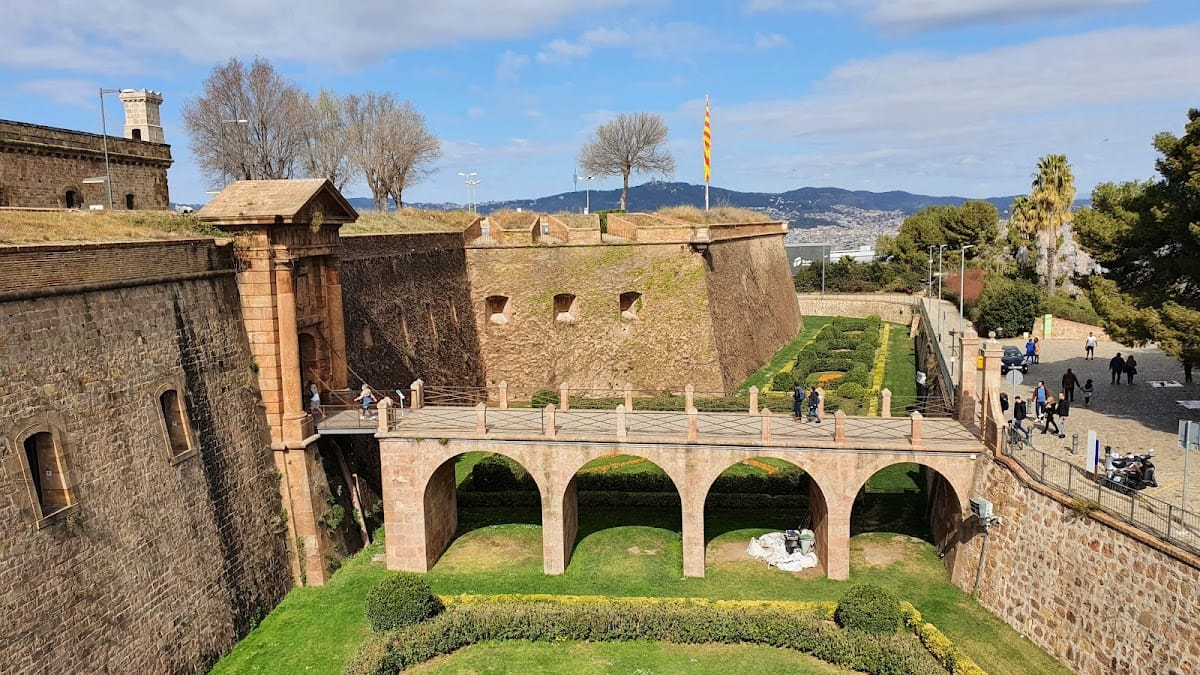
Montjuïc Castle occupies a rocky terrace more than 170 metres above Barcelona. The northern perimeter bastion reaches 175.50 metres above sea level. The complex follows a star-shaped defensive arrangement, with several bastions and exterior works protecting a central enclosure surrounded by a deep perimeter ditch. The main body is organized around a porticoed Arms Courtyard, and its rooms are covered by semicircular barrel vaults.
Fortifications and courtyards
The central castle
The castle created in 1694 occupied the level portion of the summit. Three bastions faced inland, while a serrated line of merlons faced the sea. The small earlier fort survived inside the new enclosure as a redoubt. Cermeño’s reconstruction later added defensive works, service areas, cisterns, and the deep ditch. One cistern was built specifically to store drinking water. The surrounding wall-walk and a path descending the mountain slope toward Avinguda del Castell provide access to the northern perimeter bastion, with the latter route representing a contemporary alteration.
The Arms Courtyard
The porticoed Arms Courtyard forms the main organizing space of the present complex. Rehabilitation included rooms opening onto the courtyard, and fourteen renovated rooms were completed in July 2011. Waterproofing work on the roof and watchtower began in July 2010. The western enclosure was partly demolished during works begun in April 2011, while rehabilitation also exposed remains of the 1650 bastion, which were presented in December 2010.
Ditches and bastions
Santa Amàlia and Santa Eulàlia
The Santa Amàlia Bastion and the Santa Eulàlia ditch form documented parts of the fortress. The Santa Eulàlia ditch was later adapted for an archery range, inaugurated in 1965. The Catalan flag associated with Companys’s recovery of the castle in 1936 was raised again at the Santa Amàlia Bastion in 2011.
Santa Elena and the Fossar de la Pedrera
The Santa Elena ditch became an execution site during the Spanish Civil War. A postwar Monument to the Fallen commemorated people executed there. Below the castle, a mausoleum at the Fossar de la Pedrera commemorates Lluís Companys and other victims connected with the site.
Coastal and landward artillery
Surviving batteries include four 152-millimetre Vickers coastal artillery pieces directed toward the sea and harbour. Four 305-millimetre De Bange howitzers face the fortress approaches and the city. Together, these surviving weapons reflect the castle’s continuing defensive role after its major eighteenth-century reconstruction.