Haslington Hall: A 16th-Century House in Cheshire
Site at a Glance
- Popularity
- Medium
- Country
- United Kingdom
- Primary era
- Early Modern
- Eras represented
- Medieval, Early Modern, Modern
- Civilizations
- British, English
- Site type
- Domestic
- Remains
- Manor House
On this page5 sections
History
Haslington Hall is a sixteenth-century house in Cheshire, United Kingdom. Admiral Sir Francis Vernon built it in 1545, incorporating parts of an earlier manor house traditionally dated to 1480.
Manor and house
The Vernon family acquired the manor in the fourteenth century through the marriage of Sir Thomas Vernon to Joan Lostock, its heiress. The estate thus belonged to the family before Francis Vernon built the hall.
Alterations and residents
Additions and alterations took place during the sixteenth, seventeenth, and nineteenth centuries. The hall was used as a farmhouse in the late nineteenth century, followed by extensive repairs and further building work in 1931. It was designated a Grade I listed building on 10 June 1952. Grade I is England’s highest listed-building category, for buildings of exceptional interest.
In 1940, a bombing during the Second World War destroyed the Manchester bank vault where the hall’s early records were kept. Former residents included Colonel H. Watts and his wife, Lillian. After the First World War, their daughter, Dame Felicity Peake, spent much of her youth at the hall. Peake held the senior air-force rank of air commodore and became the first director of the Women’s Royal Air Force, the women’s service associated with Britain’s air force. Lillian Watts was the first president of the Haslington and Crewe Green branch of the Women’s Institute, a voluntary organization for women, founded in 1944.
Restoration and recent events
Tony Vernon bought the hall in 1970 and restored it over the following three decades. He had established Murray Vernon, an independent dairy company. After his death, the hall was sold to Mohammed Isaq in 2005. A fire broke out on 24 March 2018; by April, police were investigating, and the cause had not been determined.
In December 2019, the hall and estate were sold in derelict condition to retired property developer Peter Jans. He restored the building as a private dwelling and made it his home.
Remains
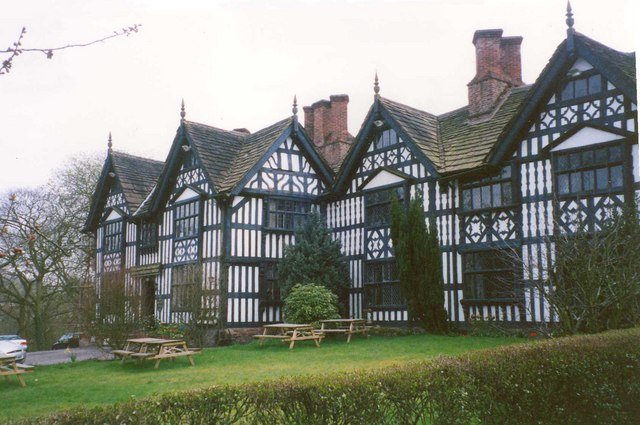
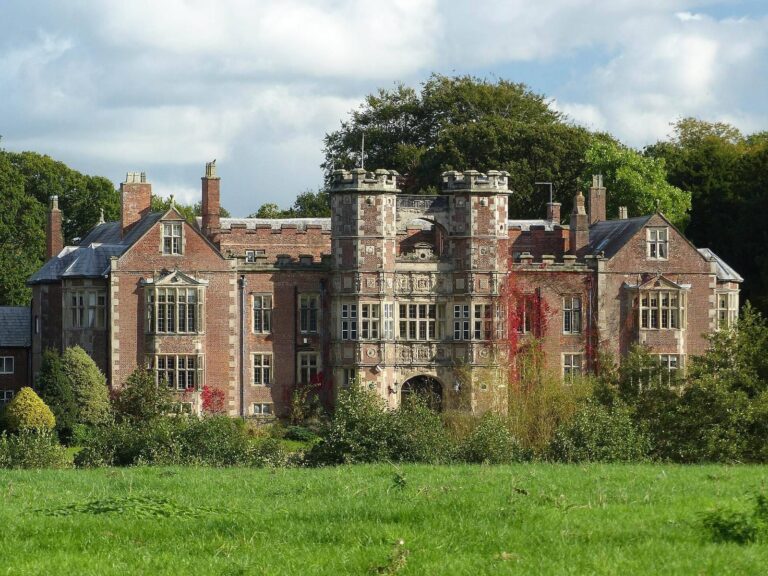
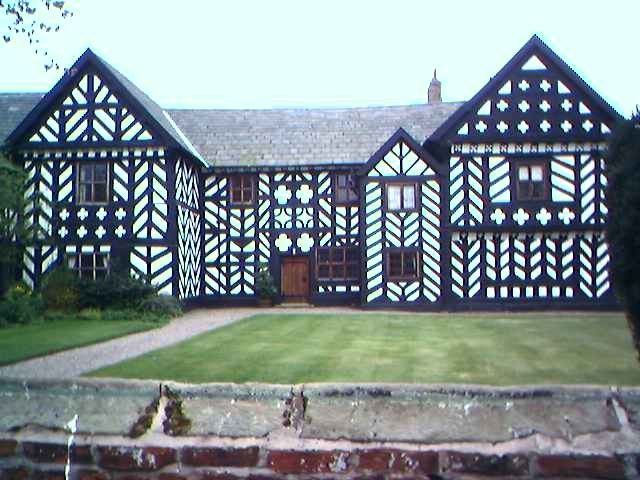
Set in open countryside about 1 km east of Haslington village, the two-storey hall has six bays, or structural divisions, and a slate roof. Its construction combines timber framing and brickwork, with brick forming most of the rear elevation.
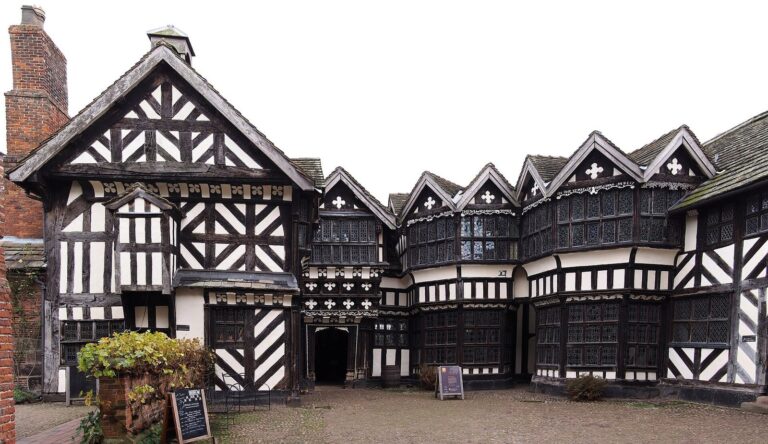
The timber-framed sections have herringbone bracing, arranged in a zigzag pattern, alongside quatrefoils, or four-lobed ornaments, and cusped lozenges, diamond-shaped forms with curved sides. A tradition links some timbers from an early building phase to ships of the Spanish Armada, the fleet sent against England in 1588. That attribution places the timber’s supposed source later than the hall’s stated construction date.