Goytepe Archaeological Complex: An Early Neolithic Settlement in Azerbaijan
Site at a Glance
- Rating
- 5
- Popularity
- Very Low
- Country
- Azerbaijan
- Primary era
- Stone Age
- Eras represented
- Stone Age
- Civilizations
- Unclassified
- Site type
- Settlement
- Remains
- Village
On this page15 sections
History
Goytepe is an early Neolithic settlement in Azerbaijan’s Tovuz District, associated with the Shulaveri-Shomu culture, an early Neolithic tradition of the South Caucasus. The settlement dates to approximately the sixth millennium cal BC, meaning calibrated dates before the Common Era. It was one of the largest early Neolithic settlements in the South Caucasus and among the oldest farming villages in western Azerbaijan. Although classified as a single-period site, its material record reflects changes during its occupation.
Neolithic settlement and regional development
Finds from Goytepe point to a shift in the use of pottery. At the nearby settlement of Haci Elamxanli Tepe, about 1 km to the north, the dated period is 5950–5800 cal BC, more than a century earlier in the regional sequence. Ceramics made up less than 5% of finds there, while stone artifacts accounted for more than 95%. At Goytepe, the balance changed from about 10% pottery and 90% stone artifacts in the oldest layer to about 75% pottery and 25% stone artifacts in the youngest. This change has been interpreted as evidence that pottery production began at Goytepe during 5800–5650 cal BC.
The appearance of farming and animal husbandry in the region need not mean that every Neolithic practice arrived at once. Local development, including an aceramic stage, a phase or context without pottery, has also been proposed. Very early Neolithic sites appeared around 6000 BC in the Lesser Caucasus foothills, and excavations at Damjili Cave, farther upstream along the Kura, added evidence relevant to this interpretation.
Investigation and the archaeology park
Archaeologist Ideal Narimanov first documented Goytepe about four decades before detailed investigation began in 2006. An Azerbaijani-French mission mapped the mound’s topography and collected charcoal for dating. Azerbaijani specialists from the Institute of Archaeology and Ethnography, led by Farhad Guliyev, investigated the site in 2008. In 2009, a larger team from the University of Tokyo, led by Yoshihiro Nishiaki, carried out further work, with Japanese specialists concentrating on the study of the site’s layers and their sequence.
From 2008 onward, French and Japanese laboratories conducted eight radiocarbon analyses, a method for estimating the age of organic material, using charcoal from different excavation squares. Four tests concerned upper layers. Charcoal from square 4BII yielded a date of 5600–5500 cal BC; samples from squares 1A/B and 2A/B yielded 5450–5350 cal BC. The other four analyses focused mainly on cultural deposits 150–175 cm deep.
On 18 April 2012, President Ilham Aliyev signed the order establishing the Goytepe Archaeology Park to support detailed study of the site. The park was established that day.
Remains
Mound and excavation
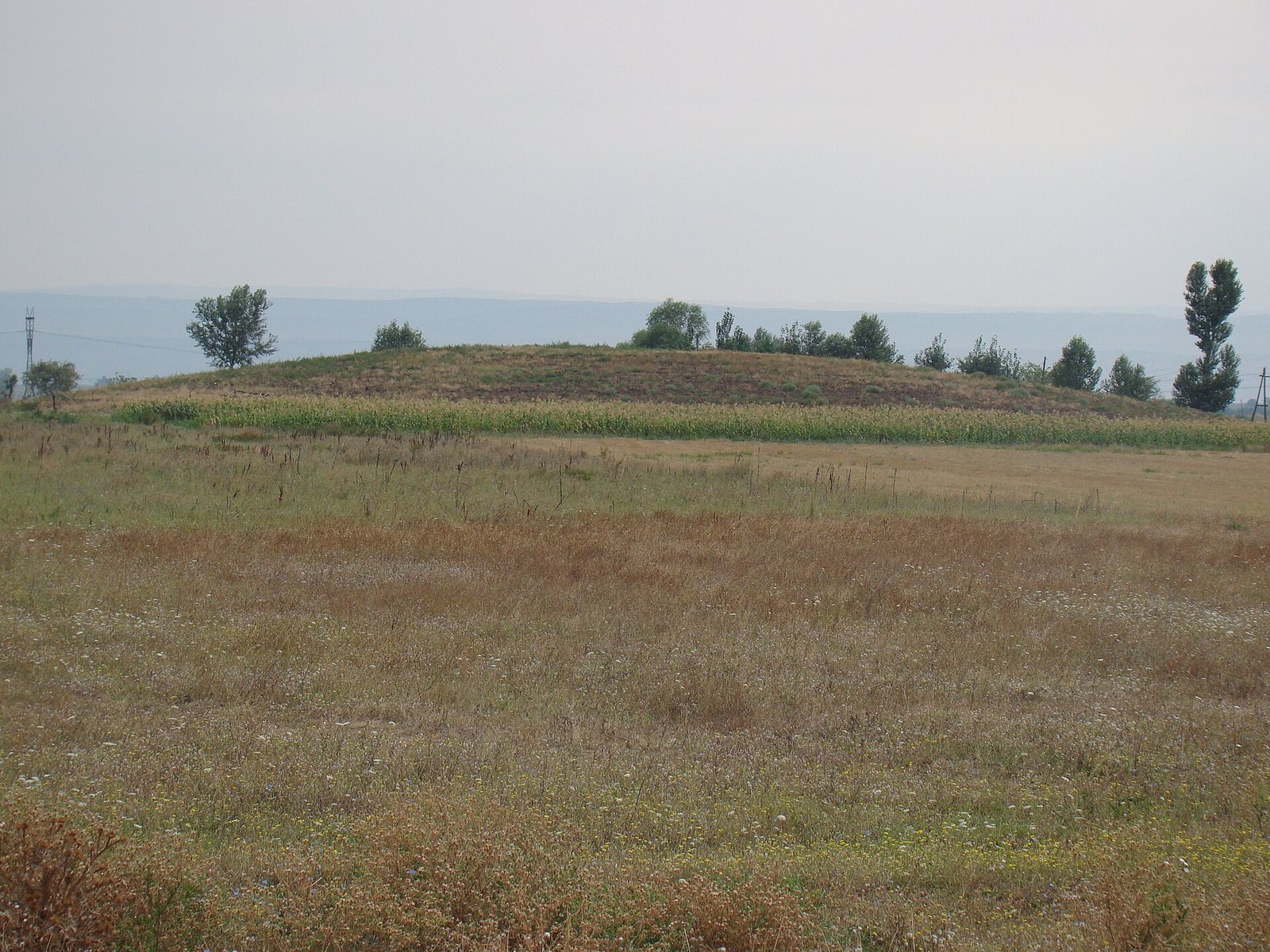
The mound covers more than 2 hectares, measures nearly 145 m across, and reaches an elevation of 420 m. It lies on the Kura’s right bank, south of the river’s present course, near the Tovuz River’s confluence with the Kura. The site occupies the western terrace of the Zayam valley in the middle Kura region, several kilometres east of Tovuz town.
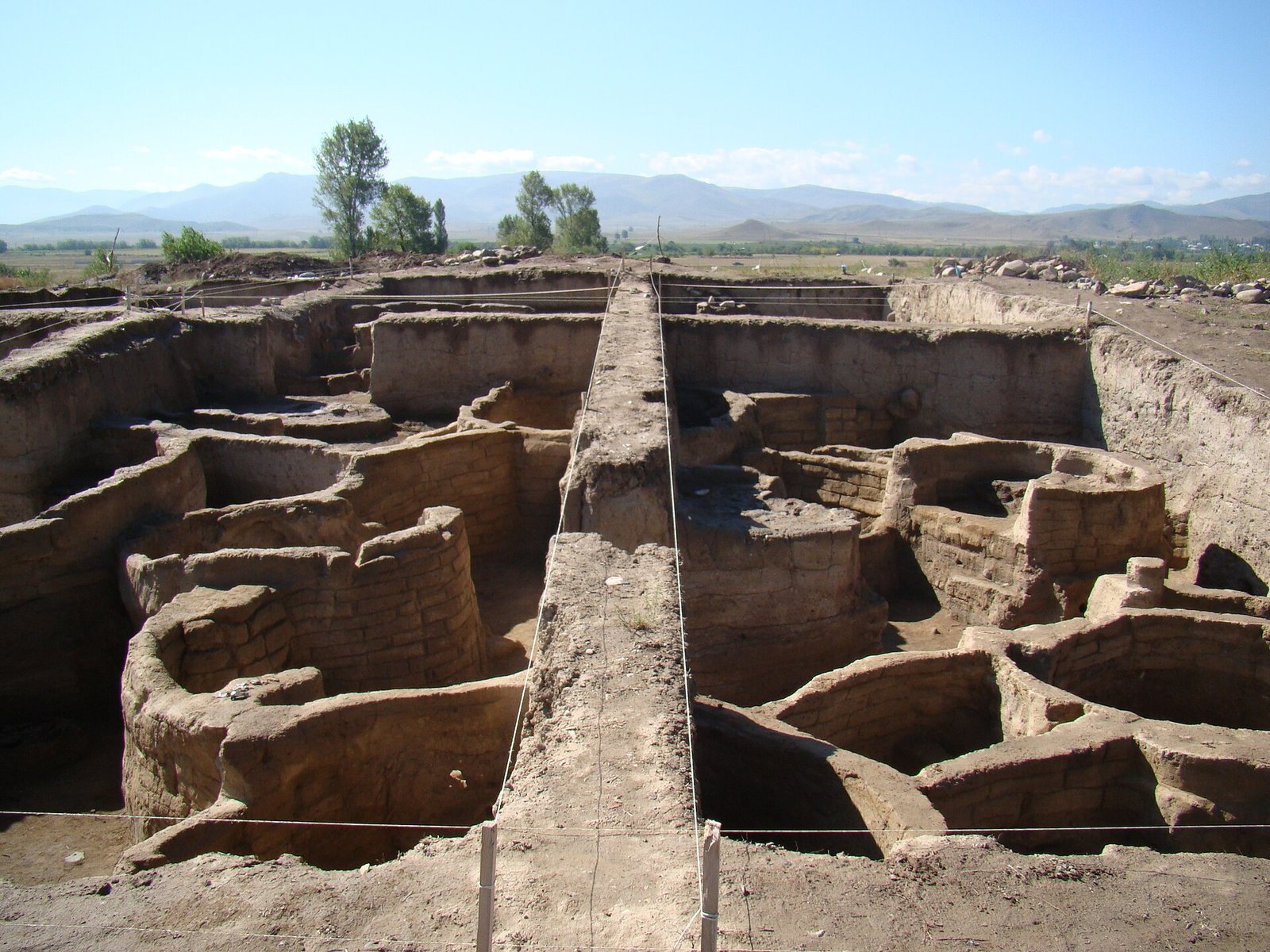
Excavation exposed an area of 300 m² and reached depths of 3–4 m. The work used a 10-by-10 grid laid out north and east from a fixed reference point. Squares were numbered and lettered, then divided into western and eastern parts. Investigated areas included squares 1A, 2A, 1B, and 2B on the mound top, as well as sub-square 4BII in its northern part.
Buildings and courtyards
Round houses and courtyard units
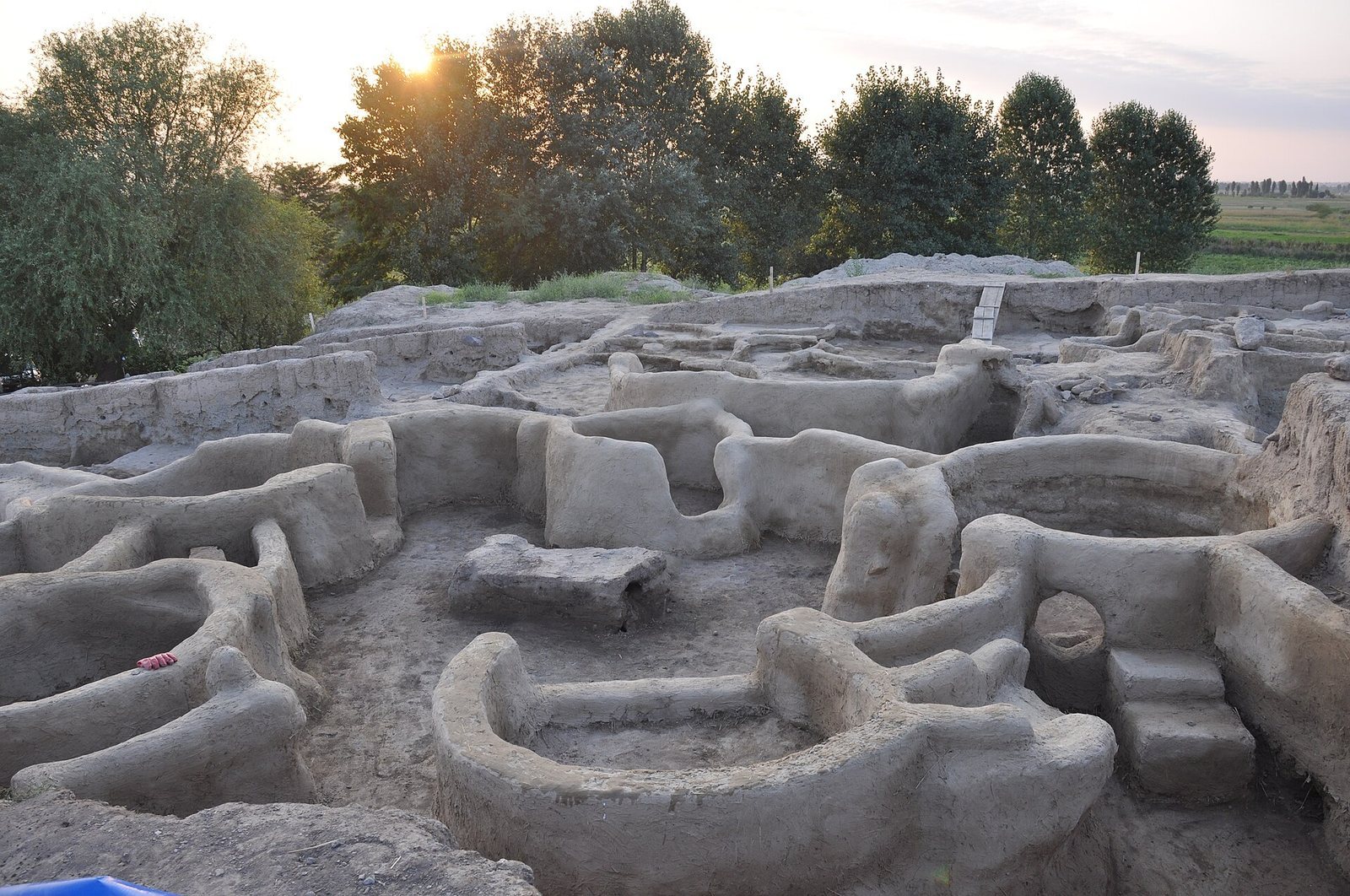
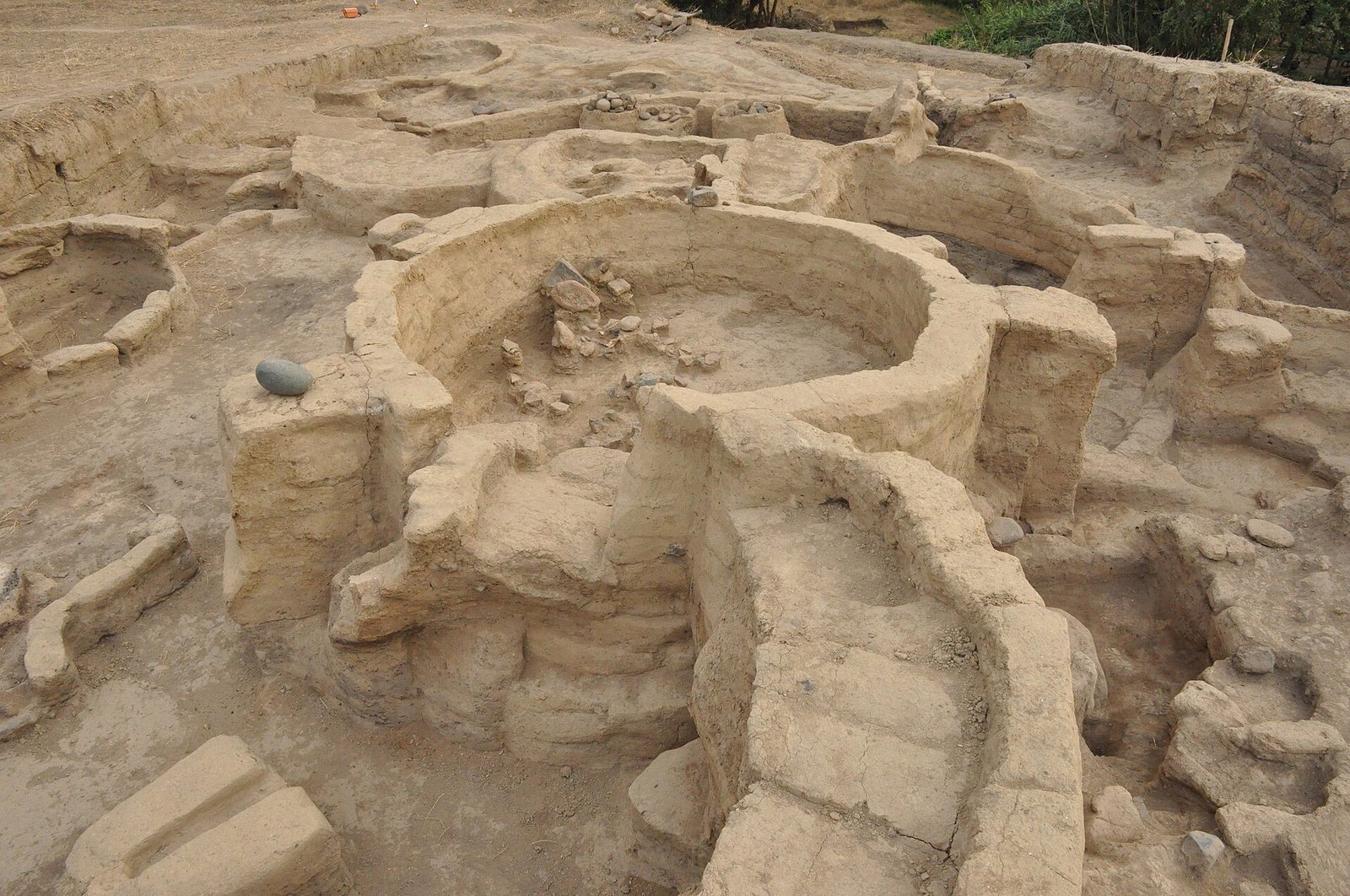
A Neolithic cultural sequence about 11 m thick contains 14 architectural levels. Circular mudbrick houses, linked by curved walls, recur through these levels, with broadly similar construction methods and arrangements. The bricks were made of yellow or brown clay mixed with straw. Plano-convex bricks, flat on one face and rounded on the other, measured 40–60 × 20 × 8–10 cm. Some walls had up to 15 courses and stood 1.5 m high; these structures were described as well preserved.
Two sizes of circular buildings have been identified. Larger examples reached 3.5 m in diameter and were usually independent or only partly enclosed; smaller structures measured up to 2 m and were generally connected to other buildings by wing walls, connecting walls that help define a courtyard. Larger settlement units, 7–8 m across and circular or oval in outline, combined several round buildings linked around a courtyard. A gap in each enclosing wall is thought to have provided an entrance.
Courtyard installations
Clay bins and ovens or hearths were concentrated in courtyards, near connecting walls or round buildings. The round or oval bins measured 50–60 cm across and about 50 cm high, with their bases set 10–15 cm into the ground. Some held tools and other materials, indicating use for storage. The ovens, about 60–70 cm across, had bases covered with river cobbles and edges formed by a raised clay rim.
Rectangular structure
A separate rectangular building in square 2B measured 4 × 2.5 m and stood some distance from the circular houses. A partition wall divided its interior. Its form has led to the suggestion that it served a different purpose from the round buildings.
Pottery, tools, and subsistence
Pottery
Excavations recovered 1,525 pottery pieces, and pottery occurred throughout the layers. Forms include upright and inward-curving jars, bowls, small vessels without handles, and deep bowls. Decoration was uncommon. A few pieces carried simple raised patterns of circles, oval knobs, or wavy lines; examples from upper levels had single-colour decoration around the neck.
Both mineral and plant material were mixed into the clay as temper. Mineral-tempered pottery became less frequent in upper layers, and basalt and obsidian were among the minerals used. The use of mineral temper resembles pottery associated with the Shulaveri-Shomu culture.
Stone tools
More than 5,000 stone artifacts were studied. Nearly 70% were obsidian, used chiefly for blades and blade tools. A layer-by-layer group of 901 obsidian pieces came from 10 levels, and the material is thought to have originated in the Lesser Caucasus. Retouched blades and flakes were widespread. Burins, chisel-like stone tools, and splintered pieces formed nearly 30% of the retouched-tool group; other types included toothed-edge tools, sickle elements, notched pieces, and transverse arrowheads.
Other stone materials included locally available flint, tuff, andesite, and mudstone. Flint tools were mostly made on flakes struck for immediate use. Several blades had a polished sheen running diagonally to the edge. Ground-stone objects included slabs, mortars, pounding stones, and handstones used to prepare food and pigments. Finds were relatively uncommon inside the smaller circular buildings but more numerous in larger buildings and courtyards, where large obsidian blades and bone tools were among the recovered objects.
Bone and antler tools
A small group of finds indicates that bone and antler were worked into tools. Common types included short pointed awls, spatulas, and knives; axes, hammers, picks, and hoes occurred less often. The finds also include a polished green-stone axe and an antler hammer with a smooth surface, wavy grooves, and notches. Polished axes and smooth-surfaced hammers resemble objects associated with the Shulaveri-Shomu culture.
Plant and animal remains
Remains of domesticated wheat and barley were found. The plant samples were beaten, charred, and mixed. Naked barley and free-threshing wheat, grain types that separate readily from their husks during processing, are notable among the finds because they are rare at Neolithic sites in the Middle East, including those in Syria and Turkey. Domesticated goats, sheep, and cattle are also represented.
Copperworking evidence
Glassy waste from high-temperature metalworking contained small droplets of copper. This material is dated to the middle of the sixth millennium BC and provides evidence of early copper metallurgy at Goytepe.