Prescot Parish Church: An Anglican Parish Church
Site at a Glance
- Rating
- 4.6
- Popularity
- Medium
- Country
- United Kingdom
- Primary era
- Early Modern
- Eras represented
- Medieval, Early Modern, Modern
- Civilizations
- British, English
- Site type
- Religious
- Remains
- Church
On this page13 sections
History
Foundation and rebuilding
Prescot Parish Church, also known as the Church of St Mary the Blessed Virgin, is a Gothic Anglican parish church in the United Kingdom, with its foundation dated to 1350. The circular churchyard has been interpreted as suggesting that a church stood here before the Norman Conquest, the Norman takeover of England in 1066.
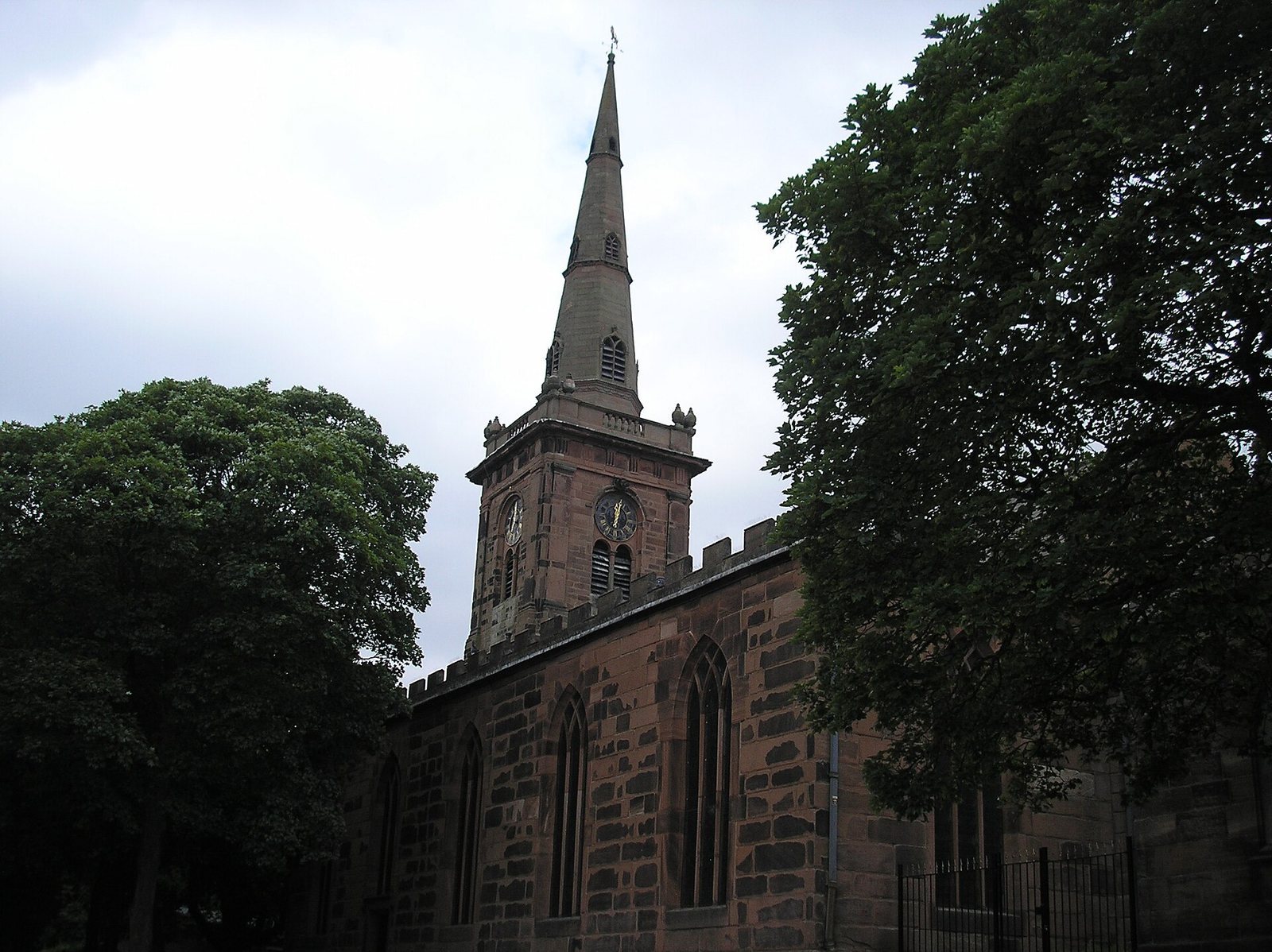
The church was largely rebuilt in 1610. Its west tower followed in 1729, and a spire was added in 1797. English architect Henry Sephton designed both. After lightning struck the spire, it was rebuilt.
Later changes and parish life
The aisles were widened between 1817 and 1819, and the church underwent restoration in 1876. A south vestry was added in 1900, and the aisles were rebuilt in 1953.
The church remains an active Anglican parish church, with a moderately Anglo-Catholic tradition that incorporates elements of Catholic liturgy and practice. It shares the Benefice of Prescot, a group of churches served by a minister, with the Church of St Paul. The parish is in the Diocese of Liverpool, within the Archdeaconry of Knowsley and Sefton and the Deanery of Huyton, and belongs to the Province of York. The church has held Grade I status since 19 March 1951, the highest listed-building category in England.
Remains
Plan and exterior
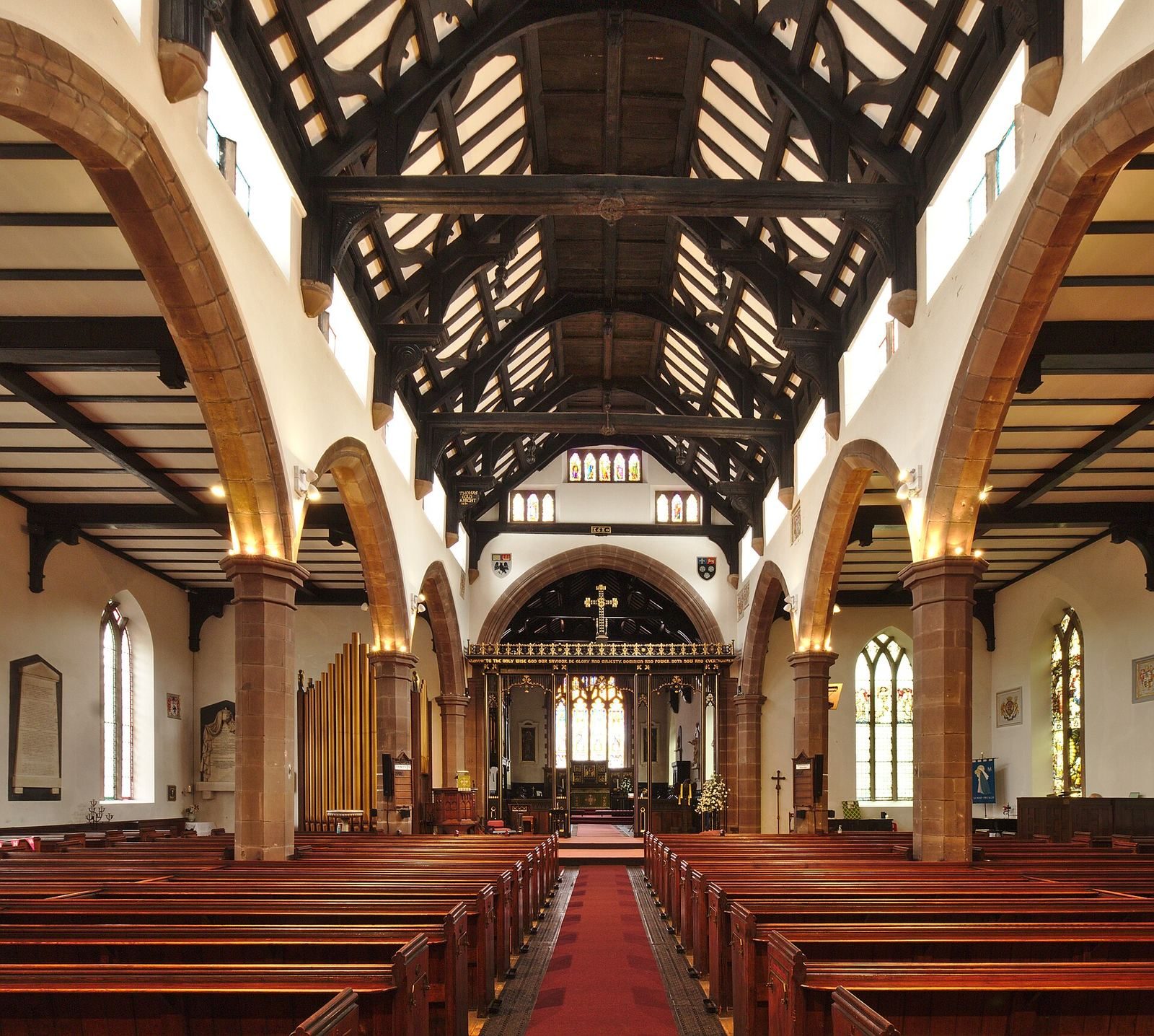
Built of red sandstone, the church has a west tower, a nave with a clerestory, north and south aisles, and a chancel with vestries on both sides. A clerestory is a high section of wall above adjoining roofs. Parts of the chancel and north vestry may date to the fifteenth century.
West tower and spire
The tower has a west entrance and a three-light window above it, with an inscribed frieze higher up. At the bell level, flat Doric pilasters, shallow attached columns, support a horizontal entablature. Two-light louvred openings and clock faces occupy this stage. A balustrade crowns the parapet, with three finials at each corner; the spire above has three tiers of small openings.
Nave, aisles and chancel
The aisles have cornices and parapets with alternating raised and lowered sections. Inside, rows of arches divided into five bays separate the spaces. The chancel and its adjoining vestries complete the church’s east end.
Interior furnishings and memorials
Furnishings and fonts
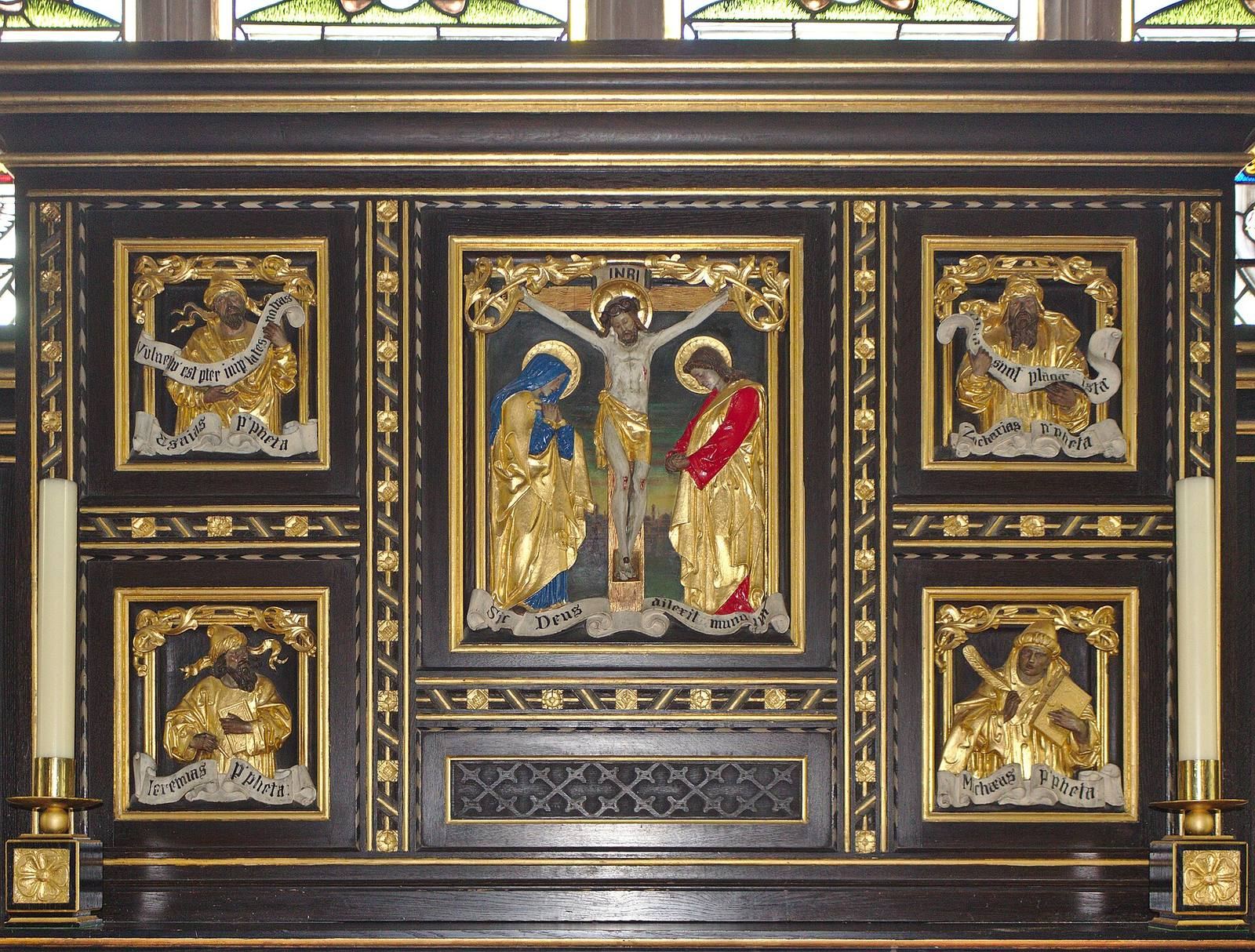
Stone wall plaques bear the coats of arms, and in some cases the initials, of the benefactors associated with the 1610 rebuilding. The stalls, with ornamental poppyhead carving at their ends, date from 1636. A panelled wooden structure behind the altar was designed by Charles Eamer Kempe and dates to 1891; the chancel screen was installed in 1921.
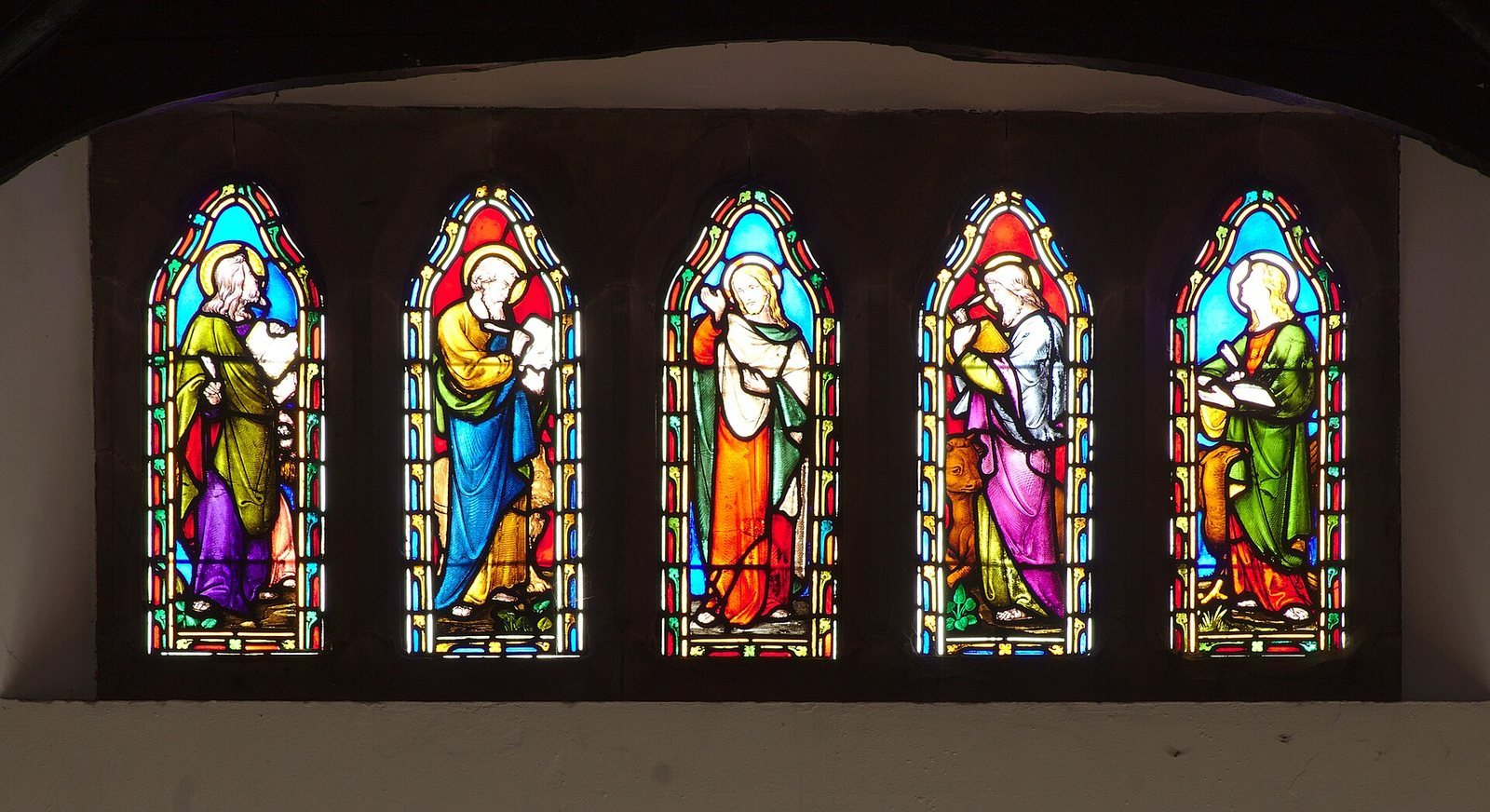
The church has two fonts: a plain Norman-style font on a modern base, and a second, donated in 1755, that was formerly an Italian-marble vessel for holy water. Some stained glass in the south aisle is by Morris & Co.
Memorials
A monument on the south side, made by sculptor Sir Richard Westmacott and dated 1803, commemorates William Atherton. It carries a family crest and the motto clarior e tenebris, meaning “brighter after the darkness.” A brass memorial dated 1836, designed by A. W. N. Pugin, commemorates George Case, a Liverpool mayor and slave trader.
Organ, bells and churchyard
Organ and bells
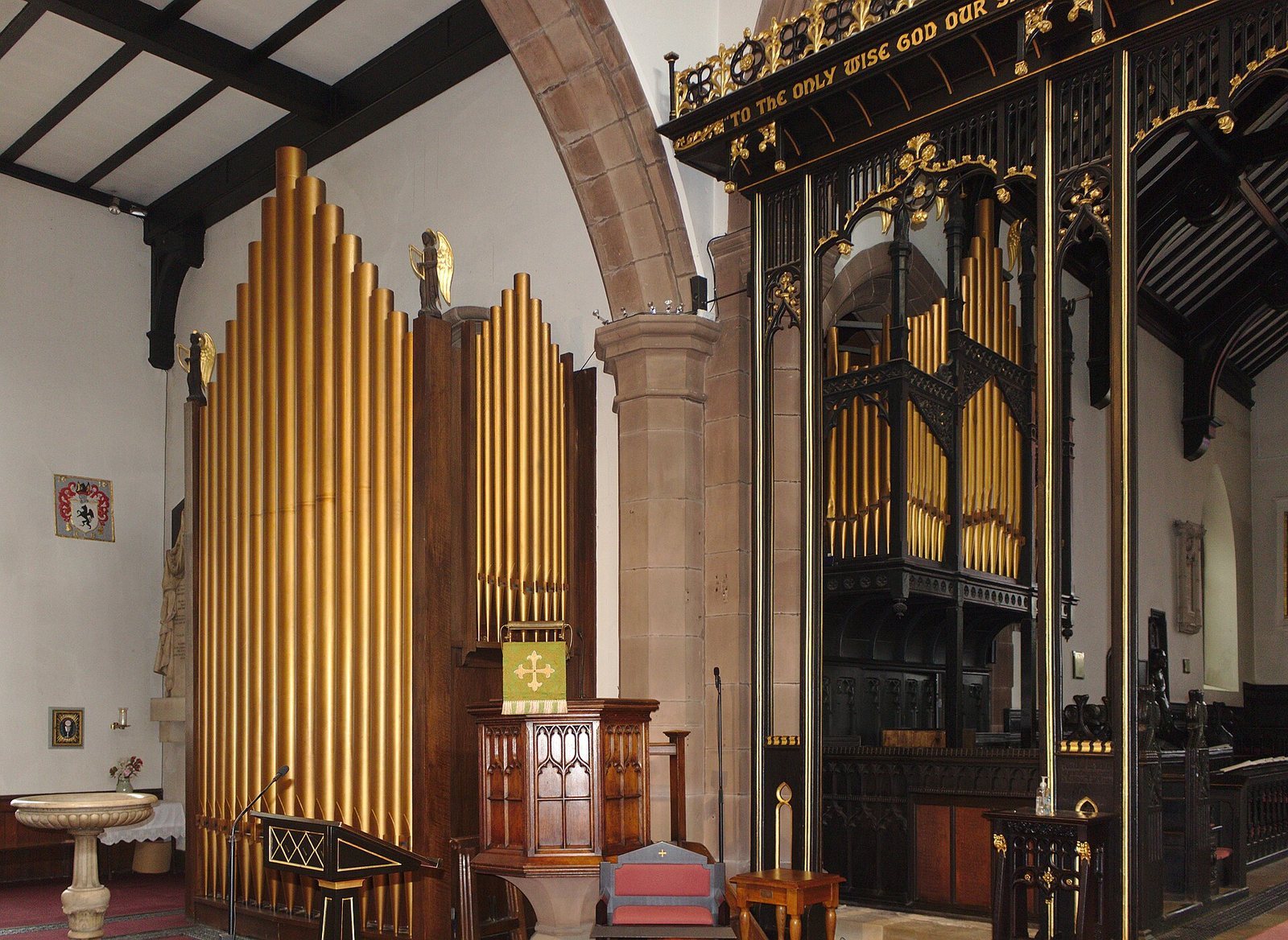
Elizabeth, widow of Prescot plantation owner William Atherton, donated the organ. Gray & Davison built it in 1822; the John Compton Organ Company substantially rebuilt it in the 1950s, and David Wells Organ Builders overhauled it in 1992. It has 54 speaking stops, controls that select different pipe sounds. The ringing peal comprises eight bells cast in 1845 by Charles and George Mears of the Whitechapel foundry. The bells were retuned and rehung in 1994.
Churchyard graves
The churchyard contains 24 war graves: 22 belonging to service personnel who died in the First World War and two to those who died in the Second World War.