Pedersöre Church: A Medieval Church in Jakobstad, Finland
Site at a Glance
- Popularity
- Medium
- Country
- Finland
- Primary era
- Early Modern
- Eras represented
- Medieval, Early Modern, Modern
- Civilizations
- Swedish
- Site type
- Religious
- Remains
- Church
On this page9 sections
History
Medieval beginnings
Pedersöre Church is a medieval church in Jakobstad, Finland. Despite its name, it stands in Jakobstad rather than Pedersöre; municipal mergers explain the mismatch. It is among the oldest medieval churches in Ostrobothnia, a region of western Finland. A wooden church stood on the site by the late 13th century, and this phase lasted for more than 200 years, probably involving successive buildings. The first church may have been a small chapel made of stone or wood. The oldest parts of the present church date to the 15th century, while the stone church was probably built about 1510–1520.
Eighteenth-century reconstruction
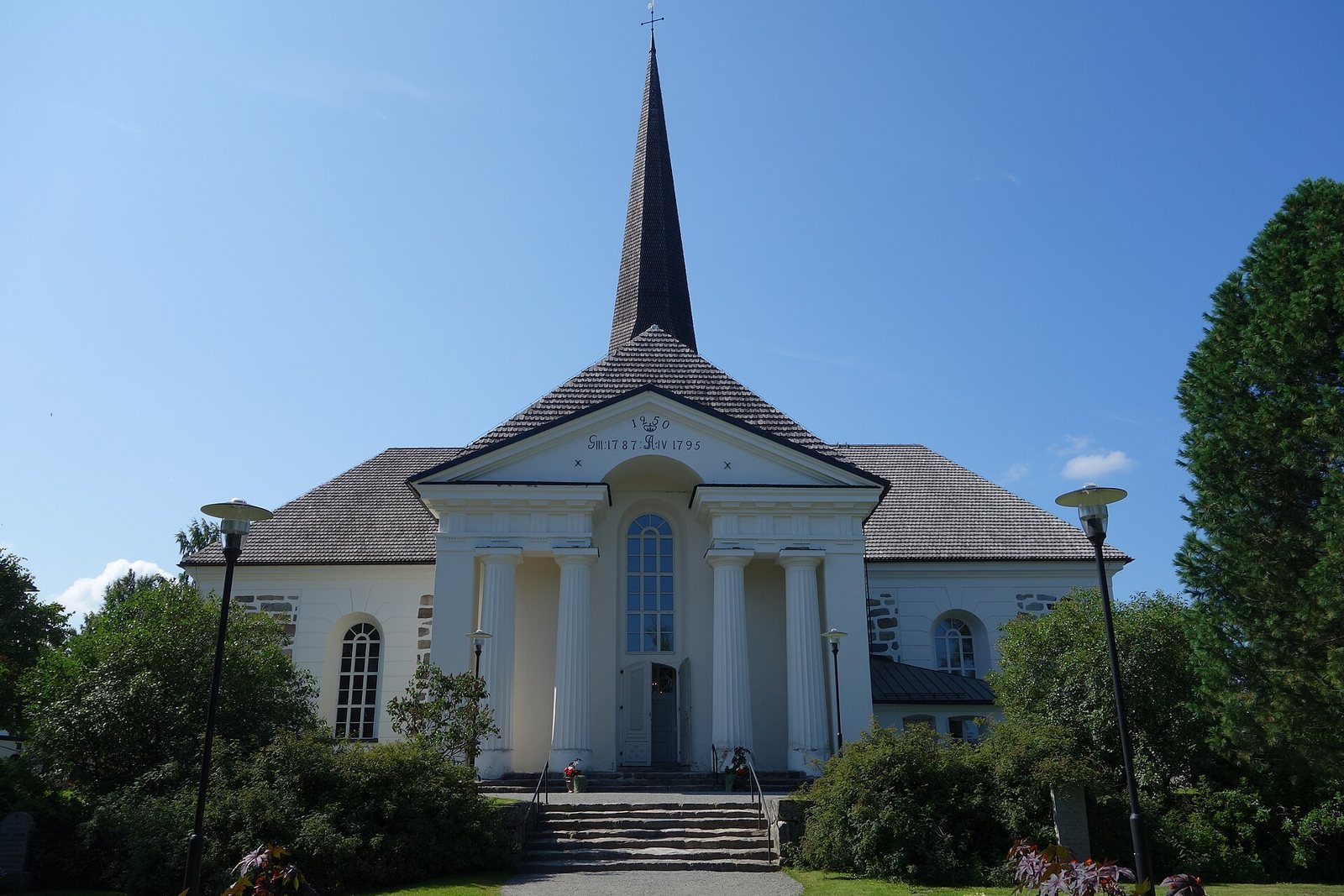
A major rebuilding campaign began in 1787 under church builder Jacob Rijf and continued through 1795. Its plans had been approved by King Gustav III, Sweden’s ruler from 1771 to 1792, though the work did not follow them exactly. The existing spire was retained.
Fire and continuing use
In July 1985, a fire destroyed the spire, the altarpiece then in use and the organ. Architect Erik Kråkström’s plans guided a comprehensive renovation, and the church returned to use in 1986.
Pedersöre Church belongs to the Evangelical Lutheran Church of Finland and the Diocese of Borgå, an ecclesiastical administrative district. It is one of three churches in Pedersöre parish and is also used by the Swedish-language congregation of Jakobstad and the Finnish-language congregation of Pietarsaari.
Remains
Church building
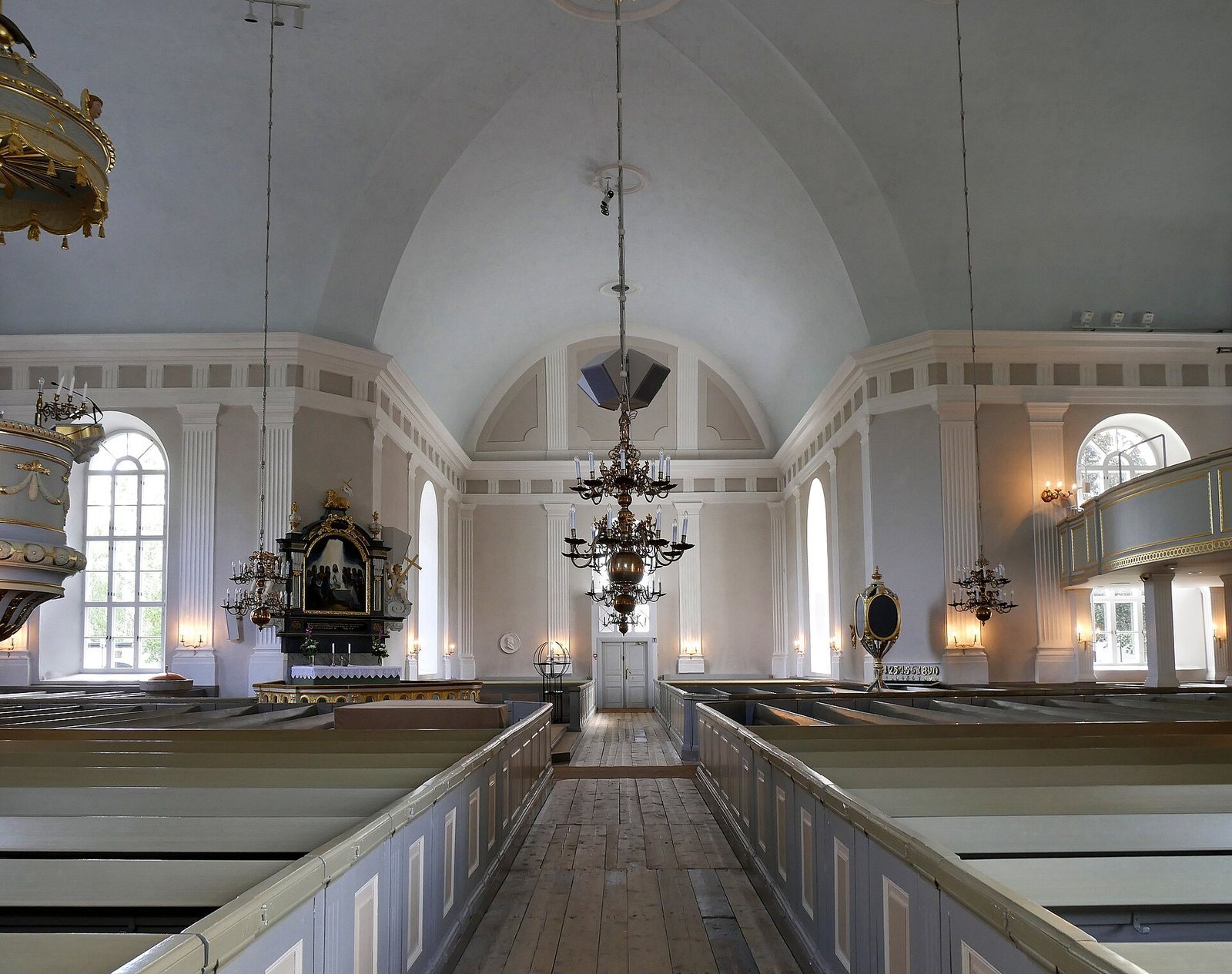
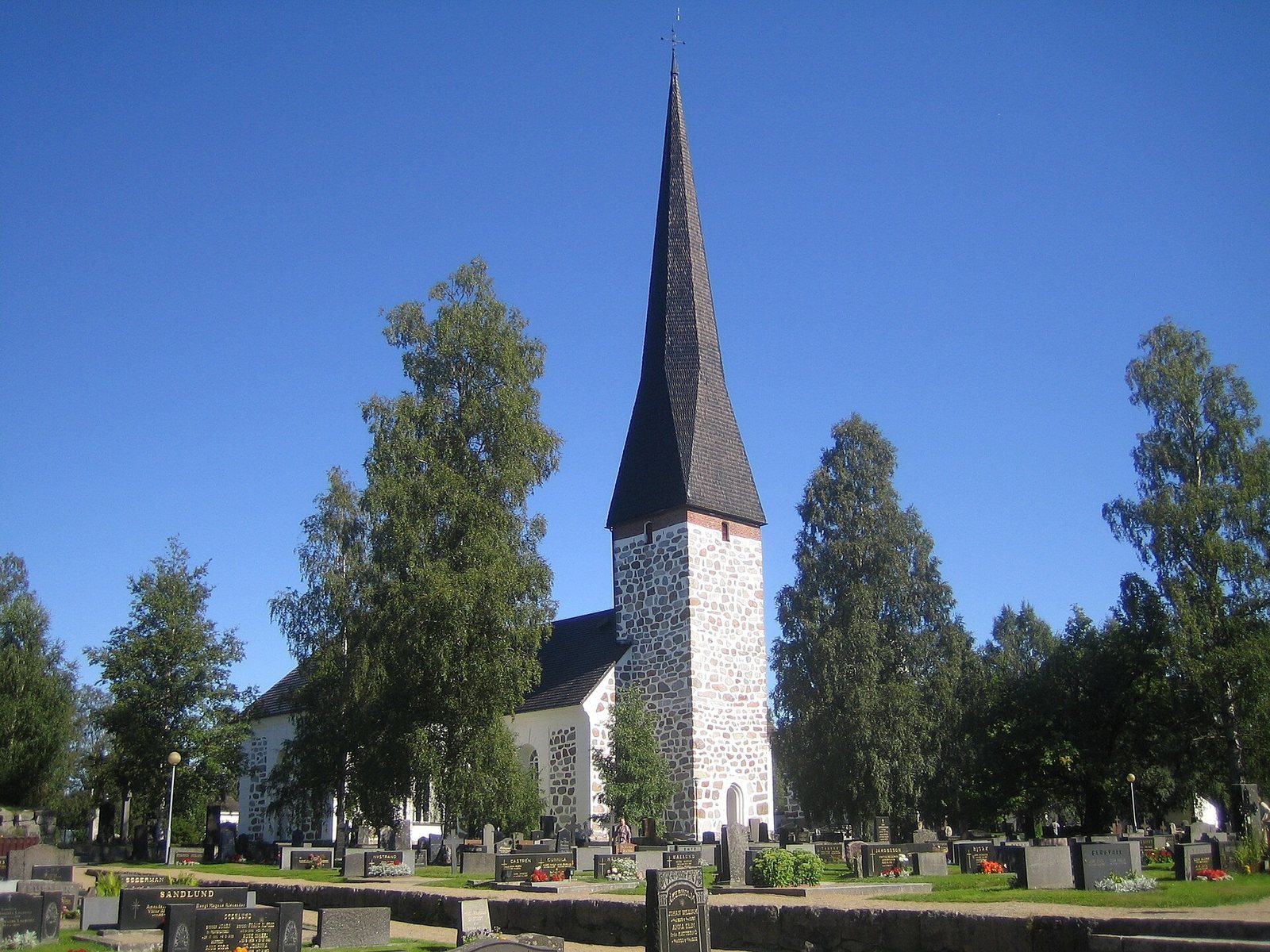
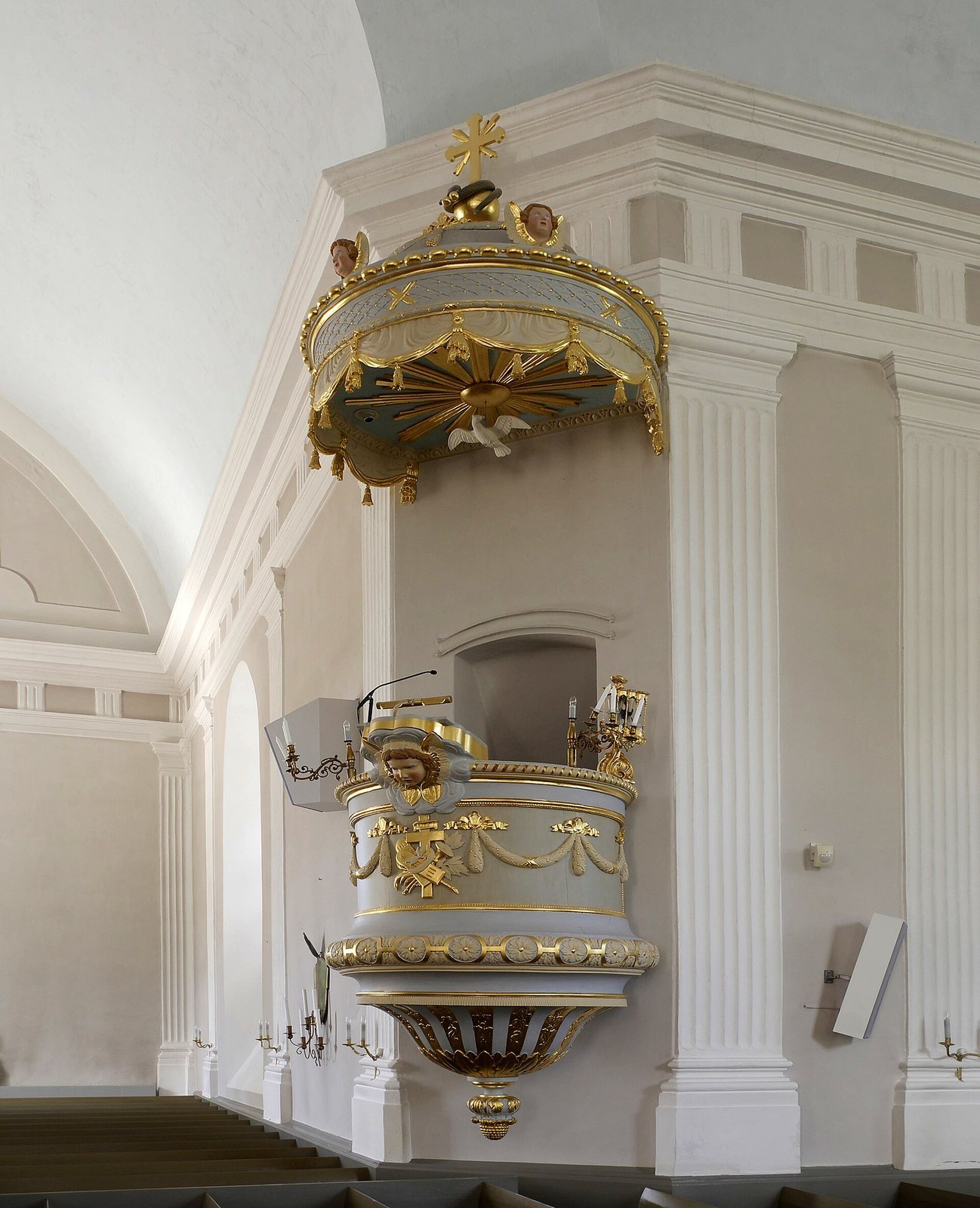
Before its eighteenth-century conversion, the gray-stone church had a rectangular main hall, with the altar at the east end and a tower to the west. Its single hall had a vaulted ceiling supported by shallow wall projections with shaped edges. The later plan has four arms of roughly equal length. A tall, pointed tower rises at the west end, while a columned porch in the Doric style reaches the height of the main body at the east. Rough-textured plaster highlights the windows, other doorways and exterior corners. A sacristy, a room for preparing for services and storing church objects, lies between the east and north arms. Inside, board ceilings form vaults, and shallow wall projections support a horizontal upper band. The altar is in the southwest corner and the pulpit in the northeast. The tower once carried a steep, shingle-covered spire 65 metres high. Its design is thought to have followed the tower of Storkyrkan, Stockholm’s cathedral, dating to the 1490s.
Bell tower and bells
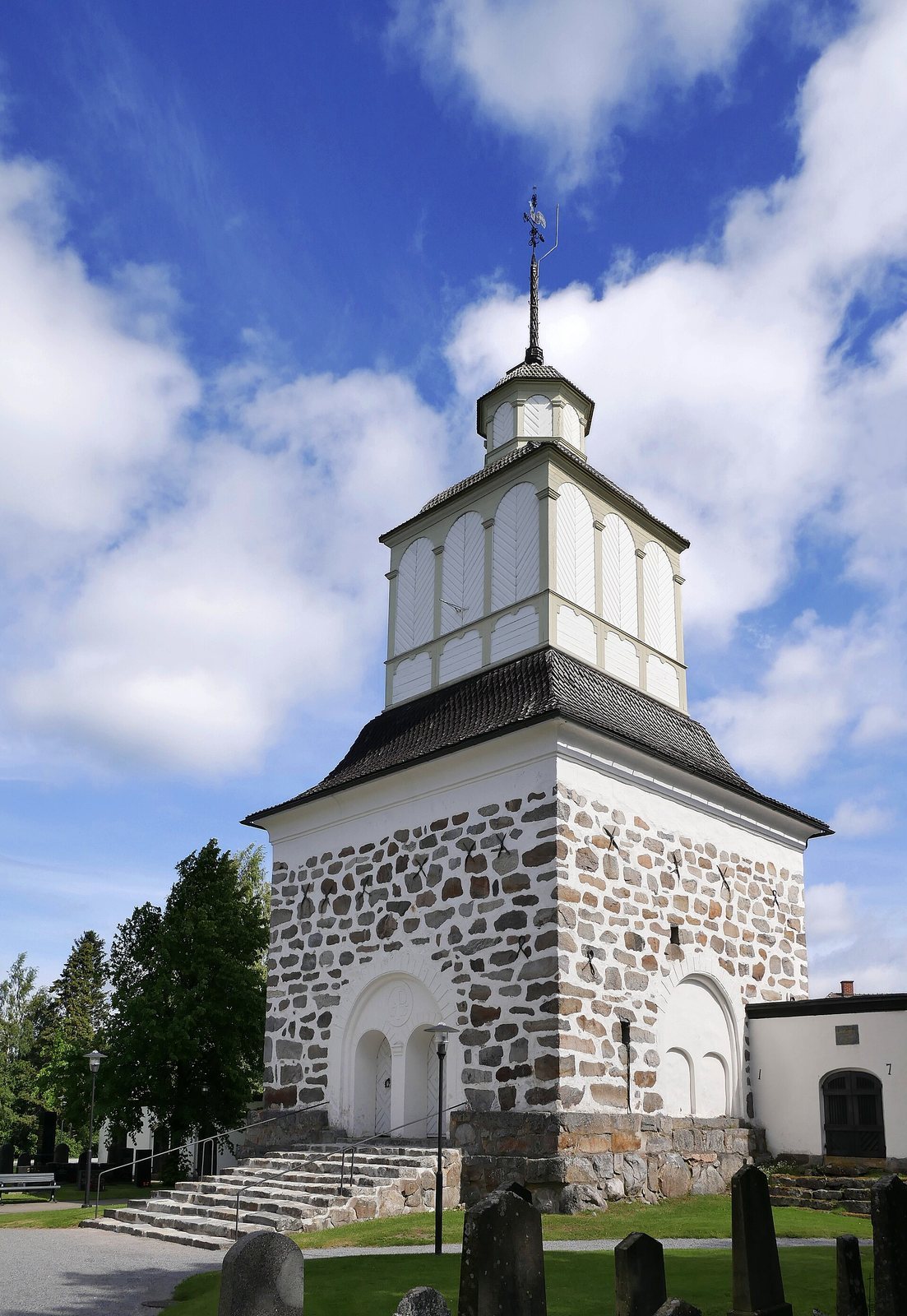
The separate bell tower was built from 1769 to 1775 under the supervision of Thomas Rijf and Matts Honga. Its stone ground floor follows a style typical of Ostrobothnia, and its upper section is wooden. One bell, dated 1488 and probably cast in Tallinn, had first belonged to Turku Cathedral. Swedish nobleman and military commander Jacob De la Gardie bought it in 1615 and gave it to Pedersöre Church. In 1813, careless ringing broke the middle bell among the church’s three main bells. Organist Leonard Marklund travelled to Stockholm to have it recast, with instructions to choose a tone that would harmonize with the other two.
Organs
Christian Beijer and Johan Christopher Beijer built an eight-stop organ for the church in 1685. An organ stop controls a set of pipes. The instrument was destroyed in 1714 during the Great Wrath, the period of Russian occupation of Finland during the Great Northern War. Parts were reused in an organ built in 1766. Medieval pipes were probably included in the 1685 instrument, and such pipes are rare in Finland. The 1766 organ went to Jeppo parish in 1888 and is now in Jeppo church. It was too tall for that church’s gallery, so it was lowered by about 1.5 metres; its trumpet stops, which produce trumpet-like tones, could not be used there. A replacement arrived in 1963, and the older instrument was moved to a room in the church, where it remains unplayable. Restoration work aims to return it to its eighteenth-century form. The organ installed at Pedersöre Church in 1988 was made by the Danish firm Marcussen & Søn. It has 39 stops and was the church’s fifth organ.
Altarpiece
The current altarpiece, Timeless Time, was painted by Jukka Nopsanen in 1991. It depicts the institution of Christian communion, as earlier paintings in the same frame did. The frame dates to 1705, and Nopsanen’s painting is the fourth to be placed in it.