Aqua Traiana: The Roman Aqueduct Supplying Rome
Site at a Glance
- Popularity
- High
- Country
- Italy
- Primary era
- Classical
- Eras represented
- Classical, Medieval, Early Modern
- Civilizations
- Papal States, Roman
- Site type
- Infrastructure
- Remains
- Aqueduct
On this page17 sections
History
Planning and inauguration
The Aqua Traiana was a Roman aqueduct in Italy that carried spring water from the Lake Bracciano area to Rome. Built during the reign of Emperor Trajan, it began around AD 104 and opened on 24 June 109. It was Rome’s tenth aqueduct and supplied potable water to Transtiberim, the district across the Tiber, which had previously relied on the Aqua Alsietina for water that was not suitable for drinking.
Frontinus, a Roman administrator and writer on water management, indicated around AD 98 that a new aqueduct was being planned. The inauguration date appears in the Fasti Ostienses, an annual record from Ostia, and is supported by an inscribed boundary marker found at Veii that names Trajan and his titles. Trajan also issued bronze coins to mark the project’s completion. The Roman administration responsible for the city’s water supply, the Cura aquarum, oversaw the aqueduct.
The Fasti Ostienses describes water issuing across the city, apparently through a network of outlets and basins. The aqueduct opened two days after the Baths of Trajan were inaugurated and a few months before the Naumachia Traiani, a basin for staged naval spectacles. It may have supplied the baths and been intended to serve the naumachia as well, reducing demand on other aqueducts.
Mills, siege and medieval repairs
Water from the Aqua Traiana later powered flour mills on the Janiculum, a hill west of the Tiber. In 537, during the Ostrogothic siege of Rome, King Vitiges’s forces cut the city’s aqueducts, stopping the mills. The Byzantine general Belisarius restored the flour supply with mills floating on the Tiber. Before leaving Rome in 547, he had the Aqua Traiana repaired to serve the grain mills.
The aqueduct continued to supply the Vatican and western Rome at least into the ninth century, despite repeated damage. Repairs were undertaken during the papacy of Honorius I in the seventh century. Lombard incursions under Aistulf damaged it again in 752, and later attacks caused further harm. Pope Adrian I restored the line around 772–775, reducing the need to carry water from the Tiber in barrels to the fountains at St Peter’s Basilica. Additional repairs followed during the eighth and ninth centuries, after which the aqueduct gradually fell into ruin.
Rebuilding as the Acqua Paola
By the seventeenth century the ancient aqueduct was out of use, although parts of its structure remained visible. In 1605 Pope Paul V began a project to improve water supplies to western Rome, including the Vatican, where shortages were chronic. Rome financed the work, with Giovanni Fontana supervising it from 1609. The rebuilt aqueduct was completed in 1612. First known as the Acqua Sabbatina or Acqua Bracciano, it was renamed the Acqua Paola in honor of the pope.
The new line reused a small number of sections of the ancient aqueduct, chiefly near its springs. Some spring water had already been diverted to mills and industry around Bracciano. Among the sources not incorporated into the Acqua Paola was the abundant Manziana spring near Fosso di Fiora, which Duke Paolo Giordano Orsini had diverted for mills and industry from the 1570s.
In 1667 Pope Alexander VII considered adding the Manziana spring to the Acqua Paola to supply a new fountain in St Peter’s Square. Architect Luigi Bernini judged the water exceptionally pure and estimated its flow at 340 oncie, an Italian measure of water flow. He calculated that it could double the aqueduct’s yield, matching the combined output of its other springs. The plan ended after Alexander VII died that year. Lake water was used to supplement the Acqua Paola instead, making its water unpleasant to taste and unsuitable for drinking. The poor quality gave rise to a Roman expression comparing something bad to the Acqua Paola.
Archaeological rediscovery
In the twentieth century, archaeological work examined the aqueduct and its mill complex beneath the American Academy in Rome. Further exploration followed the identification of the Acqua Praecilia springs in 1999 and the publication of research on Santa Fiora in 2010. In early 2009, two British filmmakers identified the Manziana spring, and archaeologist Lorenzo Quilici confirmed it on 24 June, the 1,900th anniversary of the aqueduct’s inauguration.
Remains
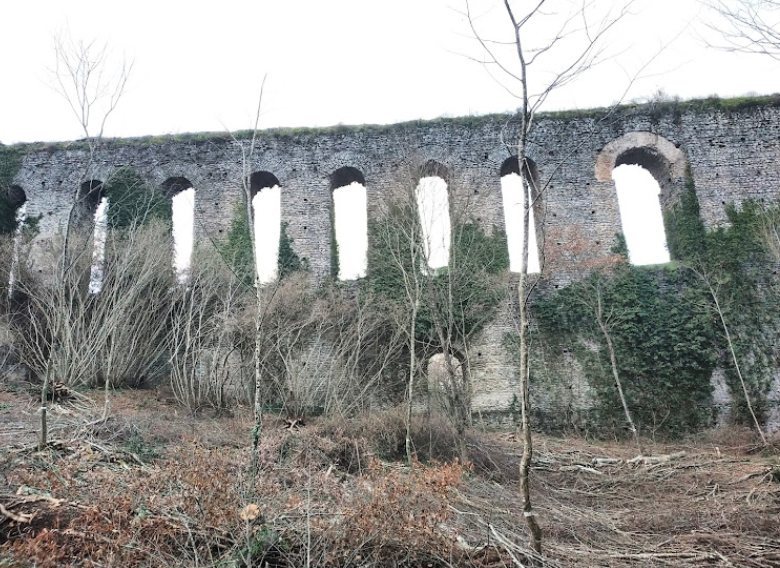
The aqueduct drew on springs around Lake Bracciano and carried their water toward Rome through a system of underground channels and above-ground sections on arches. Most of the conduit was underground, and many maintenance shafts remain visible. Its channels were vaulted and built in Roman concrete, with brick or patterned masonry facing and water-resistant mortar coating the lower interior surfaces.
Source network and intake structures
Spring groups around Lake Bracciano
The source network gathered water from hills around the volcanic lake, especially along its western and northern sides. Around Villa Flavia and Fosso di Grotta Renara, seven springs fed three tanks. Alberto Cassio and Rodolfo Lanciani called these Greca, Spineta and Pisciarello. Carlo Fontana used the names Botte Greca, Botte Ornava and Botte Arciprete for three tanks, and identified another farther down Fosso di Grotta Renara as Botte di Pisciarelli. One tank is now called Fonte Micciaro.
Other springs in the Fosso di Fiora area included Matrice, Carestia and Fiora, as well as sources at the Fiora and Carestia spring monuments, about a kilometre apart. The Carestia monument is now ruined. Further groups lay at the Vicarello Baths, near the present Acqua delle Donne site, and at the Sette Botti, seven tanks immediately to its east. Sources also came from north of Monte Rocca Romana and along Fosso della Calandrina, including Fonte Ceraso, as well as from Aquarelli northeast of the lake and Acqua d’Impolline to its east.
Santa Fiora grotto
At Santa Fiora, Roman engineers shaped a spring into an artificial grotto with three vaulted chambers of different sizes. Only the central chamber opens outdoors; the chamber on the right connects directly to the aqueduct channel. A niche at the far end of the central chamber probably held a statue, and the vaulted ceiling retains sky-blue frescoes. Above the niche, a medieval stucco plaque bears a five-petalled flower, the emblem of the Orsini family.
Along the tunnel from the grotto to the main channel, the facing changes from brick to net-pattern masonry, and water-resistant mortar begins at the same point. In the thirteenth century, the church of Santa Maria della Fiora was built over the ancient masonry and used the underground structure as an annex. A statue in the grotto was probably replaced by an image of the Virgin Mary, venerated there as Madonna della Fiora.
Acqua Praecilia and Archi di Boccalupo
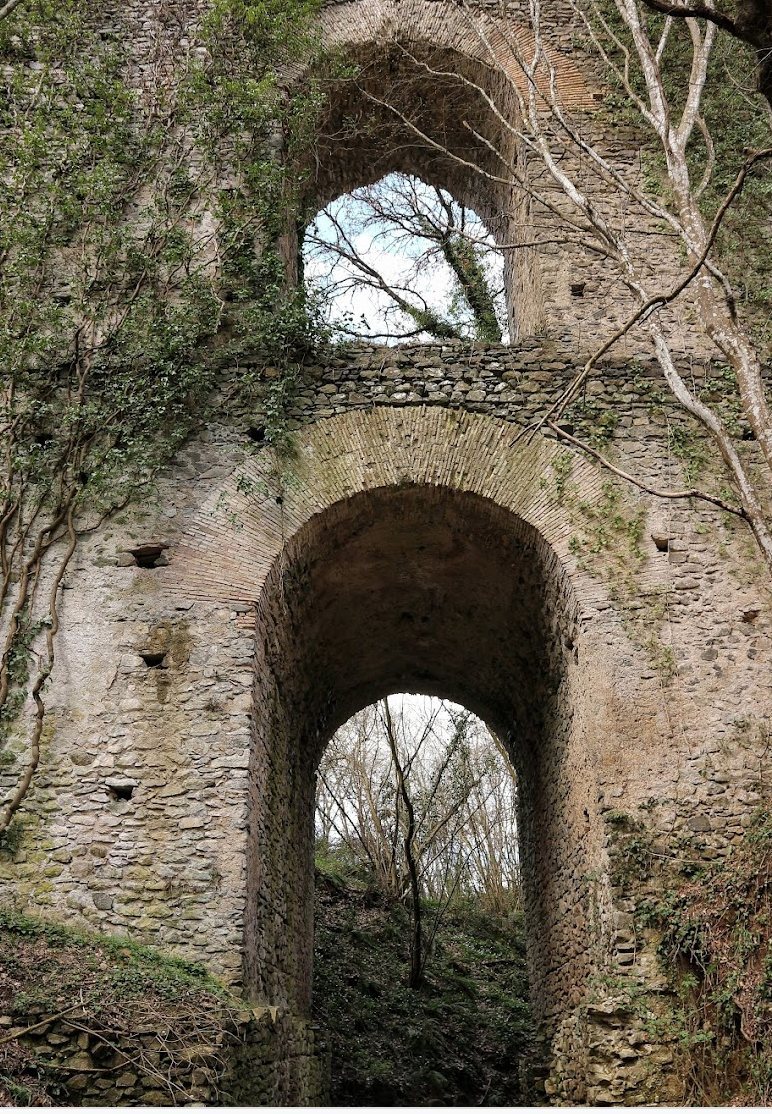
Acqua Praecilia, near Manziana, was identified as another source in 1999. Other springs augment its flow, which is carried by the Archi di Boccalupo bridge, rising to 15 metres. The bridge has alternating bands of brick facing and net-pattern masonry. An opening in the structure lets water pass into a collection pool.
Conduit and route
Course from the lake to the Janiculum
The full route is estimated at about 57 to 59.2 kilometres. It began between Vicarello and Trevignano Romano on the lake’s northern shore, then followed the eastern side, sometimes underground and sometimes on arches, gathering water from springs. After Anguillara Sabazia it ran along the left bank of the River Arrone, the lake’s only outlet. For a long stretch it shared arches with the Aqua Alsietina, then separated and continued underground beside the Via Clodia to La Giustiniana.
Farther south, the route roughly followed the lines of today’s Via della Pineta Sacchetti and Via di San Pio V. It emerged on arches beside the Via Aurelia and reached the Janiculum, where the Porta Aurelia was later built. From an elevation of about 300 metres at its source area, the line descended to around 71 metres, a drop of approximately 220 metres. Its average gradient was given as 2.67 metres per kilometre.
Channel dimensions and construction
The channel measured 1 to 1.30 metres across and 1.78 to 2.30 metres high. Its stated capacity was 2,848 quinariae, a Roman measure of water flow, or more than 100,000 cubic metres a day, roughly 1.1 to 1.15 cubic metres per second. The vaulted channels used Roman concrete faced with brick or net-pattern masonry. A section found in 1912 beneath the American Academy on Via Angelo Masina combines brick with net-pattern masonry. The lower interior surfaces were coated with waterproof mortar.
The final course through Rome remains uncertain. One proposed reconstruction has the aqueduct crossing the Tiber on a high bridge, curving around the Aventine and continuing toward Oppian Hill. Both the bridge crossing and the route beyond it remain hypothetical.
Urban installations and evidence
Janiculum mills
Excavations beneath the American Academy in the 1990s revealed aqueduct remains and a complex of water-powered mills. Water could descend through several levels to drive the machinery. Two branches served the mills; excavation found the larger branch still obstructed by material left from the siege of 537.
Oppian Hill pipe and imperial coins
A lead pipe 18 metres long, found on Oppian Hill in 1935, bears an inscription connecting the Baths of Trajan with the Aqua Traiana. Trajan’s bronze coins also depict the aqueduct: beneath the emperor’s portrait, a reclining deity appears under an arch representing the water channel and caves at its source.
The Acqua Paola fountain
At the rebuilt aqueduct’s terminus, architect Flaminio Ponzio designed the monumental fountain known as Il Fontanone. Its freestanding triumphal-arch form had a white-marble facing, granite columns on high bases and five openings, three broad arches between two narrower ones. Water flowed into five basins at the foot of the structure. Much of its building material came from the Forum of Nerva. Sculptor Ippolito Buzzi made the Borghese coat of arms, flanked by an eagle and a dragon and supported by child figures.
In 1690 Carlo Fontana replaced the five basins with one much larger basin, creating the Fontana dell’Acqua Paola that survives today. A small garden has since been laid out behind the fountain.