The Haining: A Palladian Country House in Selkirk
Site at a Glance
- Rating
- 4.7
- Popularity
- Medium
- Country
- United Kingdom
- Primary era
- Early Modern
- Eras represented
- Early Modern, Modern
- Civilizations
- British
- Site type
- Domestic
- Remains
- Manor House
On this page15 sections
History
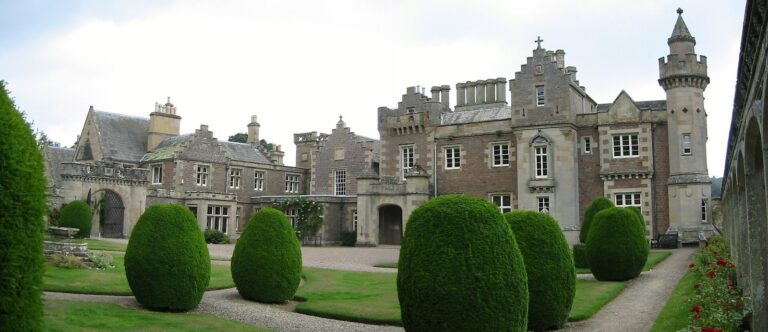
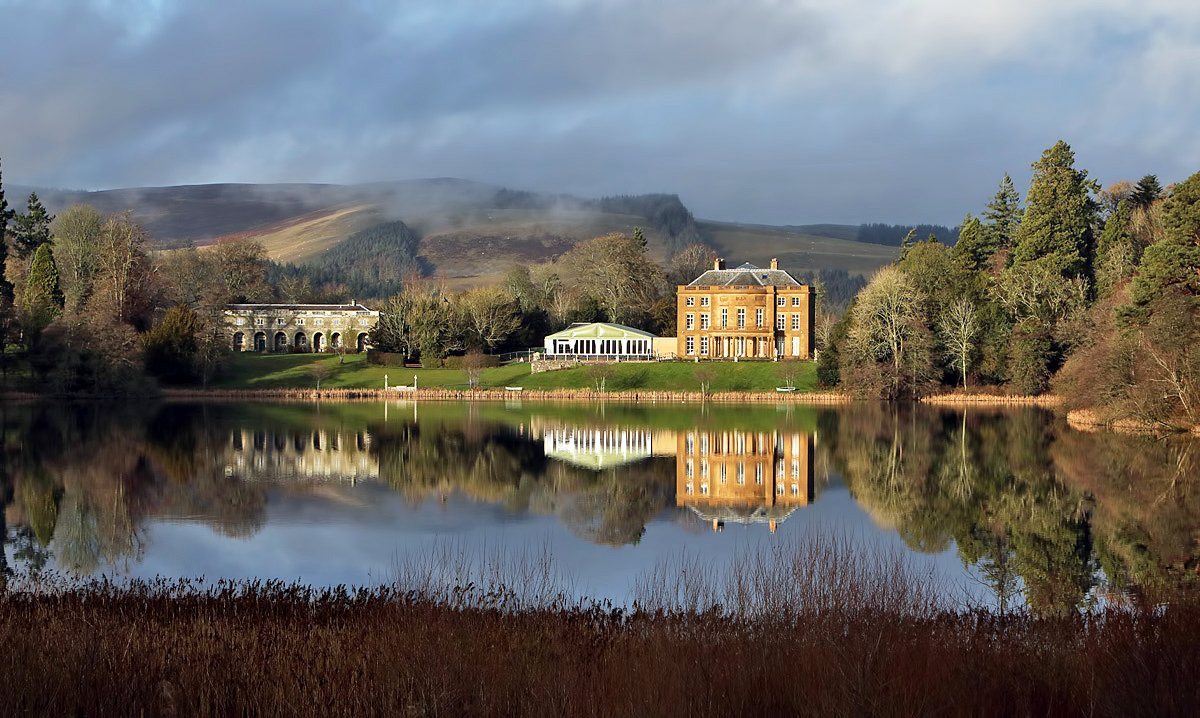
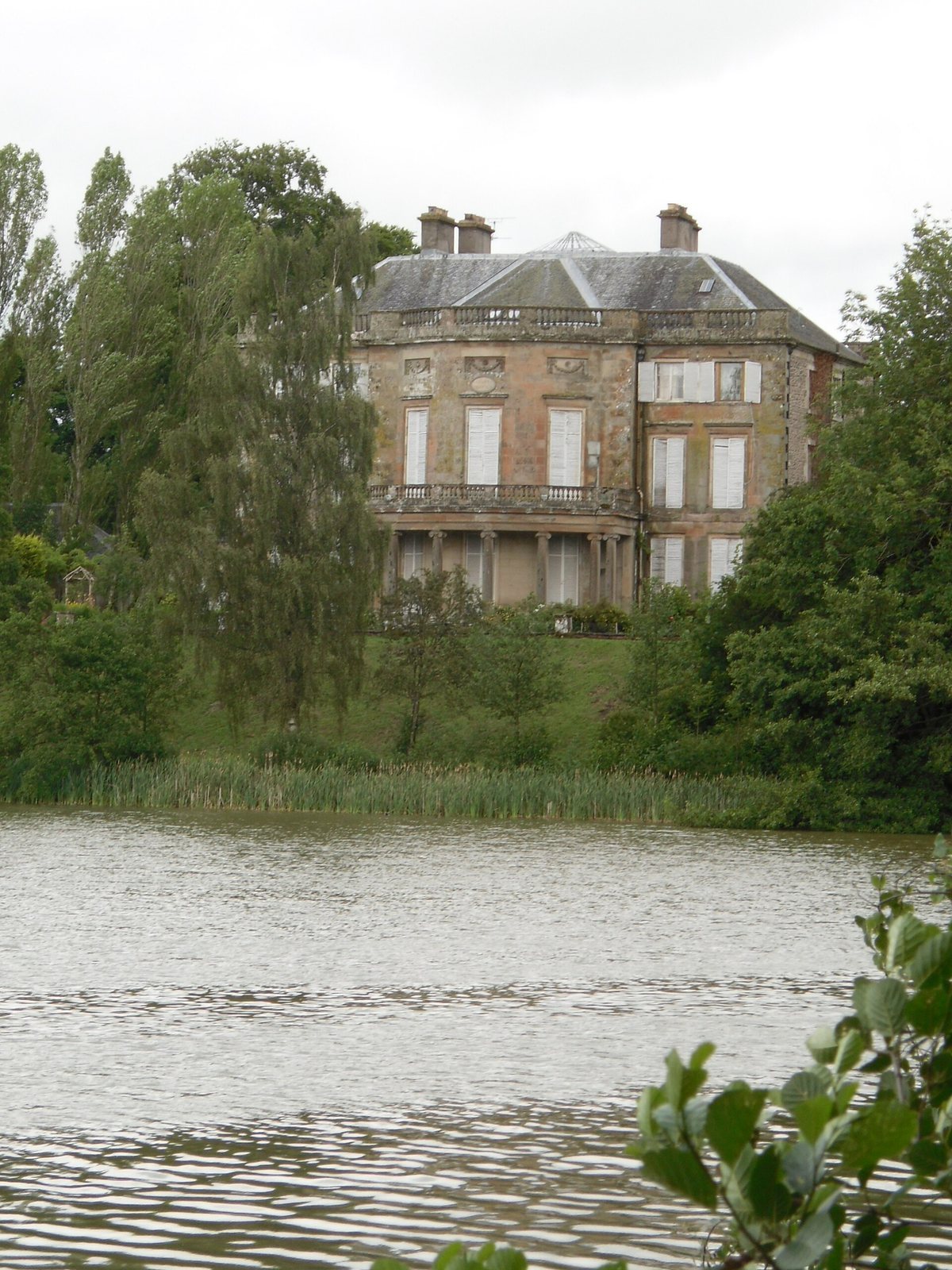
The Haining is a Palladian country house, begun in 1794, at the southern edge of Selkirk in the United Kingdom, on the north shore of Haining Loch. Palladian design draws on classical forms associated with the Italian architect Andrea Palladio. Built for the Pringle family, the house stands within an estate that had earlier included Selkirk Castle and a farm, and later became associated with the Dandie Dinmont Terrier.
Selkirk Castle and the early estate
Selkirk Castle stood on a motte, a raised mound supporting a fortified stronghold, north-east of the present house. First recorded around 1119, the castle was repeatedly attacked and damaged during the Wars of Scottish Independence, conflicts between the English and Scottish kingdoms in the late thirteenth and early fourteenth centuries. Edward I, king of England from 1272 to 1307, had it rebuilt in 1301, with Sir Alexander de Balliol of Cavers in command. The Scots took the castle the following year. The English regained it before 1311, but it had been demolished by 1334.
The name The Haining appears in 1463, when the Scott family held the estate. Around 1507, John Scott received permission to build there, and a farm was established west of the present mansion. It prospered and grew during the sixteenth century.
Scott, Riddell and Pringle ownership
Lawrence Scott sold the estate to Andrew Riddell in 1625. It was developed during Riddell ownership and later passed to John Riddell, whose only child, Magdalene, married David Erskine, Lord Dun. The Erskines already owned the House of Dun estate, so in 1701 they sold The Haining to Andrew Pringle of Clifton for his younger son, John, a lawyer. The next year, John secured the union of The Haining and Burn Mill as a barony, a territorial holding with baronial jurisdiction. He began creating a designed landscape, which was expanded through the eighteenth and nineteenth centuries with extensive tree planting. An earlier house may have been commissioned by John, or may have stood there before his arrival.
Building and remodelling the mansion
In 1754 the estate passed from Andrew Pringle’s elder son to his younger brother John, a merchant in Madeira. It went to the merchant’s great-nephew, Mark Pringle, in 1792; Mark began the present house two years later. The design is attributed to William Elliot, an architect and builder based in Kelso. Mark’s son John commissioned Archibald Elliot to remodel the house in 1819, and the work was carried out around 1820. A scheme for further extensions that would have replaced the older house was not completed. Captain John Pringle also kept a collection of animals on the estate.
The nineteenth-century estate and its terriers
John Pringle died in 1831. The estate passed first to his brother Robert, a soldier, and then to their sister Margaret. The Haining kennels became founding kennels of the Dandie Dinmont Terrier, a distinct Scottish terrier breed. Old Ginger, born at the estate on 4 June 1842, was the offspring of Old Pepper, a dog rescued from a trap by a gamekeeper at nearby Bowhill House. Every male line of the breed can be traced to Old Ginger.
Margaret’s daughter, Anne Pringle-Pattison, left the estate to her relative Andrew Seth, a philosopher at the University of Edinburgh who later took the name Pringle-Pattison. The house was leased until 1939, when the estate was divided into 40 lots and sold.
War, family ownership and public benefit
During the Second World War, the military requisitioned the house, which was occupied by Free Polish soldiers and their bear mascot, Wojtek. The older house beside the mansion burned down in 1944 and was demolished in the late 1950s. In 1959, Andrew Seth Pringle-Pattison’s daughter, Elina, and her husband, Francis Nimmo-Smith, bought the estate back. Their son Andrew Nimmo-Smith lived in the house until his death in 2009, when he bequeathed it and its 160 acres of grounds for the benefit of the Selkirkshire community and the wider public. The Haining Charitable Trust took ownership and set out its vision for the estate in 2010; it manages the property for public benefit.
Remains
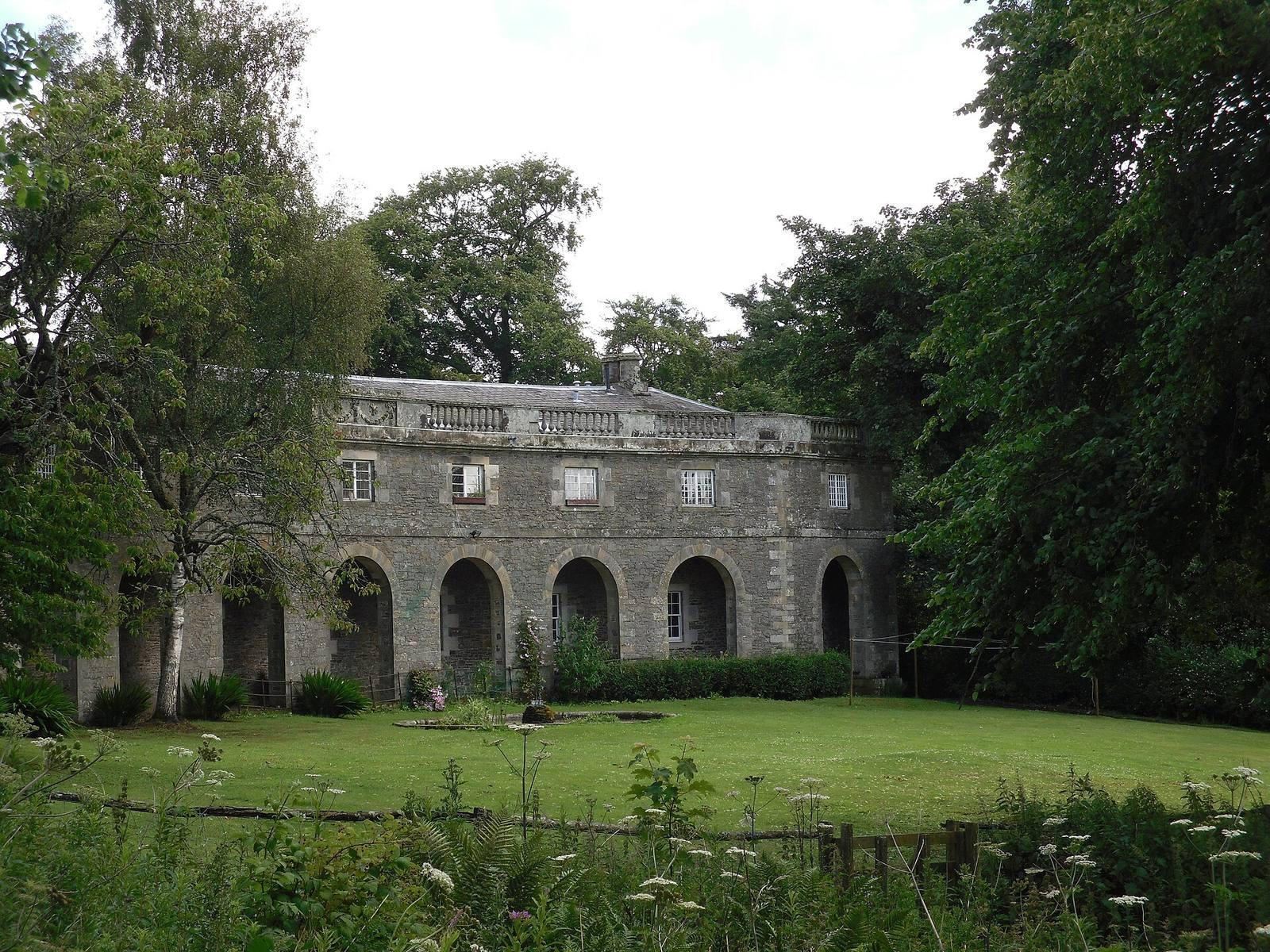
The mansion stands beside Haining Loch, with the stable group to its west and other estate buildings and the kennel yard within the grounds. Its classical composition includes a columned porch and an open-sided gallery, while the stables form a distinct group overlooking the loch.
The mansion and terrace
Main house
The house has an Ionic portico, a columned porch using a classical Greek order, and a loggia, a roofed, open-sided gallery. These features belong to the remodelling carried out around 1820.
Garden terrace
Marble statues were installed on the garden terrace around the time of the remodelling.
Stable court and service buildings
Stables
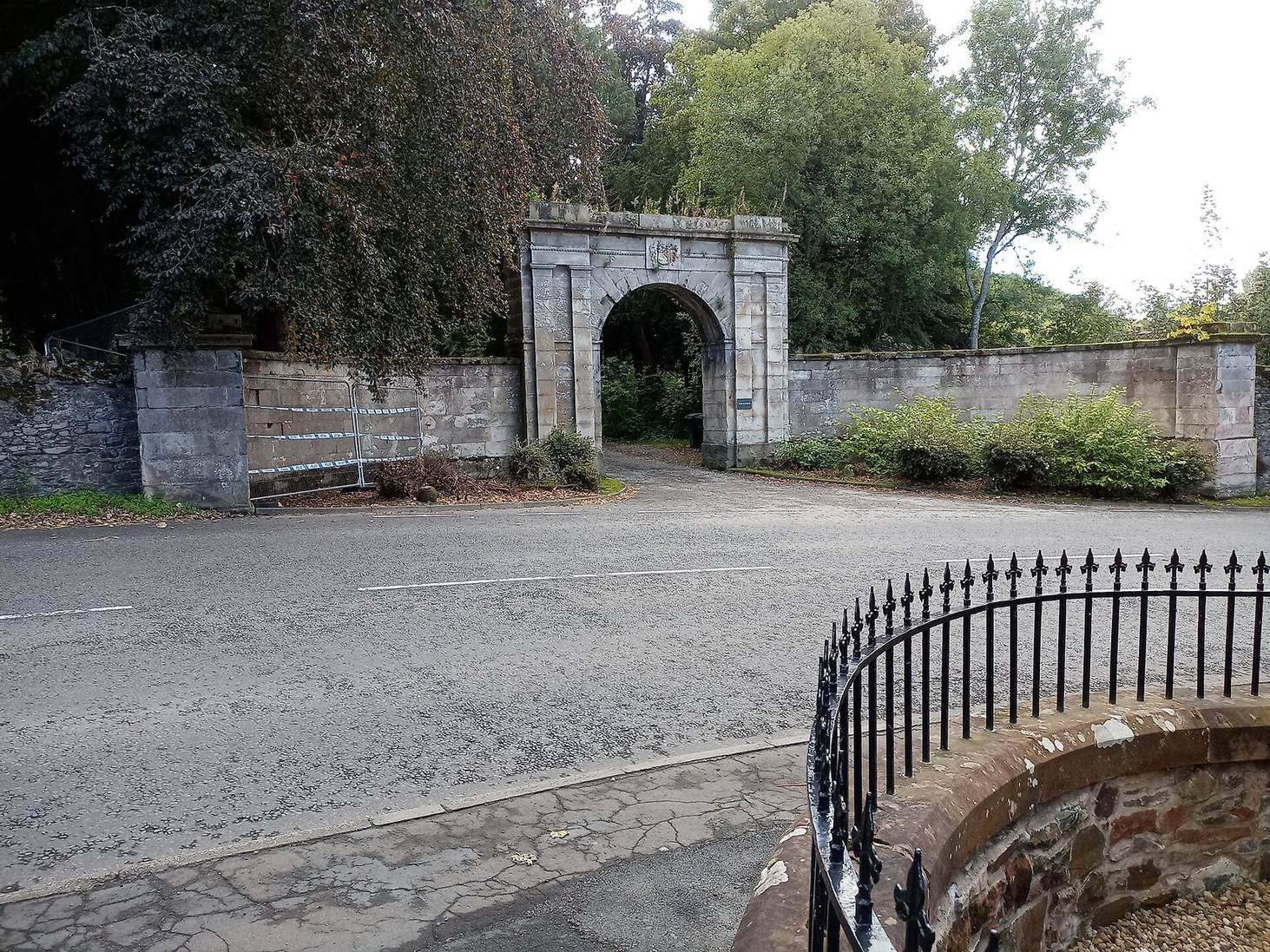
Designed by Archibald Elliot around 1820, the stables lie west of the mansion. The group has a U-shaped building to the north and a rounded southern end overlooking the loch. Doric columns, another classical Greek column type, flank the northern gateway. Its round arch has a central wedge-shaped stone carved as a horse’s head.
Old Coach House and outbuildings
The Old Coach House and stable outbuildings have been refurbished as six artists’ studios.
Kennel yard
Cages built for the estate’s former collection of animals still stand and were later used by the kennels. A statue of Old Ginger, created by Alexander Stoddart, was unveiled in the yard on 4 June 2017 after a fundraising effort by Dandie Dinmont Terrier enthusiasts. During Storm Dennis in February 2020, a tree fell over the statue but did not damage it. The fallen tree and another in the yard were felled, and the Dandie Dinmont Terrier Club of Canada donated a Canadian maple, described as a friendship tree, and three flowering cherry trees for the yard.
Loch and grounds
The estate overlooks Haining Loch, around which a circular public walk runs; walking paths also cross the grounds. Improvement work on trees and footpaths around the loch and estate began in 2019.