Säben Abbey: A Benedictine Monastery in South Tyrol
Site at a Glance
- Rating
- 4.6
- Popularity
- Medium
- Country
- Italy
- Primary era
- Early Modern
- Eras represented
- Classical, Medieval, Early Modern, Modern
- Civilizations
- Austria-Hungary, Habsburg, Habsburg Austria, Holy Roman Empire, Roman
- Site type
- Religious
- Remains
- Fortified Monastery
On this page15 sections
History
Early Christian center and bishopric
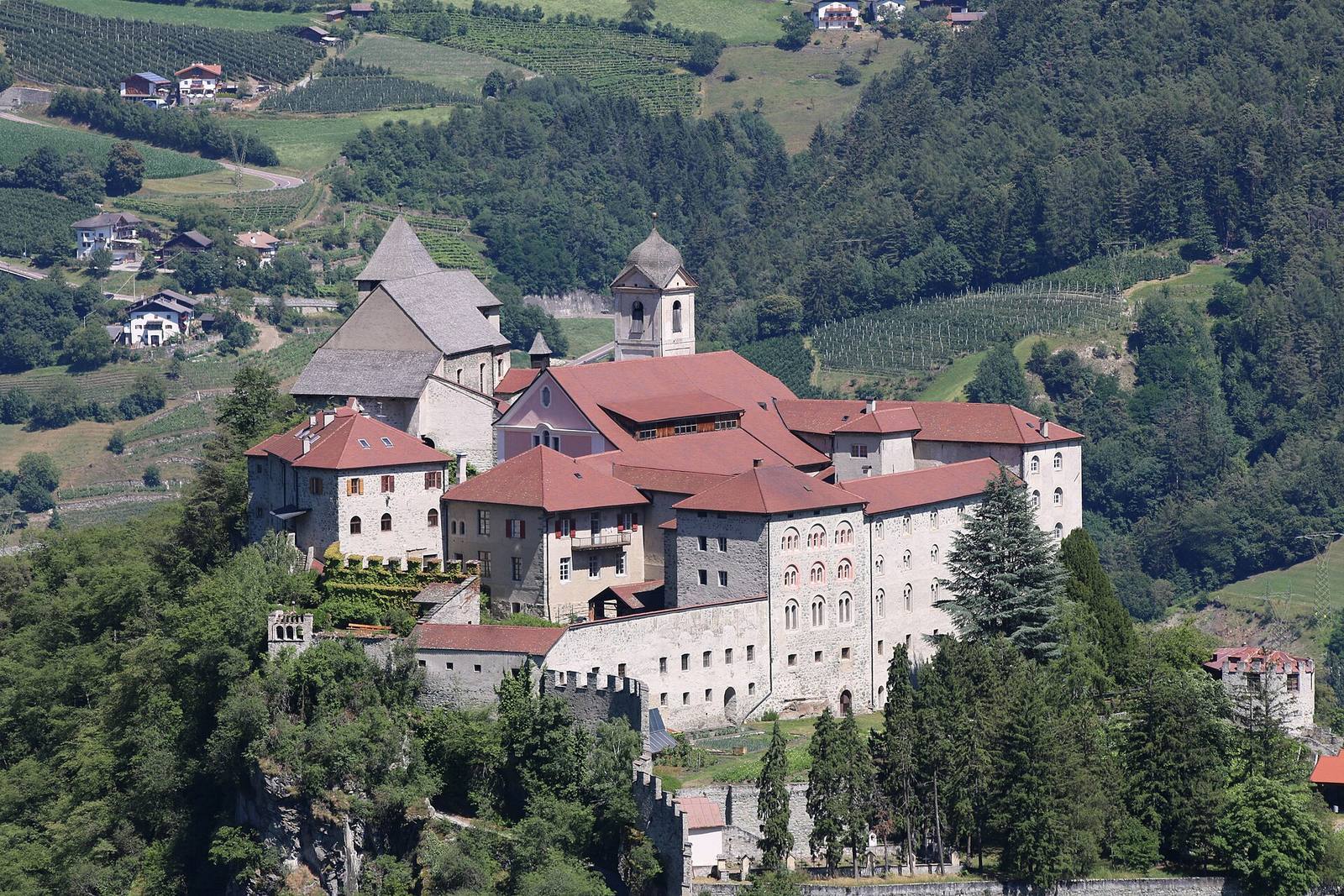
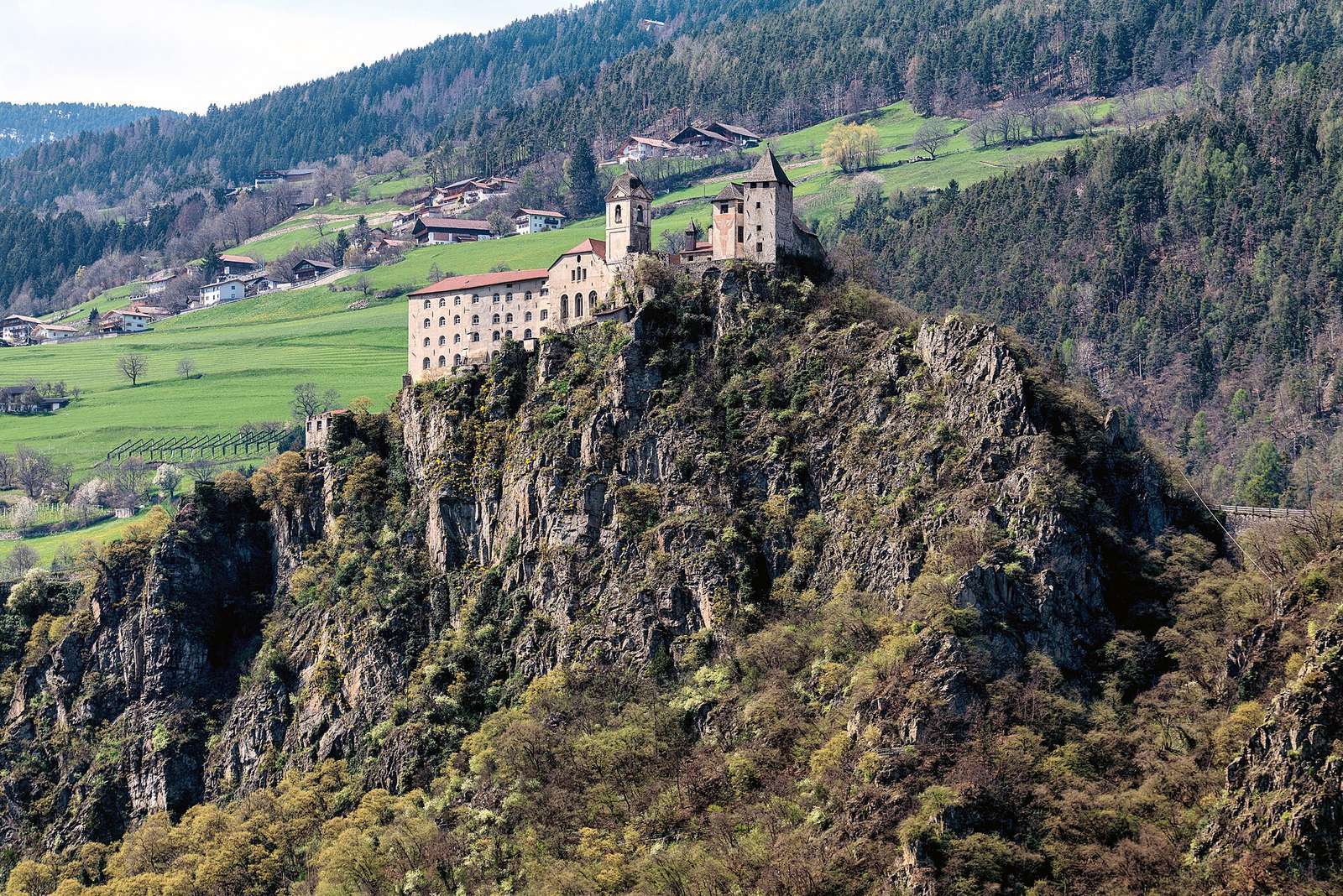
Säben Abbey is a Benedictine monastery on a high rocky outcrop above Klausen in South Tyrol, Italy. The site was inhabited in the Neolithic period, and a late Roman settlement later developed into an early Christian center. From the sixth century until about 960, Säben was the seat of a bishopric, the area under a bishop’s authority.
Bishop Ingenuin attended the Synod of Grado, a church assembly, in 579. On 13 September 901, Louis the Child, a king of East Francia, granted Bishop Zacharias the estate of Prichsna, from which Brixen later developed. By about 960, during Bishop Richbert’s tenure, the bishop’s official seat had moved to Brixen.
The bishops’ castle
After the transfer, Säben became a fortified castle belonging to the bishops. In the fourteenth and fifteenth centuries, it housed the judge of Klausen and served as an administrative center for the southern territories of the Prince-Bishopric of Brixen. A prince-bishop held both religious authority and the powers of a territorial ruler. The castle withstood repeated attacks during the medieval period.
In 1535, lightning caused a fire that destroyed the episcopal palace. The castle then became an uninhabited ruin, and judicial activity there came to an end.
Foundation and life of the abbey
In 1685, five nuns from Nonnberg Abbey in Salzburg arrived at the initiative of Matthias Jenner, a canon, or member of cathedral clergy, who served as a priest in Klausen. Their new community was confirmed by Prince-Bishop Johann Franz Khuen von Belasi in a charter dated 21 November 1686, when he also consecrated its church. The community had grown to 30 nuns by 1687. In 1699, the monastery became an abbey, a monastery led by an abbess, and Maria Agnes von Zeiller was elected its first leader.
The Benedictine nuns followed a communal monastic tradition based on the Rule of Saint Benedict. They lived under strict enclosure, rules that limited contact with the outside world, and followed the choir office, the community’s regular cycle of prayer. Their work included caring for the household, tending vineyards and fields, making and embroidering church vestments, receiving pilgrims, and hosting summer guests.
Disruption and revival
During the eighteenth and nineteenth centuries, invading forces occupied the monastery at several points and used it as a defensive stronghold. It was repeatedly looted during the Napoleonic Wars. In 1803, secularization, the removal of church property from ecclesiastical control, cost the community its assets. The nuns nevertheless remained, living in poverty.
The community began to recover around 1880, after contact with monks from Beuron Abbey who were exiled in Tyrol during the Kulturkampf, a period of conflict between the German state and the Catholic Church in the 1870s. Säben adopted the Beuronese form of Benedictine practice and formally joined the Beuron Congregation, an association of Benedictine monasteries, in 1974.
Closure and renewed pastoral care
Marcellina Pustet led the community as abbess from 1970 to 1996. Maria Ancilla Hohenegger, elected in 1996, announced in May 2021 that the monastery would close because too few new members were joining. The last three nuns left in November that year for Mariengarten Abbey and Nonnberg Abbey. The monastery passed to the Diocese of Bolzano-Brixen, and its future use became the subject of an internal church dispute.
From 2022, the diocese discussed the possibility of a renewed religious presence with the Austrian Cistercian Abbey of Heiligenkreuz. Cistercians are a monastic order that developed from the Benedictine tradition. After four monks visited in 2023 to assess the proposal, Heiligenkreuz agreed in 2024 to take responsibility for pastoral care for pilgrims, without creating a separate priory, or dependent monastic house. Father Kosmas Thielmann moved into the monastery in September 2024 as its sole resident monk.
Remains
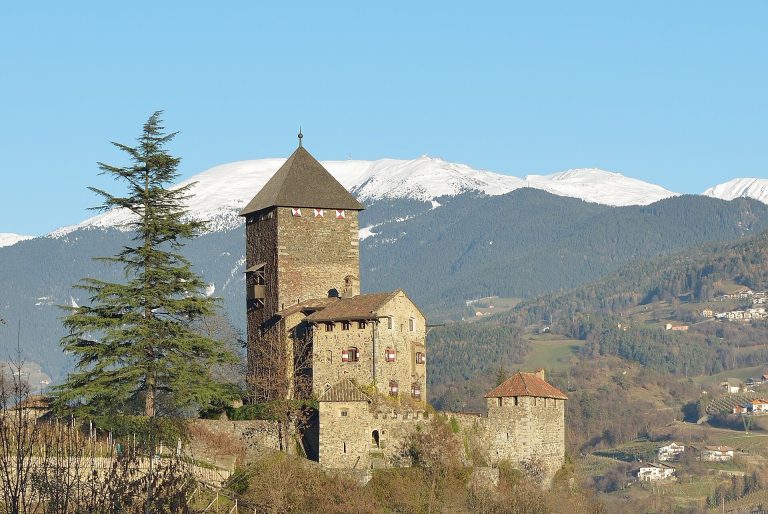
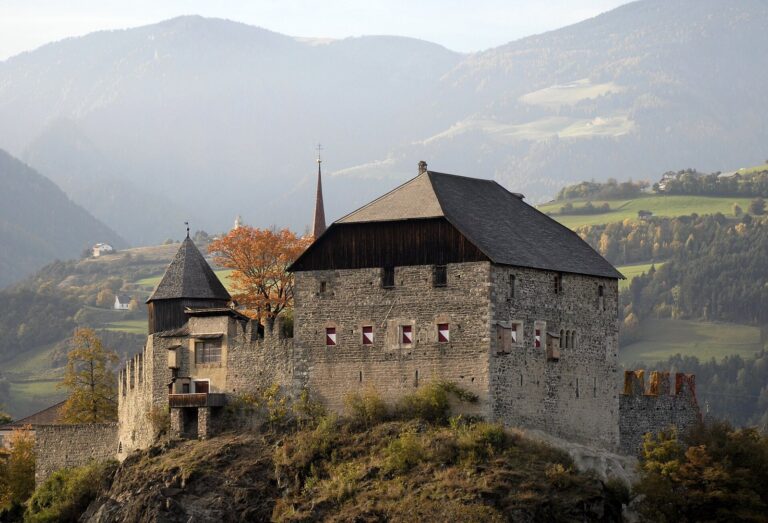
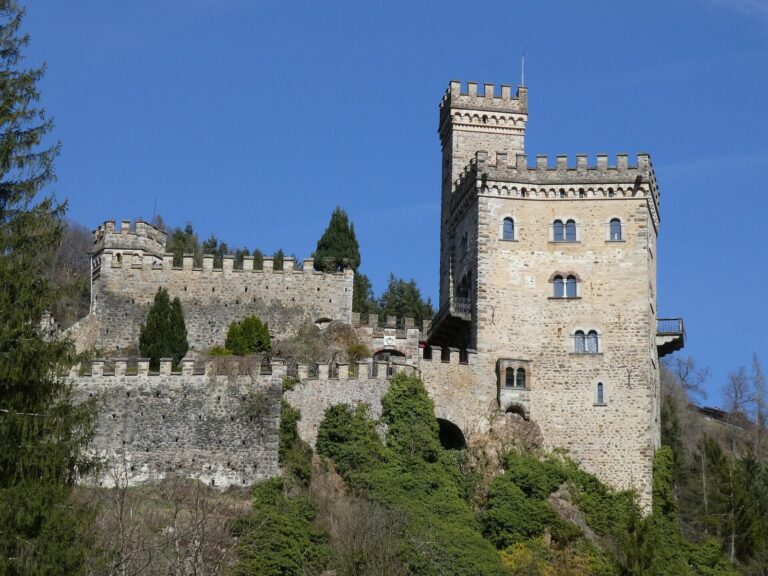
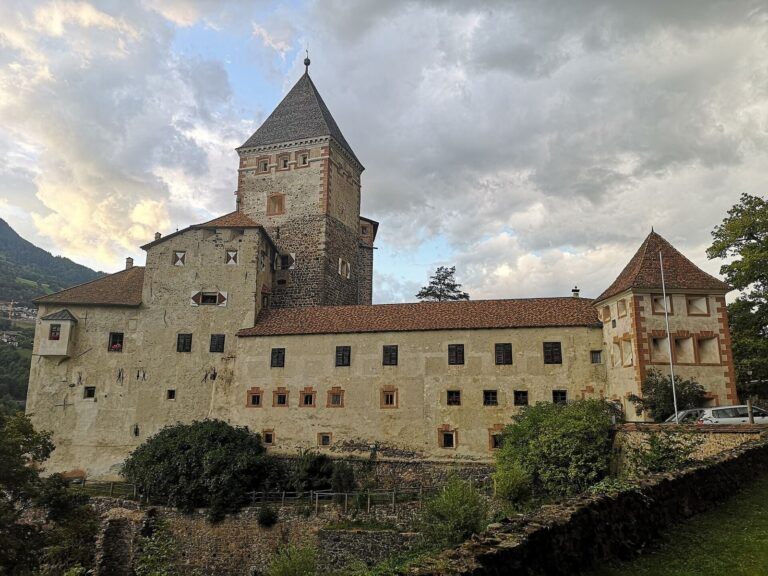
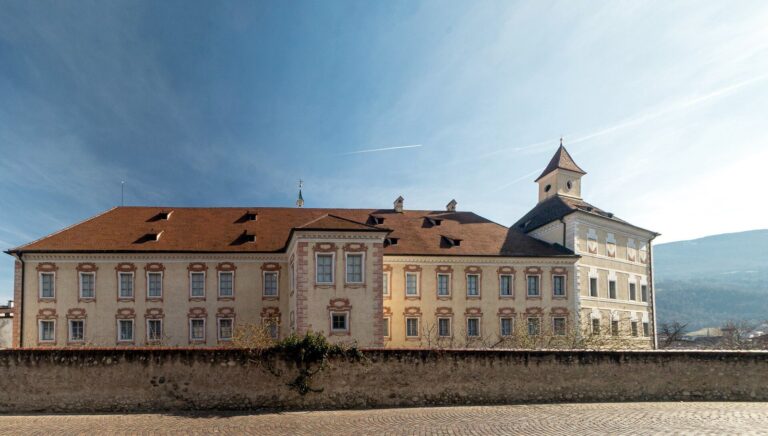
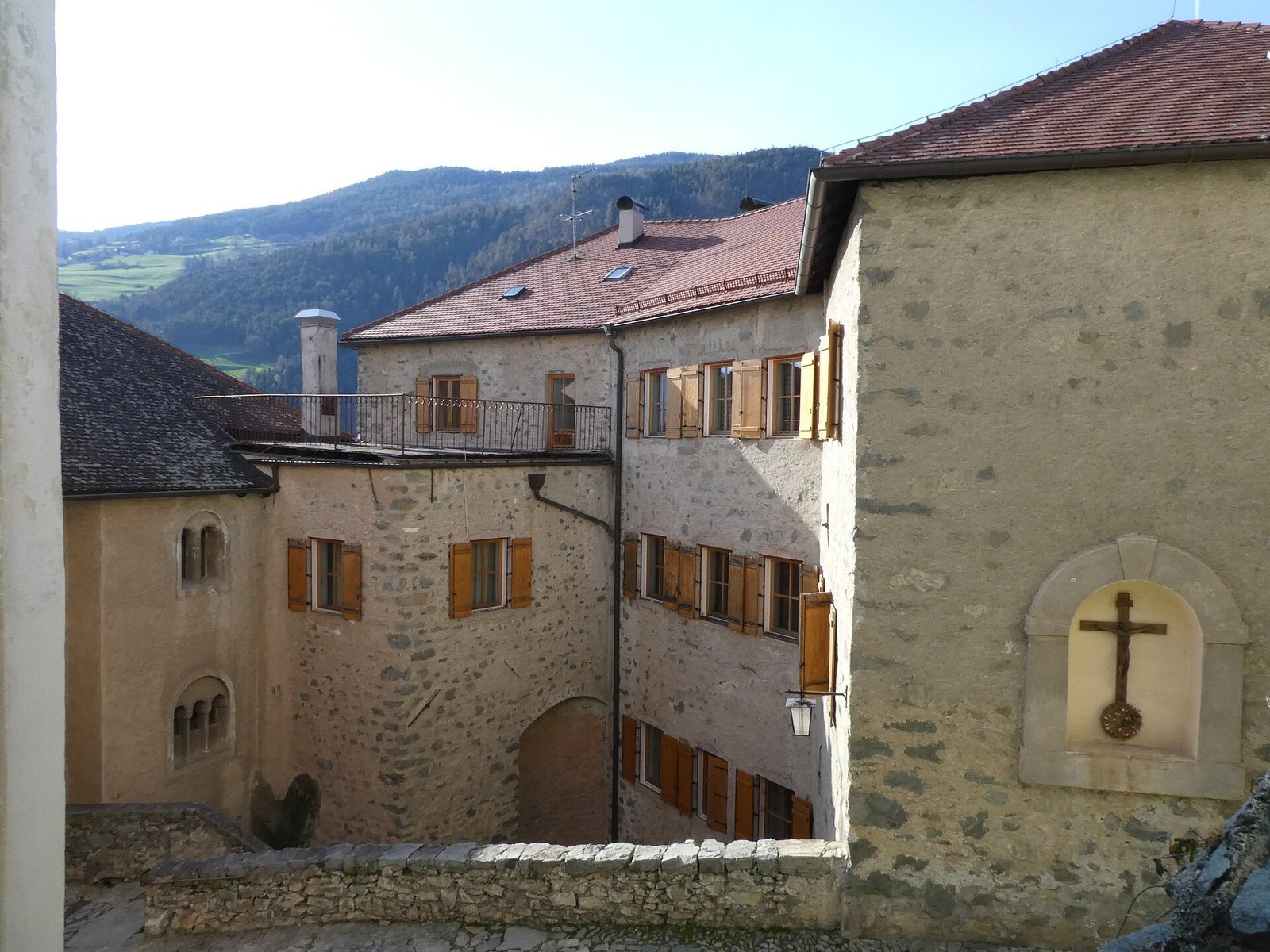
The monastery complex stands on the rocky height above Klausen and includes defensive walls. Its buildings date from the late seventeenth century and incorporate remains of the medieval bishops’ castle. Alterations and enlargement around 1890 changed the complex further. The churches and chapels occupy the same rocky site, while the remains of an early Christian church and burial ground lie in the vineyard below the castle walls.
Churches and chapels
Monastery church
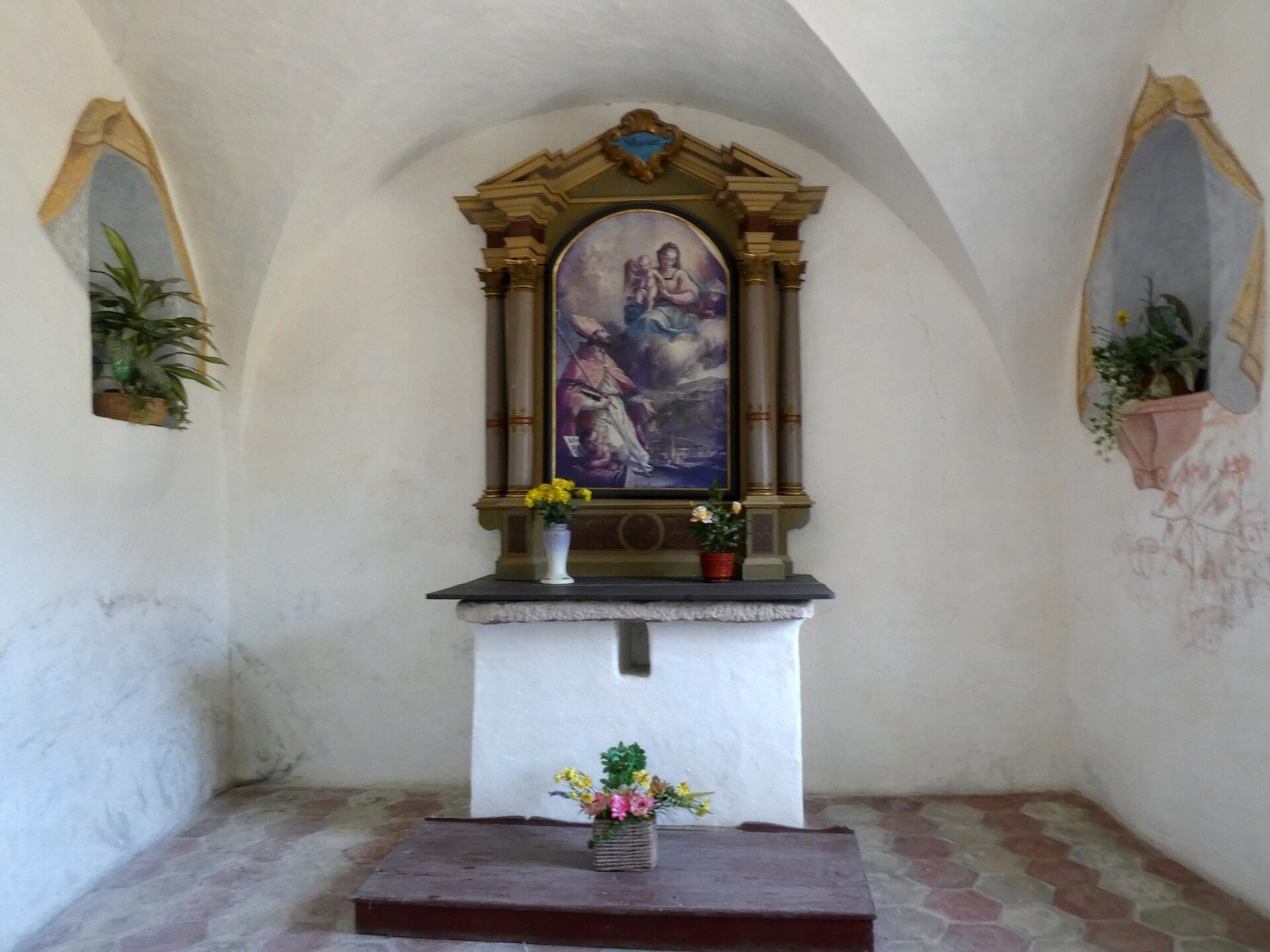
The monastery’s plain church forms part of the late seventeenth-century complex. The nearby Church of the Holy Cross and Church of Our Lady are also among the principal religious buildings on Säben.
Church of the Holy Cross
The Church of the Holy Cross served as the location of the bishop’s seat for more than four centuries. A passage beneath the thirteenth-century Tower of Saint Cassian runs alongside the church and leads to the main apse, the projecting rounded end of the building.
A large crucifix on the main altar is probably the work of the sculptor Leonhard of Brixen and dates to the second half of the fifteenth century. The church’s other sculptures date to the seventeenth century. Outside, a separate crucifix stands 12 metres high on the main apse. Weather has almost entirely eroded it. It once greeted pilgrims arriving from the north of the Eisack Valley and represented salvation.
Church of Our Lady and Chapel of Saint Mary
The octagonal Church of Our Lady stands beside the small Chapel of Saint Mary, also called the Chapel of Graces. The chapel preserves parts of earlier early medieval and Romanesque construction, including a rounded apse and a triumphal arch, the arch framing the entrance to the apse, along with part of the south-facing outer wall. The earliest church on Säben stood in this area. A rock-cut baptismal basin, used for baptism, dates to the second half of the fourth century and was kept in the sacristy of that earlier church. It is associated with the late Roman settlement.
The chapel’s ribbed vault, a ceiling formed by intersecting masonry ribs, dates to the fourteenth century. A nave was added to extend the chapel westward, but the building was reduced in the seventeenth century to make room for the Baroque Church of Our Lady. The chapel has a large south-facing window and four corner pillars. A cornice decorated with small block-like projections supports its dome-shaped vault. Frescoes were identified in the chapel in 1987.
Defensive structures
Tower of Saint Cassian
The Tower of Saint Cassian was built in the thirteenth century as part of the castle’s defenses. The passage beneath it connects with the area beside the Church of the Holy Cross and leads toward the church’s main external apse.
Captain’s Tower
Lower down on the rock stands the Captain’s Tower, also known as Castel Branzoll. It formed a further defensive structure within the site.
Vineyard archaeology and other features
Foundations identified as those of the first episcopal cathedral lie in the vineyard below the defensive walls. They date to the fifth or sixth century and were examined in 1982 and 1983 before being reburied for preservation. Remains of an early Christian church in the vineyard and a large burial ground have also been excavated. A commemorative fountain is another feature of the site.