Chelsea Old Church: An Anglican Parish Church in Chelsea
Site at a Glance
- Rating
- 4.5
- Popularity
- Medium
- Country
- United Kingdom
- Primary era
- Medieval
- Eras represented
- Medieval, Early Modern
- Civilizations
- English
- Site type
- Religious
- Remains
- Church
On this page11 sections
History
Chelsea Old Church is an Anglican parish church in the United Kingdom, with origins dating to 1157. It formerly served as Chelsea’s parish church before the expanding city of London encompassed the area. The church remains an active parish in the Church of England’s Diocese of London, a church district overseen by a bishop. Its Prayer Book Catholic tradition combines use of the Book of Common Prayer with Catholic emphases in worship and tradition.
Medieval and Tudor church
The north chapel, known as the Lawrence Chapel, was privately owned by Chelsea’s lord of the manor, an estate holder with rights associated with the manor. In 1528, the south chapel was rebuilt as the private chapel of Sir Thomas More, an English statesman, lawyer, and humanist.
Later parish life and artistic record
The church became the burial place of people from several centuries. Those buried there include Jane, Duchess of Northumberland, who died in 1555; John Braye, 2nd Baron Braye, who died in 1557; the 10th Baron Dacre, who died in 1594; Anne, Baroness Dacre, who died in 1595; Katherine, Countess of Huntingdon, who died in 1620; Sir Robert Stanley, who died in 1632; Sir Hans Sloane, who died in 1753; and social reformer Catherine Courtney, Baroness Courtney of Penwith, who died in 1929.
During the nineteenth century, the church was painted white. Its tower appears in the distance in paintings by American-born artist James McNeill Whistler and British landscape painter J. M. W. Turner. Whistler included it in the background of Nocturne: Blue and Gold – Old Battersea Bridge, painted around 1872–1875.
Wartime destruction and restoration
On 14 April 1941, during the Blitz, Germany’s bombing campaign against Britain in the Second World War, a parachute mine severely damaged the church. Most of the building and its tower were destroyed. The Thomas More Chapel suffered the least damage, and services took place at nearby Cheyne Hospital for nine years.
Architect Walter Godfrey led the restoration. The More Chapel reopened in 1950, followed by the chancel and Lawrence Chapel in May 1954. The church received Grade I listing, the highest category of listed-building protection in England, on 24 June 1954; the listing was amended on 18 December 1992. The restored church was reconsecrated in May 1958 by the Bishop of London, in the presence of Queen Elizabeth The Queen Mother.
Later claims and archaeological work
In 1978, Jack Leslau proposed that Edward V, who briefly ruled England in 1483 and is one of the Princes in the Tower whose fate remains unresolved, survived and was buried at the church. Leslau based the theory on an elaborate interpretation of a painting by Hans Holbein the Younger, a major Renaissance painter. No major academic institution has endorsed the claim.
In 2000, Museum of London Archaeological Services carried out an archaeological excavation in the churchyard.
Remains
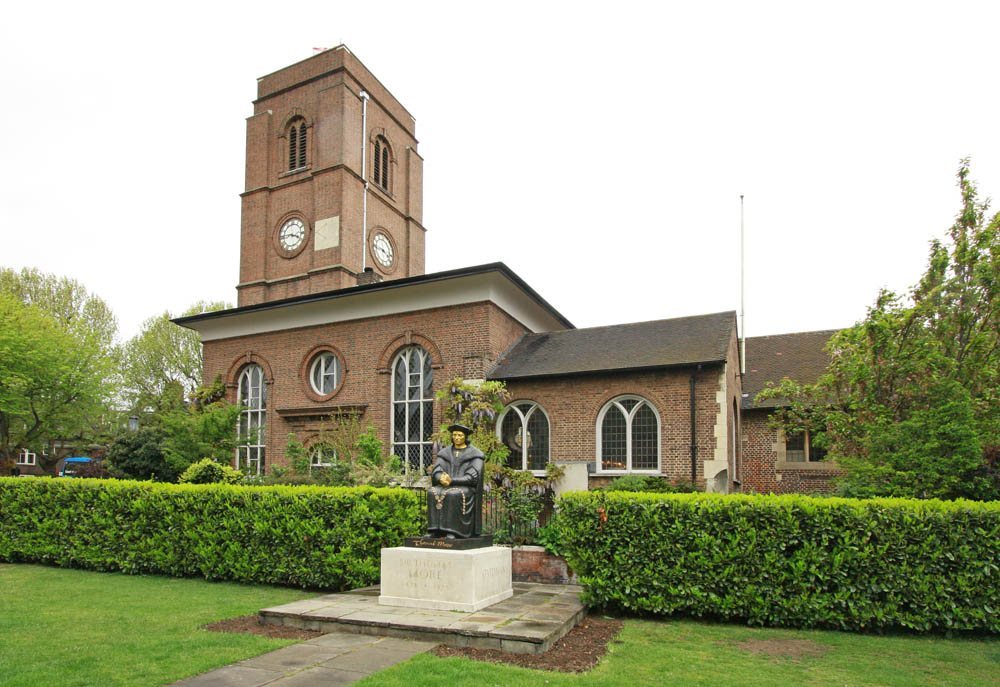
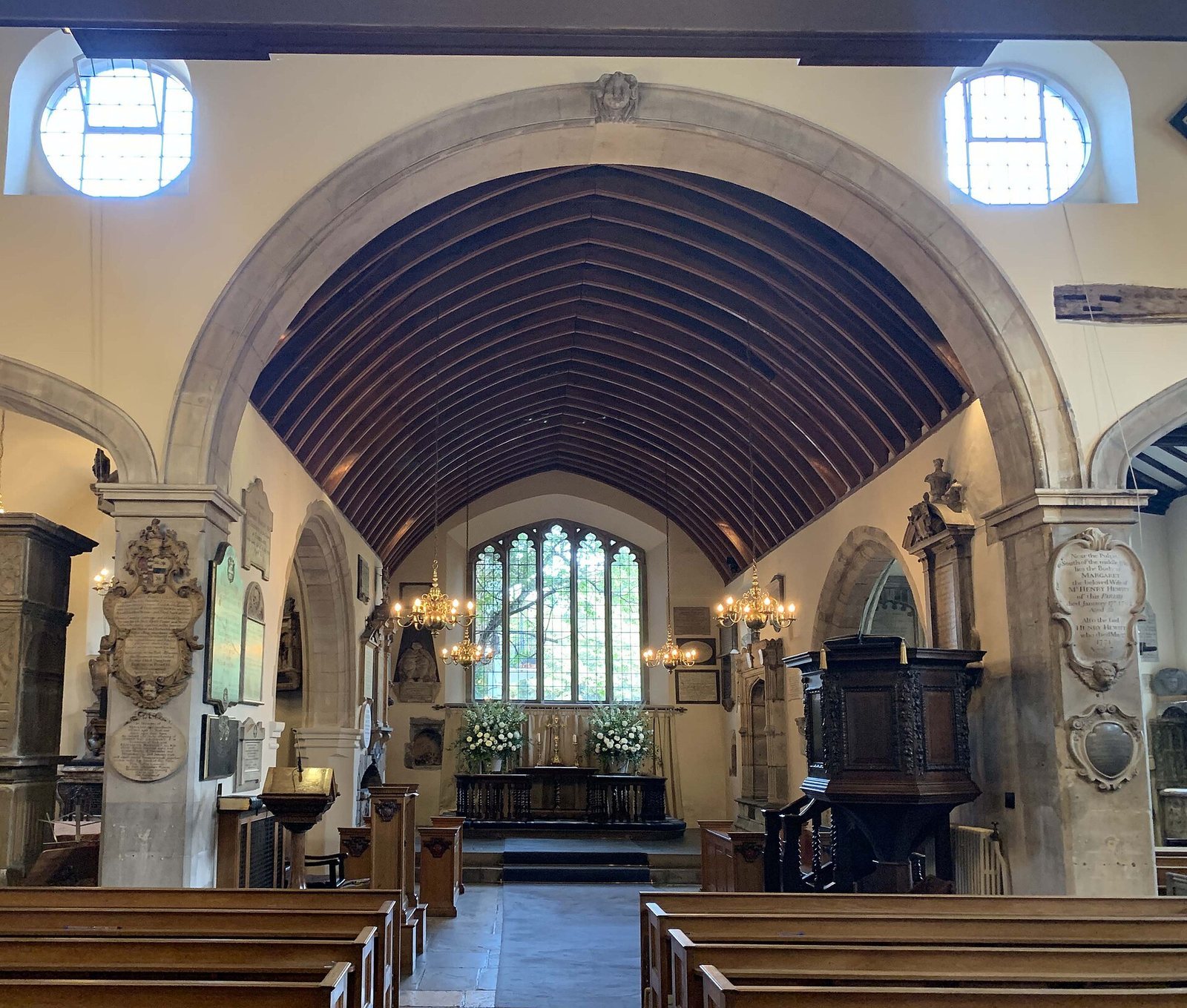
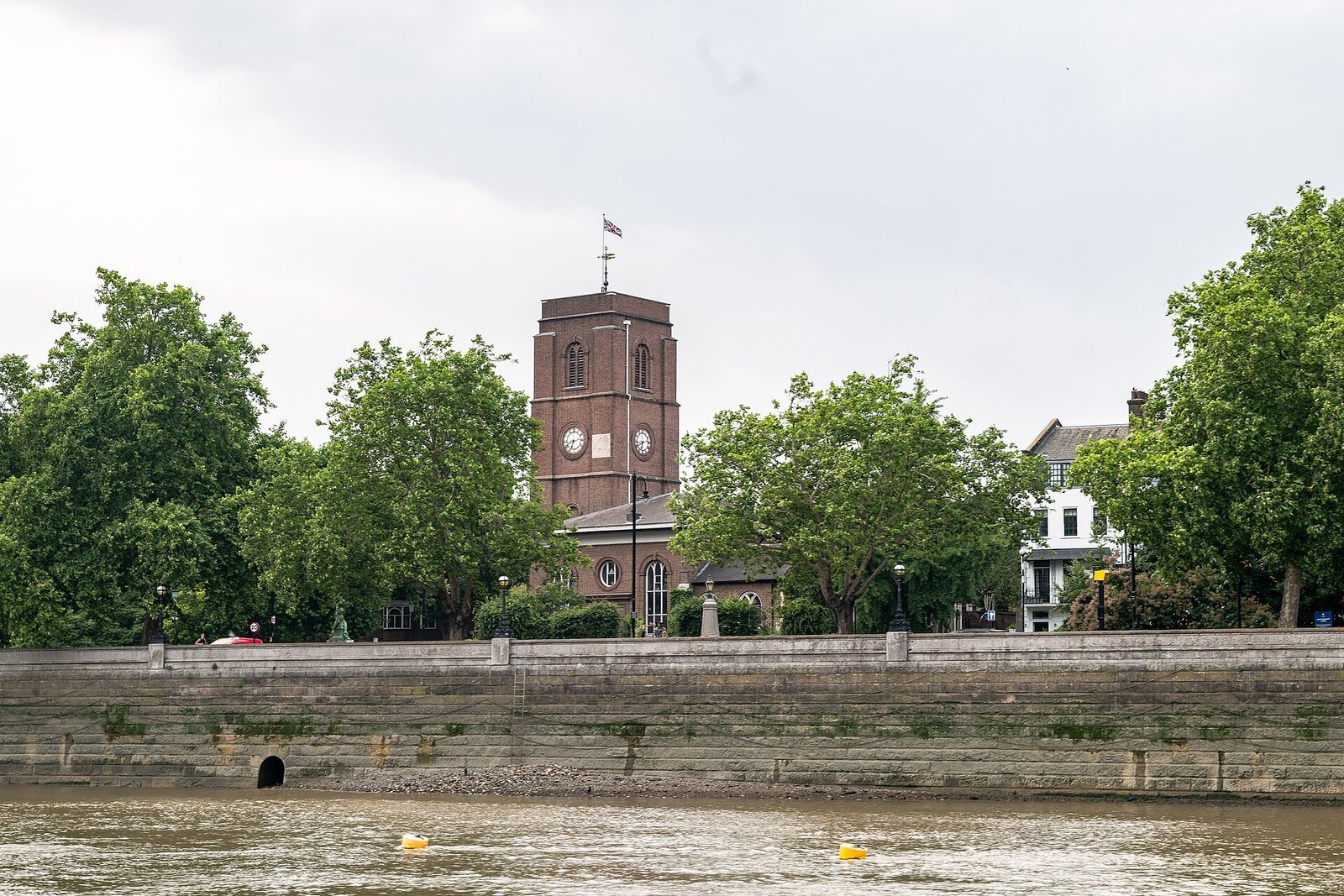
Restored on its old foundations, the church retains a form resembling its prewar appearance. It stands on Old Church Street near Albert Bridge. Its layout brings together a thirteenth-century chancel, the area around the altar, and north and south chapels dating to about 1325. The nave, the main space for the congregation, and the tower were built in 1670. The interior seats 400 people, and the single tower has eight bells.
Interior and structural fabric
One of the pillars leading to the chancel has the date 1528 carved on its top. The pillars’ design is attributed to Hans Holbein the Younger. The church’s surviving fabric also includes original sixteenth-century stained glass preserved during the postwar restoration.
Monuments and commemorative features
Tombs, monuments, and stained glass
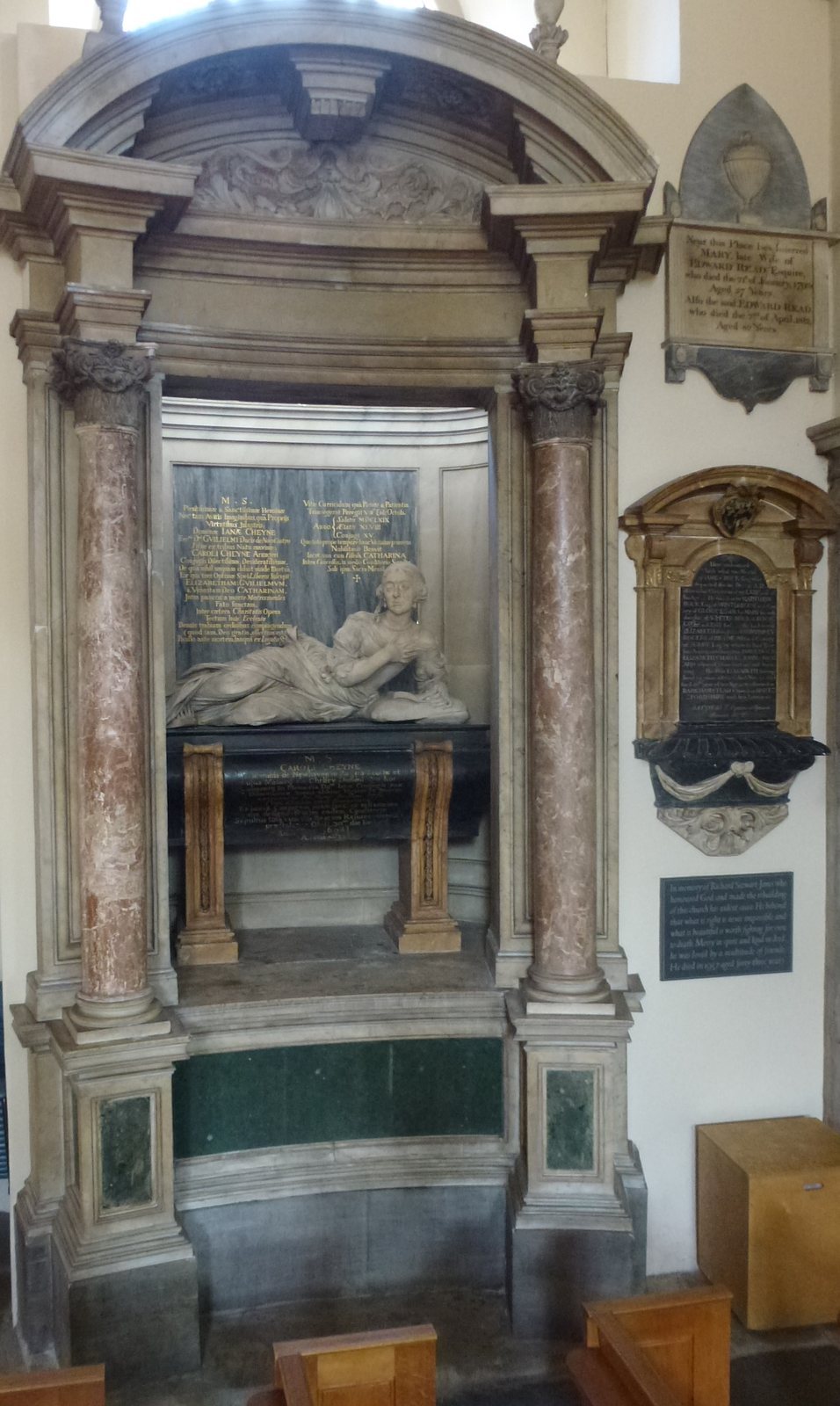
Many tombs and monuments were salvaged and reconstructed during the restoration. A monument to Lady Jane Cheyne dates to 1669. It was designed by a son of Gian Lorenzo Bernini, an Italian Baroque sculptor and architect, and executed by Antonio Raggi, an Italian Baroque sculptor favored by Bernini. Verses on Sir Robert Stanley’s tomb have been claimed by some to point to the true author of Shakespeare’s works.
Chained books
Sir Hans Sloane gave the church its collection of chained books, which are secured to shelves while remaining available for consultation. The collection includes a 1717 copy of the so-called Vinegar Bible, a nickname linked to a printing error involving the word vineyard; two volumes of the 1684 edition of Foxe’s Book of Martyrs; a 1723 printing of the Book of Common Prayer; and a 1683 edition of The Books of Homilies.
Statue, plaque, and garden sculpture
A statue of Thomas More by Leslie Cubitt Bevis stands outside the church facing the river. Inside, a plaque commemorates author Henry James, who lived nearby on Cheyne Walk and was buried in Cambridge, Massachusetts. A small public garden west of the church contains a sculpture by modern sculptor Sir Jacob Epstein.