Ras il-Wardija: A Rock-Cut Sanctuary on Gozo
Site at a Glance
- Rating
- 4.4
- Popularity
- Medium
- Country
- Malta
- Primary era
- Classical
- Eras represented
- Classical
- Civilizations
- Carthaginian, Roman
- Site type
- Religious
- Remains
- Sanctuary
On this page12 sections
History
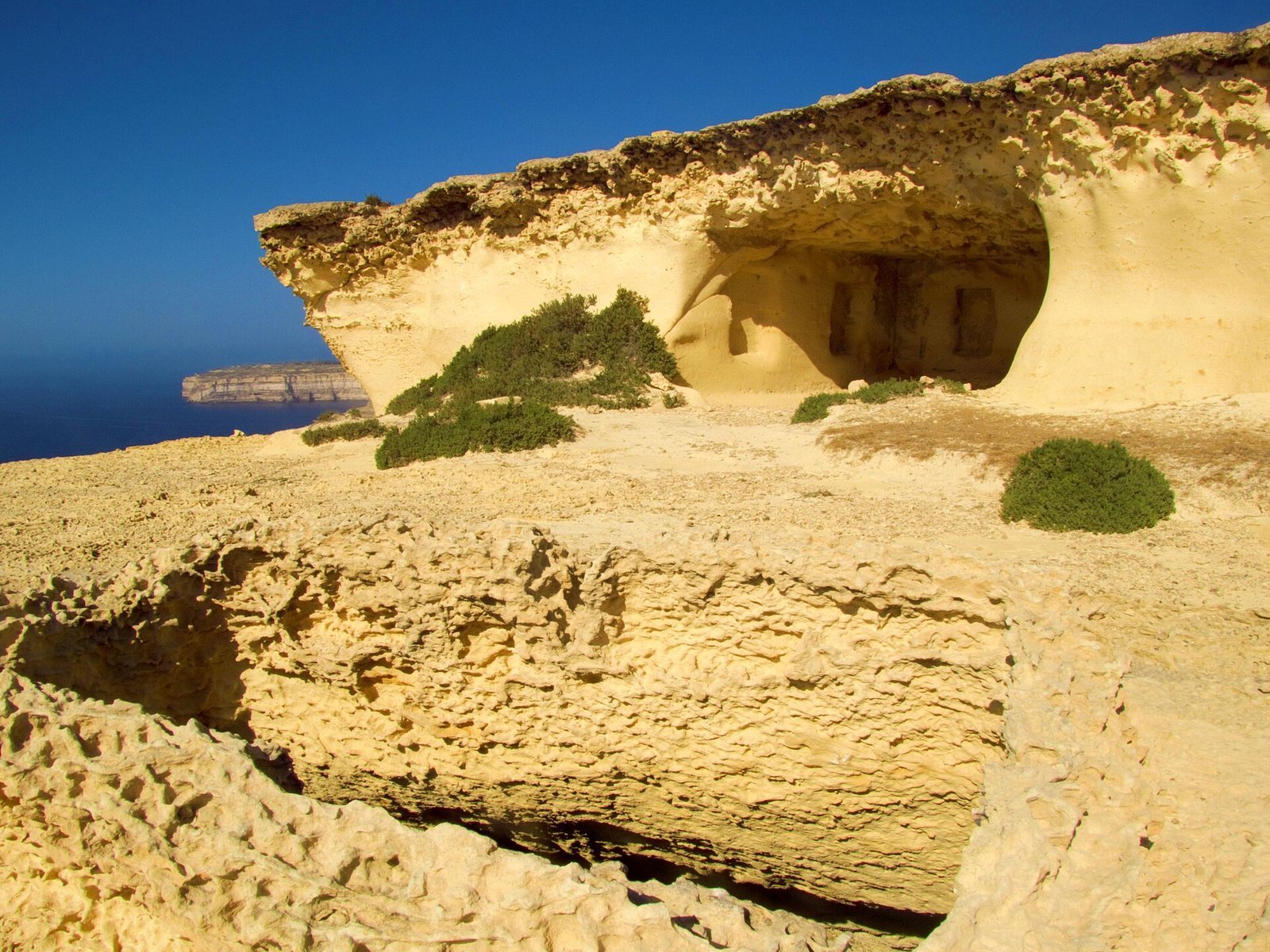
Ras il-Wardija is a rock-cut archaeological sanctuary on a promontory in San Lawrenz, on Gozo’s southwestern coast in Malta. It was probably established around the 3rd century BC as a religious complex of the Punic culture, a Phoenician-derived society associated especially with Carthage and the western Mediterranean. Visible far out at sea, the site may also have served as a navigational marker for ancient ships, including vessels travelling between the Maltese Islands and North Africa.
Early activity and the Punic sanctuary
Activity at the site may reach back to the Bronze Age, around 1500 BC, although this date is uncertain. Nearby grooves cut into the rock have been identified as cart-ruts, but their age is disputed.
The sanctuary’s likely Punic origins have been tentatively linked to one of four temples named in an inscription found on Gozo in 1855. The inscription refers to temples dedicated to deities including Sadambaal and Astarte, but no evidence confirms that Ras il-Wardija was one of them.
Roman and later use
The sanctuary remained in use under Roman rule and influence until around the 4th century AD. Carved crosses have been interpreted as signs of later Christian worship, and a medieval hermitage has also been proposed. The evidence for these later religious uses is inconclusive.
Excavation and later history
An Italian archaeological mission led by Catherina Caprino and Anna Maria Tamassia excavated the site from 1964 to 1967. The rock shelter or its surroundings were used in the defence of Gozo during the Second World War. Ras il-Wardija is included in Malta’s National Inventory of the Cultural Property as a Class A site and lies within Natura 2000, a network of areas protected for nature conservation.
Remains
The sanctuary is cut into a hillside and may have been formed from a natural cavity. Its main chamber connects to a T-shaped rock-cut passage. Nearby are cuttings in the bedrock, cisterns, masonry remains, and grooves identified as cart-ruts. The site is now severely deteriorated.
Rock-cut sanctuary
The rectangular chamber measures 4.67 × 5.80 × 2.10 m and extends along an east–west axis, facing the sea and the setting sun. Five finely carved recesses, or niches, each about 1 m high and 50 cm wide, have molded projecting edges. A natural rock barrier, masonry, or a curtain may once have screened the cavity from outside. The space has been described as a possible nymphaeum, a water-associated shrine often placed in a cave or grotto.
Exposure to wind has worn the chamber’s walls and ceiling. As the soft rock broke down, a thick layer of fine dust accumulated on the floor.
External remains and water installations
Bedrock cuttings and masonry
Large rectangular hollows cut into the rock lie in front of the entrance. Traces of white mortar within them have been interpreted as evidence of Roman rather than Punic construction. An external masonry structure with an altar has been compared with remains of the Punic-Roman sanctuary at Tas-Silġ in Marsaxlokk.
Cisterns and altar structures
Two rock-cut cisterns were found near the sanctuary. One held 37 m³, while the smaller, bell-shaped cistern had a capacity of 14 m³. Three stone structures have been interpreted as altars, two inside the building and one outside. Holes cut into them may have been used to pour liquid offerings.
Carvings and finds
Figure carving
A deeply cut image in a niche on the south wall depicts a stylized human figure with outstretched arms. It has been interpreted in different ways, including as a crucifix, a winged being, or Tanit, a goddess worshipped in Punic religion. The carving went missing on 30 March 1988, probably removed with a pneumatic tool, and Maltese police recovered it in June 2011. The cave’s owner relinquished rights to it, and it is now displayed at the Gozo Museum of Archaeology in the Cittadella.
Other graffiti and excavated material
Further markings appear between the niches. Their dates may range from the Punic era to modern times. Two cross-shaped drawings have been connected to the proposed medieval hermitage, although that interpretation remains uncertain.
Pottery fragments and coins have also been found, but they came from outside layers that could securely establish their date or use. Many pottery pieces are small and difficult to date; the best-preserved examples have been assigned to the 3rd–2nd centuries BC.