Franciscan Monastery of Rama-Šćit: A Monastery and Marian Pilgrimage Site in Bosnia and Herzegovina
Site at a Glance
- Popularity
- Medium
- Country
- Bosnia and Herzegovina
- Primary era
- Modern
- Eras represented
- Modern
- Civilizations
- Austria-Hungary, Habsburg, Ottoman
- Site type
- Religious
- Remains
- Monastery
On this page18 sections
History
The Franciscan Monastery of Rama-Šćit is a Catholic religious house of the Order of Friars Minor, founded by Francis of Assisi, at Šćit in Bosnia and Herzegovina. A monastery there was probably established in the fifteenth century, before the Ottoman conquest.
Foundation and Franciscan administration
In 1514, Rama was listed among thirteen monasteries then remaining in the Bosnian Franciscan province. That year, the Bosnian Franciscan vicariate, an administrative unit of the order, was divided into Bosnia Srebrena, within Ottoman-held territory, and Bosnia-Croatia. Both divisions became provinces in 1517.
The monastery and its church were burned in 1557, and several Franciscans were killed. The buildings were restored before 1587, when the monastery appears in the record again.
Repeated destruction and departure
Rama remained an active religious and educational centre during the first half of the seventeenth century. The community included as many as ten priests, and taught both school pupils and clerics preparing to join the Franciscan order. Its friars provided pastoral care in Rama and the Livno, Duvno, and Skopalje areas until their departure in 1687. The parish had about 1,200 Catholics early in the century.
Violence and fire repeatedly damaged the monastery. It was plundered in 1653, when several Franciscans were killed. After repairs to the deteriorated buildings, a fire in 1667 destroyed many valued objects. Another fire followed in 1682. An Orthodox roofer deliberately set it after finding a bone in a meal served on a Wednesday, a fasting day. With a loan from Beg Kasumović of Kasapovići and donations gathered elsewhere, the Franciscans rebuilt the monastery by 1684.
The Great Turkish War (1683–1699), a conflict between the Ottoman Empire and its opponents, including the Habsburg monarchy and its allies, made the friars’ position increasingly difficult amid heavy levies and persecution. In 1687, at the urging of Venetian representative Antun Zeno, the Franciscans and some Catholic residents moved to the Cetina region. Venetian soldiers then burned the monastery, church, and many houses in Rama to stop Ottoman forces from using them. The friars carried away valuables, including a Marian image now kept in the Franciscan church at Sinj.
Franciscans from Fojnica subsequently cared for Catholics who remained in Rama, while also having to repay the loan taken for the rebuilding. In the first half of the eighteenth century, the parish priest had no permanent home and travelled between villages. Tradition places his successive residences at Proslap near Nešnica, then at Jaklići and Podbor.
Parish life, pilgrimage, and education
The Catholic population was counted at 857 in 1743, 1,167 in 1762, and 1,957 in 1798. In 1773, the parish priest settled at Proslap. The following year he built a rectory, or parish priest’s residence, in the Nikolići hamlet, and parish registers began that same year. A replacement rectory was built on the same site in 1818 and remained in use until 1864. The parish counted 2,782 Catholics in 1813, 3,102 in 1877, and 5,138 in 1935.
A plague epidemic killed almost a thousand people in Rama in 1814. Over time, the large parish was divided into several new parishes, including Gračac, Uzdol, Doljani, Prozor, and, more recently, Rumboci. The Franciscans acquired land at Šćit in 1855 and 1857. In 1779, a plenary indulgence, which Catholic teaching holds remits punishment due for forgiven sins, had been granted for the site of the former monastery and church there. The site became a place of pilgrimage for people from Rama.
The Franciscans opened a primary school at Šćit in 1863, at first using a room in the monastery. A timber school followed in 1865, then a more suitable building in 1876. The friars thereby added regular schooling to their pastoral responsibilities. Rama became a Franciscan residence, a religious house not formally elevated to monastery status, in 1882 and was legally declared a monastery in 1940.
The former church and monastery were dedicated to Saint Peter the Apostle. As devotion to a miraculous image of Mary grew, the church’s dedication changed to the Assumption of Mary, the Catholic belief that Mary was taken into heaven. Its principal annual celebration is associated with the Nativity of Mary, commemorating her birth, on September 8.
War, recovery, and commemoration
During the Second World War, a bomb struck the monastery in February 1943 but did not explode. Earlier, on July 13, 1942, Partisans, a communist-led resistance movement, set fire to the church. The fire killed guardian J. Jurković, the community’s local superior; chaplain V. Slišković died later. The blaze consumed the sacristy, library, artworks, chalices, coin collection, books, and archival material, including old parish registers and copies of records from the Apostolic Vicars in Bosnia.
On October 8 and 9, 1942, Chetnik forces, a Serbian royalist movement, massacred more than 900 people in Rama. The first public commemoration of the victims took place in autumn 1990, when the idea of a memorial to those killed during the war took shape.
After the church fire, worship took place in a temporary barrack until rebuilding began in 1956. Work on the interior continued over several years, and the interior was redecorated between 1967 and 1969. In the second half of the 1960s, a reservoir lake flooded large parts of the Rama Valley and forced hundreds of families to leave, reducing the parish community. The parish now comprises Šćit and the settlements of Družinovići, Jaklići, Kozo, Maglice, Mluša, Orašac, Ploča, Podbor, Proslap, Ripci, Sopot, Tribiševo, and Zlopolje. It has 3,152 faithful in 640 families.
An art-donation campaign began in 1991, during the celebration of seven centuries of Franciscan activity in Bosnia. The monastery later established an art gallery and, in 2003, installed an ethnographic collection. In 2006, the complex was designated a National Monument of Bosnia and Herzegovina, a status covering the remains of the nineteenth-century monastery, the church’s exterior form and decoration, movable cultural heritage, and the cultural landscape.
Remains
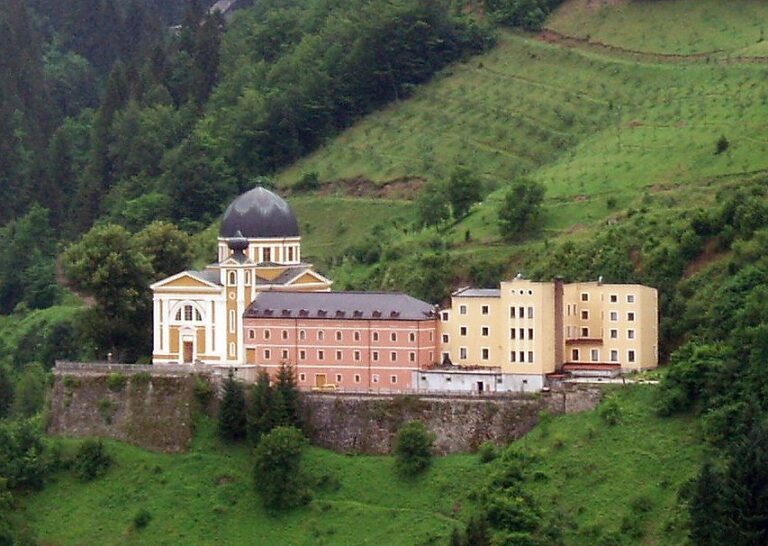
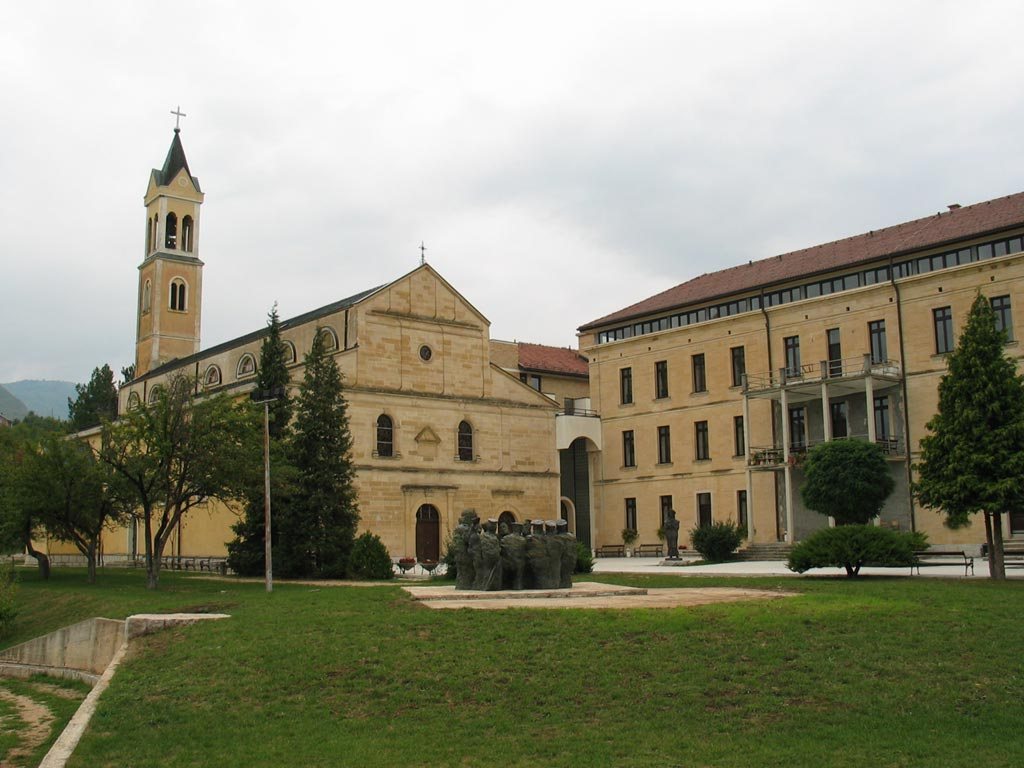
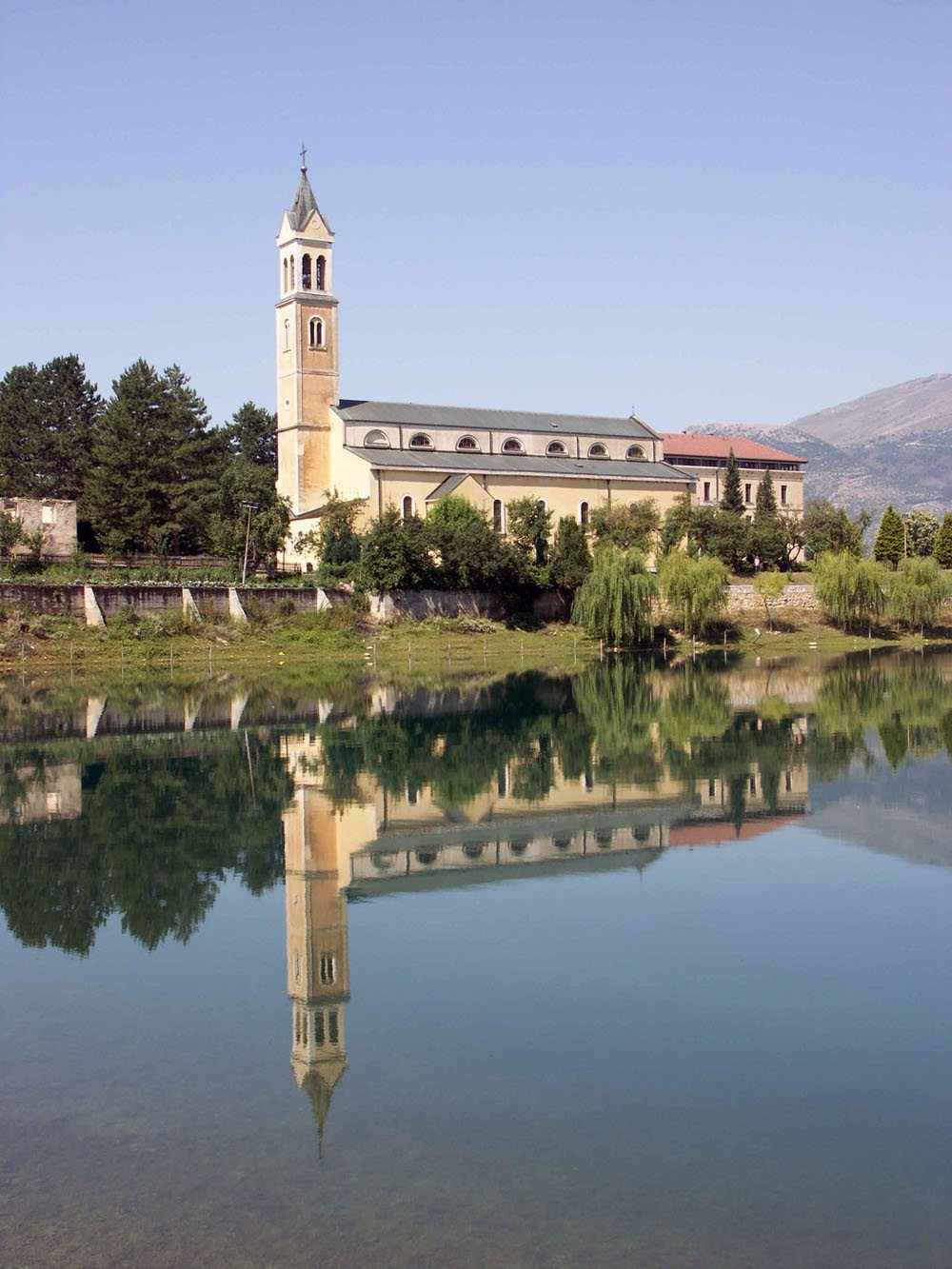
The monastery and church stand on a small peninsula above the reservoir lake. Before the lake formed, Šćit stood above a fertile valley crossed by the Rama River and its tributaries, the Buk and Krupić. The complex includes remains of the nineteenth-century monastery, later residential buildings, the church, courtyard memorial works, and collections held by the monastery.
Monastery buildings
The 1857 building
Visible walls survive from the monastery building completed in 1857 on the site’s earlier foundations. The building has been described as an example of older Bosnian architecture.
Later residence and wing
A new monastery residence was begun in 1914. Wartime difficulties delayed the first floor’s completion until 1917; the building was roofed by 1920 and finished and occupied in 1930. A further wing, begun in 1986, provides residential space. The older part of the complex was converted into a House of Peace.
Church
Building and alterations
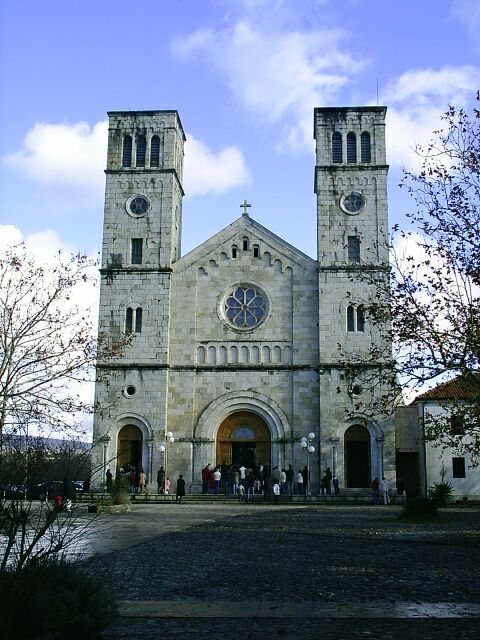
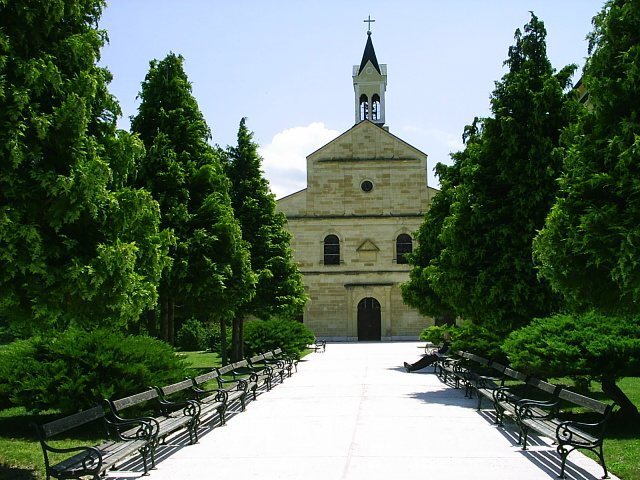
The church is a three-aisled basilica, with a central nave and an aisle on either side. It measures 43.20 by 19.20 metres, has a north–south façade orientation, and includes a bell tower 40.05 metres high. Construction began in 1873, and the principal work was complete in 1881. A sheet-metal roof and the tower were completed in 1893. The church was consecrated in 1903, when its principal altar was installed.
During postwar rebuilding, a new roof was installed in 1965 after the earlier work proved poorly executed. The central nave was raised above the columns and given semicircular windows, while a roof spanning all three aisles restored the basilican form. Two sacristies, rooms for preparing worship and keeping liturgical items, were added, and the tower was extended in 1966. Two bells cast from the former bells in 1948 stand on wooden supports. The church’s registers now survive in transcripts dating from 1884.
Art and furnishings
Painter Josip Bifel created the Stations of the Cross, a sequence of scenes recalling Jesus’s Passion, and painted the front of the choir loft in 1967. He also made an image of Saint Teresa. His central altarpiece, completed in 1968, covers 72 square metres in the sanctuary; two side paintings of Mary each cover 27 square metres. Stained-glass windows showing episodes from the lives of Mary and Jesus were made in 1967 to designs by Josip Poljan.
The church contains a marble altar table and side altars, a bronze tabernacle designed by Poljan, and paintings of Saint Francis by Lj. Lah and of the former miraculous Marian image by G. Jurkić. Earlier church holdings included two paintings by Albert de Rhoden, one showing angels returning the image of Our Lady of Sinj to Rama and the other depicting Saint Francis. The parish’s records also preserve the image’s history: it was carried to Sinj by the friars in 1687.
Courtyard memorials and monastery collections
Courtyard works
The courtyard contains the Rama Cross by Mile Blažević, a work four metres high and weighing two tonnes. Other works include Mother of Rama, Diva, The Last Supper, and Our Lady’s Gate, the last made by Kuzma Kovačić in 1998. A medallion titled Rama Martyrs, by Blažević, stands at the courtyard entrance. Plaques bearing the names of people killed in two wars were installed in 2001. Blažević made the sculpture The Mother of Rama; Diva and The Last Supper are attributed to Kovačić.
Art and ethnographic collections
The monastery gallery contains at least one hundred works, including portraits of 28 Franciscans. Its collection includes works by Đuro Seder, Josip Bifel, Nada Pivac, Kuzma Kovačić, Blaženka Salavarda, Mile Blažević, Matko Vekić, Petar Jakelić, Dražen Trogrlić, Josip Botteri, and Igor Rončević. Among its paintings are a nineteenth-century Madonna and Child by an unknown artist and Seder’s 1985 Saint Francis and the First Brothers.
The ethnographic collection includes clothing from the nineteenth and twentieth centuries, along with objects connected with farming, transporting goods, household life, and textile work.
Parish branch churches
Orašac
The parish church at Orašac was built between 1968 and 1970. Its large wall painting of Saint Nicholas Tavelić, a Croatian Franciscan missionary and Catholic saint, was made by Đuro Seder in 1990.
Podbor
The parish church at Podbor was built between 1988 and 1990. It contains a mosaic of the Blessed Virgin Mary made by V. Blažanović in 1996.