Guča Gora Monastery: A Franciscan Monastery and Church in Bosnia and Herzegovina
Site at a Glance
- Rating
- 4.8
- Popularity
- Medium
- Country
- Bosnia and Herzegovina
- Primary era
- Modern
- Eras represented
- Modern
- Civilizations
- Austria-Hungary, Habsburg, Ottoman
- Site type
- Religious
- Remains
- Monastery
On this page16 sections
History
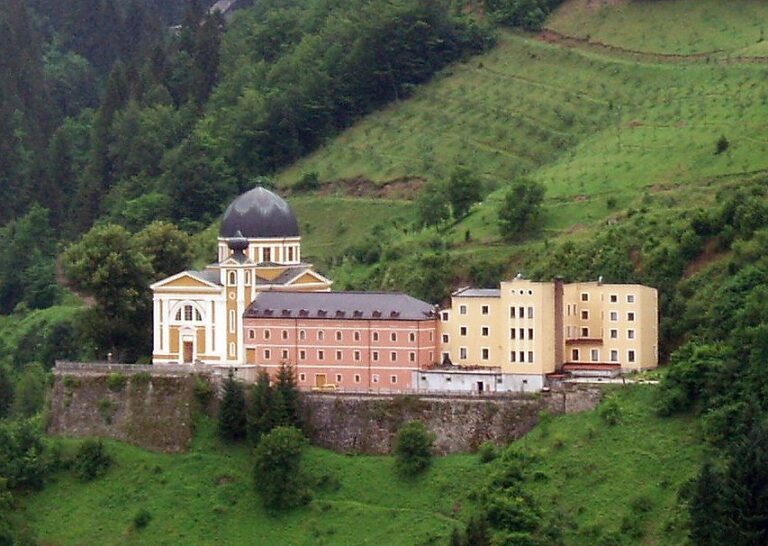
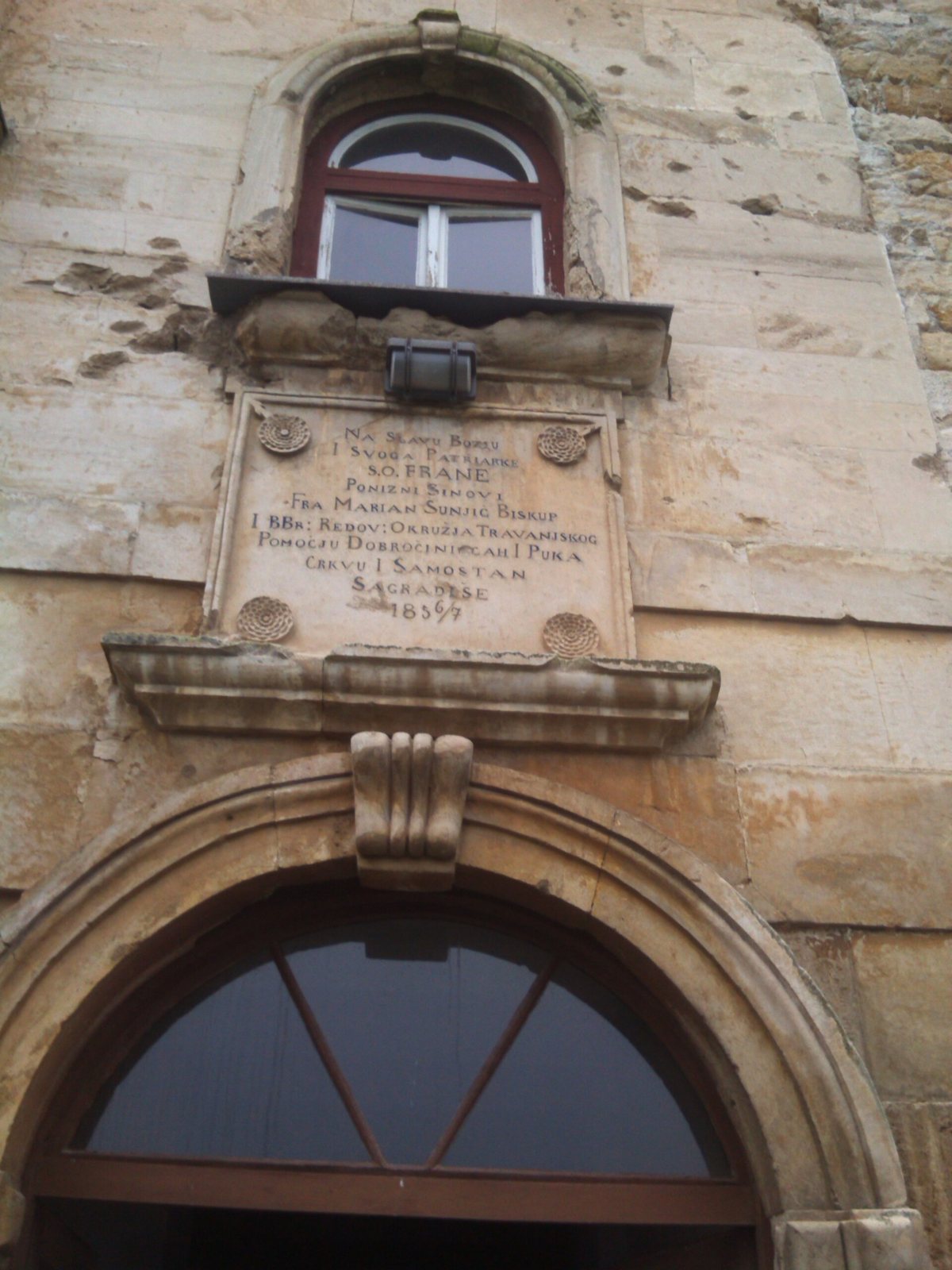
Guča Gora Monastery is a Roman Catholic Franciscan monastery and church dedicated to St. Francis of Assisi in Bosnia and Herzegovina. The Franciscans, a Catholic religious order founded by St. Francis, built the church in 1856–57 and the monastery in 1857–59. The church was replaced by a Neo-Romanesque building in 1894, and the monastery became a centre of Franciscan education as well as religious life.
Parish and foundation
As the number of worshippers in the Lašva–Travnik parish grew, it was divided in 1827 into the parishes of Dolac and Guča Gora. Guča Gora first functioned as a branch of Dolac, then became an independent parish in 1840.
In 1847, Franciscan Marijan Šunjić became provincial, the head of a Franciscan province. Together with the friar Lovro Karaula, he promoted plans for new churches and monasteries at Guča Gora and Livno. In 1851, they petitioned the Franciscan Order’s central leadership and the Catholic Church’s missionary congregation in Constantinople. They argued that existing monasteries were too cramped to train younger Franciscans. Karaula also sought approval for the monastery later built at Gorica, in Livno.
Church construction at Guča Gora began on the site of a religious residence with a parish house and chapel, but Šunjić considered the plot too small. He purchased land on a plateau above the village in 1852, then acquired an orchard and garden below the cemetery in 1854. He continued to buy and exchange adjoining parcels through 1855, securing the final one on May 16. Workers and building materials were assembled by May 1856.
The church’s foundation stone was laid on May 5, 1856, followed by the monastery’s on May 17, 1857. Ante Ciciliani of Trogir directed the work before local builder Matija Lovrinović took over. Franciscan Jako Baltić oversaw the monastery’s construction, while Šunjić is thought to have shaped the buildings’ basic design. A decree by the Franciscan Order’s worldwide superior formally established the monastery in 1859, and the friars moved in the following year. At that time, it was regarded as the largest monastery complex in Bosnia.
Education and church rebuilding
A lower Franciscan school opened in the new monastery. From 1883 to 1900, the building also housed a boys’ seminary, a school for Franciscan students. It began with three classes, adding a fourth in 1886 and a fifth in 1897; 271 students attended over its lifetime. A gymnasium library was established in 1888. The seminary moved to the Franciscan classical gymnasium at Visoko on May 22, 1900, because the monastery lacked space. A novitiate, the formation period for people entering a religious order, operated there from 1911 to 1913. Classes for the upper two elementary grades were held at Guča Gora from the early 20th century into the 1930s, and again from 1942 to 1945.
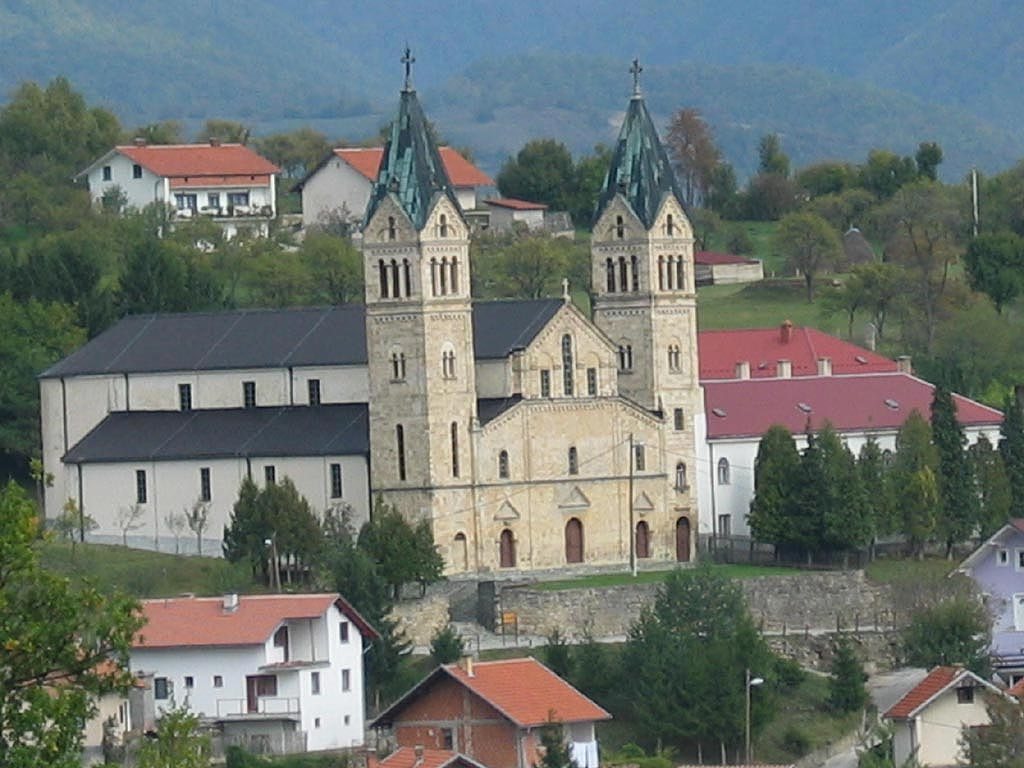
In 1894, the first church was partly demolished and replaced with a building designed by Josip Vancaš. Marko Antonini painted the new church’s interior in 1896. A bell acquired in 1900 was taken for wartime use during the First World War.
Wartime destruction and rebuilding
In February 1945, as German forces retreated from central Bosnia, 180 Circassian and Ukrainian soldiers and 11 members of the Croatian fascist Ustaše movement barricaded themselves in the monastery. Negotiations failed after three days. The Second Battalion of the 13th Krajina Brigade then attacked, setting the monastery alight with bottles of petrol. The fire destroyed the archive and library, along with much of Šunjić’s legacy, artworks, church vestments, an altar and organs.
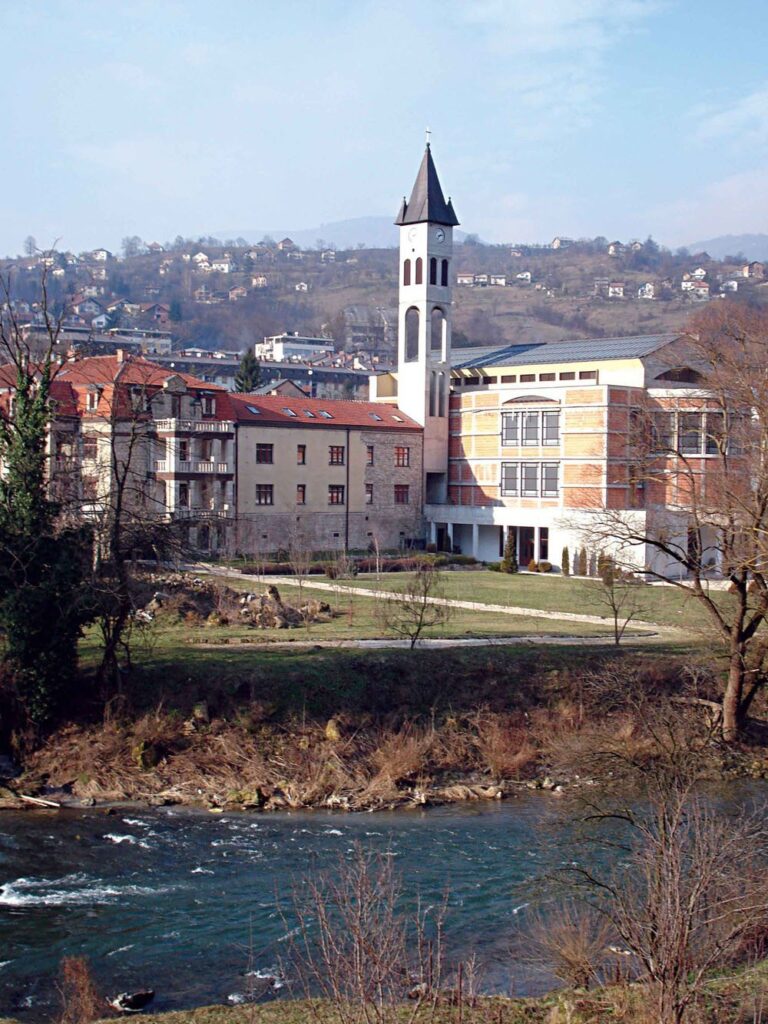
The church was roofed again in 1946. A replacement monastery was built from 1957 to 1959 on the foundations of one wing of the earlier building, following plans by Mostar architect Romeo Tiberio. In the 1970s, Srebrenka Sekulić-Grodanović designed a rearrangement of the church interior.
In autumn 1992, priests moved the most valuable artworks and church documents to Proložac in Croatia. On June 11–12, 1993, the El Mudžahid unit damaged the monastery, and plans were made to demolish the church. On June 16, military police of the Army of the Republic of Bosnia and Herzegovina took control of the monastery and set up the command post of the 306th Mountain Brigade, part of the army’s 3rd Corps. The building also served as a prison for a time. Members of El Mudžahid, the 7th Muslim Brigade and the 17th Mountain Brigade were linked to vandalism and damage to the church and monastery. The monastery’s library, which held 8,000 titles, was taken. Restoration of the church and monastery began after the 1994 return. The monastery is on Bosnia and Herzegovina’s provisional list of national monuments.
Remains
Monastery complex
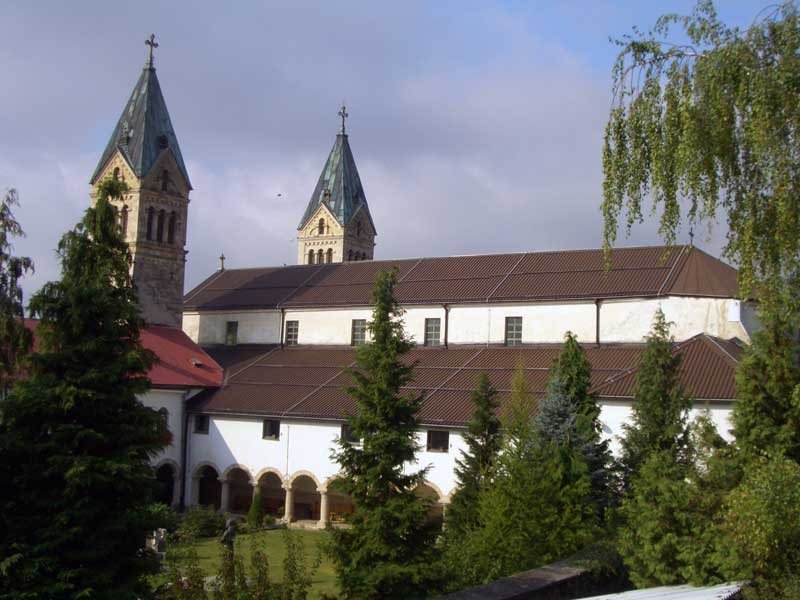
Before the 1945 fire, three residential wings and the church enclosed a square cloister, an enclosed courtyard edged by covered walks, with 58 columns around it. The monastery was a two-storey white building, with gardens, fields and groves around the complex. The replacement monastery, built in 1957–59 on the foundations of one wing of the old structure, forms part of the surviving fabric; the complex was later restored.
Church
Building and towers
The church was modelled on Trogir Cathedral. Vancaš’s replacement, built in the Neo-Romanesque style, has two bell towers, while the earlier church had one. The building was roofed again after the 1945 fire, and its interior was rearranged in the 1970s.
Bells and organs
The church has three bells. One acquired in 1900 weighed 741 kilograms before it was requisitioned during the First World War. The church received new organs in 1889 from the Zupan Brothers firm in Carniola; they had six registers, or sets of pipes producing particular tones. A different organ set, installed in 1990, had 12 registers. Built between the two world wars, it had been donated by a German parish in Neuffen and restored in Zagreb. The organs were destroyed during the Bosnian War.
Altars and church artwork
Five altars came from the workshop of Ferdinand Stuflesser in Tyrol. Zdenko Grgić made the church’s copper reliefs of the Stations of the Cross and a copper relief of St. Francis. Ivo Dulčić created the fresco Our Lady of Sorrows and the mosaic Healing of the Blind Man. Zlatko Keser’s large image of Christ Pantocrator occupies the apse wall in the presbytery, the part of the church around the altar. A 1977 altar fresco by Keser measured 40 square metres and was damaged during the Bosnian War.
Damage from the 1993 attack
The church’s commemorative plaques were destroyed during the 1993 damage. Benches and confessionals were broken, and insulting graffiti was placed on the walls and columns.
Artworks, records and sculpture
Art collection
The monastery’s collection contains more than 300 works of contemporary visual art. Artists represented include Gabrijel Jurkić, Ivan Meštrović, Mica Todorović, Muhamed Kulenović, Mersad Berber, Edo Murtić, Ivan Lacković Croata, Mario Mikulić, Ankica Oprešnik, Behaudin Selmanović, Ljubo Lah, Mirko Čurić, Josip Generalić and Petar Waldegg.
Older paintings
Eight older paintings are preserved at the monastery. They include a 1796 image of an unidentified saint, a Madonna with Jesus and a Baroque Madonna, both dating to the late 18th or early 19th century, and Alexander Maximilian Seitz’s 1887 painting Saint Elijah on a Chariot of Fire.
Chronicle and parish registers
Jako Baltić’s 19th-century chronicle survives alongside parish registers containing baptism, death and marriage records. The first baptism register, dating to 1766, is written in Bosančica, a historical form of Bosnian Cyrillic.
Statue of St. Francis
A life-size bronze statue of St. Francis by sculptor Ivan Križanac, made in 1985, stands in the monastery grounds. It sustained damage in several places during the Bosnian War.