Tianlongshan Grottoes: A Buddhist Cave Complex in China
Site at a Glance
- Rating
- 4
- Popularity
- Very Low
- Country
- China
- Primary era
- Medieval
- Eras represented
- Medieval, Modern
- Civilizations
- Tang
- Site type
- Religious
- Remains
- Sanctuary
On this page11 sections
History
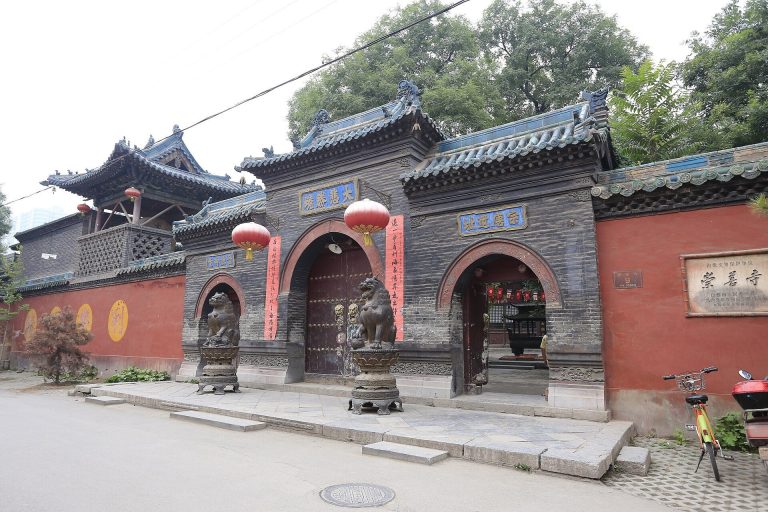
The Tianlongshan Grottoes are a Buddhist cave complex in Taiyuan, China. Carving began around the middle of the sixth century, during the transition from Northern Wei to Eastern Wei rule, and continued under the Northern Qi, Sui, and Tang. The grottoes became a focus of royal, aristocratic, and local official support for Buddhist temples and sculpture, in part because they lay near Jinyang, an ancient city in the area of present-day Taiyuan.
Eastern Wei and Northern Qi patronage
After the Northern Wei divided in 534, the powerful official Gao Huan used Jinyang as a political and military base for the Eastern Wei, a regime that ruled from 534 to 550. His government maintained a summer retreat at Tianlongshan. When Gao Yang founded the Northern Qi in 550, Jinyang became a secondary capital and a center of activity for the imperial family. This change ushered in a major phase of building at the grottoes.
Historical records and later inscriptions credit Northern Qi emperors with founding temples at the site. Emperor Wenxuan, also known as Gao Yang, was associated with the Buddha Rock Cave Temple, while Emperor Xiaozhao was credited with the later Tianlong Cave Temple. Buddhist activity was curtailed under the Northern Zhou ruler Emperor Wu, whose anti-Buddhist policy restricted the religion. It resumed after the Sui reunified China in 581 and renewed support for Buddhism.
Sui renewal and Tang expansion
The Sui period brought further cave construction, including work on Cave 8. The Tang became the most extensive and artistically important building phase. Jinyang, then known as the Northern Capital, was associated with the Tang dynasty’s origins. Members of the imperial family, officials, aristocrats, and Buddhist monks commissioned caves and images. Most of the surviving caves date to the reigns of Wu Zetian and Tang Xuanzong.
Continued worship after the Tang
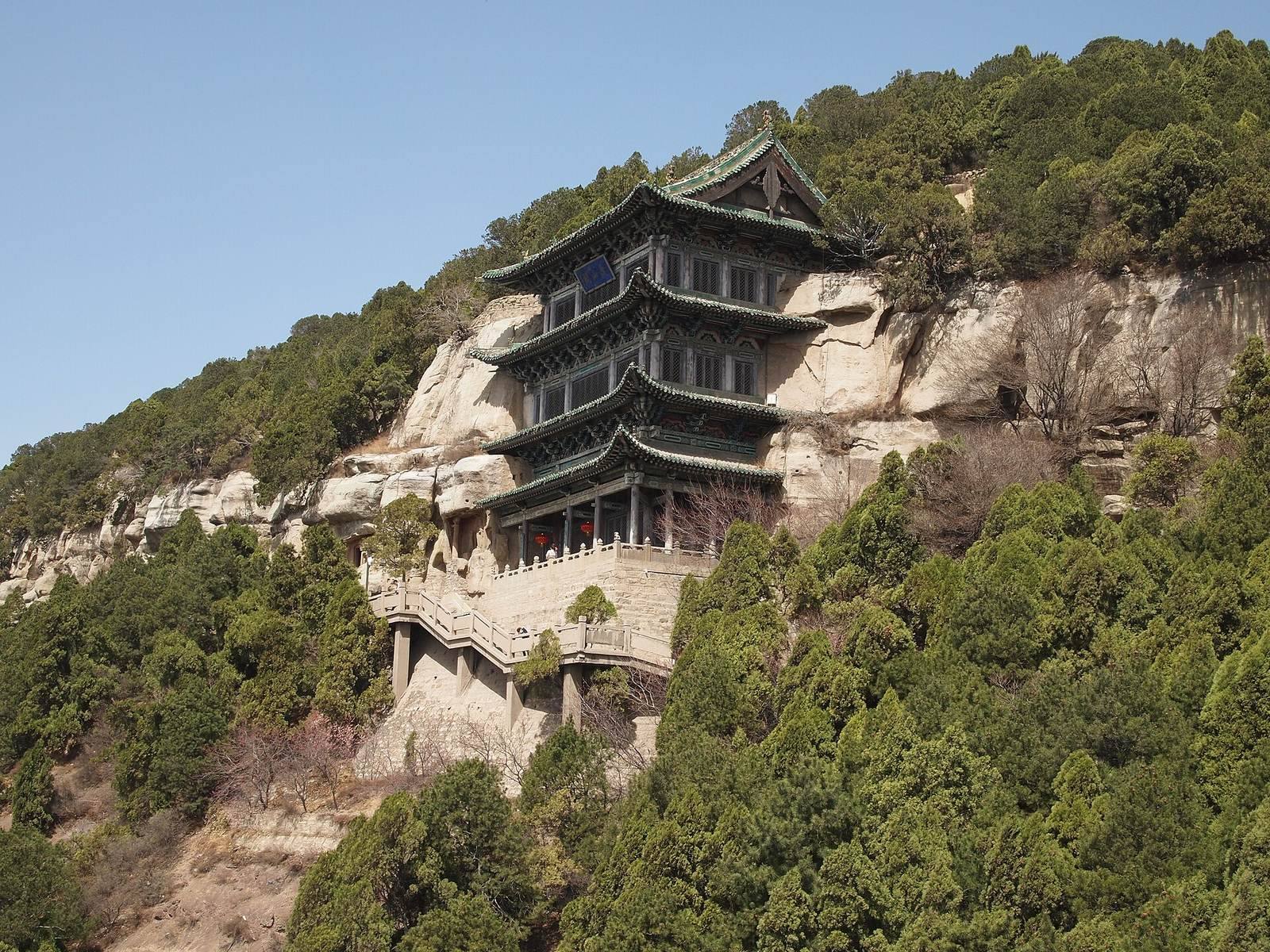
Large-scale cave building ended after the Tang, but worship continued at the temples and before the existing images. An inscription records repairs in 975, during the Northern Han, a separate regional kingdom, to a large timber building that sheltered the sculptures in Cave 9. A Buddhist hall was also built and an iron Buddha cast. Ming-period records and inscriptions describe further repairs to the temples and cave buildings.
Modern study and sculpture removals
German sinologist Ernst Boerschmann surveyed the caves and temple buildings in 1908. Japanese architectural historian Sekino Tadashi examined the site in 1918 and published his findings in the art journal Kokka in 1921, drawing international attention to the grottoes. Japanese scholars carried out a systematic survey, photography, and numbering in 1922. An album published later preserved images of many sculptures before they were looted. Those photographs have since helped researchers identify the original settings of displaced works and support digital reconstruction and recovery efforts.
Extensive looting in the 1920s removed Buddha and bodhisattva heads and hands, donor figures, and complete sculptures. Some bodies and heads were separated for sale. Japanese art dealer Yamanaka Sadajirō and his firm, Yamanaka & Company, were among the principal buyers and traffickers. More than 240 sculptures and fragments are estimated to have been taken; at least 150 entered museums or private collections in the United States, Japan, the United Kingdom, France, Germany, and Switzerland. Incomplete early transaction records leave the original caves of some displaced sculptures uncertain.
Protection and recovery
After the founding of the People’s Republic of China, heritage authorities surveyed and numbered the grottoes, stabilized the rock, built paths along the cliffs, and protected cave eaves. In 2001 the complex was designated a Major Historical and Cultural Site Protected at the National Level. Its protected area includes caves on both peaks, Tianlong Temple, and related historic remains.
A digital reconstruction project involving the Tianlongshan Grottoes Museum in Taiyuan, Taiyuan University of Technology, and the University of Chicago’s East Asian Art Research Center began in the 2010s. Researchers compared three-dimensional records of displaced sculptures with early twentieth-century photographs. By 2024, the project had recorded more than 100 displaced works and digitally reconstructed 11 major caves to varying degrees.
In September 2020, China’s National Cultural Heritage Administration halted a planned Japanese auction of a Tang-period Buddha head after experts identified it as the principal image in a north-wall niche in Cave 8. Historical photographs and analysis of the stone and form supported the identification; the head had probably been removed around 1924. Chinese expatriate Zhang Rong negotiated its purchase and donated it to the Chinese government. It arrived in Beijing in December 2020, the first Tianlongshan sculpture recovered from Japan in nearly a century.
Remains
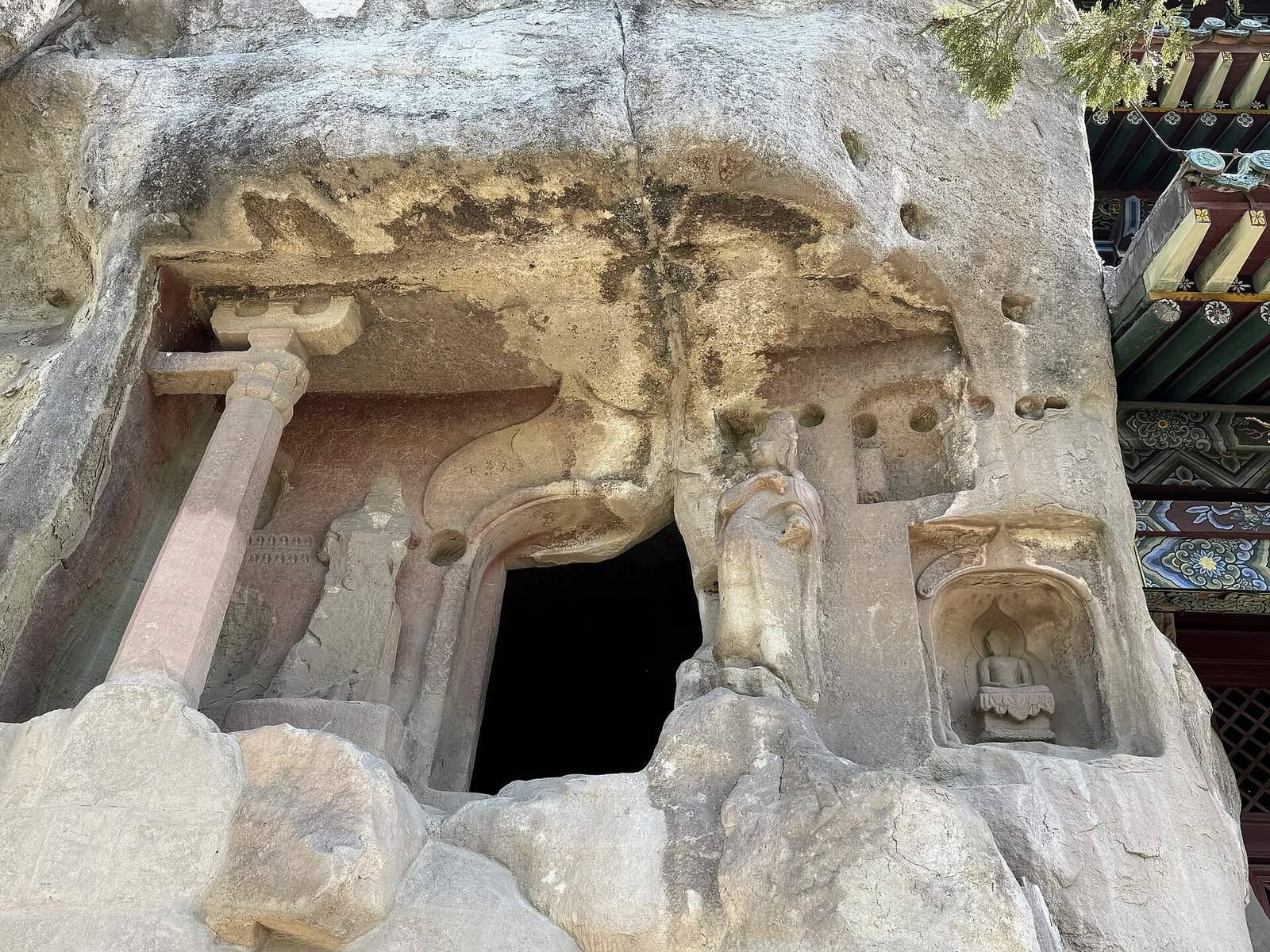
The grottoes extend about 500 metres from east to west along south-facing cliffs on Tianlong Mountain’s eastern and western peaks, west of Taiyuan. There are 21 caves, eight on the eastern peak and 13 on the western. More than 500 images survive; many are stone sculptures with traces of paint.
Caves 2 and 3
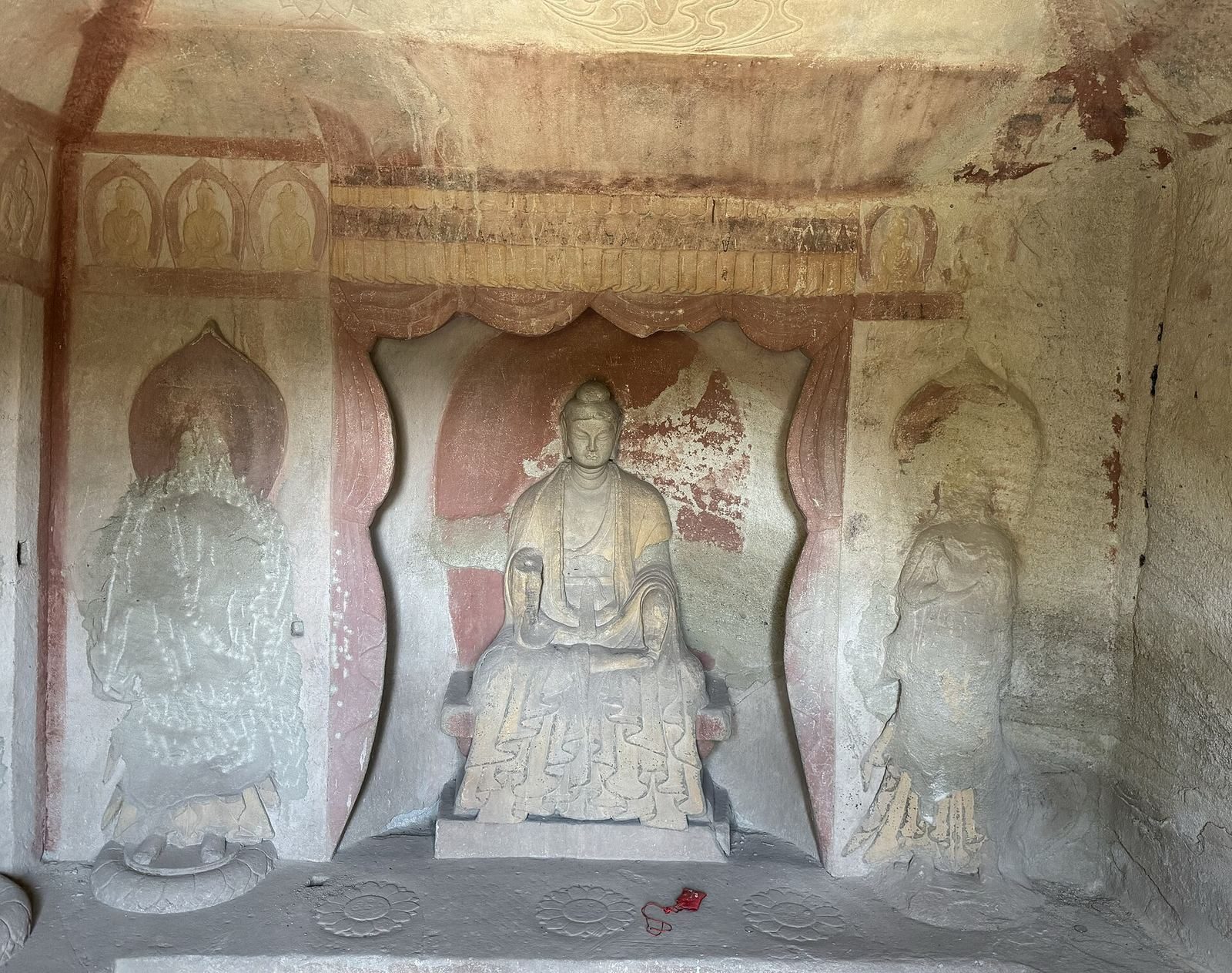
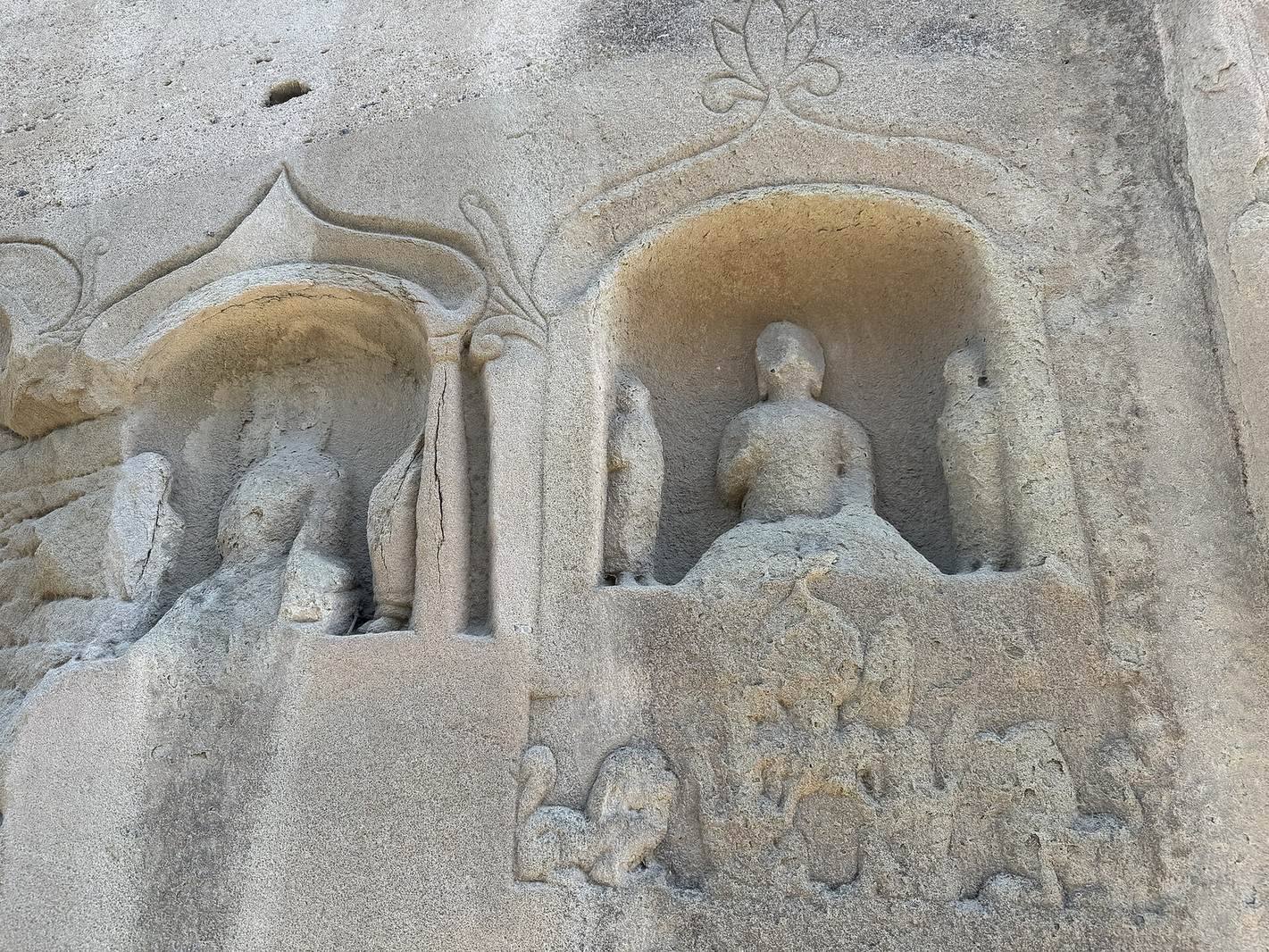
Caves 2 and 3 are generally considered the earliest group. Their plans are usually square, with image niches on three walls and a seated Buddha as the principal figure. Other figures can include bodhisattvas, Buddhist beings devoted to enlightenment and helping others, disciples, Vimalakirti, a celebrated Buddhist lay figure, and Manjushri, a bodhisattva associated with wisdom. Shallow ceiling carvings show lotus flowers, heavenly attendants, and cloud patterns. The slender figures and closely spaced folds in their robes retain late Northern Wei conventions while also reflecting Buddhist art associated with Ye, the Eastern Wei capital in present-day Hebei.
Cave 8
An inscription in front of Cave 8 dates the beginning of its construction to 584. The cave has front and rear chambers and a central pillar, a column incorporated into the interior. Its projecting eaves imitate timber construction, and image niches are cut into the pillar and all four walls. The plan bridges caves organized around a central pillar and later caves arranged like Buddhist halls. Its figures have rounded faces, fuller bodies, and softly carved drapery, combining Northern Dynasties traits with emerging Tang characteristics. The recovered head of the principal image in a north-wall niche is 44.5 centimetres high and weighs 55.5 kilograms. Its rounded face and smiling mouth retain traces of pigment.
Tang-era sculpture
Tang caves are concentrated mainly on the western peak, with Caves 9, 14, and 18 among the representative examples. Their figures have full bodies, natural proportions, and thin drapery that follows the form. Buddhas have composed expressions, while bodhisattvas appear seated or standing in curved poses and wear necklaces, beaded ornaments, and armlets. This naturalistic approach and its distinctive regional character are associated with the Tianlongshan style.
Cave 9
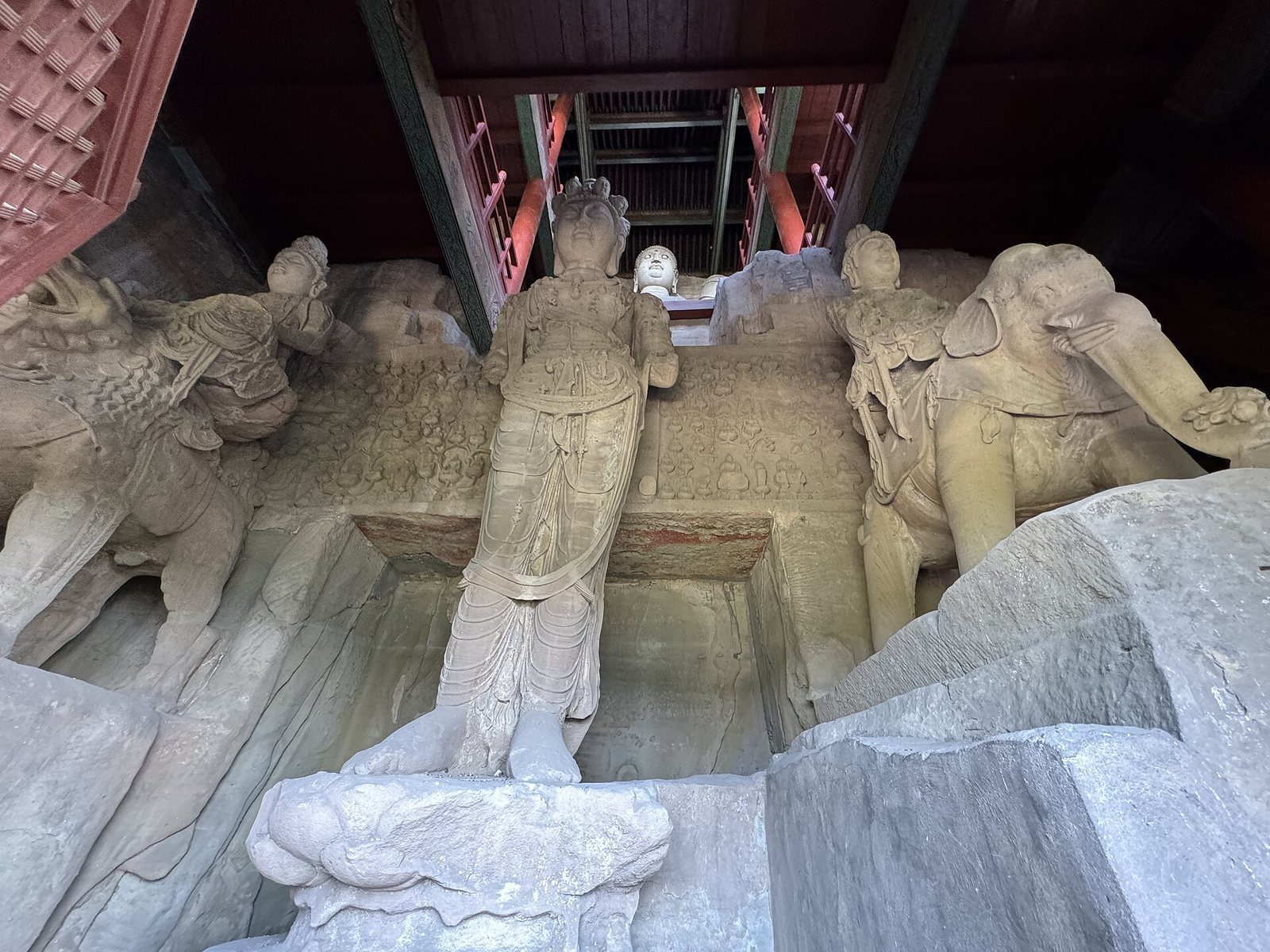
Cave 9, also called Manshan Pavilion, is a large group of sculptures carved into the open cliff. On the upper level, a seated Maitreya, the future Buddha, measures about 7.5 metres high. Below, an eleven-faced Guanyin, a bodhisattva associated with compassion, stands about 5.5 metres high at the centre. Manjushri, linked with wisdom, rides a lion on one side, while Samantabhadra, associated with practice and vows, rides an elephant on the other. A large timber building was constructed to shelter the sculptures.