Old St Andrew’s Church: A Medieval Gothic Church in Brent
Site at a Glance
- Popularity
- Medium
- Country
- United Kingdom
- Primary era
- Medieval
- Eras represented
- Medieval, Modern
- Civilizations
- British, English
- Site type
- Religious
- Remains
- Church
On this page11 sections
History
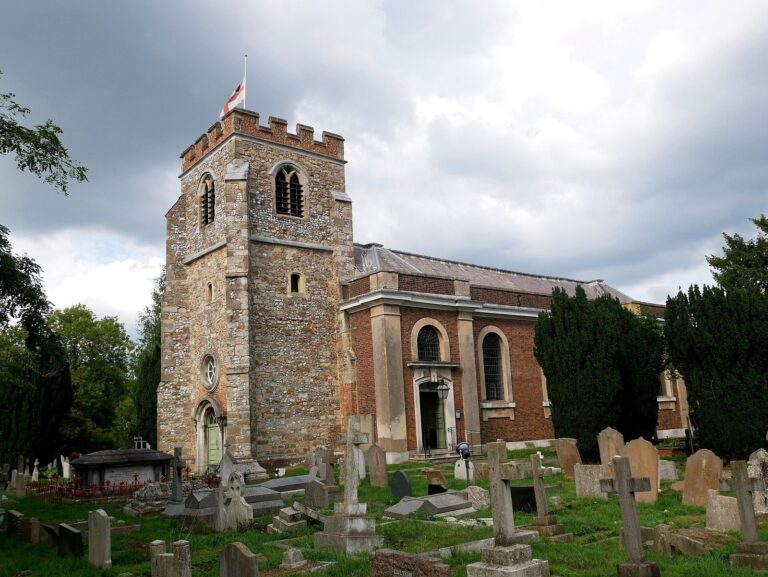
Old St Andrew’s Church is a medieval Gothic church in the London Borough of Brent, United Kingdom, with its foundation dated to 1150. The present building dates from the 12th or 13th century, and an earlier church may have stood on the site in the Saxon period. Old St Andrew’s is considered the oldest standing building in Brent.
Foundation and medieval use
By about 1244–48, the church had been assigned to the Hospital of St John of Jerusalem, a medieval institution associated with the Order of St John, known for charitable and military work. In 1393, its dedication was extended to include John the Baptist alongside Saint Andrew. Further additions and changes followed in the 14th and 15th centuries. By 1796, the church had fallen into a dilapidated condition.
Restoration and parish changes
A major restoration in 1840 altered the building: workers removed the south porch, roof bosses and rood screen, coated the exterior in roughcast, added a gallery and built a brick vestry. The bellcote, a small structure that houses bells, was rebuilt in 1870. In 1884, a new parish church dedicated to the Holy Innocents was built, and Old St Andrew’s became its chapel of ease, a secondary place of worship for people who found the main church inconvenient to reach.
The vestry was removed in 1888 and replaced by one on the north side. The roof was retiled in 1906, and the church was restored again in 1955. By the late 1920s, population growth had made the Holy Innocents church too small. In 1933, a church dedicated to Saint Andrew was erected close to the old building. First built in Wells Street, Marylebone, in 1847, it was dismantled, transported to Kingsbury and rebuilt there.
Later use and preservation
Old St Andrew’s was declared redundant on 1 April 1977. The Church of England permitted it to be used for worship by the growing Romanian community in north-west London in 2008. In 2010, the church was vested in the Churches Conservation Trust, a charity that cares for historic churches. The Romanian Orthodox Church received a 20-year lease in 2012, and the building remains active as a Romanian Orthodox church. Formerly Anglican, it now serves a congregation within the Eastern Orthodox tradition.
The church received Grade I listing in 1952. This is England’s highest listed-building category, reserved for buildings of exceptional interest.
Remains
Church building and layout
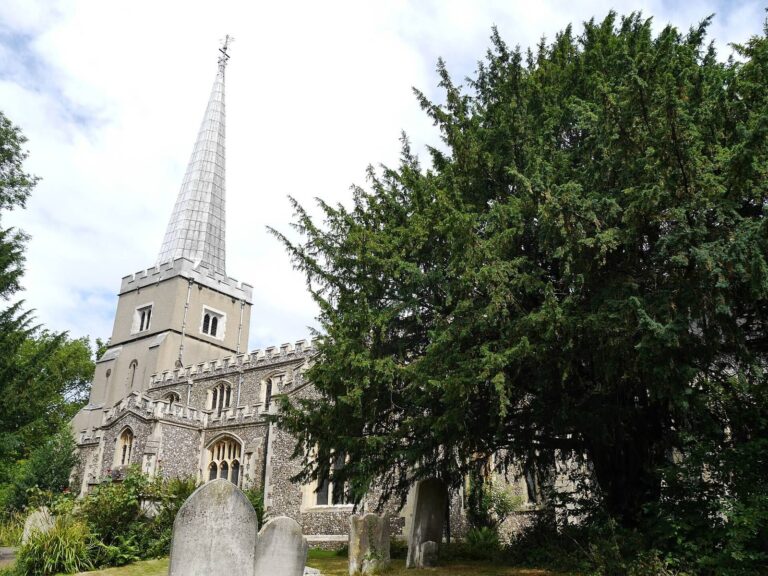
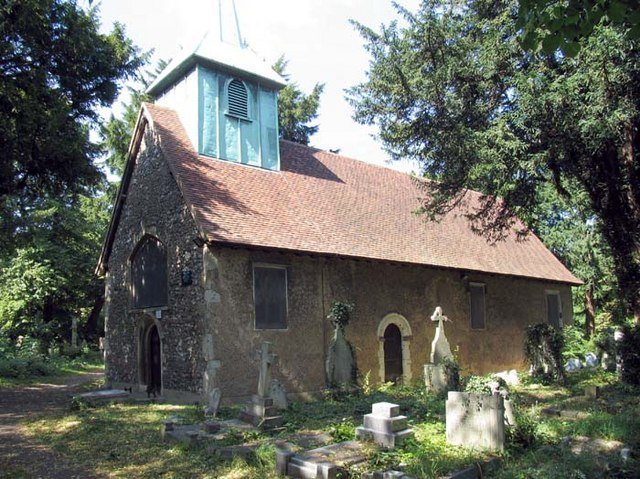
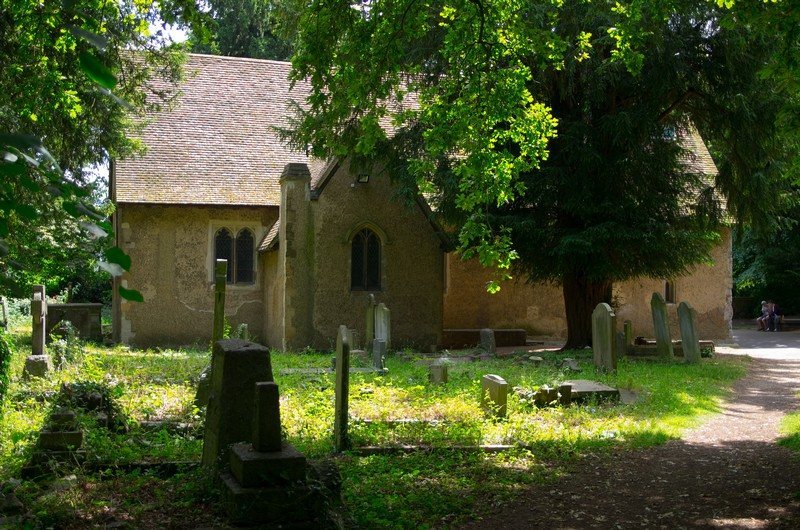
The Gothic church is built of rendered flint rubble, with some Roman bricks and tiles incorporated into its fabric. Its main worship area, the nave, and the chancel, the area around the altar, form one continuous space. A vestry stands on the north side, while a turret at the west end rises to a spire.
Interior furnishings
Font
The font probably dates from the 13th century. Its circular bowl has an octagonal rim and rests on a modern pedestal.
Lectern
An oak lectern from the 17th century remains in the church. W. E. Gladstone, the 19th-century British prime minister, used it to read a lesson during a visit.
Bells and brasses
The church contains three brasses, the earliest dated 1520, and three bells dating from about 1350, 1604 and 1708.
Churchyard memorials
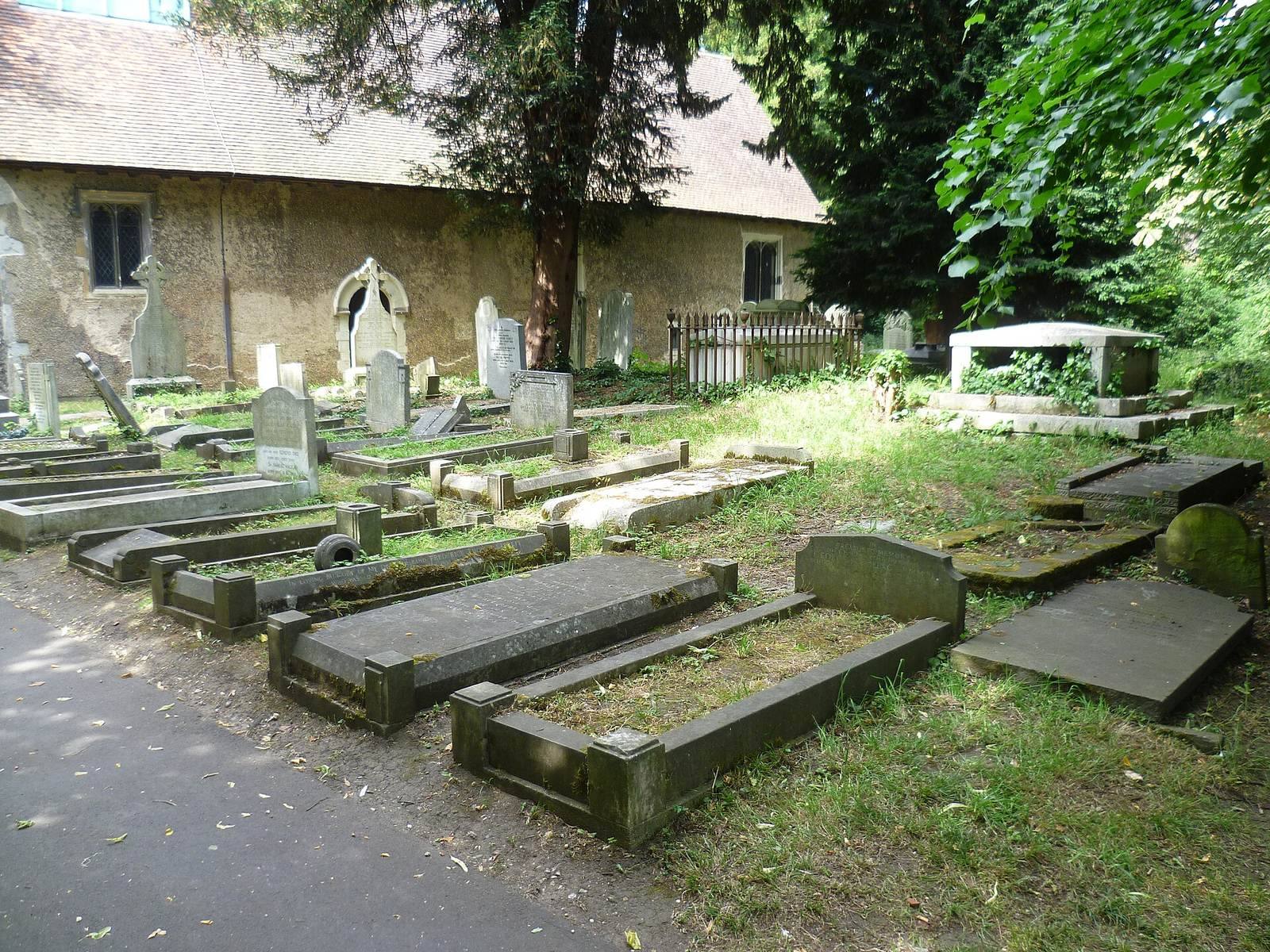
Six memorial structures stand in the churchyard. Tombstones commemorate Timothy and Henry Wetherilt, both of whom died in 1741, Thomas Raworth, who died in 1744, and the American painter Edwin Austin Abbey, who died in 1911. The churchyard also contains a monument to William Frederick Ashton, who died in 1802, and a chest tomb for Joseph Finch, who died in 1776.