Church of St Julian, Norwich: A Medieval Parish Church Associated with Julian of Norwich
Site at a Glance
- Rating
- 4.7
- Popularity
- Low
- Country
- United Kingdom
- Primary era
- Medieval
- Eras represented
- Medieval, Modern
- Civilizations
- Anglo-Saxon, British, English
- Site type
- Religious
- Remains
- Church
On this page10 sections
History
The Church of St Julian, Norwich, is a medieval parish church in Norwich, United Kingdom, founded in the 11th century and built mainly during the 11th and 12th centuries. A church on the site was destroyed during a Viking attack in 1004. St Julian’s later became associated with Julian of Norwich, a mystic who lived in a religious cell attached to the church.
Early church and medieval parish
The church’s original dedication is uncertain. It may have been named for Julian the Hospitaller, a saint associated with hospitality, or Juliana of Nicomedia, an early Christian martyr. Alan Butler, chaplain to Edward Howard, 9th Duke of Norfolk, proposed Julian of Le Mans, traditionally regarded as a bishop. Norwich stonemason Robert Flood rejected that suggestion in 1936.
In 1135, King Stephen placed St Julian’s under Carrow Priory, a religious community of nuns. Its prioress, the head of the community, and the nuns maintained the church and appointed its priest. From 1269 to 1305, the parish of the nearby church of St Edward King and Confessor, named for the king and saint also known as Edward the Confessor, was united with St Julian’s.
Julian of Norwich and the anchorites
Medieval Norwich was wealthy, with a prosperous and densely settled hinterland. By the mid-14th century, its population was probably approaching 25,000, and it may have been England’s second-largest city after London. Trade with the Low Countries and the Rhineland probably brought the region into contact with religious ideas circulating in northern Europe. Norwich also had an unusually large number of anchorites, people who withdrew from ordinary life for religious devotion. A woman who lived in such enclosure was called an anchoress.
In the later Middle Ages, Julian of Norwich lived in a cell attached to St Julian’s, then in an industrial district near the quays of the River Wensum. She was born in 1342 or 1343, and is thought to have died after 1416, although her death date is unknown. Her name may have come from the church, but Julian was a common girls’ name in the 14th century and was probably her own.
Julian is the first woman whose writings in English have survived. Her work, commonly called Revelations of Divine Love, survives in a Short Text and a Long Text. The earlier Short Text followed 16 mystical revelations she experienced after recovering from an illness that had brought her close to death. Edith Wilton, a prioress of Carrow, may have supplied her with writing materials. In 1428, another anchoress, Julian or Juliana Lampet, took up residence in the cell and lived there for 50 years.
Reformation and decline
The English Reformation, a religious and political transformation that included the dissolution of religious houses, brought major changes. The cell was demolished in the 1530s, and Carrow Priory was dissolved. No rector, or parish priest, was appointed to St Julian’s for 45 years, until Gawin Browne took the position in 1581.
During the 18th century the church deteriorated as funds dwindled, while merchants left the surrounding area. By 1845 it was in poor repair and no longer used for services. The collapse of part of the chancel that year prompted restoration. The tower was repaired in 1934 after it had become endangered by the beginning of the 20th century.
Wartime destruction and rebuilding
On 27 June 1942, during the Norwich Blitz, German aircraft attacked the city with incendiary and high-explosive bombs. One high-explosive bomb struck St Julian’s directly, destroying almost the whole church apart from the north wall. Of the five Norwich churches destroyed during the Second World War, it was the only one to be rebuilt. The reconstructed church reopened in 1953, with a chapel taking the place of the former anchorite’s cell. The bell, damaged when it fell during the bombing, was repaired and rehung in 1992.
St Julian’s remains an active Church of England parish church in the parish of St John the Baptist, Timberhill with St Julian’s. It lies in the Diocese of Norwich, a church territory overseen by a bishop, within the Norwich East deanery and Norwich archdeaconry, administrative subdivisions of the diocese. The church received Grade I listed status in 1954, the highest grade of statutory protection for historic buildings in England, reserved for buildings of exceptional interest.
Remains
Medieval fabric and plan
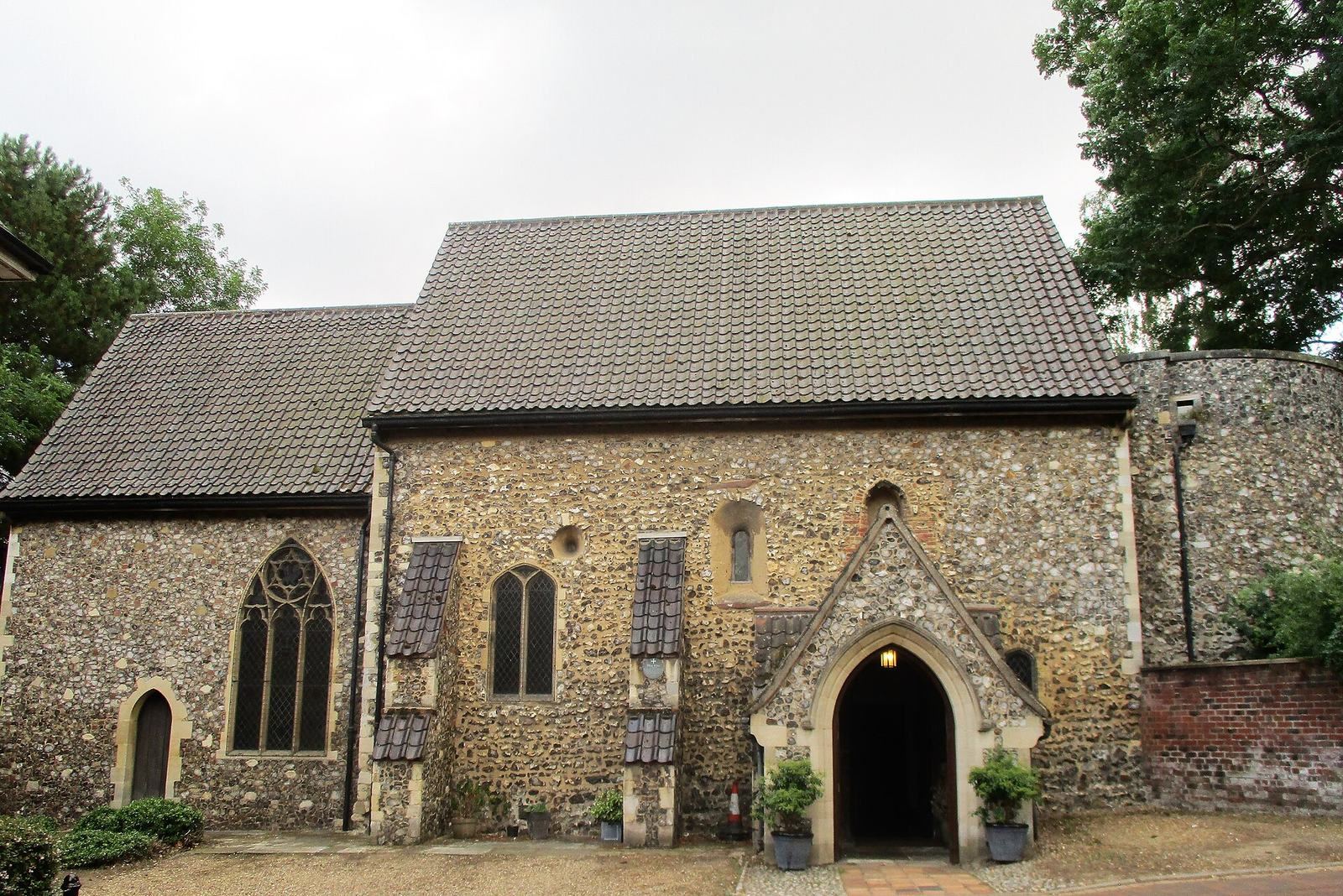
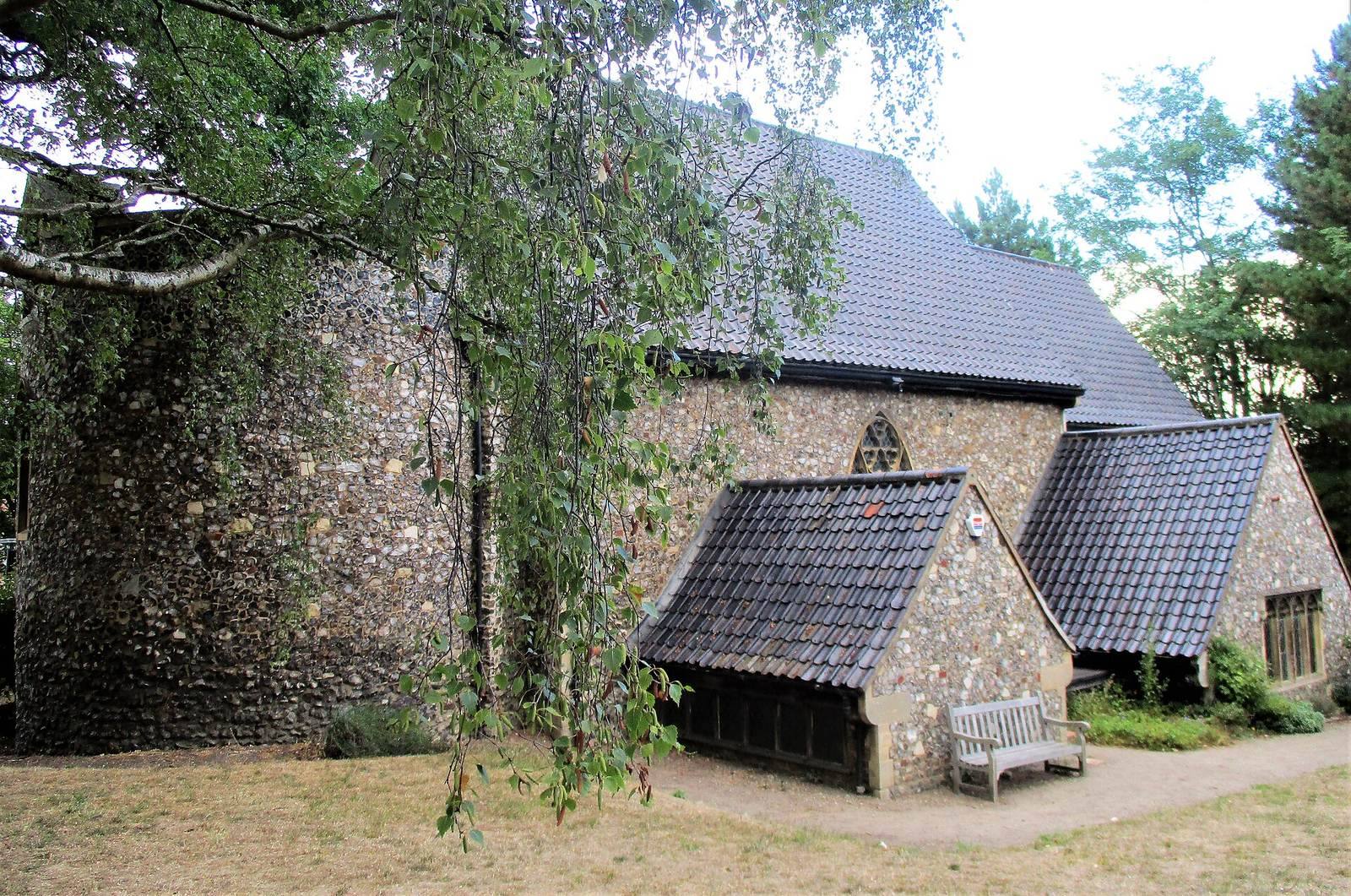
The compact church is built of flint with stone and brick dressings and has a pantile roof, made of curved tiles. Its plan includes a nave, the main body of the church; a chancel, the area around the altar; a circular tower at the west end; a south chapel; and a vestry. Much of the surviving medieval fabric belongs to the 11th and 12th centuries and incorporates Late Anglo-Saxon features, from the later period of Anglo-Saxon England before the Norman Conquest. Three such windows remain in the north wall, revealed during repair work; two are circular.
The anchorite’s cell and churchyard
The cell was attached to the church. Its doorway into the church would have been sealed when Julian entered the enclosure, while a small window allowed her to witness Mass, the Christian service centered on the Eucharist. There may also have been a window through which visitors could speak with her. Stonework thought to have come from the cell was recovered from the churchyard in 1906. Archaeological work east of the churchyard in 2014 and 2015 uncovered medieval features, including graves, and established that the churchyard once extended east to King Street. That eastern ground had been developed by the 17th century, though the date of development is unknown.
Nineteenth-century alterations
By 1827, most of the east window had been blocked. Broken pieces of coloured glass lay on the floor, and Mrs Gunn made 15 drawings from them. Norfolk artist James Sillett also drew the church that year. The 1845 restoration blocked the priest’s door, removed the interior fixtures and added a vestry on the south side. Medieval wall paintings and biblical texts were painted over or destroyed; the tower was lowered, and a new east window was installed. By 1860, thatch on the roof had been replaced with tiles.
Postwar rebuilding and furnishings
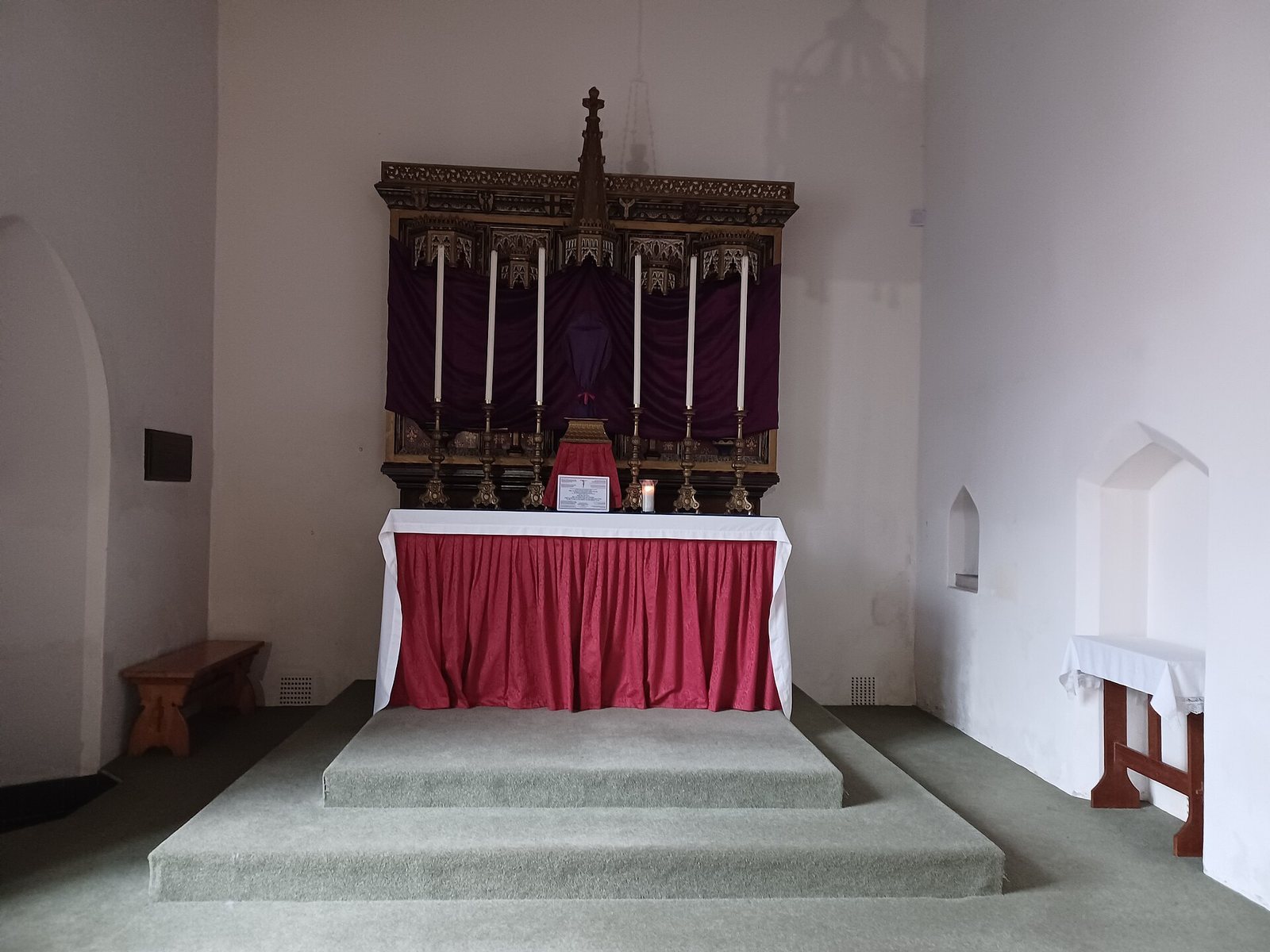
The circular tower was not restored to its former height after the wartime destruction and now ends level with the top of the nave. A south chapel and sacristy, a room used by clergy and for storing items for worship, were added in the 1950s, along with a single-storey porch. A doorway in the Norman architectural tradition, associated with Norman rule in England after the Conquest, was brought from the destroyed church of St Michael at Thorn and incorporated between the nave and chapel.
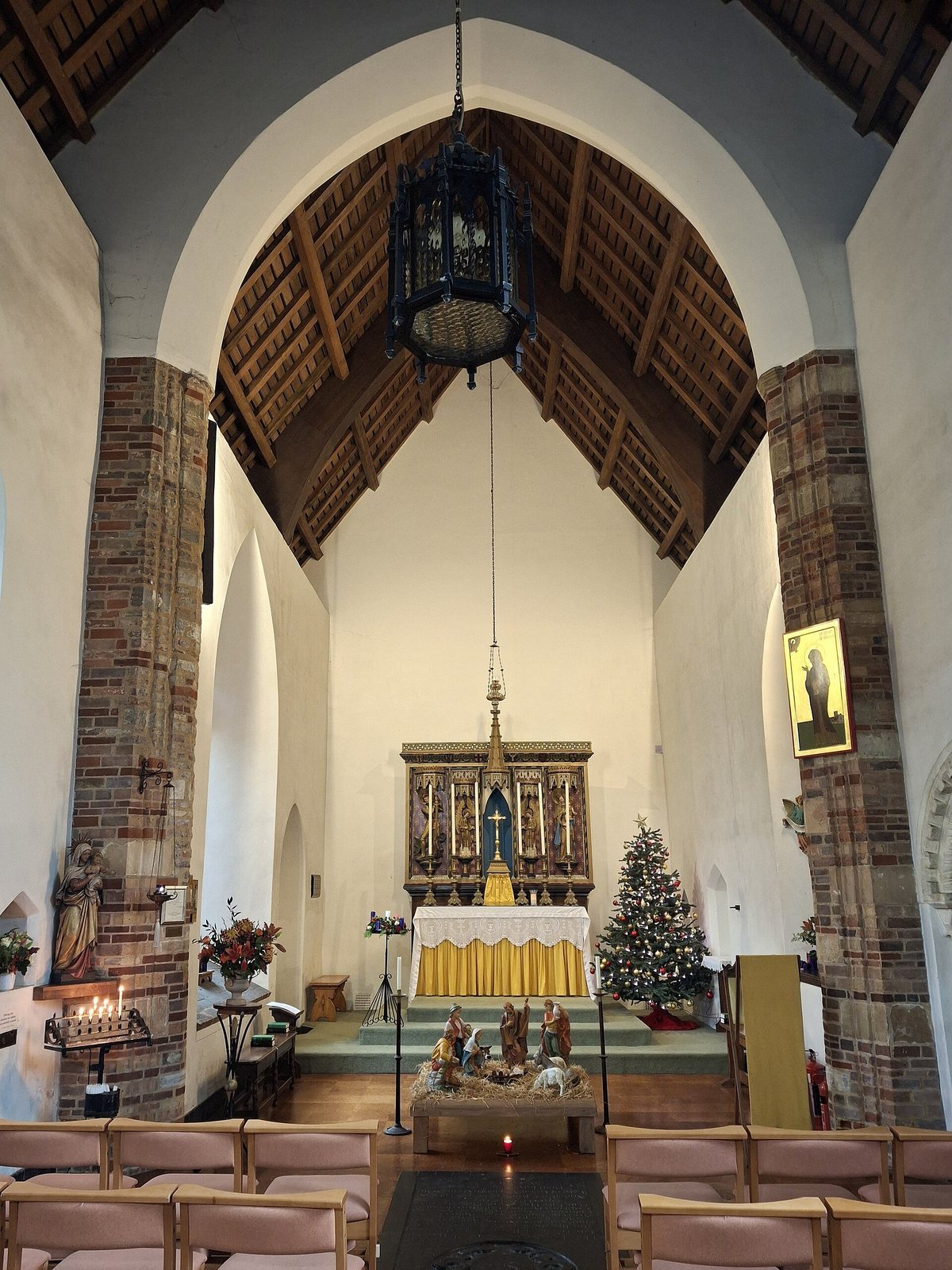
The church bell was cast in 1450 by bellfounder Richard Brayser. Its inscription means “Hail, full of grace; the Lord is with you,” and it is among Norwich’s oldest bells. The present octagonal font replaced one destroyed in the 1942 bombing and was transferred from the redundant All Saints’ Church in 1977. Its eight standing figures represent the Apostles, Jesus’s principal early followers, the archangel Michael, Saint George, a saint and martyr, and two other saints.
An organ made in 1860 by Henry Jones of London was installed at St Julian’s in 1966. It was first built for a house in Abbess Roding, Essex, and later found in a warehouse in Chelmsford, where it was rebuilt.