High Pasture Cave: A Prehistoric Archaeological Site on the Isle of Skye
Site at a Glance
- Rating
- 3
- Popularity
- Very Low
- Country
- United Kingdom
- Primary era
- Iron Age
- Eras represented
- Iron Age, Medieval
- Civilizations
- Unclassified
- Site type
- Religious
- Remains
- Sanctuary
On this page11 sections
History
High Pasture Cave is a prehistoric cave site near Kilbride on the Isle of Skye, United Kingdom. Human activity there reaches back about 6,000–7,000 years, to the Mesolithic, a period associated broadly with stone tools. Arrowheads point to visits by nomadic hunters. Use continued intermittently during the Neolithic, associated with farming and settled communities, and the Bronze Age, associated with bronze technology.
Prehistoric use and closure
A later phase of cave use is broadly dated to about 1200–200 BC. By around 800 BC, the site appears to have become more frequently used. A large hearth was established outside the entrance, possibly for ceremonies or the deposition of personal belongings. Iron Age remains, from a period associated with iron technology, have been interpreted as evidence of ritual reverence for the landscape or deities connected with the place.
As ash accumulated over the following centuries, it threatened to obstruct the entrance. A staircase was built to maintain access, and activity continued until about 40 BC. Around that time, boulders and earth were used to fill the staircase. The remains of a woman, a fetus estimated to have been four to five months old, and a child estimated to have been nine to ten months old were placed on the fill, apparently to prevent further access to the cave.
Medieval reuse
After a period of about 1,500 years without use, the site was occupied again in the Middle Ages. It served for shielings, seasonal shelters associated with summer grazing, and related enclosures.
Excavation and renewed study
Students from the University of London Speleological Society, a university-based caving society, excavated the cave in 1972. In 2002, cave explorer Steven Birch found broken pottery and bones in a passage. Earlier visitors had shifted the material aside while looking for routes through the cave.
A year-long excavation followed in 2003, with subsequent project work supervised by Birch and archaeologist Martin Wildgoose.
Remains
Geology and cave layout
The entrance lies in a narrow valley on the northern slopes of Beinn an Dùbhaich, east of the Red Cuillin. Granite from the mountain intrudes into the surrounding Durness limestone. Acidic water draining from peat over the granite dissolved the limestone and formed the cave through several phases before glaciation. Described as the Isle of Skye’s second-longest cave, it has more than 320 metres of accessible passages. A natural shaft about six metres deep leads to the main passage, which forks after roughly 80 metres. A rocky ridge on the right leads to a higher, dry passage.
Archaeological features and finds
Entrance hearth and staircase
A large hearth stood outside the cave entrance. The staircase built to maintain access was about four metres long, and its exposed remains can still be seen at the site.
Objects from the cave
Finds from the cave and surrounding area include stone objects, bones, antler, metalworking residue, and well-preserved animal remains. Hundreds of objects, including bronze, bone, and antler needles, as well as glass and ivory beads, came from around the hearth and the cave floor.
Carved wooden fragment
A small, burnt and broken piece of carved wood found in 2012 dates to about 300 BC. It is thought to be the bridge of a lyre, a stringed instrument, and has visible notches where the strings would have been attached. If both its date and identification are confirmed, it may be the earliest known find of a stringed instrument in western Europe and may point to contact between local Celtic people and Mediterranean cultures.
Medieval structures and present surface
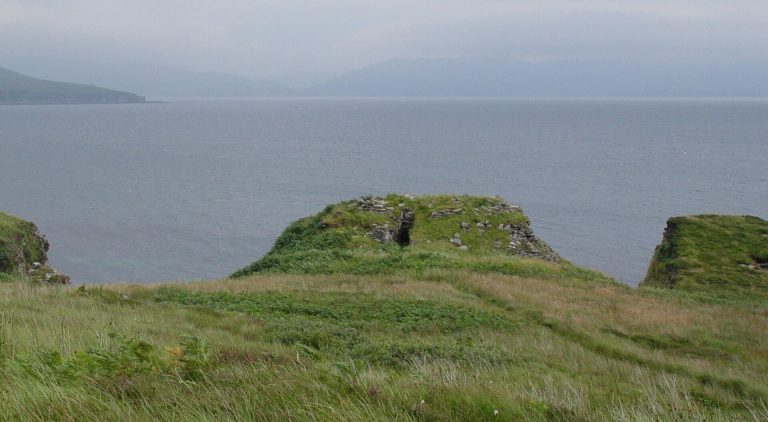
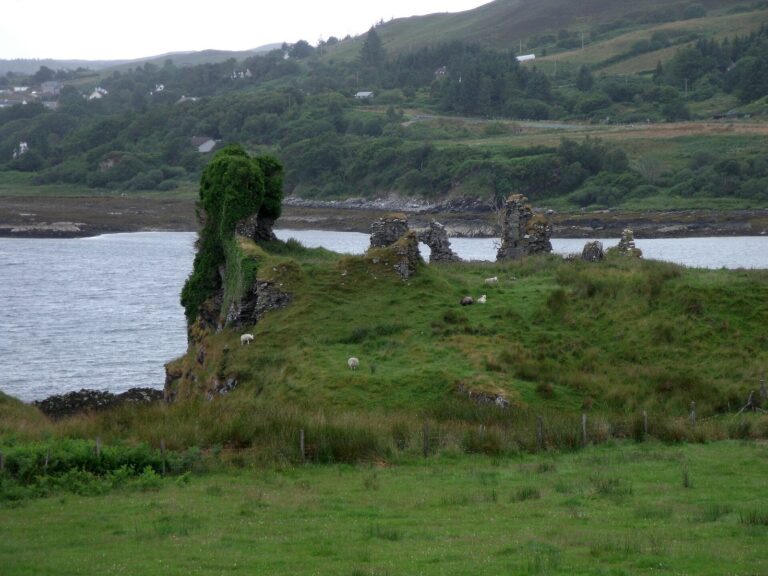
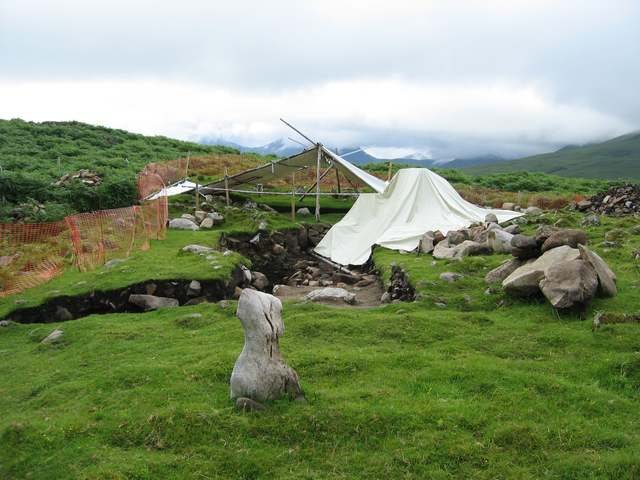
At least three shieling shelters and probably two enclosures are associated with the site’s medieval reuse. Today, the site is a grass-covered earthen mound with several trenches. A hut there houses finds.