All Saints’ Church, Oakham: A Medieval Parish Church
Site at a Glance
- Rating
- 4.7
- Popularity
- Medium
- Country
- United Kingdom
- Primary era
- Medieval
- Eras represented
- Medieval, Modern
- Civilizations
- British, English
- Site type
- Religious
- Remains
- Church
On this page12 sections
History
Foundation and parish role
All Saints’ Church, Oakham, is a Church of England parish church in the United Kingdom, founded in 1250 and dedicated to All Saints. Its Anglican churchmanship is described as Broad Church or Central, meaning relatively inclusive or moderate. The church belongs to the Province of Canterbury, which groups dioceses, and the Diocese of Peterborough. Within the diocese, it is part of the Archdeaconry of Oakham and the Deanery of Rutland, administrative groupings that include parishes.
All Saints’ is part of a team ministry, an arrangement in which clergy serve several parishes collaboratively. Its partner churches are St Andrew’s in Hambleton, St Edmund’s in Egleton, All Saints’ in Braunston-in-Rutland, St Peter’s in Brooke, the Church of St Peter and St Paul in Langham, St Andrew’s in Whissendine, Holy Trinity in Teigh, St Mary’s in Ashwell, and the Church of St Peter and St Paul in Market Overton.
The Harington library
In 1616, Anne Harington gave the church books that had belonged to her son, John Harington, 2nd Baron Harington. He died of smallpox aged 22. The library served the parish priest and grew over time. Its remaining collection, comprising 150 volumes, was transferred to Manuscripts and Special Collections at the University of Nottingham in 1980. About 70 volumes came from the original bequest; most are in Latin, with a few in Greek, and were printed in Europe. Their subjects include theology, church law and church history.
Nineteenth and twentieth centuries
Sir George Gilbert Scott, a prominent English architect associated with the Gothic Revival, restored the church in 1857–58. The building is Grade I listed, the highest category of listed-building protection in England, used for buildings of exceptional architectural or historic interest.
On 9 December 1923, the tenor bell, typically the largest and lowest-pitched in a set, came loose from its headstock, the beam to which a swinging bell is attached. The bell frame caught it before it fell into the room used by bell-ringers. The frame was still in poor condition in 1937, so the bells could not be rung for the coronation of George VI, king of the United Kingdom from 1936 to 1952.
Remains
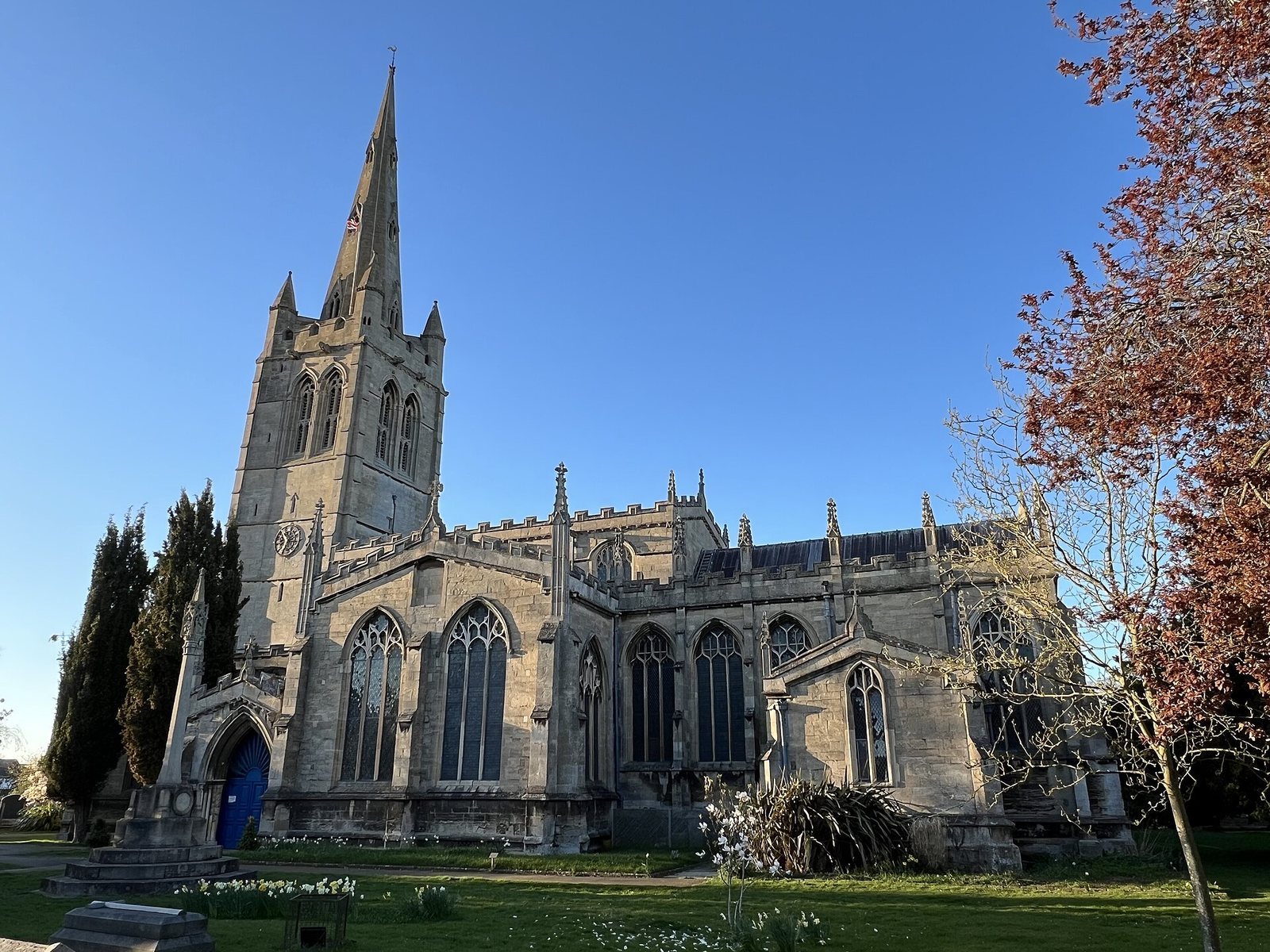
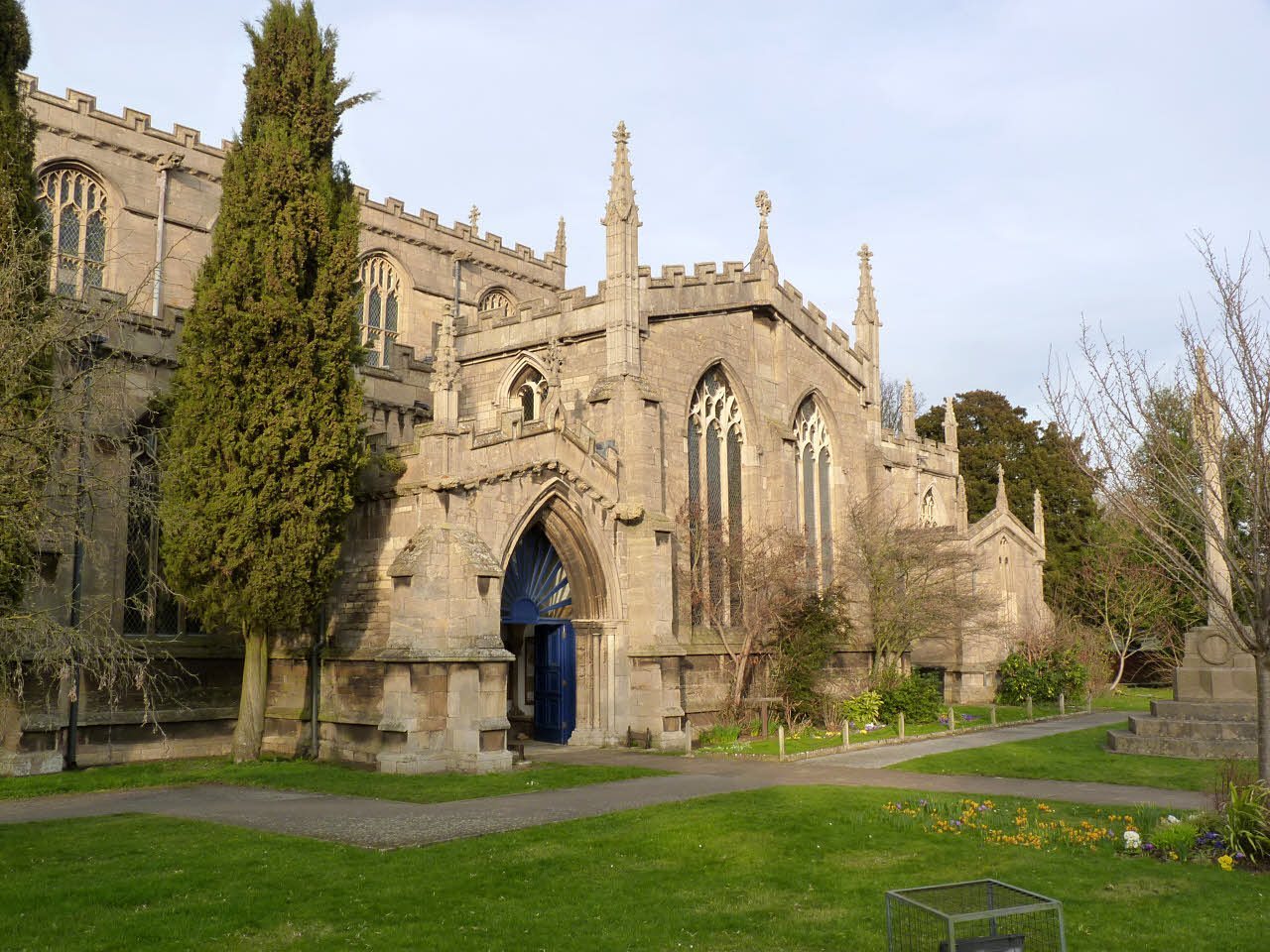
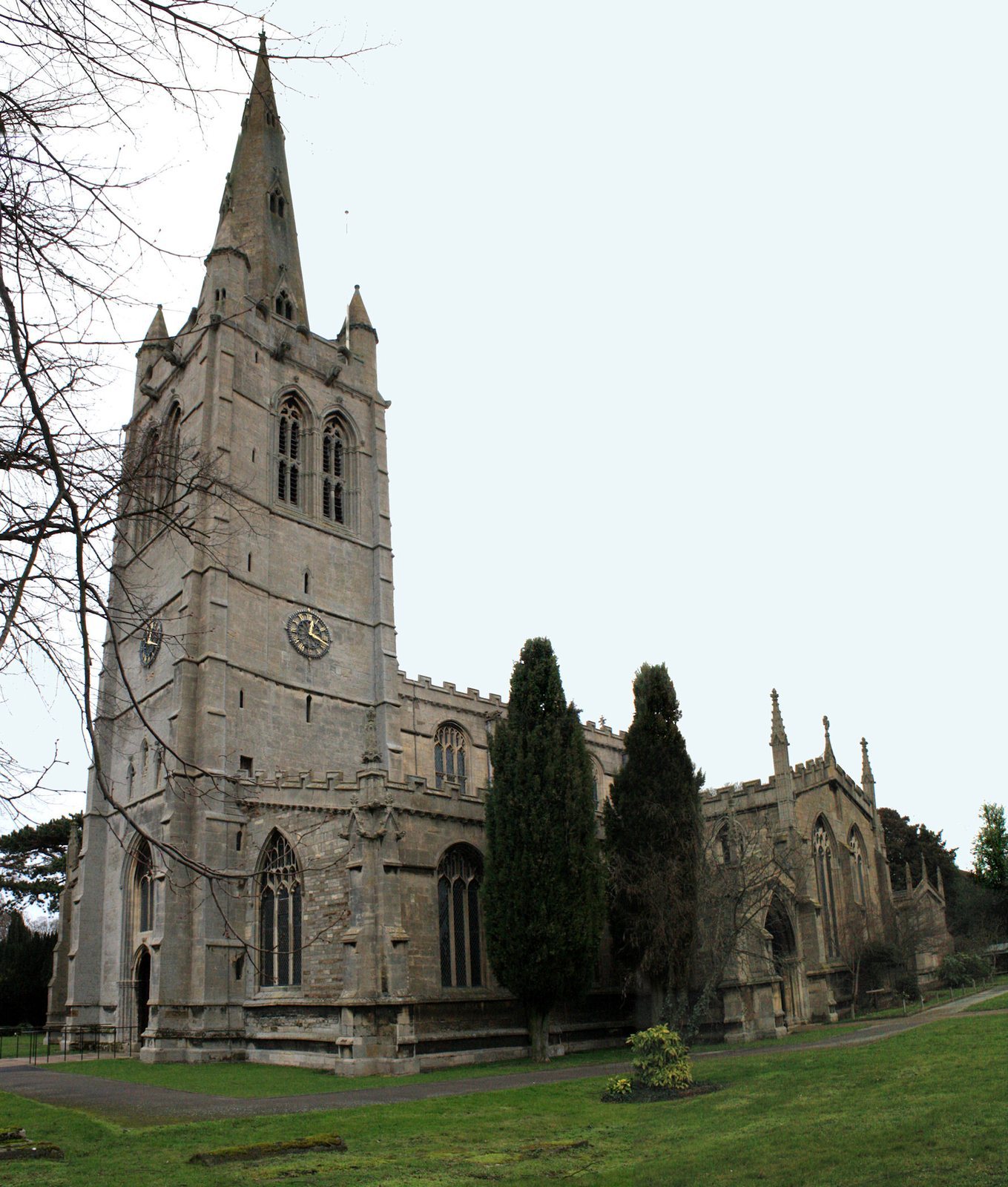
The church is arranged around its nave, with a west tower and spire and a south entrance. Its exterior reflects successive English Gothic styles, while carved stonework enriches the interior.
Exterior
West tower and spire
The west tower and spire date to the 14th century and are in the Decorated Gothic style, a phase of English Gothic architecture. The spire can be seen in distant views of Oakham from several miles in every direction.
South doorway and porch
The south doorway probably dates from the early 13th century. Its porch was added later in that century. Most of the other exterior is Perpendicular, a later English Gothic style.
Interior
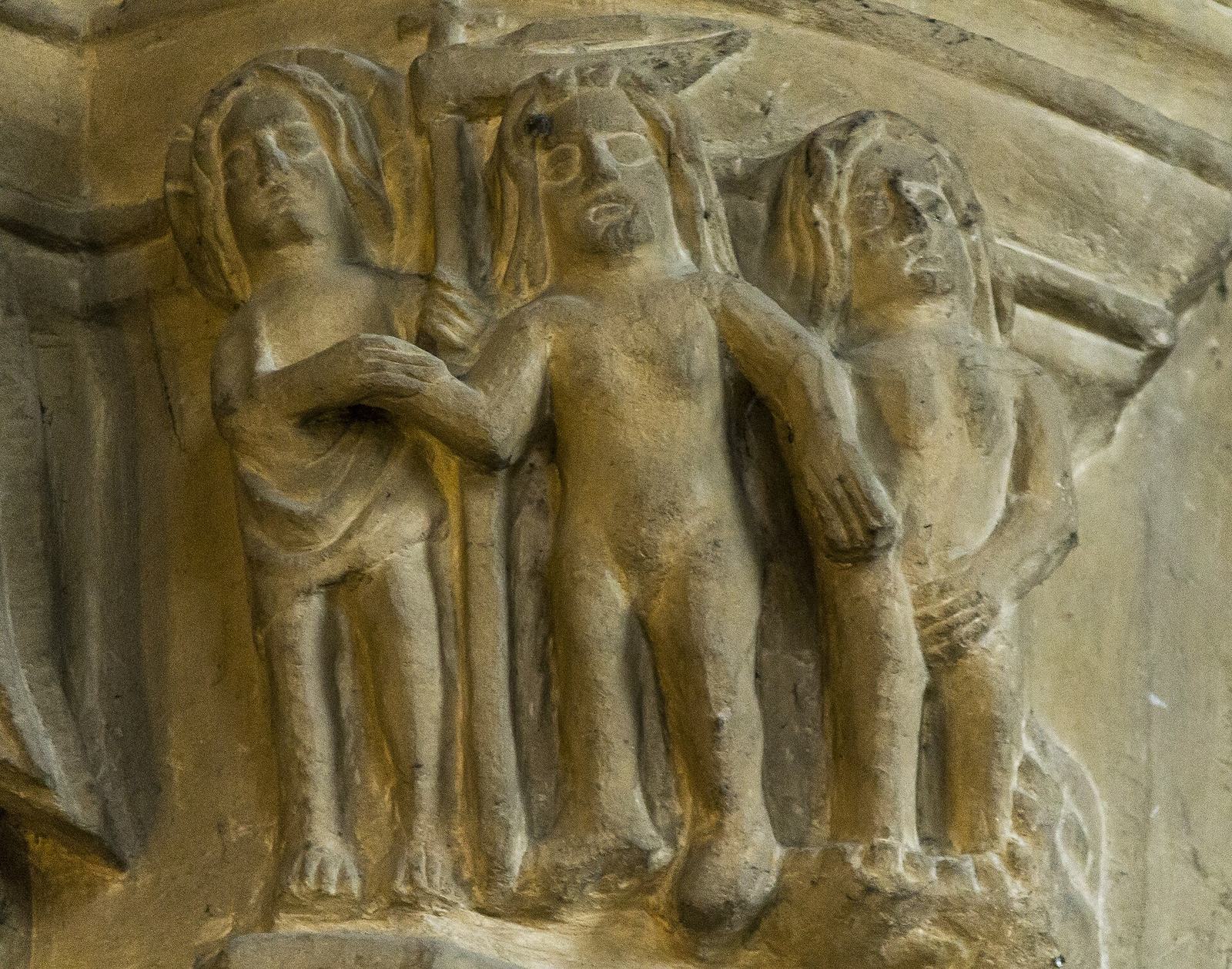
Tall, slender columns in the nave, the main body of the church, have intricately carved capitals. Their scenes and motifs include animals, birds, human figures and foliage, as well as Adam and Eve and their expulsion from the Garden of Eden. Other carvings depict the Annunciation, when the angel Gabriel told Mary she would bear Jesus, and the Coronation of the Virgin, showing Mary crowned in heaven. A Green Man, a human face associated with foliage, also appears among the carvings.
Bells and organs
Bells
In 1858, the first stage of the tower received a new ringing floor, and the bells were rehung in an oak frame. Two bells were recast by Mears of London. The church has a set of eight bells cast by Gillett & Johnston in 1910, along with a priest’s bell dated 1840, a small bell associated with signaling services.
Organs
A Brindley & Foster organ was installed in 1872 in the Lady Chapel, a chapel dedicated to the Virgin Mary, and enlarged in 1896. In 1937 Roger Yates improved and electrified it and moved it to the church’s northwest corner, with its console in Trinity Chapel, named for the Christian Trinity. The instrument was removed in 1994. A replacement pipe organ, made by Kenneth Tickell and Company, was installed in 1996. It has two hand-played keyboards.