Argiñeta Necropolis: An Early Medieval Cemetery in Elorrio
Site at a Glance
- Rating
- 4.5
- Popularity
- High
- Country
- Spain
- Primary era
- Medieval
- Eras represented
- Medieval, Early Modern
- Civilizations
- Crown of Castile, Spanish
- Site type
- Burial
- Remains
- Necropolis
On this page13 sections
History
Origins and early Christian community
The Argiñeta Necropolis is an early medieval cemetery associated with the Hermitage of San Adrián, a small chapel, in Elorrio, Spain. Its burials date from the seventh to ninth centuries. The cemetery is regarded as one of the earliest signs of Christian communities in Biscay and the Basque Country, and its inscriptions are considered the oldest written evidence of Christian communities in Biscay.
The burial arrangements reflected social standing. People of higher status were placed in sarcophagi, while people of lower status were buried in pits dug into the ground. One proposed explanation for the arrival of Christianity in the area links it to Visigoths, a Germanic people whose kingdom ruled much of the Iberian Peninsula in the early Middle Ages. They are thought to have arrived in 711 while fleeing after the Battle of Guadalete. This possibility has also been suggested as a context for the graves, but the connection is uncertain.
Recognition and gathering of the monuments
By the sixteenth century, Gonzalo de Otalora, a Basque historian and chronicler, had recognized the site’s value. The name Argiñeta is said to mean “place of stonemasons,” perhaps referring to the Christian sandstone tombs. Nearby, the cemetery at the Hermitage of San Tomás has similar tombs said to be about two centuries later. The Hermitage of San Bartolomé in Miota also has comparable medieval graves.
In the late nineteenth century, tombs and grave markers from hermitages in Mendraka, Miota and Berrio were gathered around San Adrián. This work is credited to Domingo de Retolaza, the parish priest of Elorrio. Further pieces were added in 1947.
The hermitage and heritage recognition
The Hermitage of San Adrián was built in the sixteenth century over an earlier building. The necropolis was designated a Spanish Asset of Cultural Interest in 1931, a legal status for protected cultural property. In 1964, the assemblage became Biscay’s first Artistic Ensemble, a designation for a group of cultural features considered together. It is also included among the National Monuments of the Basque Country.
Remains
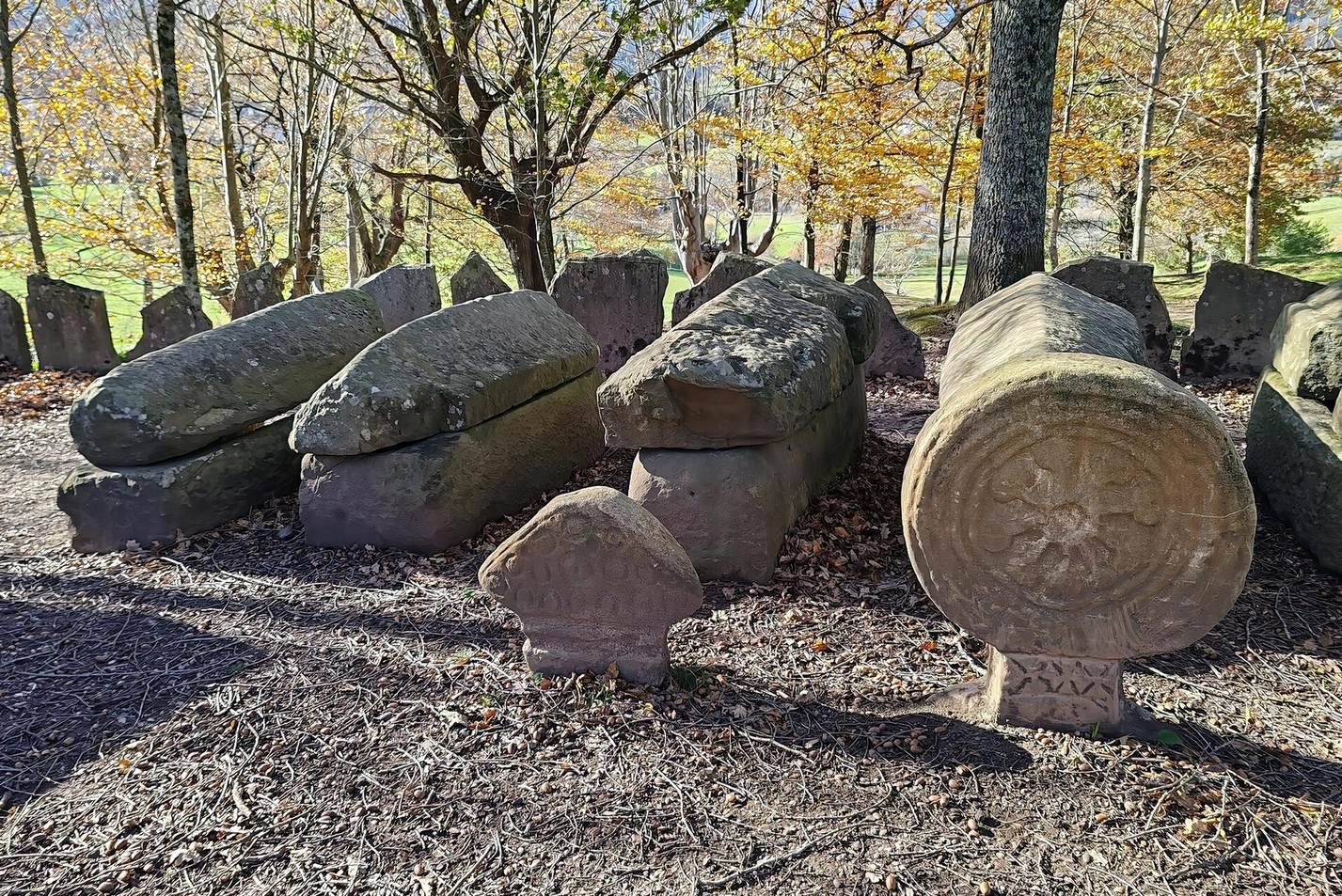
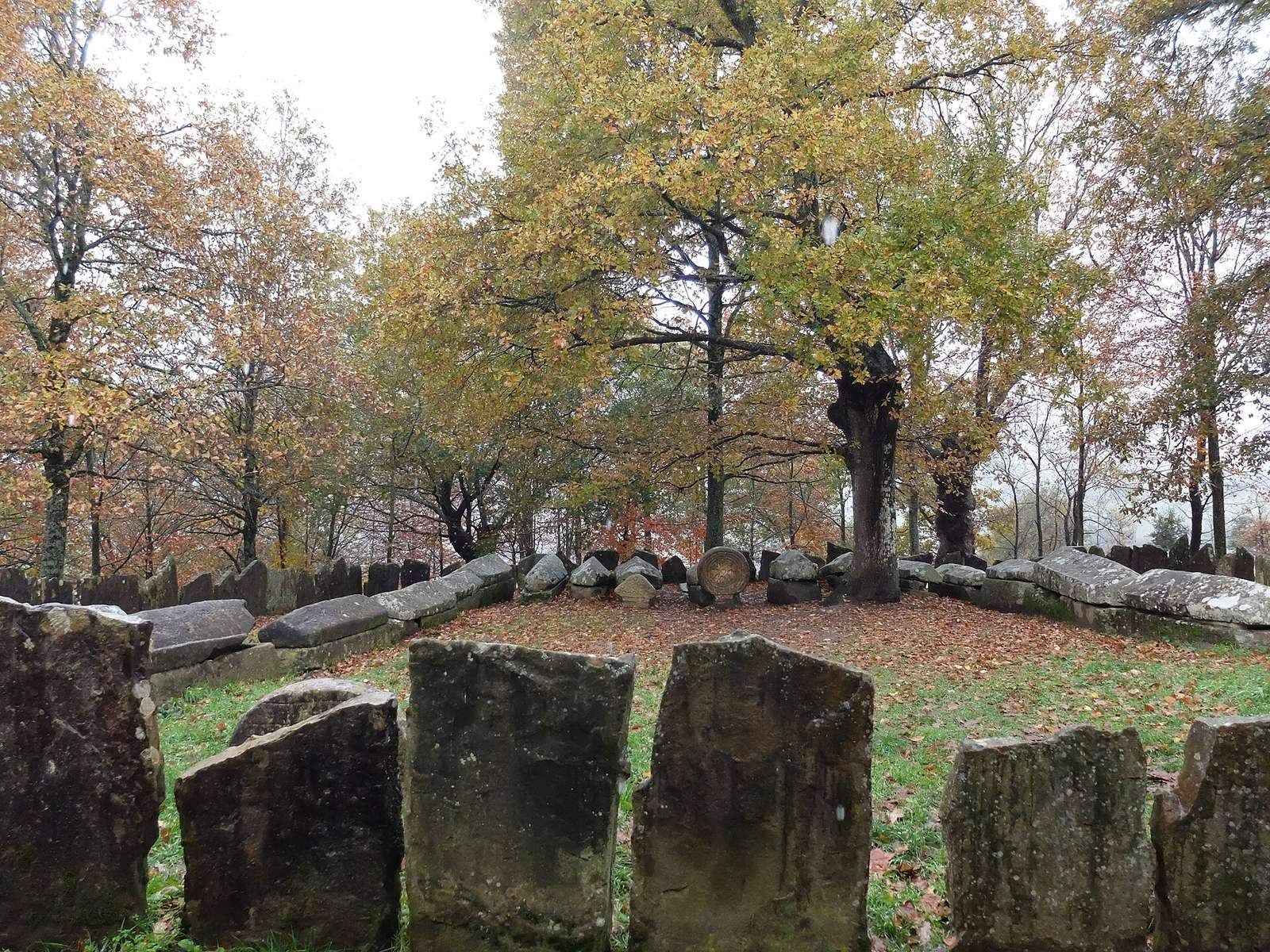
The remains are arranged in and around the hermitage, with sandstone sarcophagi and upright grave markers above ground and a separate cemetery of stone-slab graves beneath the surrounding ground. The assemblage is generally counted as 20 sarcophagi, including one double tomb, two separate covers and five funerary stelae, or upright stone grave markers. The sandstone is attributed to the Oiz Mountains.
Funerary monuments
Sarcophagi
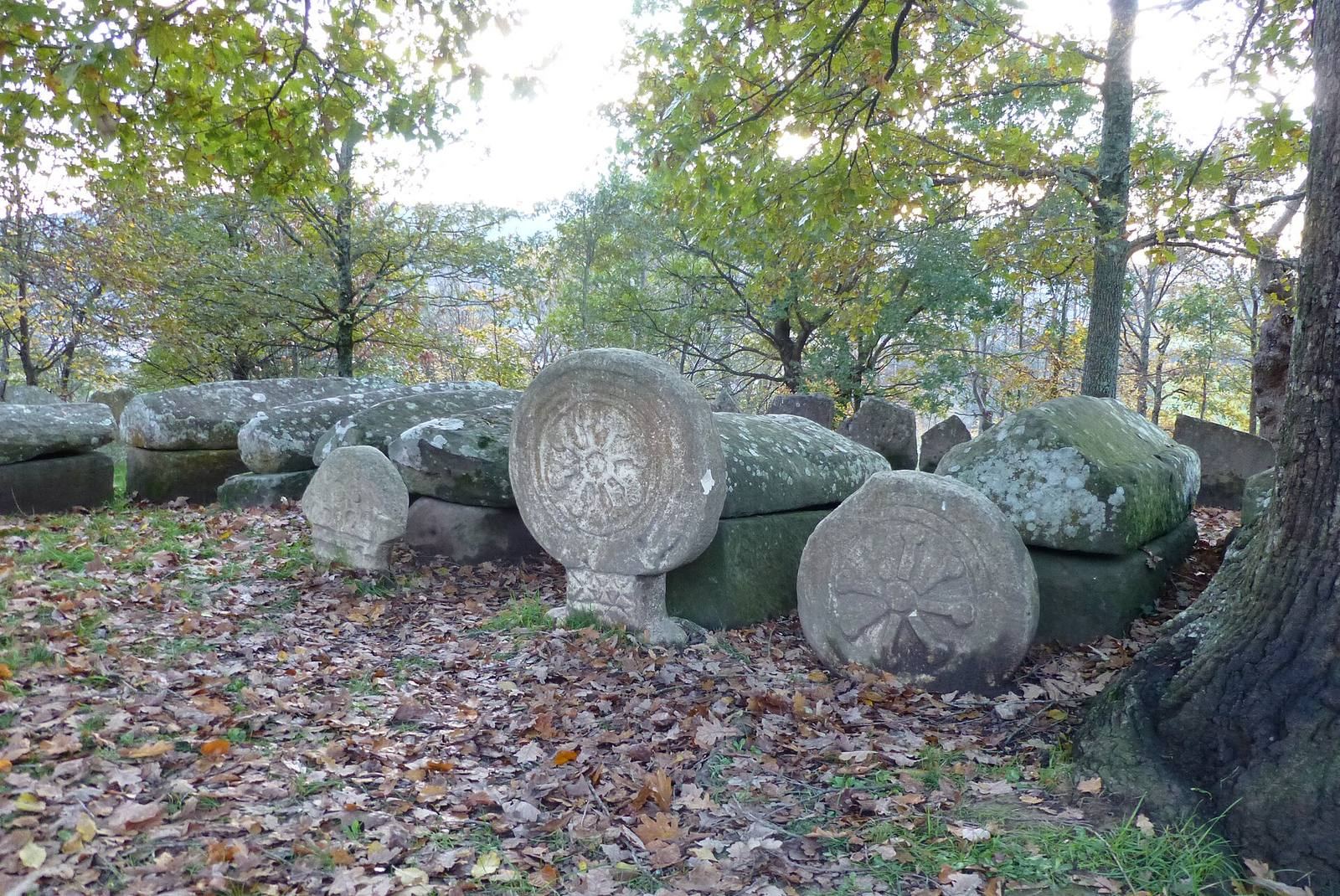
Each sarcophagus has a human-shaped stone box and a triangular, roof-like cover. Most are about two metres long: 13 exceed that length, while the other seven are shorter but longer than 1.83 metres. Their interiors suggest burials of people about 1.63 to 1.97 metres tall; the tombs are around 0.32 metres deep and 0.60 to 0.70 metres wide. One has an incised line around the outer edge of its side, apparently intended to be completed with a sawtooth border. The double tomb has been interpreted as possibly made for a married couple. Local legend instead names its occupants as sisters Dalda and Trigilda, said to be abbesses and daughters of Sancho García, ruler of the County of Castile. The tale credits Sancho García with founding the monastery at Oña. It also says a priest, prompted by recurring dreams of the partly open tomb, exposed bones, two women’s figures and the smell of roses, moved its cover to shelter the remains from rain.
Stelae
The five stelae include four disk-shaped stones about 70 centimetres across and one triangular example. Their patterns include concentric circles, radiating extensions, cross forms and toothed borders. The disk-shaped stones have also been described as having oval heads and narrow necks that create a human-like outline. Some are considered to predate Christianity.
Funerary inscriptions
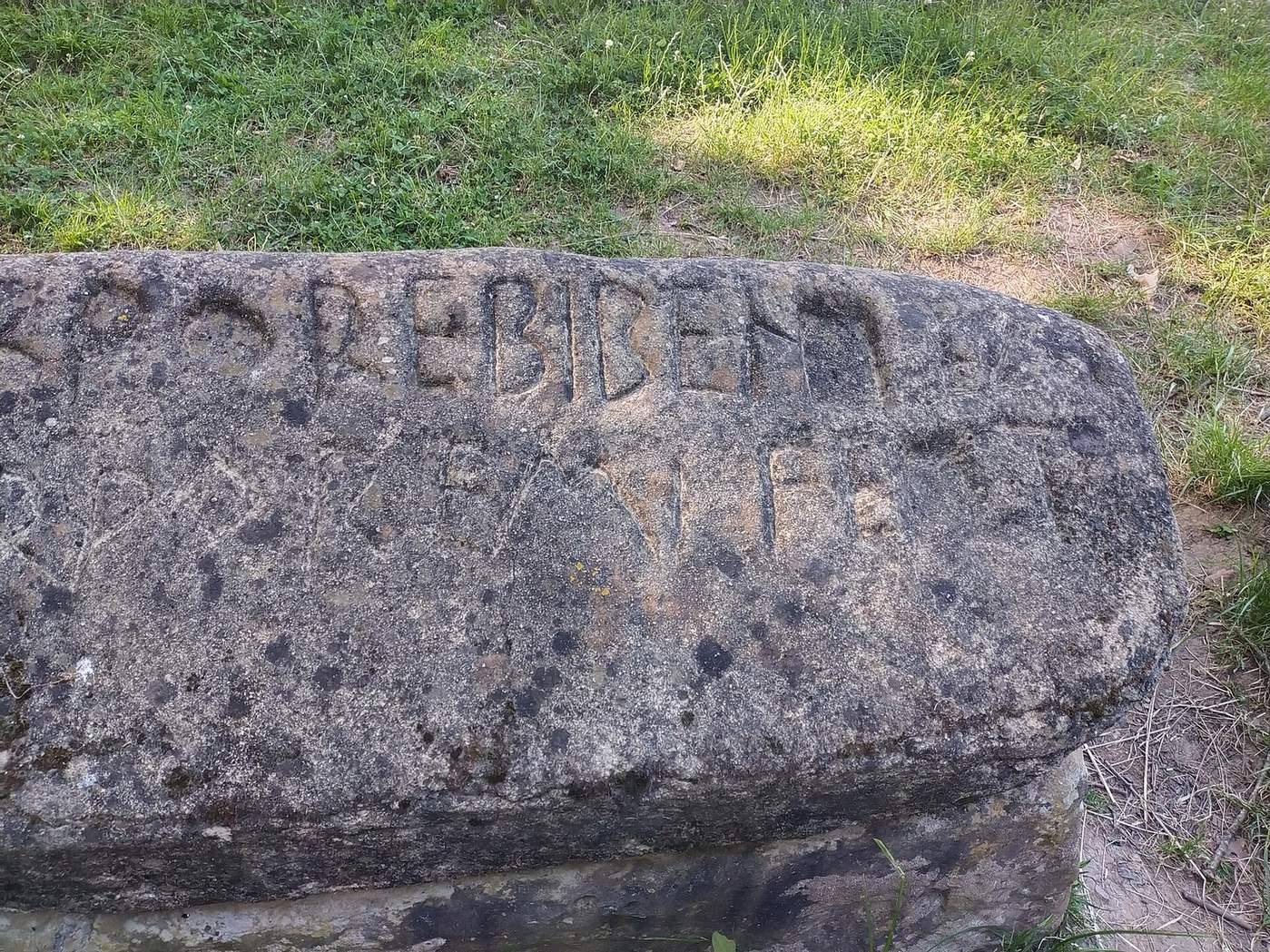
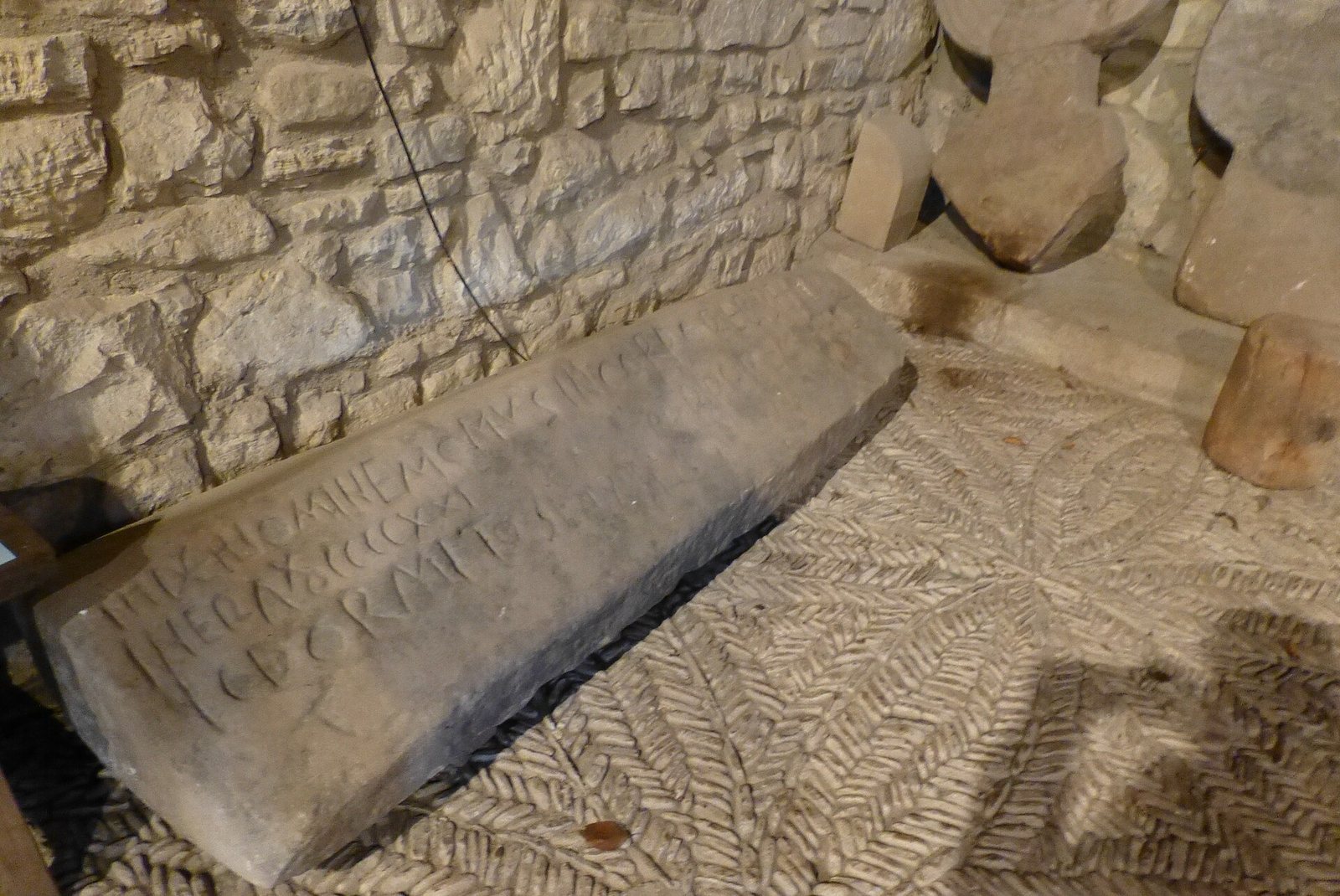
One inscription states that Momus made his tomb while alive in year 921 of the Hispanic Era, a medieval Iberian dating system, equivalent to AD 883. It ends with the words “Here lies.” Another inscription has been read as recording the death of Paterna, described as a “servant of God,” on the seventeenth day before the Kalends of August. The Kalends was the first day of the month, and dates were counted backward from it, including that day; the reading of this inscription remains uncertain. A cross appears below a word understood as “died,” with Alpha and Omega, the first and last letters of the Greek alphabet used in Christian symbolism, to its right.
Buried cemetery
A separate cemetery of stone-slab graves lies beneath the ground around the hermitage. The southern area has not been studied because modern rubble fill was used to level the ground. It is considered a possible location for the cemetery’s richest section.
Hermitage of San Adrián
Building and porch
The hermitage is rectangular, with one main interior space, and is built of rubble masonry, using rough, irregular stones, with trim of ashlar, or carefully shaped stone blocks. Its hipped roof slopes down on all four sides, and a bell gable, a raised structure with openings for bells, stands on the south side. A large porch surrounds the building. The porch floor is made of pebbles on the west and limestone slabs elsewhere; the interior floor is also paved with pebbles. One entrance, at the end of the main space, has a three-centered arch formed from three arcs with separate centres. The south entrance has a lintel, with a stone table and an inscription dated 1666 beside it.
Interior and collection
The hermitage is no longer used for worship and shelters some of the collection’s notable inscribed and decorated pieces. Four displayed pieces are copies, while the original pieces are kept inside the building. The altar incorporates a tomb brought from the Hermitage of San Esteban in Elorrio and an image of the saint. The building underwent a comprehensive renovation in 1982, and its roof was repaired and retiled in 2018.