St Mary’s Church, Bungay: A Church Founded to Serve a Benedictine Priory
Site at a Glance
- Rating
- 4.6
- Popularity
- Low
- Country
- United Kingdom
- Primary era
- Medieval
- Eras represented
- Medieval, Modern
- Civilizations
- British, English
- Site type
- Religious
- Remains
- Church
On this page8 sections
History
Priory and medieval church
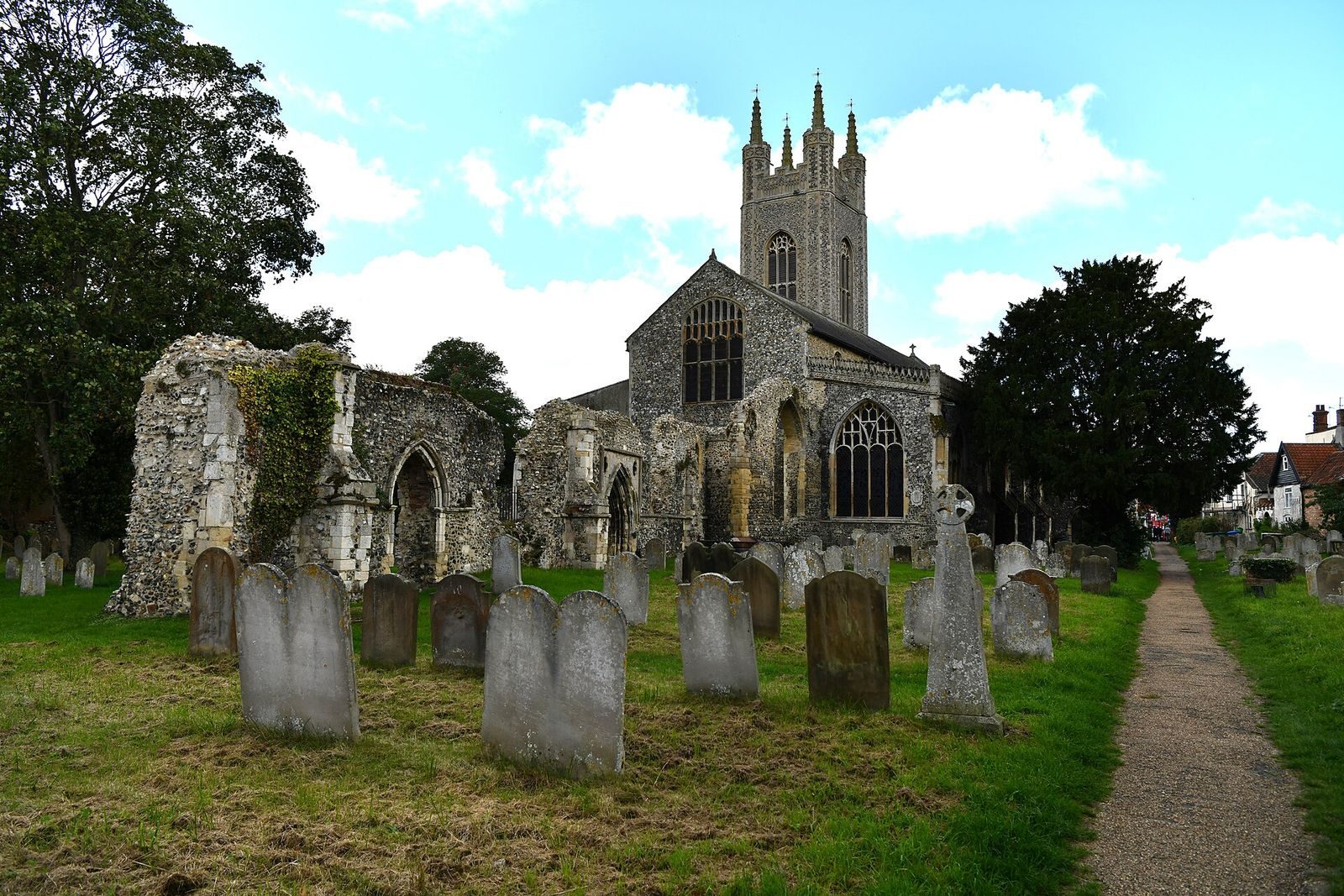
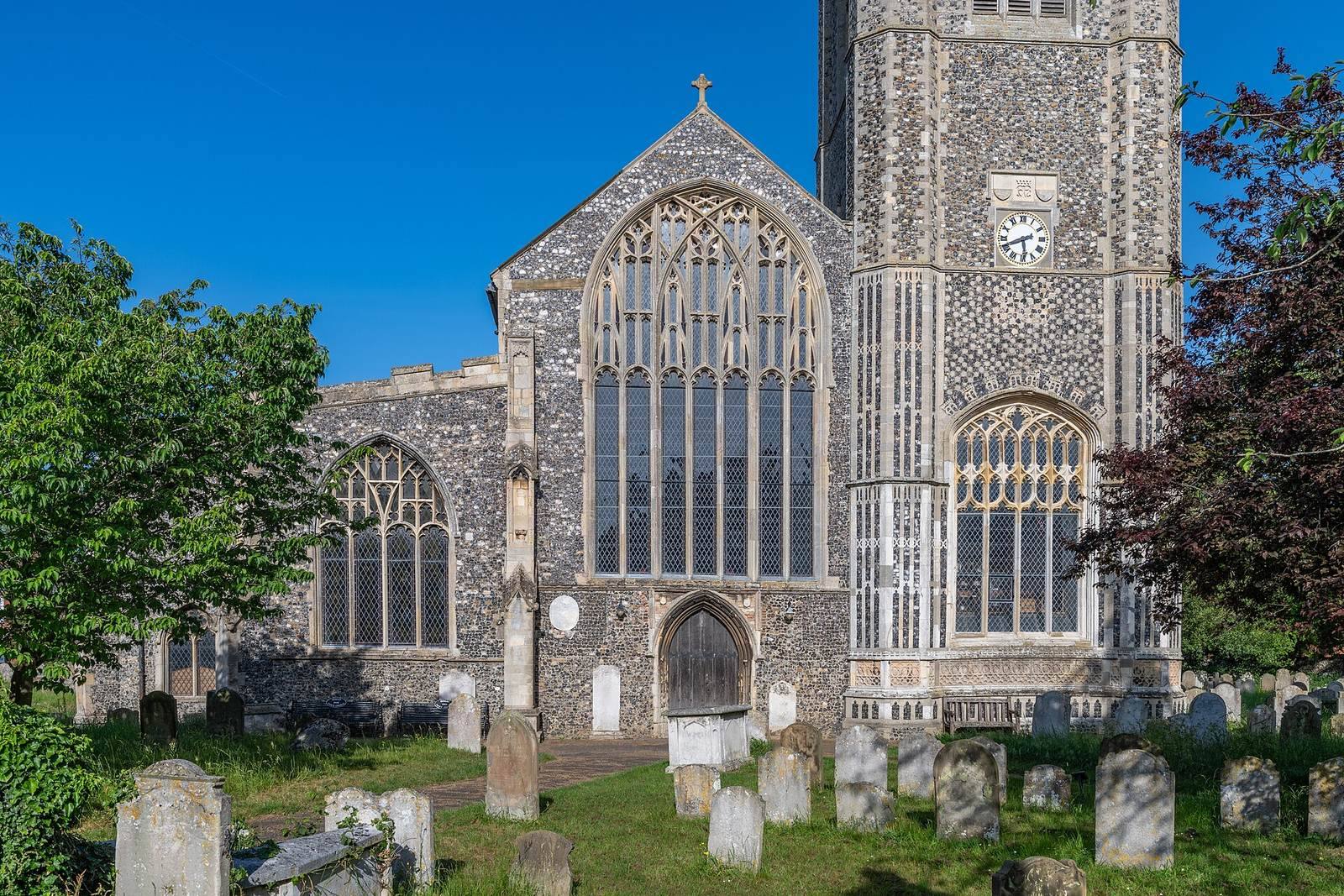
St Mary’s Church, Bungay, in the United Kingdom, was founded in 1309 to serve a Benedictine priory, a monastic house governed by a prior and belonging to an order that followed the Rule of St Benedict. The main part of the present church dates from the 14th and 15th centuries and follows Perpendicular Gothic, a late medieval English style known for its strong vertical emphasis.
The Domesday Survey lists a church dedicated to the Holy Cross in Bungay. St Mary’s is thought to occupy the site of an earlier Saxon church.
Parish church and later events
In 1536, Henry VIII’s suppression of England’s monasteries brought the priory to a close. St Mary’s became a parish church, and a grammar school was established in one of the priory’s chapels.
On Sunday, 4 August 1577, lightning struck the church. The storm gave rise to the Legend of the Black Dog, in which a black hellhound appeared inside the church, attacked members of the congregation, and vanished. The story says the creature then appeared at Holy Trinity Church in Blythburgh, 12 miles away, and injured members of its congregation. The Black Dog is associated with Black Shuck, a spectral dog in eastern English folklore, and appears in Bungay’s coat of arms.
A great fire in Bungay in 1688 damaged the church. It burned the south-aisle roof and fittings, including benches and possibly the pulpit, while sparing the nave roof. The south aisle was re-roofed in 1699, and the church reopened in 1701. The tower was repaired and the rest of the church restored in 1879.
Modern use and protection
During the 20th century, the congregation declined and the church became redundant, meaning it was no longer needed for regular worship. Its benefice, the church living or office, was united with that of Holy Trinity Church. St Mary’s remains an Anglican church, within the tradition associated with the Church of England, cared for by the Churches Conservation Trust, a charity that looks after historic churches. St Mary’s and the adjacent priory ruins received Grade I listing, England’s highest listed-building category, on 9 May 1949.
Remains
Plan and exterior
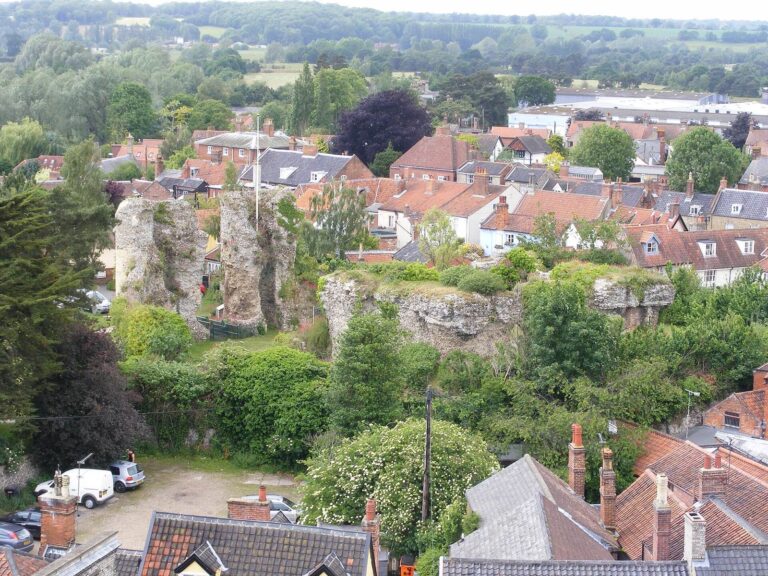
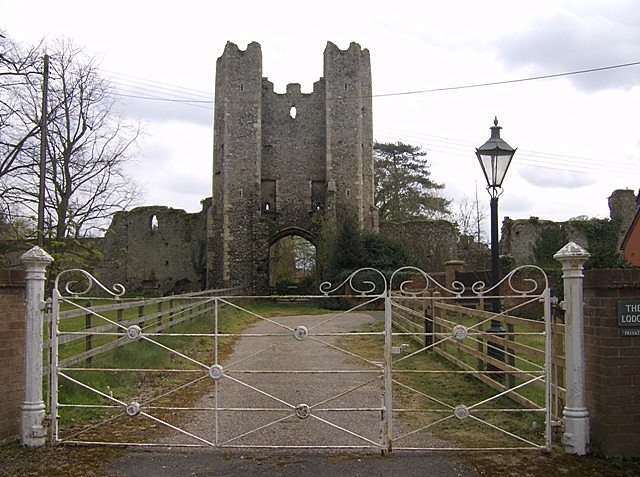
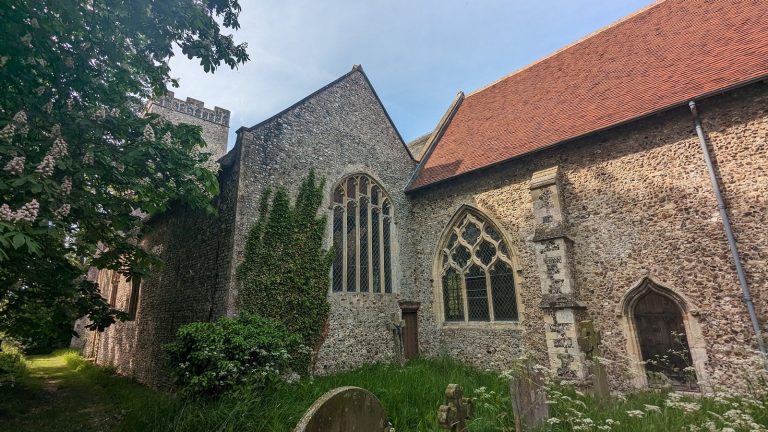
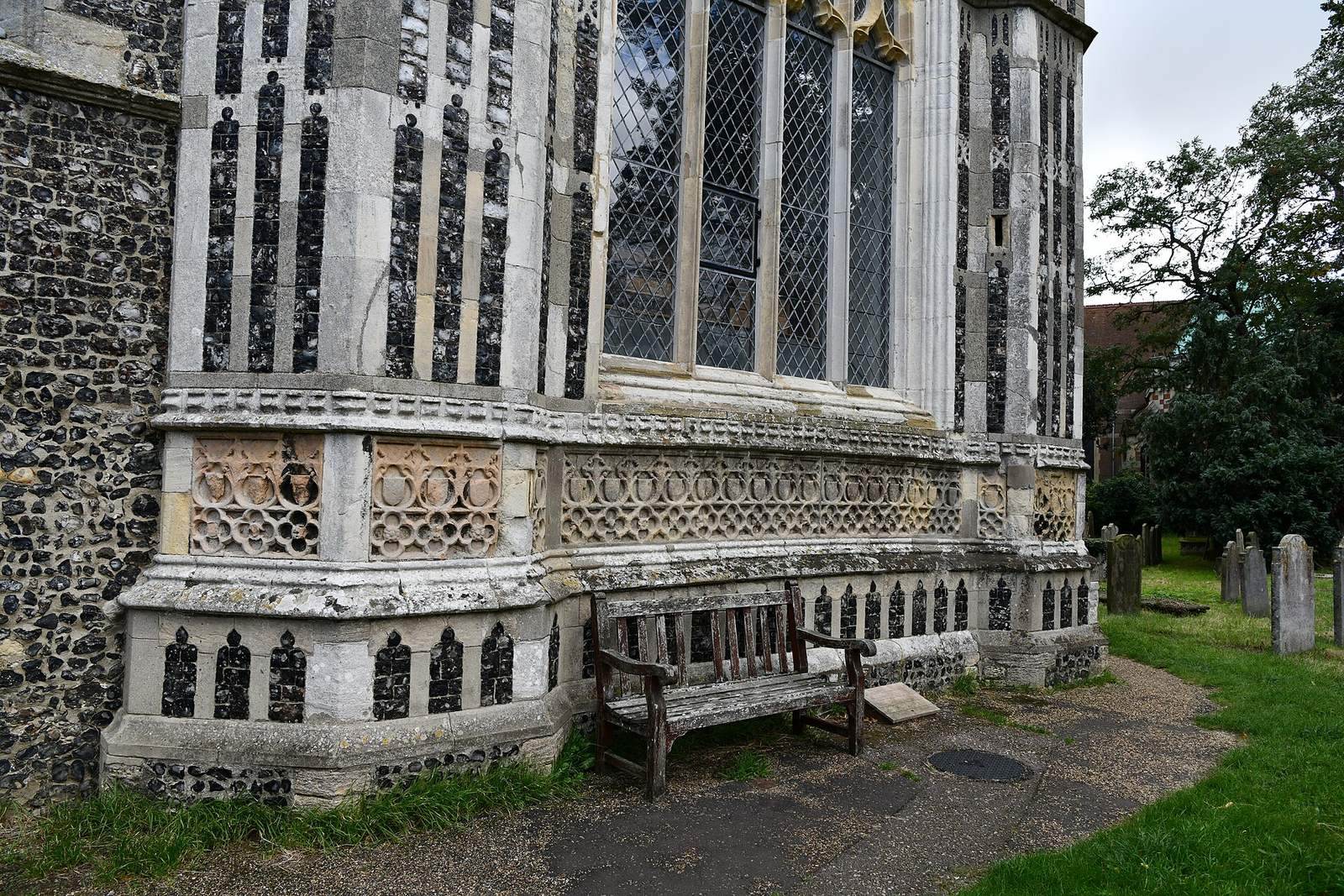
Built of flint and stone, the church has a nave, the main body of the building, with an upper clerestory, a row of windows above lower roofs, north and south aisles, or side spaces, and a tower. The tower stands at the west end of the south aisle and rises 110 feet (33.5 metres). Four tall pinnacles, upright architectural ornaments, crown it, decorated with small projecting details. Ruined remains of the priory lie in the churchyard east of the church.
Interior architecture and furnishings
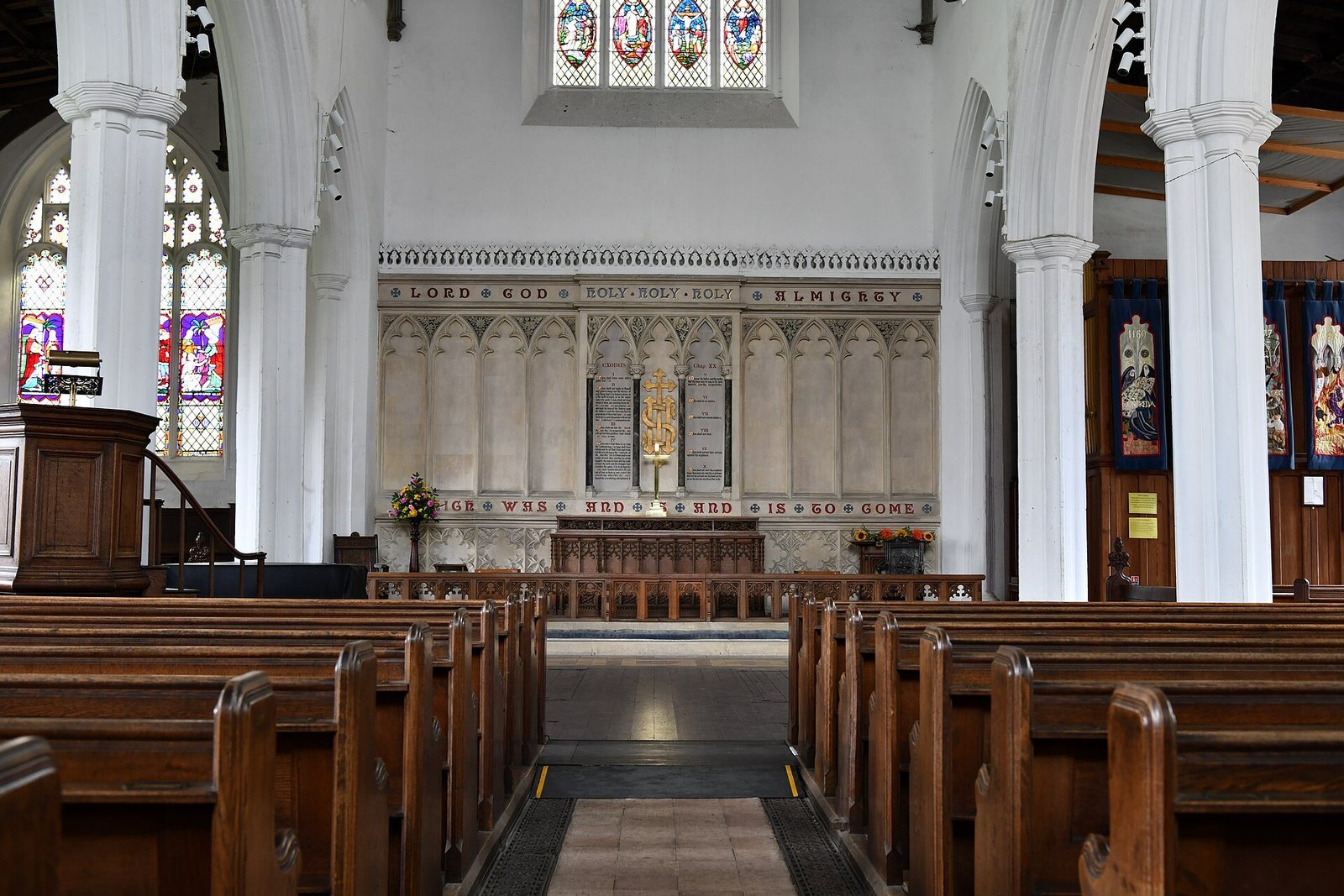
Five columns made up of clustered vertical supports carry the arcades, rows of arches. The large west window has elaborate tracery, or ornamental stonework, in its upper section. Carved roof bosses, ornaments projecting from the roof, show angels, a lion, two-headed eagles, and a bat. Near the entrance, a dole cupboard, used to store charitable provisions, is carved with a rat; bread was kept there for distribution to the poor.
Part of the church serves as a War Memorial Chapel. It contains a 17th-century Flemish panel depicting the Resurrection, given to the church by the English novelist H. Rider Haggard.
Organ and bells
The church’s two-keyboard organ was made by E. W. Norman and moved from Rose Hall in Bungay. The organ-building firm Walker rebuilt it in 1961. The church also has eight bells, all cast in 1820 by Thomas Mears II at the Whitechapel Bell Foundry.