Church of Saint Michael the Archangel in Prague: A Medieval Church and Servite Monastery
Site at a Glance
- Popularity
- Medium
- Country
- Czechia
- Primary era
- Early Modern
- Eras represented
- Medieval, Early Modern, Modern
- Civilizations
- Duchy of Bohemia, Habsburg, Habsburg Austria, Holy Roman Empire, Kingdom of Bohemia
- Site type
- Religious
- Remains
- Church
On this page11 sections
History
The Church of Saint Michael the Archangel in Prague is a former church in Czechia, built in stone in the Romanesque style between 1150 and 1200. Dedicated to Michael, regarded in Christian tradition as a high-ranking angel, it grew into one of Prague’s largest churches and later served as a parish, an educational center, and a focal point for religious reform.
Early church and parish
A wooden building, possibly used for worship, may have stood on the site before the stone church. A route between Vyšehrad and Prague Castle passed nearby, using a ford and wooden bridge before the later Judith and Charles bridges existed. The church’s early community is uncertain: one interpretation places it at the center of a settlement of Italian or Venetian merchants, while another associates it with German residents. A cemetery formed part of the church complex.
The church was enlarged during the thirteenth century and almost entirely rebuilt in the fourteenth. Kings of Bohemia held its right of patronage, the right to nominate or support its clergy, and Queen Elizabeth of Bohemia later took up that role. In 1335, a king transferred the patronage to the Zderaz monastery; Pope Benedict XII confirmed the grant on October 12. Land for a new rectory was acquired in 1364.
Parish, university, and reform
By 1380, eleven priests served the church and taught at its parish school, among the oldest in Prague. Its teachers also taught at the nearby university, where instruction became fully established in the 1360s. A foundation created in 1386 provided for an eternal light in the church.
From 1390, the parish priest Bernard hosted regular open debates among university masters. Jan Hus attended, defended the reformist ideas of the English theologian John Wycliffe from 1399, was ordained in 1400, and preached at Saint Michael in the early fifteenth century. After Bernard died in 1406, Křišťan z Prachatic became parish priest. A professor and supporter of Hus, he helped initiate the Decree of Kutná Hora, a university measure that shifted authority toward Czech teachers and students.
Saint Michael became an important center of reform alongside Bethlehem Chapel. On March 15, 1411, it was among the few churches where Hus’s excommunication was not proclaimed. From 1414, worshippers received communion in both bread and wine, a practice central to Utraquism, a reform movement that demanded both elements for laypeople. In 1415, Křišťan went to Constance as an envoy of the Prague university under the authority of King Wenceslaus IV. He visited Hus in prison, was arrested, and was later released after Sigismund of Luxembourg intervened. During Křišťan’s absence, the Hussite preacher Jakoubek ze Stříbra preached at the church.
Křišťan later opposed the Taborites, a radical Hussite faction, and rebuked their priest Václav Koranda. Supporters of the preacher and political leader Jan Želivský attacked the parish, forcing Křišťan to flee. On November 10, 1419, the church was ransacked. Its pews were broken up and carried off for use in barricades, and the church suffered further damage during the Hussite Wars, conflicts arising from the religious reform movement.
The church was reconsecrated on September 29, 1436, by Bishop Filibert of Coutances. An altar was consecrated on October 6, and the cemetery was blessed on October 21. Petr z Mladoňovic subsequently administered the parish and became rector of the Prague university in 1438.
Rebuilding and confessional change
A major fire affected Prague’s Old Town in 1540. Around the middle of the sixteenth century, the church underwent Renaissance alterations. Its cemetery probably closed around this time, and stone grave markers were reused in nearby rebuilding, including at a house on Michalská Street. The church remained Utraquist until the restoration of Catholicism in lands where the Reformation had taken hold.
After 1620, the departure of Protestants ended the church’s role as an important educational center. A decree issued by Charles of Liechtenstein in 1621 required the last non-Catholic pastor to leave. Saint Michael continued as a Catholic city church. In 1626, Emperor Ferdinand II gave the church, rectory, and school to the Servites, the Order of Servants of Mary, a Catholic order devoted to the Virgin Mary, and contributed toward a monastery.
Servite monastery and Baroque life
Construction of the Servite monastery proceeded in stages from 1640. Its first major phase, which established the complex’s monastic arrangement, continued until 1664. Later work on the church and monastery produced the church’s high-Baroque form, probably around the middle of the eighteenth century.
The Servites fostered devotion to the Virgin Mary through elaborate services on seven Marian feast days, accompanied by music. Šimon Brixi directed the order’s choir until 1727 and composed chants for Marian observances. Felix Benda became organist and choir director in 1762. The monastery also served as a center of learning and sacred music; a mid-eighteenth-century catalogue gives an indication of the scale of its library.
Suppression and later use
On June 23, 1786, reforms under Emperor Joseph II suppressed the church and monastery. They passed to the Religious Fund, which sold their contents. Most church furnishings were dispersed among churches elsewhere in the Kingdom of Bohemia, including those at Rokycany, Líbeznice, Sokolov, and Holany. The buildings were sold in 1789 to a merchant who established a warehouse. The former church later housed a factory and served as a wholesale store.
The property was confiscated after 1948. During the socialist period, the former church stored industrial goods, including oils; in 1984, it was transferred to the State Library of Czechoslovakia for use as a depot. A fire in 1990, whether deliberately or accidentally started, caused further damage. In 1995, archaeologists from the Museum of the City of Prague confirmed Romanesque masonry and uncovered several dozen graves, thought likely to belong to Servite members.
After 1990, the former church was used for the Michael Mystery Show and later as a music club. Adaptations around the turn of the twenty-first century and in subsequent years damaged parts of its Baroque form. Human remains from earlier burials were moved within underground areas, prompting debate about the church’s desacralization. The former monastery now houses Collegium Marianum, a higher vocational school, and its preserved library hall is used for concerts, mainly of Baroque music.
Remains
Layout
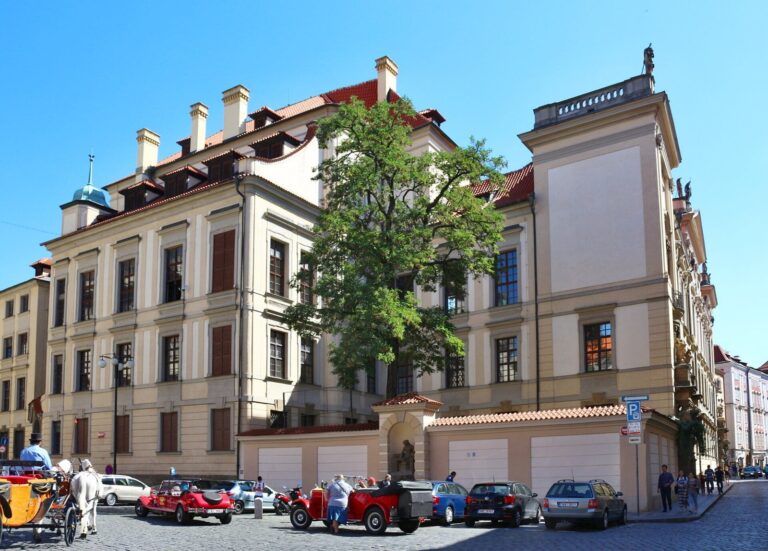
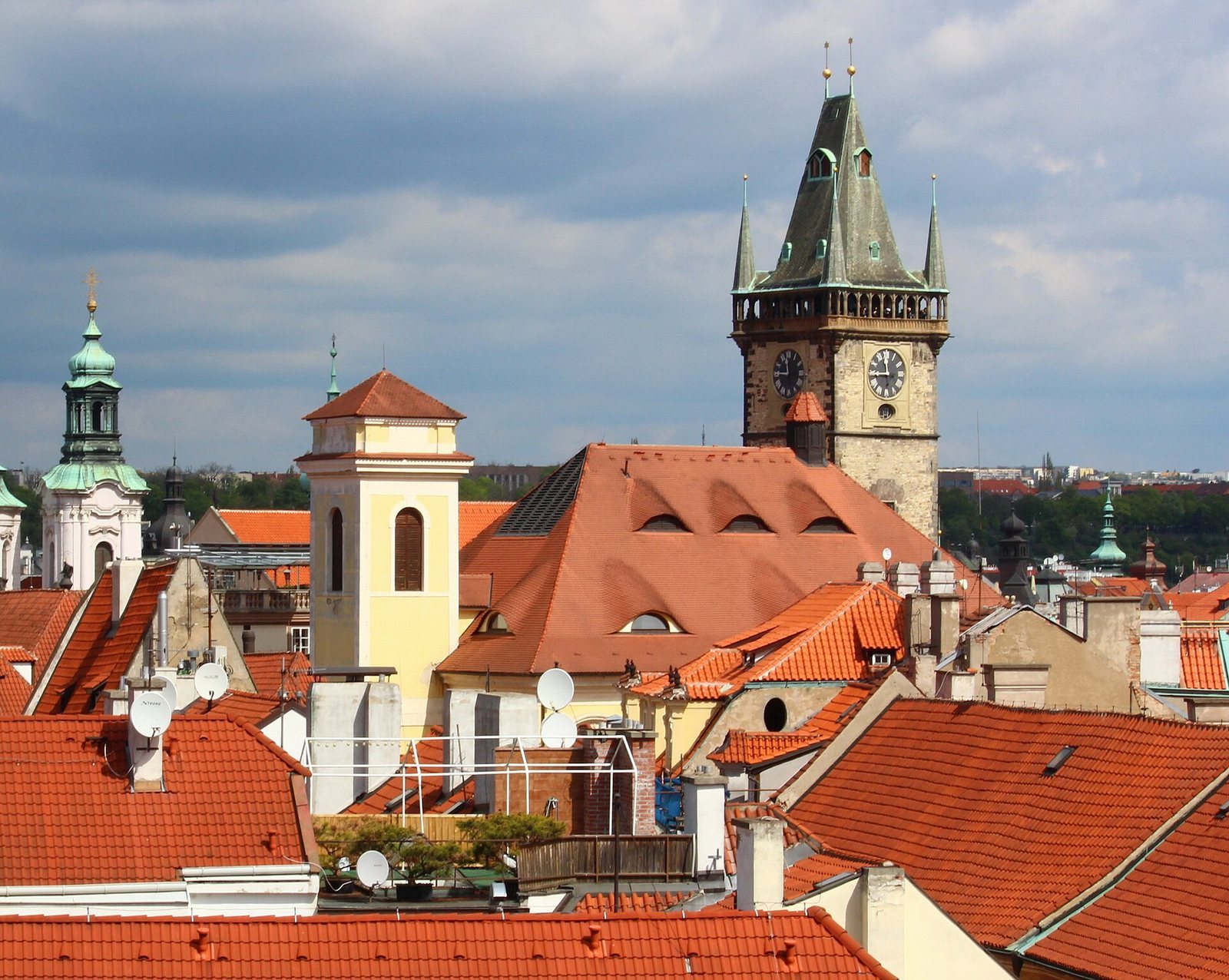
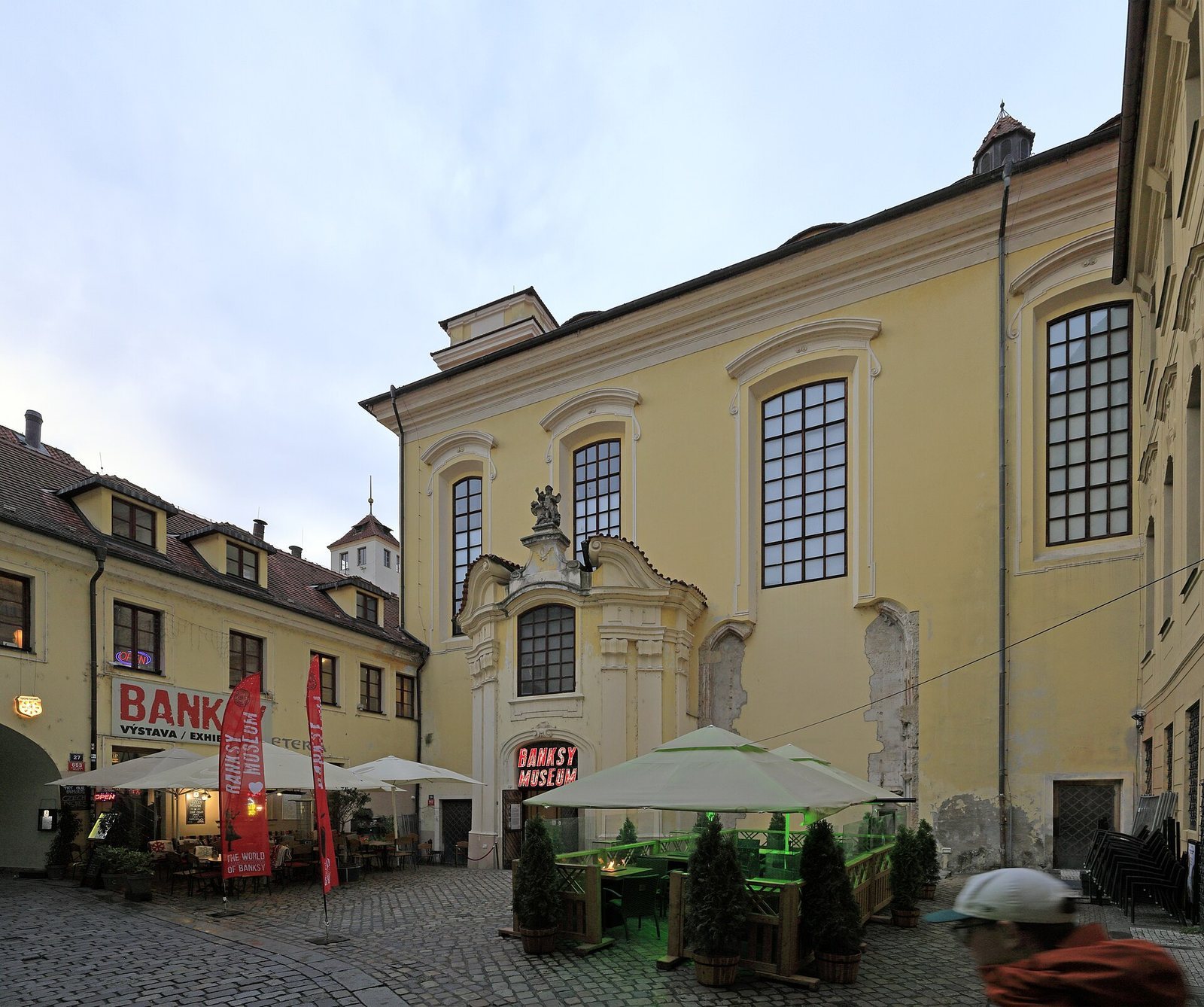
The former church stands in Prague’s Old Town, near Old Town Square and between Michalská and Melantrichova streets. Its fabric reflects Romanesque, Gothic, Renaissance, and Baroque building phases. The adjoining historic ensemble also includes a four-wing former monastery, formed from four earlier town houses and institutional buildings.
Church structure
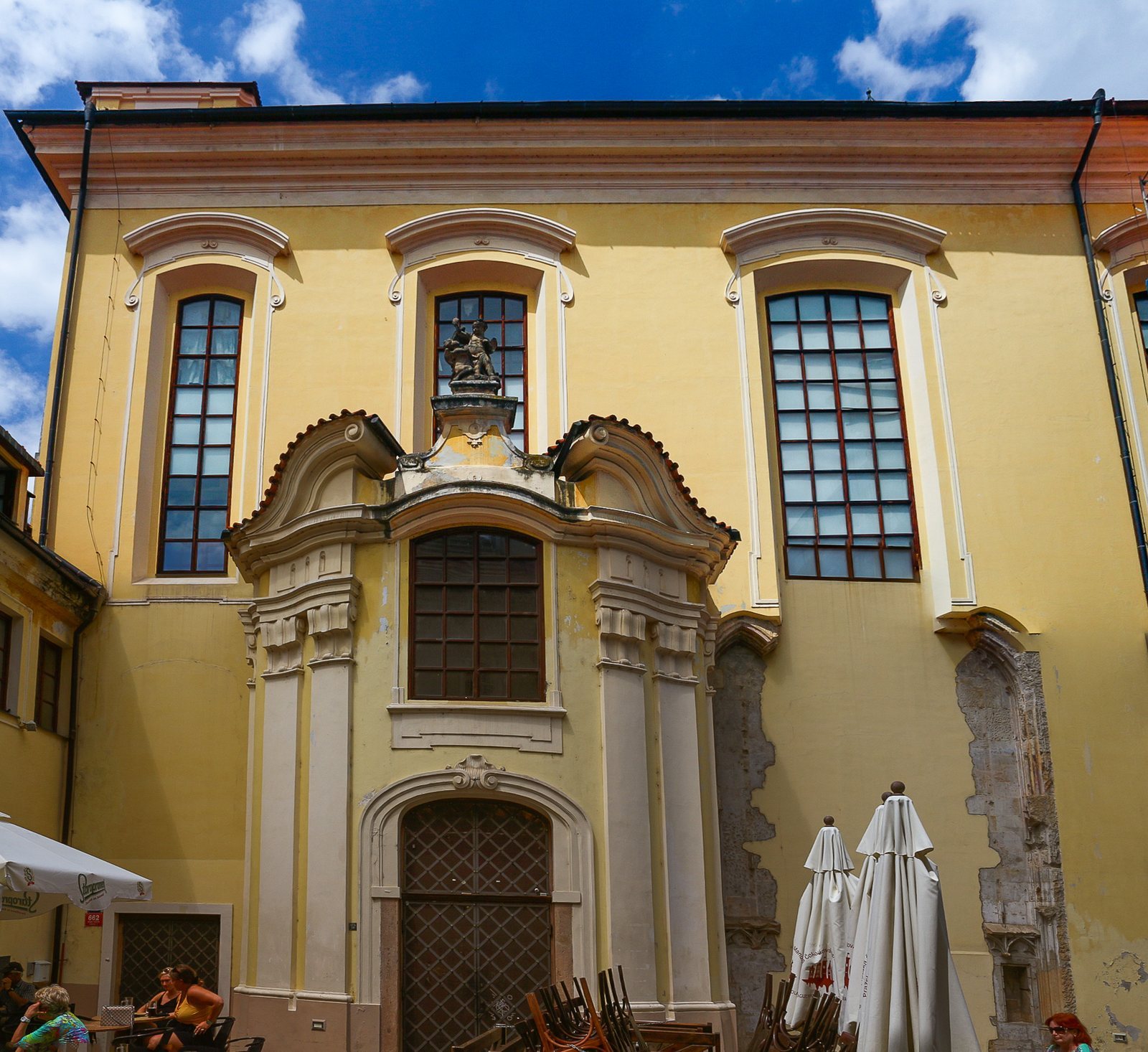
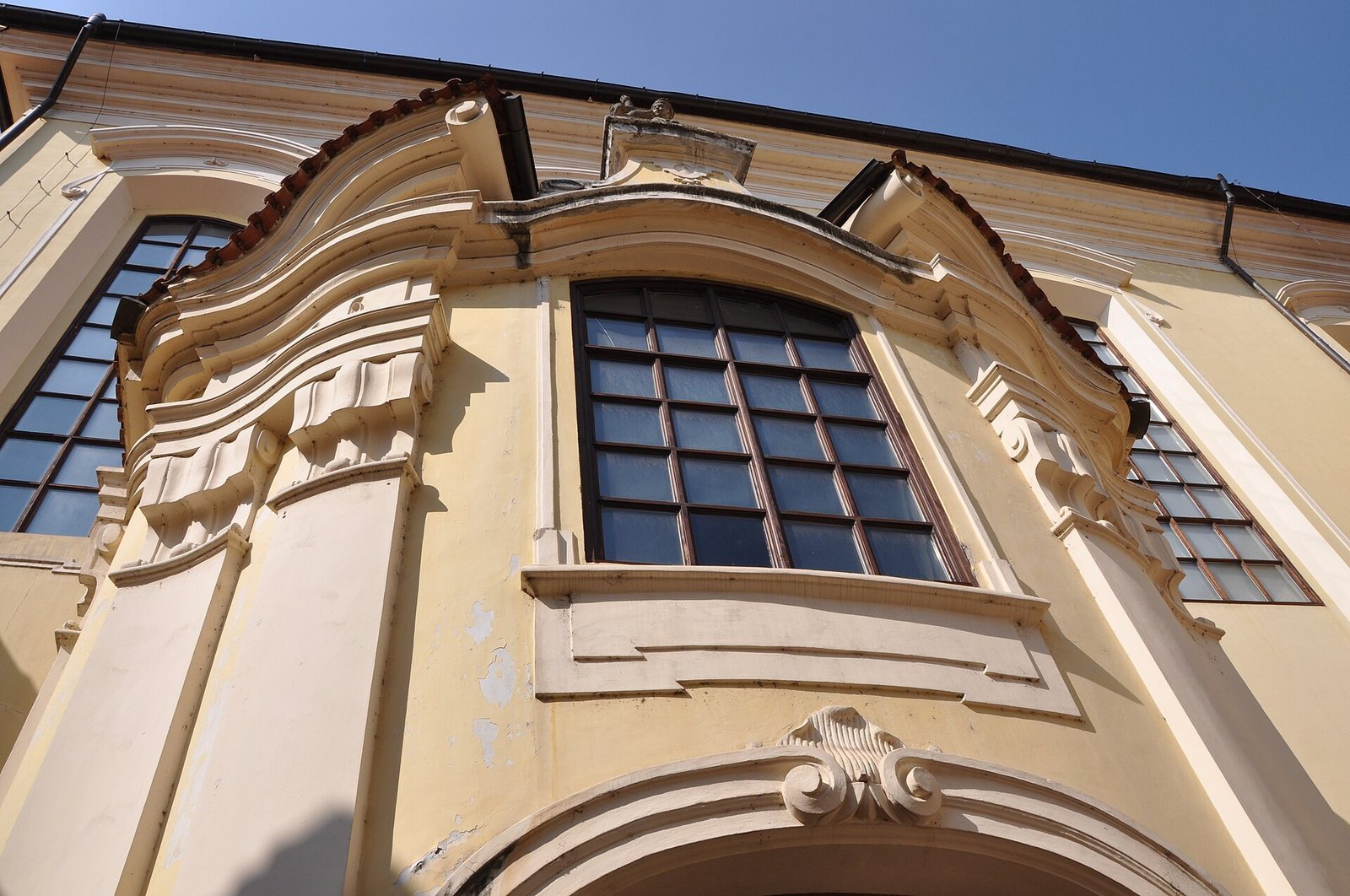
The earliest stone church had a single nave ending in an apse. A western tower and side aisles later gave the building a basilican arrangement, with a taller central nave flanked by lower aisles; a subsequent hall-church form brought the nave and aisles to similar heights. A fragment of a Gothic chapel with forms associated with the medieval tradition of Arras survives on the façade. A Renaissance portal is also attributed to the church, although its date is uncertain. Much of the exterior retains a Baroque appearance, notably a projecting, convex vestibule with massive stucco architectural details. Warehouse and factory use, along with later adaptations, damaged parts of this historic fabric.
Monastery and library hall
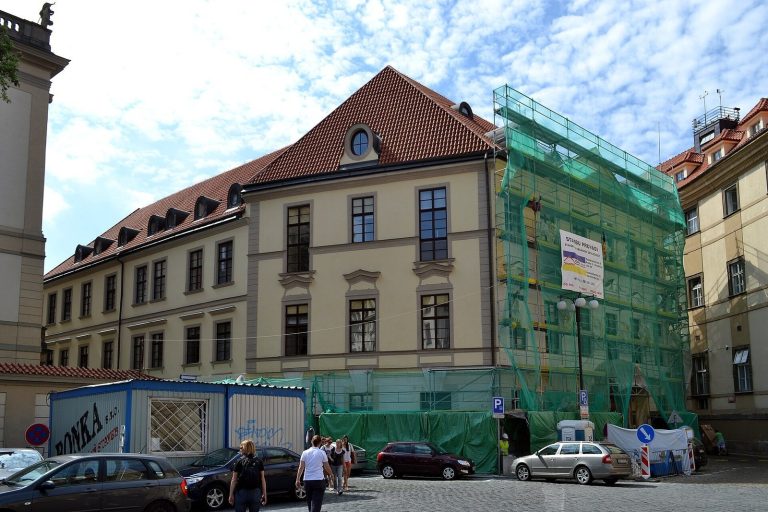
The former monastery’s four wings and three-storey arrangement reflect its use as a religious house, which could accommodate as many as twenty members of the order. Its later appearance probably results from a late-Baroque rebuilding. The preserved Baroque library hall contains a fresco by Josef Hager associated with the former library.
Interior features and burials
A surviving church fresco depicts merchants being driven from a temple. The high altar held a painting by Peter Brandl showing the battle between good and fallen angels; statues of a guardian angel and the archangel Raphael probably formed part of the altar ensemble. Burials include rectors of the Prague university in the crypt. Several dozen graves uncovered during the 1995 investigation are thought likely to have belonged to Servite members. Human remains from earlier burials were later relocated within the underground areas.