Church of Blessed Virgin Mary of Consolation, Vilnius: A Late-Baroque Catholic Church
Site at a Glance
- Popularity
- Medium
- Country
- Lithuania
- Primary era
- Early Modern
- Eras represented
- Early Modern, Modern
- Civilizations
- Polish–Lithuanian Commonwealth
- Site type
- Religious
- Remains
- Church
On this page11 sections
History
Earlier churches and the Augustinians
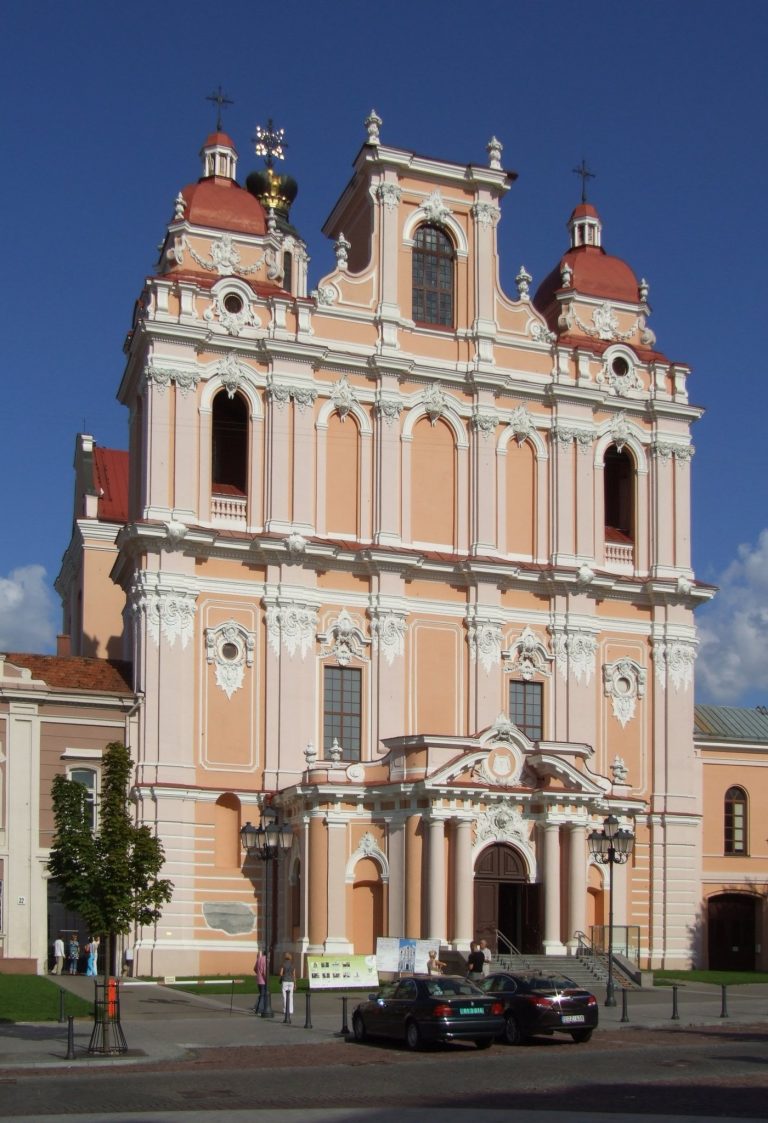
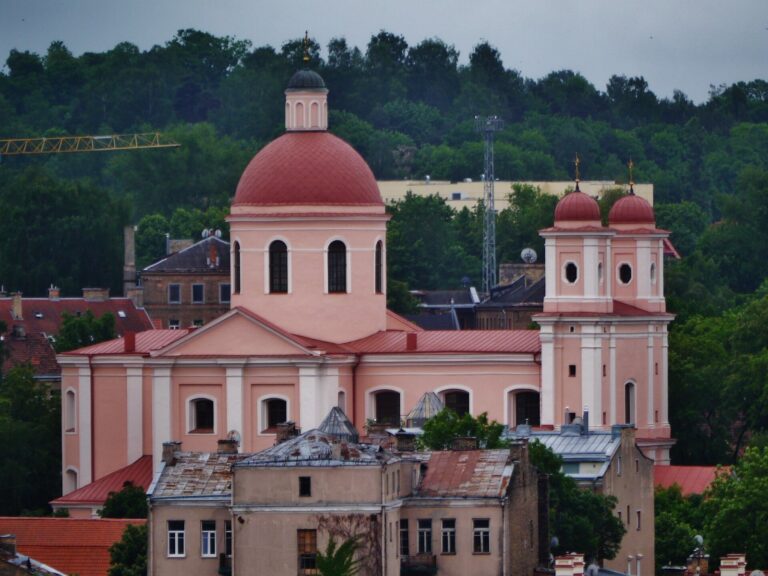
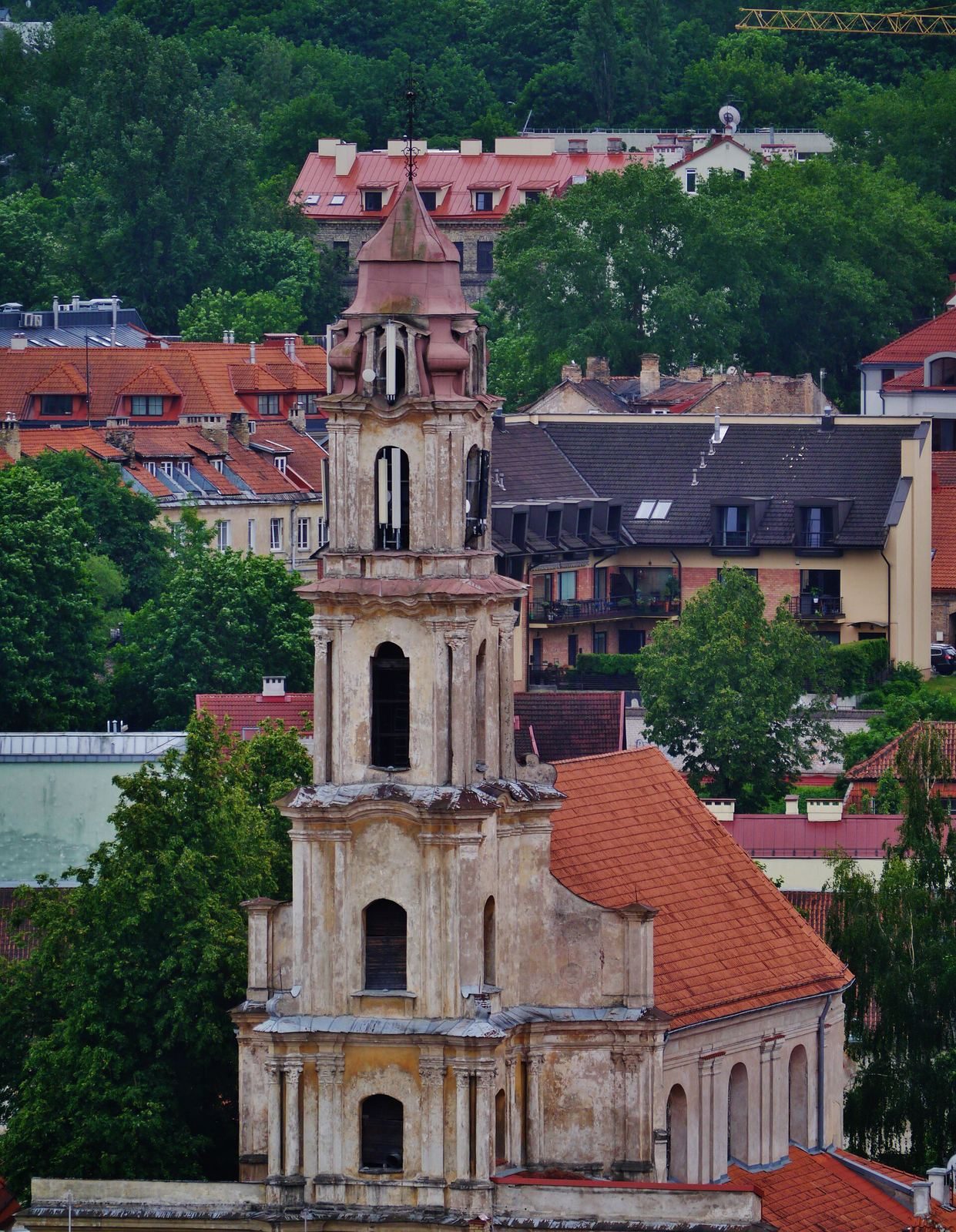
The Church of Blessed Virgin Mary of Consolation is a Catholic place of worship in Vilnius, Lithuania, built by the Augustinians between 1746 and 1768. Its late-Baroque design, part of a European artistic tradition, incorporates Rococo details, known for lighter, elaborate ornament. It is Lithuania’s only single-tower late-Baroque church and Vilnius’s last Baroque landmark.
An earlier church dedicated to Saints Cosmas and Damian is believed to have occupied the site. It was an Orthodox church that became Uniate before 1655. A Uniate church belonged to an Eastern Christian tradition in communion with Rome while retaining its own rites. Around 1670, Carmelites, members of a separate Catholic religious order, built a wooden church or chapel there dedicated to the Transfiguration.
The site and two adjoining plots passed to the Augustinians in 1675. This Catholic order follows a rule associated with Saint Augustine, and its members had settled in Vilnius in 1673. They began building a church and monastery in 1675–1677. In 1677, King John III Sobieski granted the community income from a mill on the Vilnia River, but the revenue could pay only for wooden buildings. A new wooden church followed in 1679. The monks also acquired nearby buildings, adapting and joining them for use as monastery quarters.
The Augustinian church and monastery
A fire destroyed the church and monastery in 1742. The Augustinians replaced them with a new church and monastery between 1746 and 1768. On 26 June 1768, Tomasz Zienkowicz, a bishop serving under the metropolitan archbishop of Vilnius, consecrated the church to the Blessed Virgin Mary of Consolation. The architect has not been securely identified.
The monastery supported a novitiate, a period of preparation for entry into a religious order, and for a time a school; it also held a large library. Confraternities, devotional associations often involving lay members, gathered under the patronage of Our Lady of Consolation and Saint Thecla. At the 1772 First Partition, the first of three divisions of the Polish–Lithuanian Commonwealth among neighboring powers, 34 monks lived at the monastery. It was the second-largest house in the Polish Augustinian province.
Educational use and Orthodox conversion
In the late eighteenth or early nineteenth century, the monastery buildings passed to Vilnius University, and the monks left the main complex. The buildings housed a theological seminary. After the university closed in 1832, the seminary became an independent Roman Catholic Spiritual Academy, an institution for advanced theological education and clerical training. It operated until its closure and transfer to Saint Petersburg in 1842. Lithuanian bishop and writer Motiejus Valančius taught there from 1839 to 1842 and earned a doctorate in theology.
After the academy closed, the former monastery housed an Orthodox theological seminary and school. The church was assigned to the Carmelites in 1852, then closed in 1854. During the 1850s, it was converted for Orthodox worship as the Church of Saint Andrew.
Catholic return and later uses
In 1918–1919, the church returned from Orthodox control to Catholic use and was restored. Parts of the former monastery served Stefan Batory University as a men’s dormitory, dining hall, and premises for student organizations; other buildings housed a teachers’ seminary. The southern wing, which housed the Lithuanian girls’ gymnasium Birutė in 1940–1941, was destroyed during fighting in 1944.
After the Second World War, the church was closed and used as a vegetable store. Its interior was altered with reinforced-concrete floors, while surviving monastery buildings became apartments, including housing for Vilnius University staff. After Lithuania regained independence, the church returned to the Catholic Church, but funds for restoration were lacking. The restored eastern monastery building on Bokšto Street became available for use by the European Humanities University in autumn 2017. The restored western part of the complex contains apartments and offices.
The church returned to religious use, and on 8 June 2018, 250 years after its opening, Archbishop Gintaras Grušas of Vilnius celebrated Mass there. The church, former monastery buildings, and enclosure are protected as a state cultural-heritage ensemble; the church is also recognized as a cultural-heritage object.
Remains
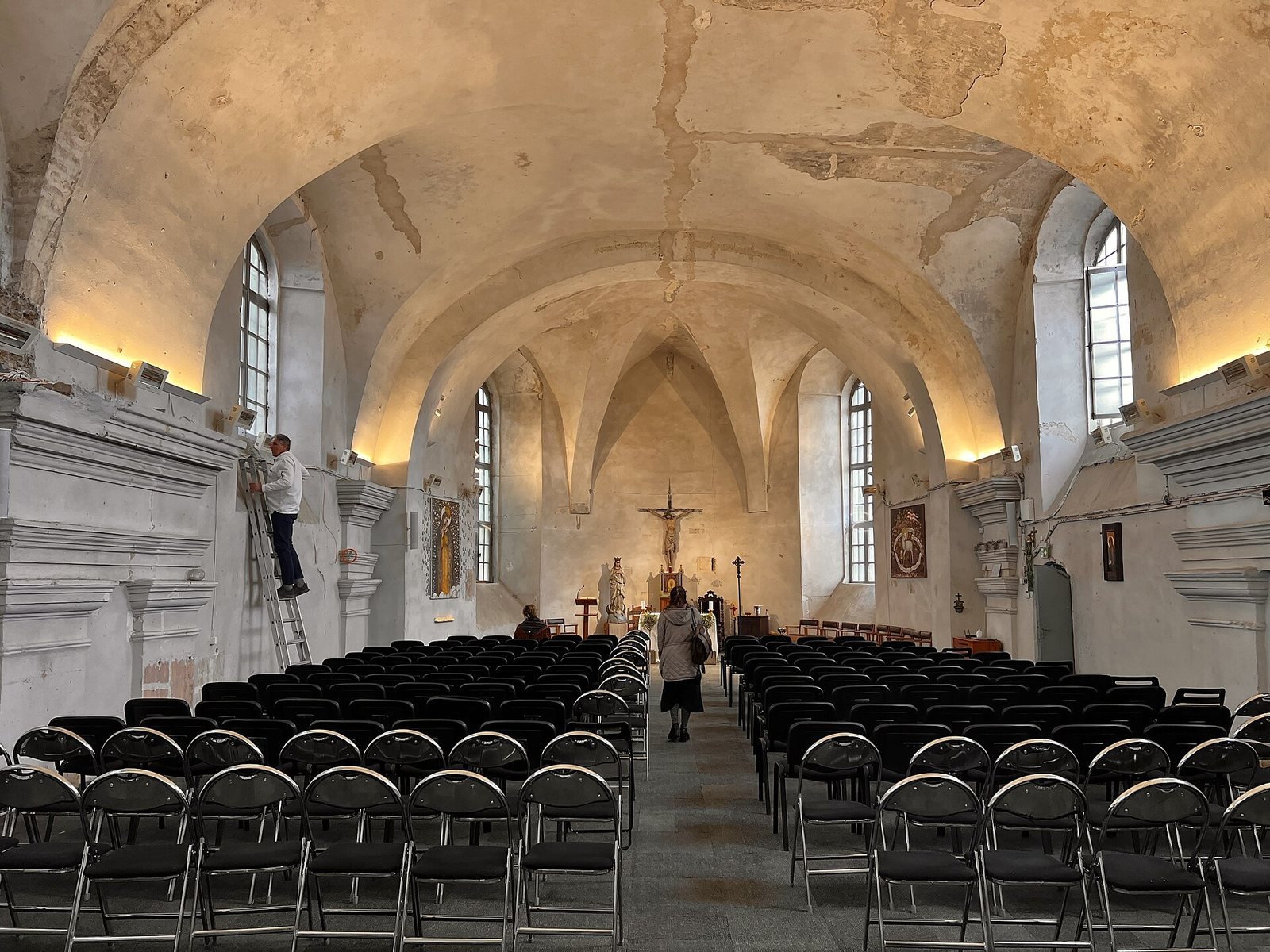
The church has a rectangular plan arranged around a central nave, the main body of the building, and two side aisles, passages alongside it. The nave was designed to be three times the width of the aisles. The building is made of brick masonry with a plastered exterior.
The church
Plan and exterior
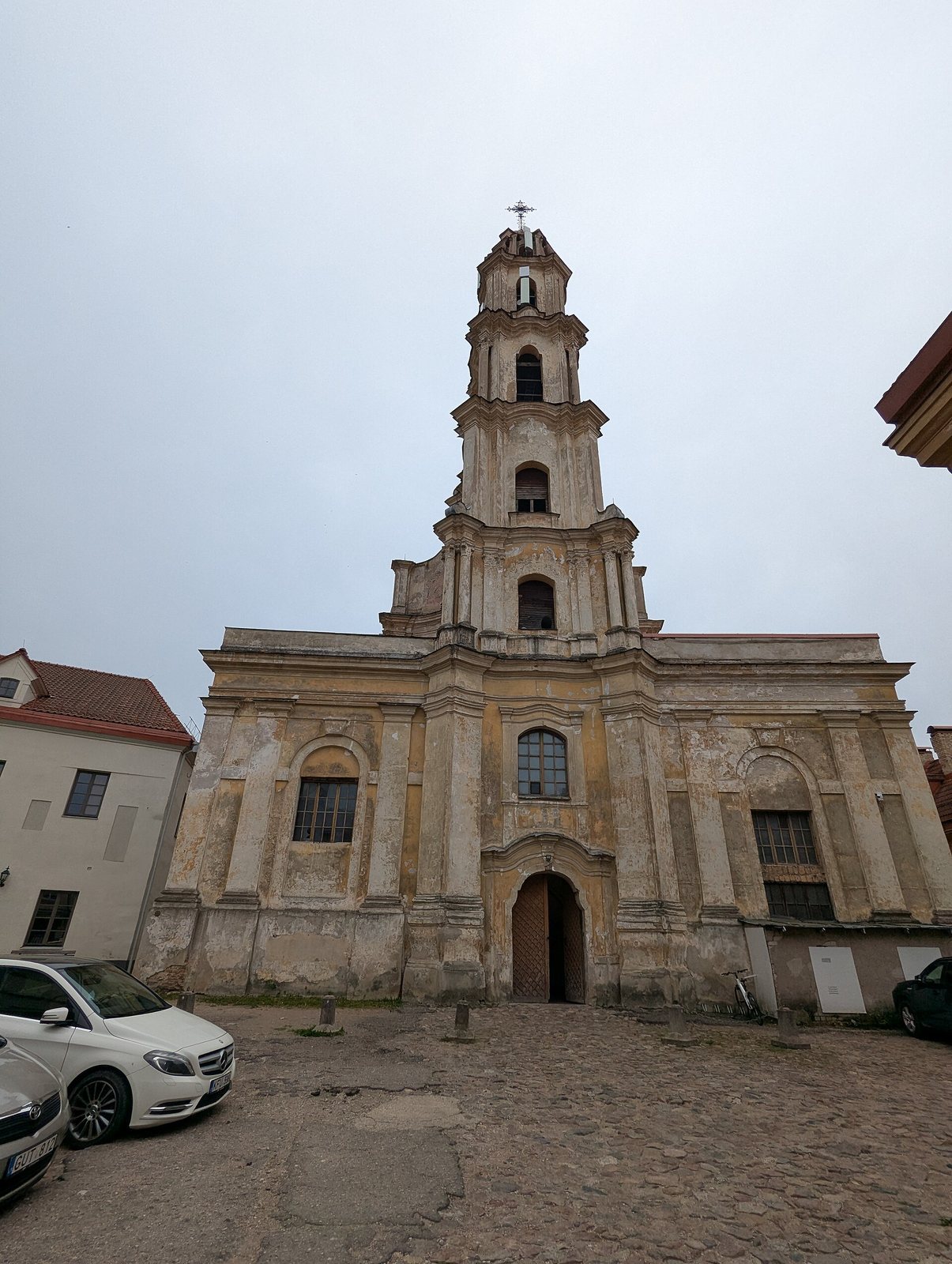
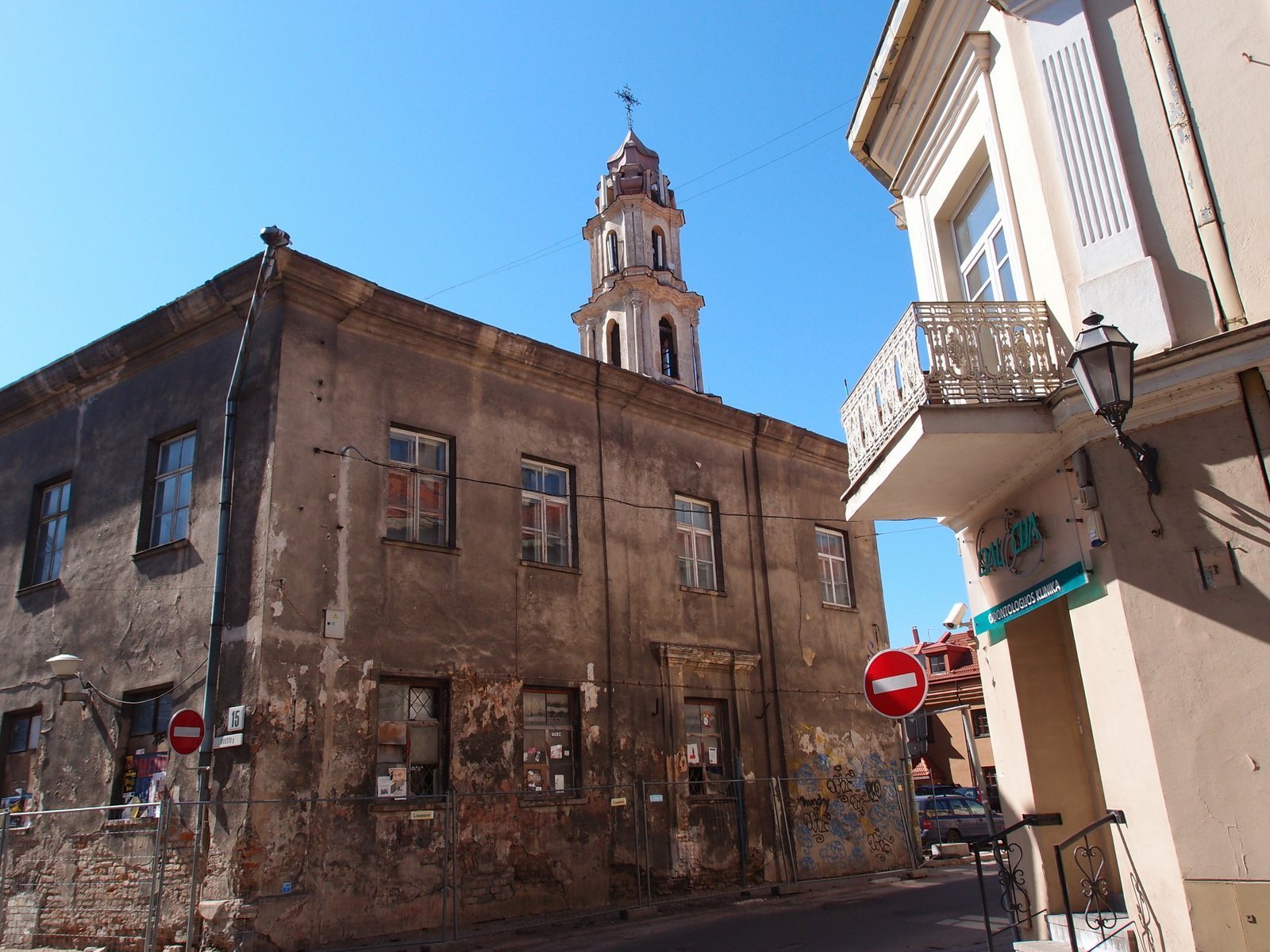
A slender, multi-tiered tower rises 41.5 metres above the front facade and ends in an openwork cross. Columns and other classical details decorate the tower, whose small upper roof has dormer windows. Two pilasters, shallow wall projections resembling columns, flank it. The lower level contains a portal framed by triangular pilasters. Along the main nave, pilasters use the Tuscan order, a plain classical column style. Two-storey rooms were added on either side of the tower in the late eighteenth century. A masonry wall and gate once separated the church from the street.
Altars and interior
The original interior had nine altars. The main altar held an image of the Blessed Virgin Mary of Consolation associated with the church’s reputation for miracles; it was probably copied from an image at the Augustinian church in Kraków. A painting of Saint John Cantius, a fifteenth-century Polish priest and theologian, could be lowered in front of it. Other altars displayed paintings of Saint Augustine, his mother Saint Monica, Saint Nicholas of Tolentino, Saint Thaddeus, Saint John of Nepomuk, and Saint Thecla. A richly decorated pulpit featured a sculpture of Saint Augustine above it.
Transferred furnishings and paintings
The Marian image and liturgical objects were transferred to the Church of Saints John. The organ and a full-length portrait of Grand Duke Vytautas went to Vilnius Cathedral. Brought from an Augustinian church in Brest, the portrait is displayed above a memorial plaque to Vytautas in the cathedral.
Kanutas Ruseckas’s 1847 painting Lithuanian Girl with Palm Sunday Palms depicts the church facade, with the main altar and Marian image visible through the open doors. The painting provides a visual record of the altar and image.
Former monastery buildings
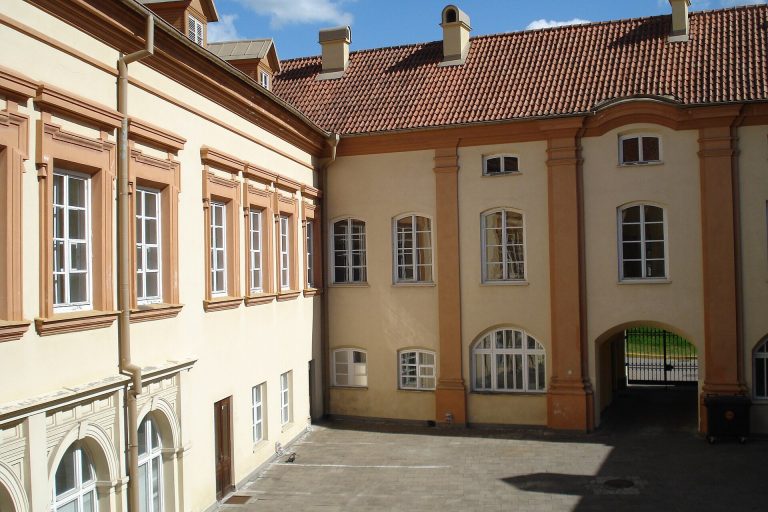
The former monastery complex extended between Bokšto and Augustijonų streets, with its main building along Bokšto Street. Buildings stood on both sides of the church, their ends facing the street: a service building on the right and a monastery building on the left, with its facade toward Bokšto Street. A small annex connected the church and monastery, allowing the Augustinians to pass between them. The buildings have modest decoration; the two-storey block facing Bokšto Street is particularly dilapidated.