Jaina Island: A Maya Religious and Funerary Center
Site at a Glance
- Popularity
- Medium
- Country
- Mexico
- Primary era
- Classical
- Eras represented
- Classical, Medieval
- Civilizations
- Maya
- Site type
- Settlement
- Remains
- Town
On this page11 sections
History
Jaina Island is an artificial island and Maya archaeological site off the coast of Campeche, Mexico. The Maya settled it around 300 CE, and the community grew into a major center during the Late and Terminal Classic periods, the later phases of the Maya Classic era. Around 600, it became an important religious and funerary center. Fishing and trade also sustained the settlement for more than seven centuries.
Burial and cosmological interpretations
Jaina and nearby Isla Piedras were both small towns or villages. The island’s many burials have prompted different explanations of who lived and died there. Some interpretations describe it as a cemetery for outsiders, including people from Edzna or the Chenes and Puuc regions. Another proposes that rulers and elites from western Yucatán were buried there, while a further view holds that many of the dead were Jaina residents interred beneath their own homes. The identity of the burial population remains uncertain.
Interpretations of Jaina’s place in Maya cosmology also differ. One connects its western position with the setting sun and death. Another places the island at the mouth of a sacred cosmic reptile and understands it as an ancestral homeland where the north–south and east–west axes met. The name Jaina has been translated as house of water, house on the water, or temple in the water; Hina and Hinal are also given as earlier forms.
Political change and abandonment
Priests governed the settlement, although their standing is unclear, and a small kingdom of Chan arose there. During the regional dominance of Chichen Itza, the major Maya city of northern Yucatán, Jaina prospered again. The halach uiniks, regional Maya rulers, continued to venerate its sanctuary. The island’s decline followed the defeat of a city-state late in the twelfth century, and Jaina was deserted around 1200.
Later records and archaeological study
The sixteenth-century Calkini Codex, a Maya manuscript, includes Jaina. A French map published in 1703 labels it Morros de Jaina, meaning Hills of Jaina. In the nineteenth century, the island belonged privately to Andrés Espinosa, a port official in Campeche. Visitors included the American explorer B. Norman in 1843, Bancroft in 1883, and the French explorer and archaeologist Désiré Charnay in 1886; fishers, antiquarians, pirates, and other travelers also left records and maps.
The Mexican Revolution of 1910–1920 ended the island’s private ownership. Systematic archaeological research began in the 1940s, involving Alberto Ruz and Román Piña Chan. Antonio Benavides established a field research and artifact-processing station in 1986. From 1996 to 1998, he and Elizabeth Zaragoza directed excavations at the Zayosal group and the study of pottery and other finds.
Remains
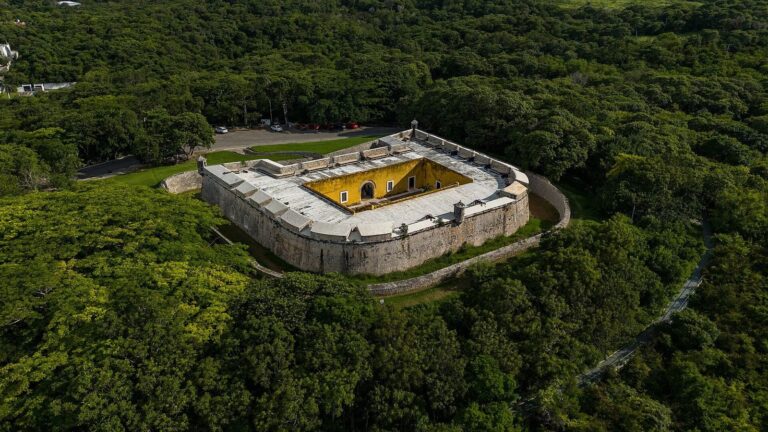
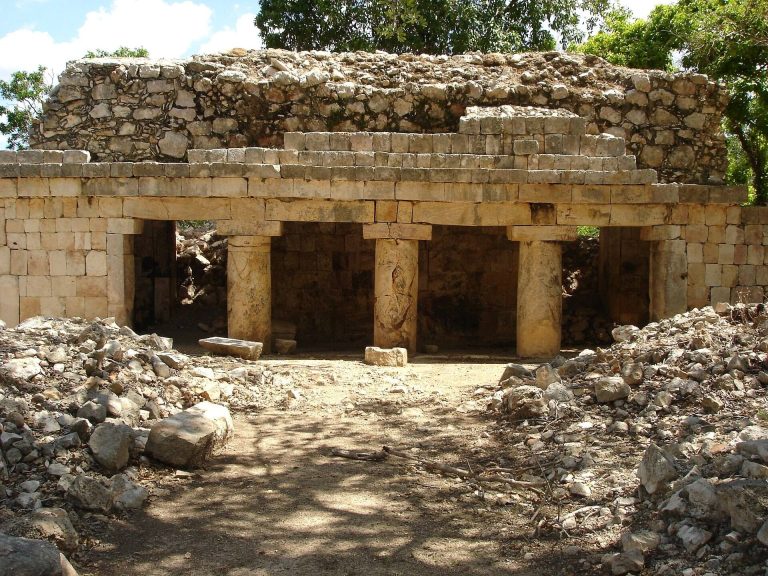
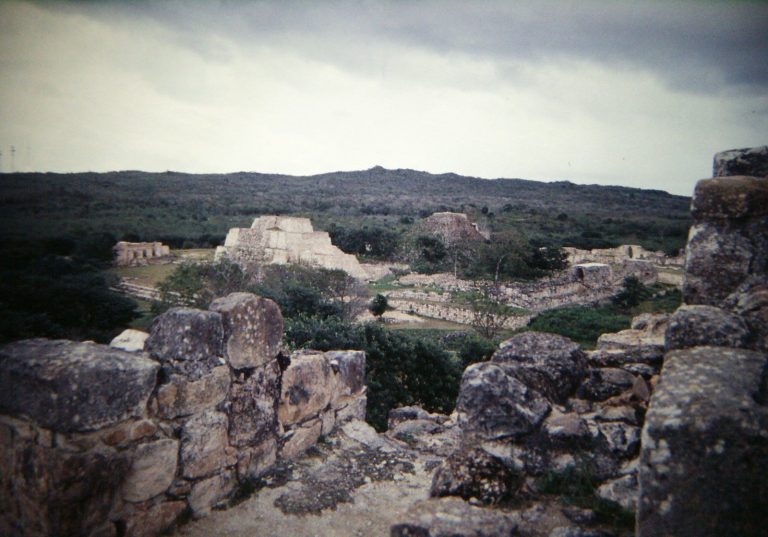
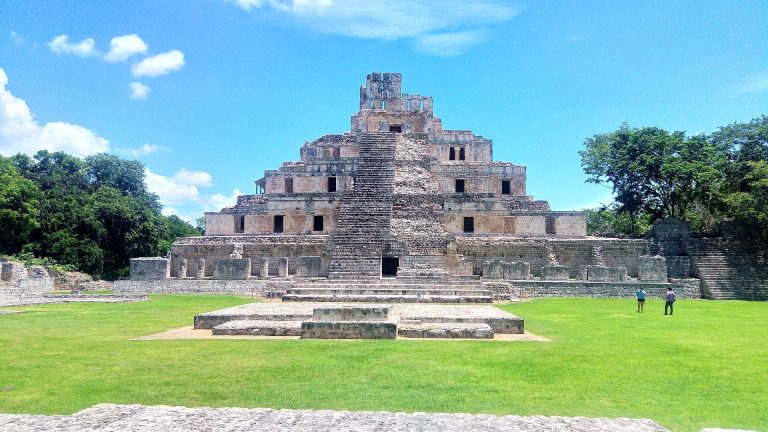
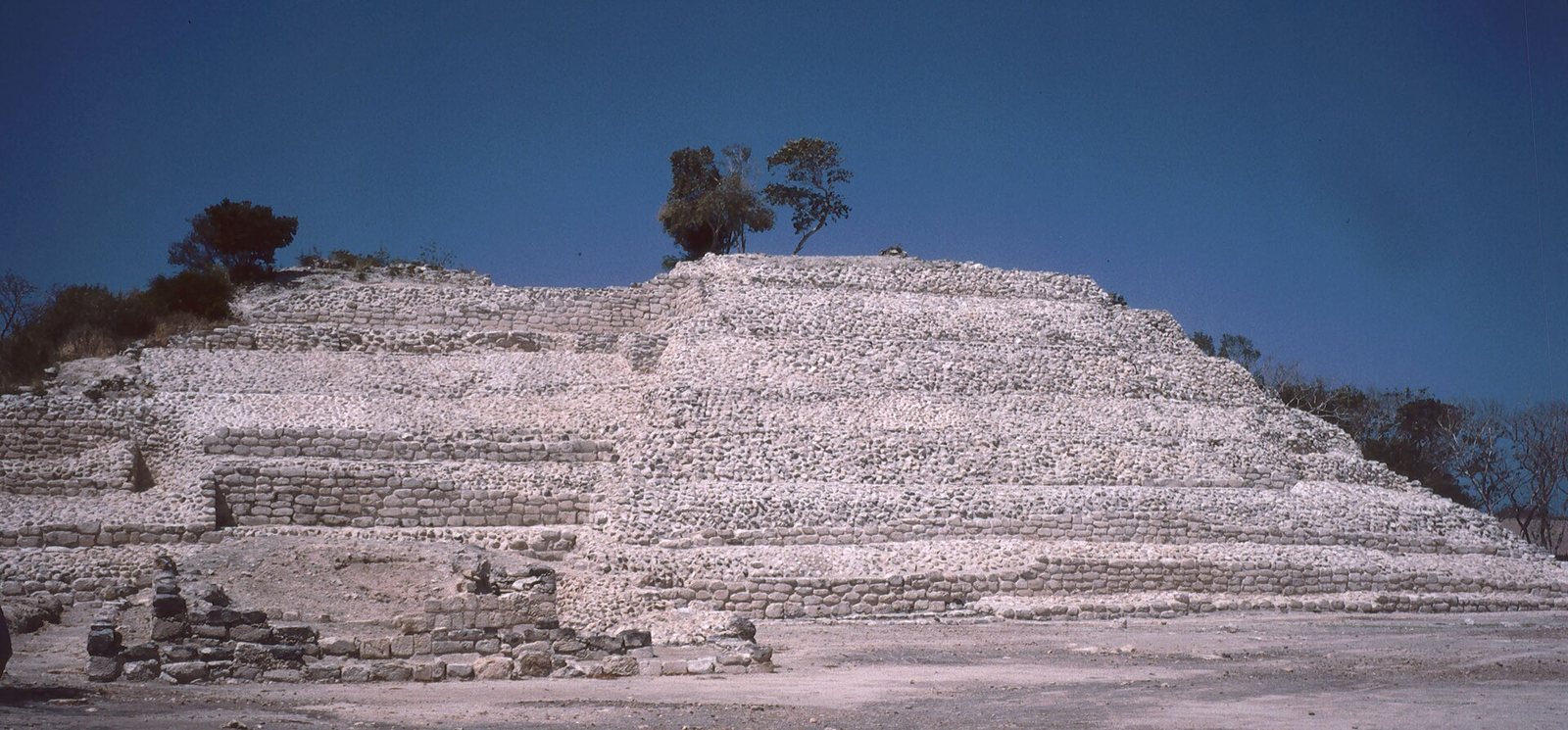
Jaina is separated from the mainland by a narrow tidal inlet and now covers about one square kilometre. It began as a mound of Gulf Coast sediments and expanded over centuries as rock, limestone, and sascab, a limestone-based building material, were added around its perimeter. Buildings were raised on packed-earth mounds, faced with rough stone, and finished with plaster. The ruins form two groups around plazas, eastern Zayosal and western El Zacpool. The site also has two large plazas, a small ballcourt, a purpose-built space for the Mesoamerican ballgame, and small temple structures.
Carved stone monuments
Five upright carved or inscribed stone monuments, called stelae, and two stone slabs have been found on the island. Their inscriptions include dates of 652 and 854. Some researchers have described the reliefs as more dynamic in style than those at ceremonial centers in Petén, a Maya region in present-day Guatemala.
Burials and grave goods
The island’s graves are estimated to number about 20,000, with more than 1,000 excavated; some date to approximately 500–1000. Burials contain human remains with pottery, including glossy pottery and slateware, vessels probably used for water or food, everyday objects, and a few gems. Carved shell objects also occur, some decorated with apple-green jade. One or two figurines were commonly placed near the deceased’s chest or in their hands.
Figurines
Form and manufacture
Jaina figurines are generally made of orange clay and stand about 25–65 centimetres tall, though some are larger. They were painted, and in an early phase pigment was applied after the clay had dried. Both solid and hollow examples exist, with hollow figures more common. Some could whistle or make a rattling sound, but their precise use is uncertain. Early examples are often hand-modelled, finely detailed, and individually varied, with incised lines, punctures, applied clay pellets or strips, and paint. From around 600 or 650, makers also used moulds. Some figures combine moulded bodies with hand-modelled heads and limbs; later examples often have carefully finished faces and headdresses, with more roughly shaped limbs. Moulded surfaces could be incised or decorated with added clay strips and ornaments, and some later figures received a whitewash or plaster coating.
Subjects and interpretation
The figures portray men and women, clothing and ornaments associated with social status, and scenes of daily life. Other subjects include older people, people with disabilities, hunchbacked figures, dwarf-like figures, animals, and abstract forms. Some depict cranial deformation, tooth removal or dentures, scarification, and body painting, practices also indicated by skeletal remains from the island. Recurring scenes show an older woman sheltering an adult man as if he were a child, or an older man courting a young woman. A frequently depicted “fat god” is associated with Maya communities in Campeche. One figurine found in 2015 represents an unusual animal or bird.
A common later figure is a standing woman with raised arms, often identified as Xochiquetzal, an Aztec goddess. Identifying this figure as Ix Chel, a Maya goddess, is considered mistaken. The figures’ subjects do not consistently correspond to the sex or age of the person buried with them. Some have been interpreted as deities or references to myths and legends, while another interpretation sees them as ancestors.
Chronology and production
Figurine dates remain debated. One influential scheme places hand-modelled Phase I examples in 600–800, mould-made Phase II figures in 800–1000, and the Campeche phase in 1000–1200. In this scheme, Phase I is marked by skilled, individual work; Phase II by increased production and less individuality; and the Campeche phase by near-exclusive mould use and many raised-arm female figures. Many researchers instead place hand-modelled figures in the Early Classic, around 250–600 or 650, and mould-made examples from about 600 or 650 onward, in the Late Classic and Postclassic, the era following the Classic period.
Figurines in the Jaina style have been found at inland Maya sites as well as on the island. Clay composition points to northern Tabasco or southwestern Campeche as the source for most examples, while smaller groups came from locations along as much as 700 kilometres of the Gulf Coast and from the coasts of Yucatán and Quintana Roo. Proposed production places include Isla de Sacrificios, Xicalango, Champotón, Jonuta, and Xcambo. Some mould-made figures have been linked to workshops at Jonuta and near Jaina.
The varied clay sources have been interpreted as evidence of exchange networks carrying obsidian, basalt, jade, cacao, pottery and figurines, as well as salt, honey, wax, timber, textiles, and shell goods. A related interpretation connects the expansion of trade by Putun or Chontal Maya groups, Maya-speaking peoples of the Gulf Coast, with the dynamic style of Jaina’s stone reliefs.