Church of the Immaculate Conception at the Jesuit College in Trapani
Site at a Glance
- Popularity
- Medium
- Country
- Italy
- Primary era
- Early Modern
- Eras represented
- Early Modern
- Civilizations
- Habsburg, Habsburg Spain, Kingdom of Sicily, Spanish
- Site type
- Religious
- Remains
- Church
On this page21 sections
History
Jesuit foundations and construction
The Church of the Immaculate Conception at the Jesuit College is a Baroque church in Trapani, Italy, designed in 1614 and completed in 1705. It formed part of a complex built for the Jesuits, members of the Catholic Society of Jesus founded by Ignatius of Loyola. The church is dedicated to the Immaculate Conception, the Catholic teaching that Mary was conceived without original sin, and is affiliated with the Diocese of Trapani.
In 1580, Jesuits established an altar dedicated to the Virgin Mary’s Conception in the church of the religious brotherhood of San Michele. Between 1581 and 1596, they secured permission to build a church, college, and convent, with financial support from Trapani’s city senate. The brotherhood left the site in 1616. Natale Masuccio, a Jesuit architect, designed the church in 1614. Tommaso Blandino later took charge of the work, joined over time by local craftspeople, architects Pietro Castro and Giovanni Biagio Amico, and sculptors Giuseppe Milanti and Giacomo Tartaglio.
Cardinal Giovanni Domenico Spinola, bishop of Mazara del Vallo, consecrated the church on 13 June 1638. In 1655, Francesco Bonamici of Lucca was assigned to complete its façade. The building campaign reached completion in 1705.
After the Jesuits
The Society of Jesus was suppressed in 1767, and the church’s planned decoration remained unfinished. The design had called for an interior scheme using colored marble throughout. The Jesuits left Trapani in 1770, and their property came under the Diocese of Mazara del Vallo. The church is now affiliated with the Diocese of Trapani.
After the Jesuits’ expulsion, their college became a seat of schools under Sicily’s Bourbon rulers. In 1834 it became the Royal Lyceum Leonardo Ximenes, named for the Jesuit mathematician and engineer. Following Italian unification, it served as the Ximenes classical high school. The college’s large library was transferred to Palermo and later dispersed. Its books and documents are now held by the Central Library of the Sicilian Region, the Jesuit collection of the National Library of France in Paris, the Jesuit historical archive in Rome, and the Fardelliana Library. The former convent served as a courthouse until the 1950s.
The church closed for restoration in 1961, and architectural restoration work was completed in 2011.
Remains
Layout and façade
The Jesuit complex
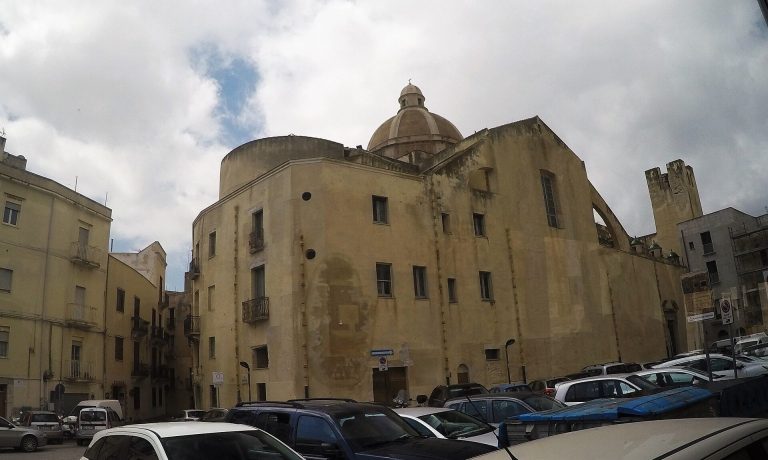
The church stands on Corso Vittorio Emanuele in Trapani’s historic center. The former college adjoins it on the west, while the former convent is on Via Roma. The college, designed by Masuccio in 1613, faces Corso Vittorio Emanuele and includes a square cloister with a portico of five arches on each side. Building wings enclose the block to the north, creating a large complex.
The church façade
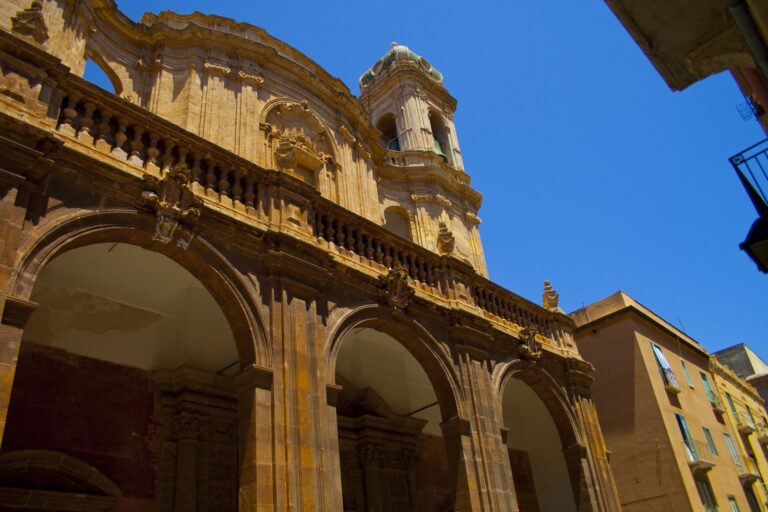
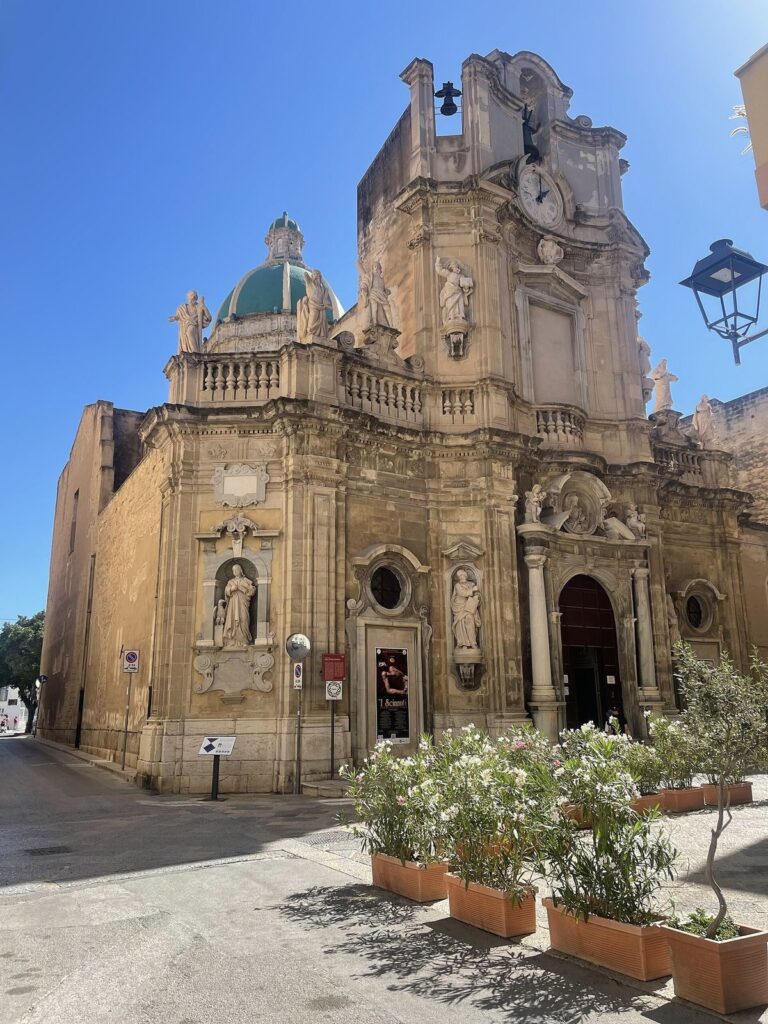
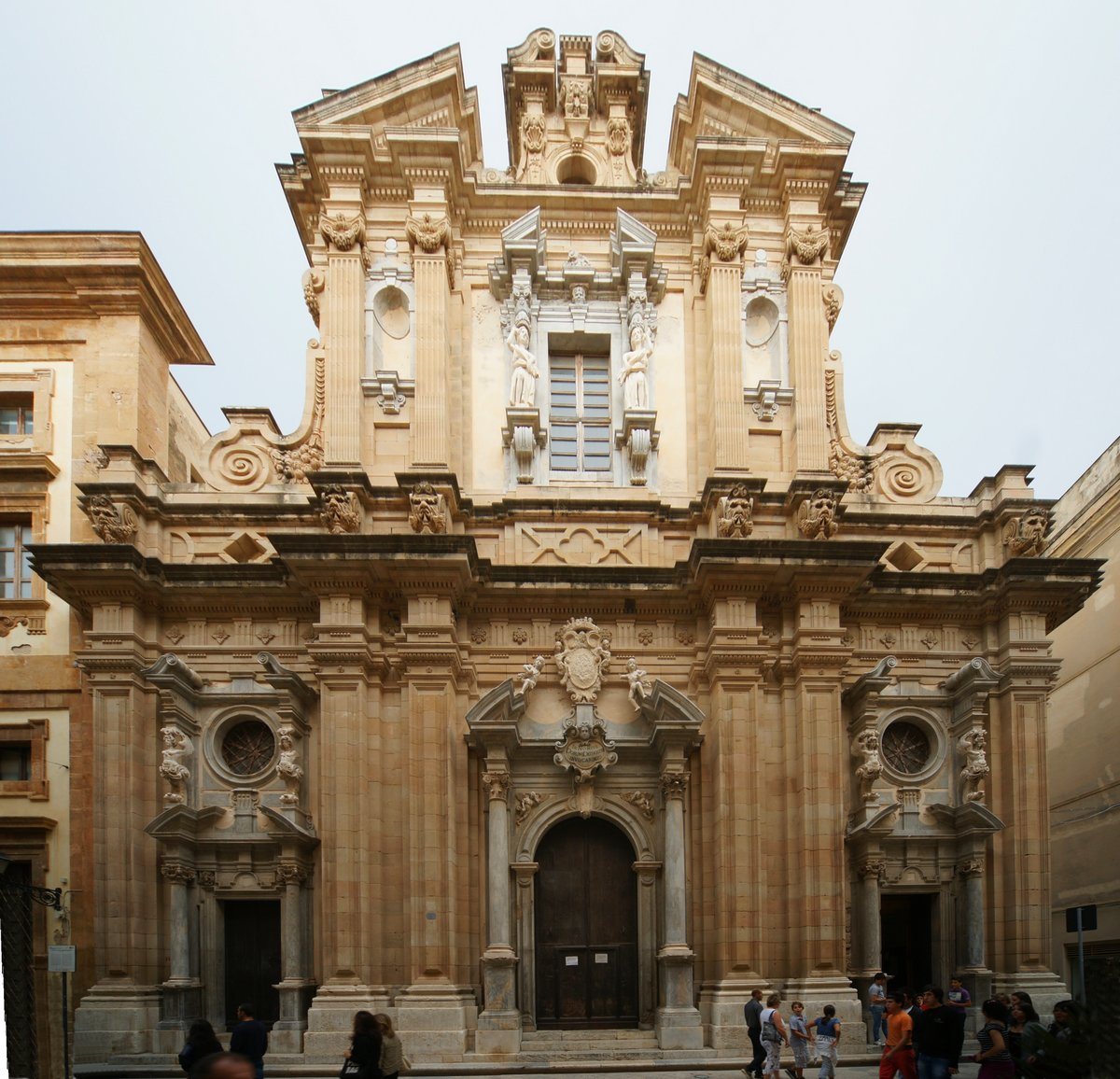
The façade has two main levels and three gray marble-limestone doorways framed by pilasters, flat, column-like strips on the wall. Tall bases and paired pilasters provide a vertical framework for the central sections of both levels; masks sit on blocks projecting from the horizontal band between them. Each doorway has Ionic columns topped by Corinthian capitals and layered pediments whose upper edges are interrupted. Sculpted figures described as human supports or harpies, mythological female creatures, support another tier of pediments, with curled ornaments framing large round windows. The central doorway is taller and wider than the others. Above it, two angels hold a Marian coat of arms and a scroll inscribed IN NOMINE DOMINI DEI NOSTRI INVOCABIMVS.
On the upper level, paired fluted pilasters topped with garlands frame empty niches and a central window. Female figures support a broken triangular pediment above the window. Large curled ornaments decorated with plant garlands connect the central section to the level below. A monumental broken triangular pediment crowns the façade, with a round window beneath a curled pediment at the intermediate level. The ornament includes childlike figures, cherub heads, floral and fruit garlands, masks, female figures, shells, mouldings, rosettes, stylized flowers, and geometric patterns.
Nave and interior decoration
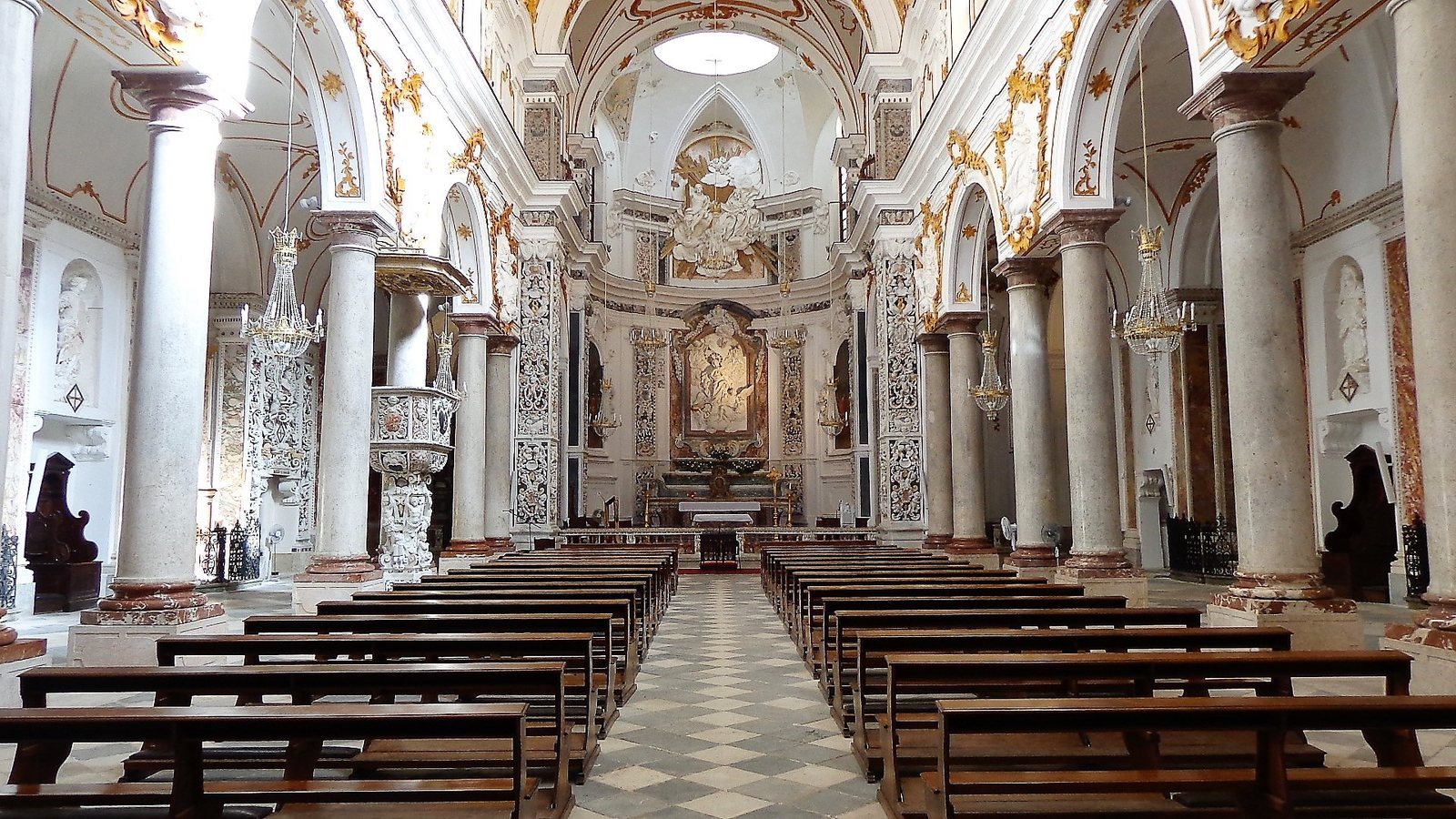
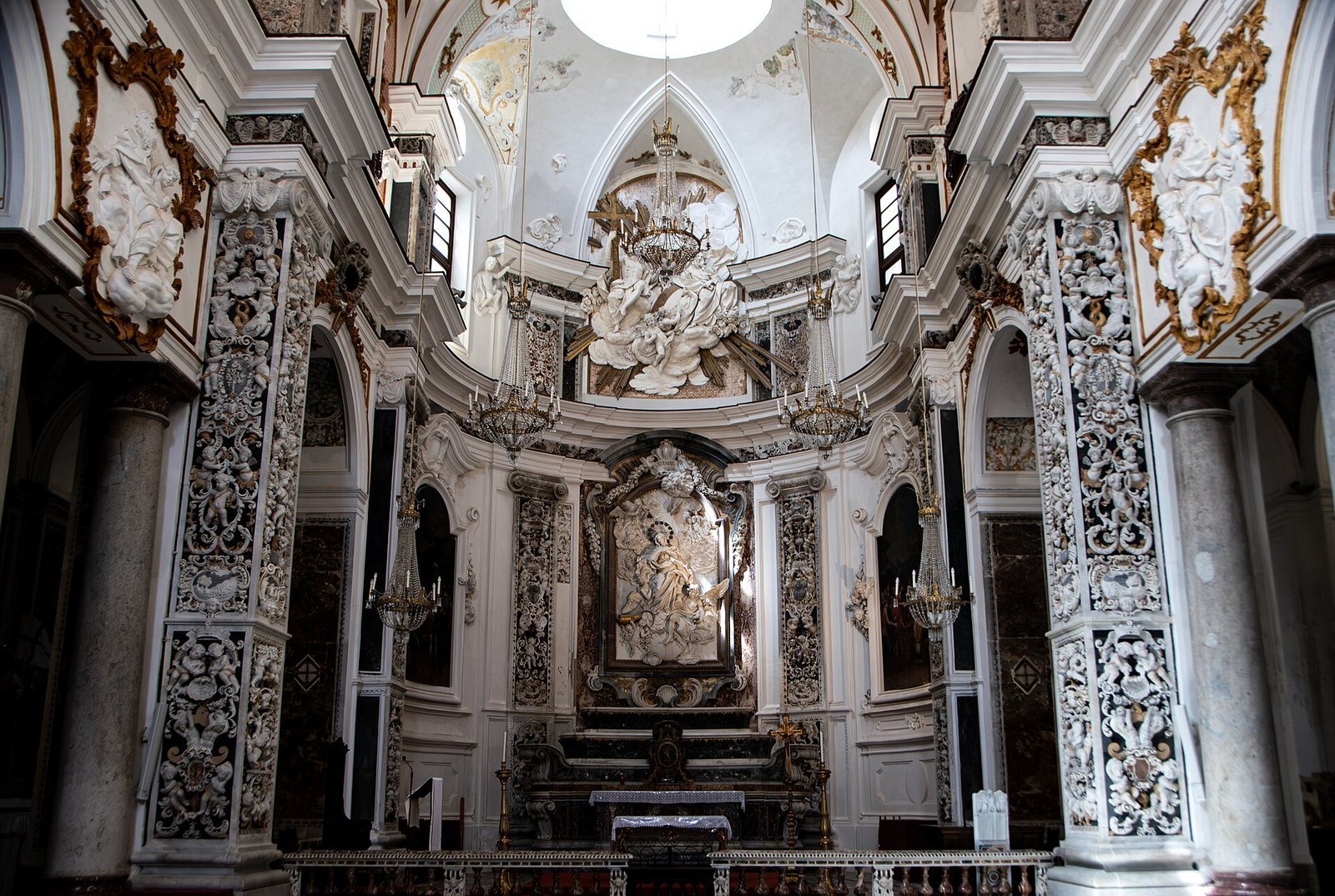
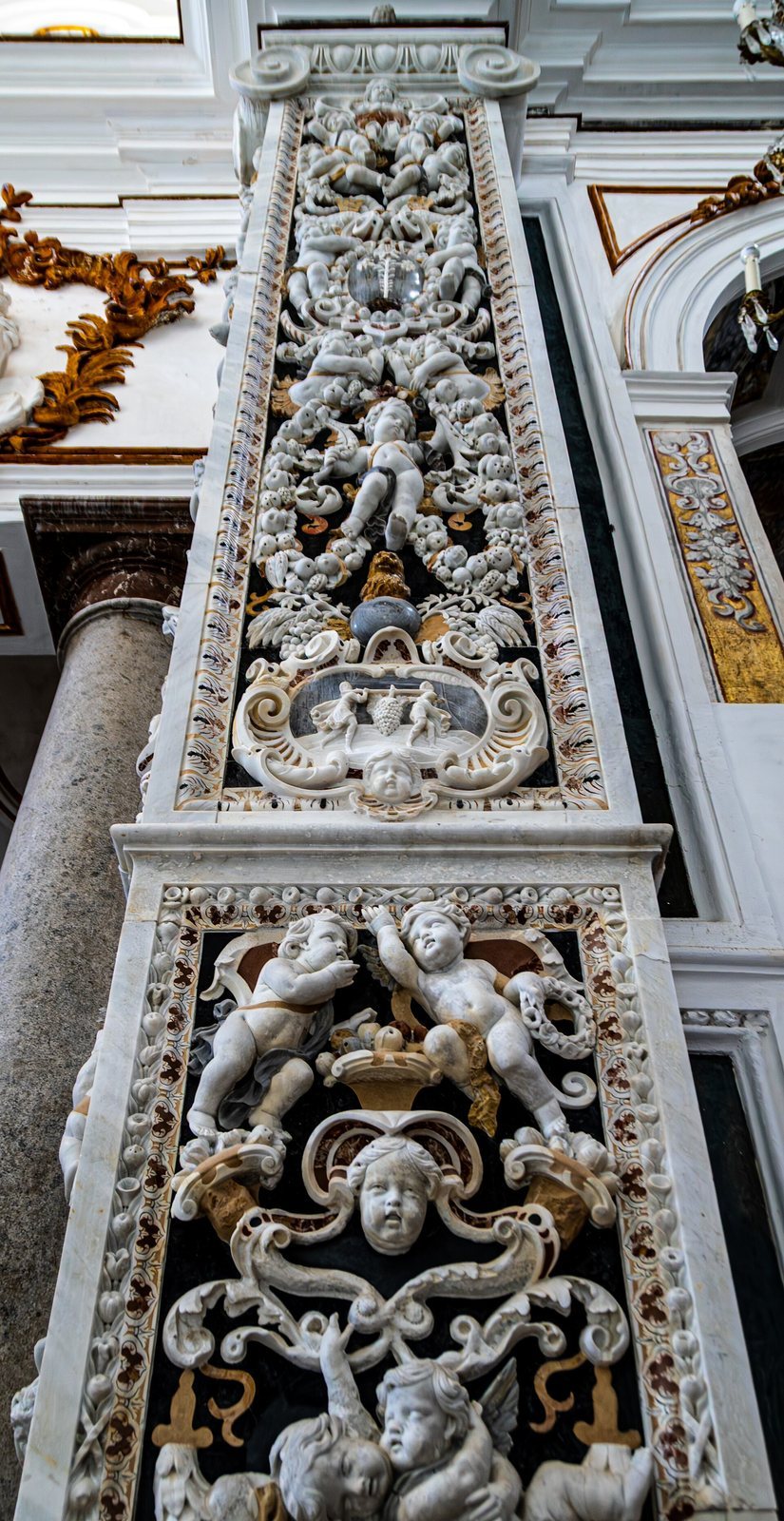
The church has three naves, with columns and Serlian arches, each formed by a central arch flanked by narrower openings. A choir loft is attached to the inner face of the entrance wall. Stucco and marble cover the walls, including colored-marble inlay, especially notable on the altar dedicated to Saint Ignatius of Loyola and on the pulpit. The stucco decoration includes eight medallions bordered by acanthus leaves on the curved supports above paired columns, and eight framed panels on the wall sections between the large windows. Two smaller panels and a larger central scene decorate the vaulted ceiling. Four sculptural works occupy niches in the side walls, and the church also has several marble busts.
Bartolomeo Sanseverino made the stucco work and signed it in 1766 as an architect and sculptor. He was a pupil of Giacomo Serpotta, the Sicilian Baroque sculptor known for his stucco decoration.
Chapels and furnishings
Chapel of the Holy Family
The Chapel of the Holy Family occupies the first section of the church and has a painting of the Holy Family by Domenico La Bruna on its wall. In the central nave, a red-marble basin serves as a holy-water stoup, and a lower niche compartment holds a statue of the Madonna of Trapani.
Chapel of Saint Albert of Trapani
Saint Albert of Trapani, a medieval Carmelite friar and saint, is honored in a chapel with a grille and a raised structure of inlaid, twisted columns. A small shrine-like frame holds a painting of the saint. A niche contains a statue, while a lower compartment holds a confessional.
Chapel of the Madonna of Trapani
This restored chapel contains a bust set against a wall inlaid with colored marble.
Pseudo-transept spaces
The pseudo-transept spaces suggest crosswise arms without forming full arms across the church. Their niches hold statues, and lower compartments contain either a statue of the Madonna of Trapani or confessionals. Busts stand against walls inlaid with colored marble.
Chapel of Saint Rosalia
Saint Rosalia, a Christian saint particularly associated with Palermo, is represented by a white alabaster sculpture beneath the chapel altar. Giacomo Tartaglio made it in 1717 from alabaster from Gibellina. The sculpture was offered to the saint by the people of Trapani.
Chapel of Blessed Luigi Rabatà
Blessed Luigi Rabatà, a Carmelite friar venerated as a blessed, has a chapel with a statue in a niche and a confessional in a lower compartment. Nearby in the central nave, a marble pulpit has harpies on its support and figures of the Evangelists on its bowl. Palermo craftsmen Francesco Scuto and Nunzio La Matina made it, taking inspiration from the pulpit at Casa Professa, the Jesuit Church of the Gesù in Palermo.
Chapel of the Holy Crucifix
The chapel contains a crucifix by Giuseppe Milanti and a bust of Allegranza Sanclemente against a wall inlaid with colored marble. An opening leads from the chapel to the sacristy rooms.
End chapels and sacristy
Chapel of Saint Francis Xavier
The chapel at the right end of the church is dedicated to Saint Francis Xavier, a Jesuit missionary and early leader of the order. It contains a painting of him by Pietro Novelli.
Chapel of Saint Ignatius
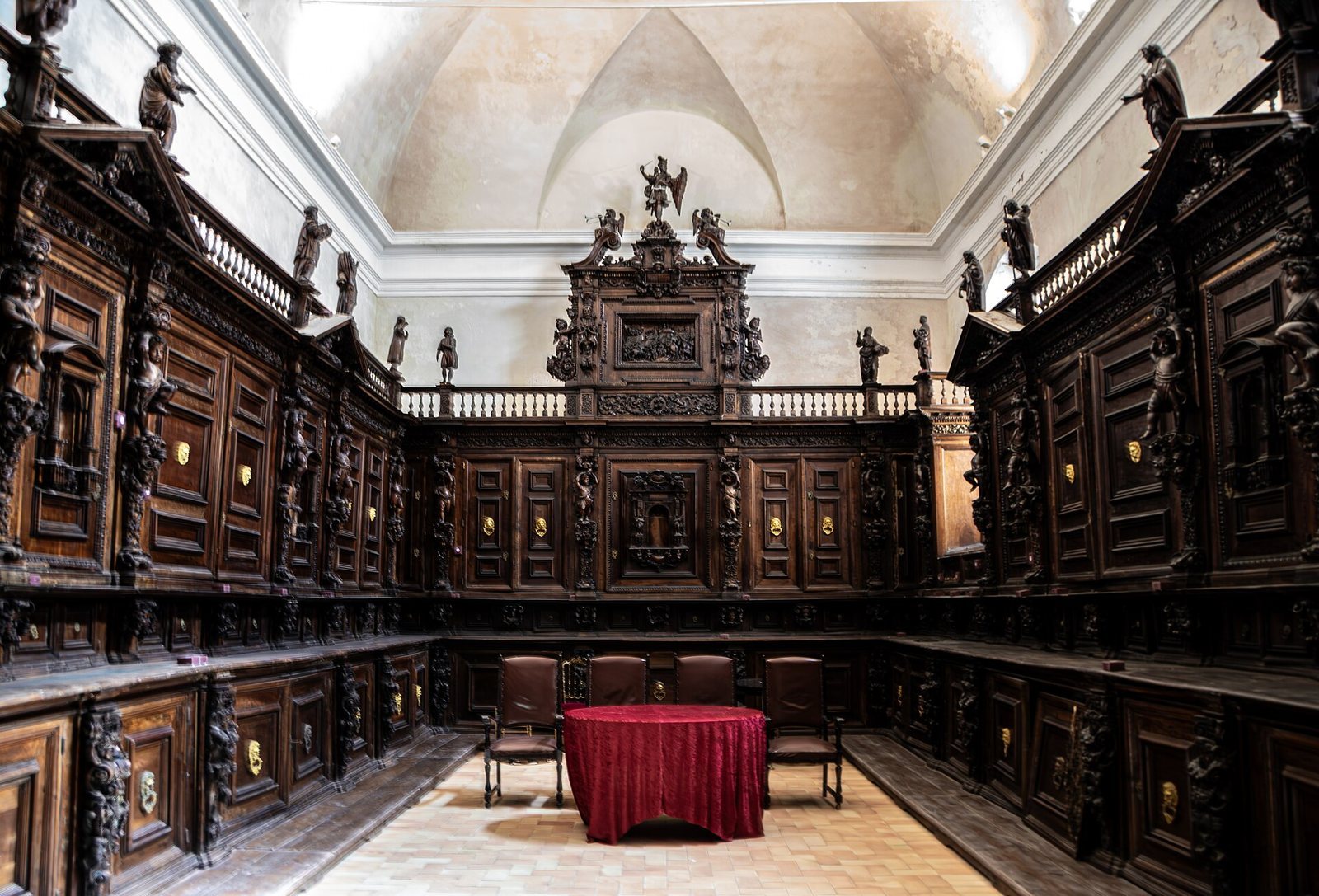
Giovanni Biagio Amico created the chapel at the left end of the church in the eighteenth century. A painting of Ignatius by Vito Carrera sits within a small shrine-like frame, surrounded by twisted columns and a broken-arch pediment. Columns, marble, brackets, curled ornaments, vases at the pediment’s corners, stucco, and wooden reliquaries of holy martyrs adorn the chapel walls.
High altar
A painting of the Immaculate Conception by Geronimo Gerardi, dated 1637, was placed on the high altar before being replaced by a marble high relief of the same subject by Ignazio Marabitti.
Sacristy
The sacristy vault bears an eighteenth-century fresco by Giuseppe Felice showing Saint Ignatius of Loyola and Saint Francis Xavier. The church also contains the tomb of Giacomo Tartaglio.