Pacopampa: A Formative Period Ceremonial Center in Peru
Site at a Glance
- Popularity
- Medium
- Country
- Peru
- Primary era
- Iron Age
- Eras represented
- Iron Age, Classical
- Civilizations
- Chavín
- Site type
- Religious
- Remains
- Sanctuary
On this page18 sections
History
Pacopampa is a major ceremonial center in the northern highlands of Peru, whose monumental buildings date to the Formative Period, broadly around 1200 to 500 BC. The Formative is a broad archaeological period in ancient Andean history. Pacopampa was contemporary with Chavín de Huántar, a major ceremonial center associated with Chavín culture. The site’s name comes from the Quechua words paqu pampa, meaning “plain of alpacas.”
Early activity and construction
Activity at Pacopampa began as early as about 2500 BC. Its monumental buildings took shape during the Middle and Late Formative, through a sequence of three phases. Pacopampa I, dated to about 1200 to 900 BC, was a period of construction. During Pacopampa II, about 900 to 500 BC, the complex underwent extensive remodeling, and most structures now visible at the surface belong to this phase.
Pacopampa III is dated to about 500 to 1 BC. Occupation associated with the Cajamarca culture, an ancient Peruvian tradition, continued into the Early Intermediate Period, another broad chronological label for Andean history. The site was eventually abandoned.
Regional and Chavín connections
Pottery studies by Hermilio Rosas and Ruth Shady distinguished an earlier Pacopampa-Pacopampa phase, around 1200 BC and preceding Chavín influence, from a later Pacopampa-Chavín phase, around 700 BC. They regarded the uppermost terrace as sacred and reserved. Pacopampa was also linked to Chavín culture through archaeologist Julio Tello’s influential theory about the origins of Peruvian culture.
About a dozen archaeological sites have been identified near Pacopampa. La Capilla and El Mirador, about one kilometer to the east, were among those investigated. Pandanche, a smaller Formative ceremonial center about three kilometers southeast, produced pottery in an earlier style. That find raised the possibility that Pacopampa’s sanctuary had an older beginning.
Research and changing interpretations
Archaeologist Rafael Larco Hoyle visited the area in the 1930s, collected stone-sculpture samples, and provided the first brief account of such finds from Pacopampa. Pablo Macera investigated the site in 1966. In 1970, Emilio Choy provided funds for the National University of San Marcos to acquire the land. The university’s Seminar of Andean Rural History has cared for the monument since then. Peru declared Pacopampa National Cultural Heritage in 1972.
Work at Pacopampa and nearby sites continued through the 1970s. Peter Kaulicke’s 1975 investigation at Pandanche identified pottery earlier than the Pacopampa-Pacopampa phase, while Isabel Flores worked at El Mirador that year. Excavations on Pacopampa’s third platform led Rosa Fung Pineda to identify five archaeological phases in 1976. Julián Santillana and Daniel Morales Chocano also conducted work at Pacopampa.
The Pacopampa Archaeological Project began in 2005 through an agreement between the National Museum of Ethnology in Osaka and the Faculty of Social Sciences at San Marcos. Directed by Yuji Seki with Daniel Morales as co-director, the project used radiocarbon dating, which estimates age from radioactive carbon, and stratigraphic correlation, which compares sequences of layers or building phases. These methods refined the chronology of the settlement and its architecture.
Burials and social status
In 2009, the project announced the discovery of the burial now called the Lady of Pacopampa, along with other human burials. She may have been a powerful regional figure, but her precise role remains uncertain: she may have been a ruler, adviser, or religious authority. Five tombs more than 2,900 years old were announced in 2012. Their position after construction of the ceremonial temple suggested that their occupants belonged to the elite responsible for administering the sanctuary.
In 2015, archaeologists announced a tomb containing two high-ranking individuals, possibly priests. The discovery was interpreted as evidence that priestly elites exercised authority over the surrounding population by about 700 BC. In 2022, another burial was revealed under the name Tomb of the Conch-Trumpet Priest. The individual was estimated to have been about 25 to 35 years old at death.
Remains
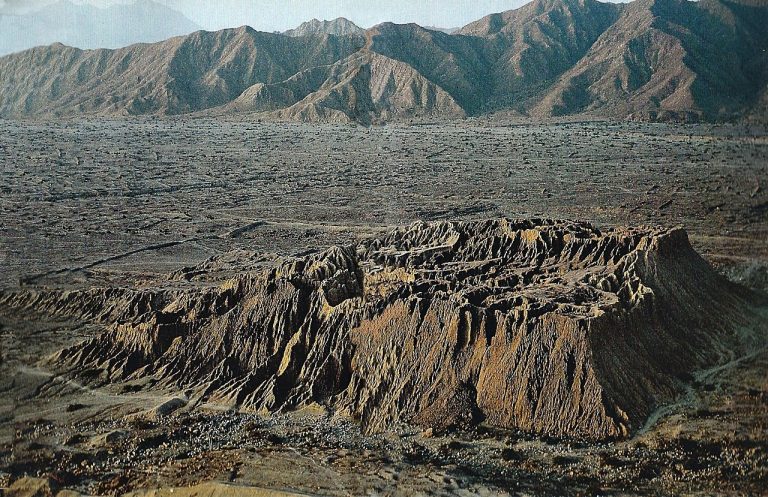
Pacopampa stands on a hill at an elevation of about 2,140 meters. Its complex of cut and polished stone covers approximately 600 by 200 meters and rises about 35 meters above the floor of the first platform. Three platforms, set one above another, give the complex the shape of a pyramid with its top cut flat. Entrances face east, and large stone stairways connect the principal levels.
Platform architecture
Lower platform
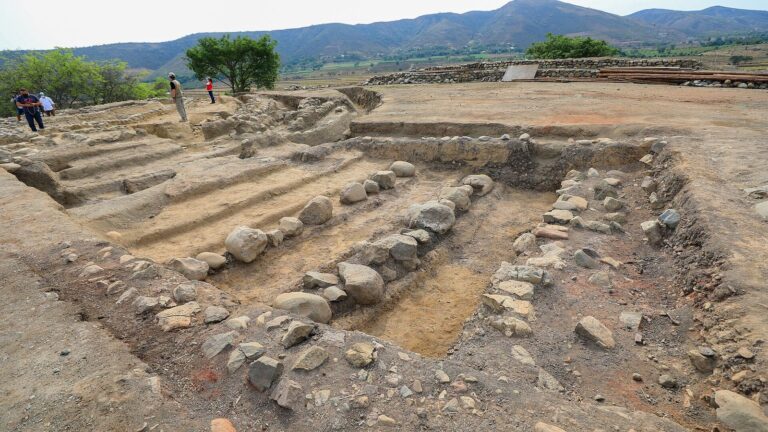
The lower platform contains interior galleries and a central staircase leading to the level above. A stone-carved feline was associated with this staircase. The complex also includes corridors, ventilation ducts, and channels for drainage.
Second platform
The second platform has interior galleries and its own central staircase, continuing the vertical arrangement of the complex. The stairways throughout Pacopampa were made from large cut and polished stones.
Upper platform and summit
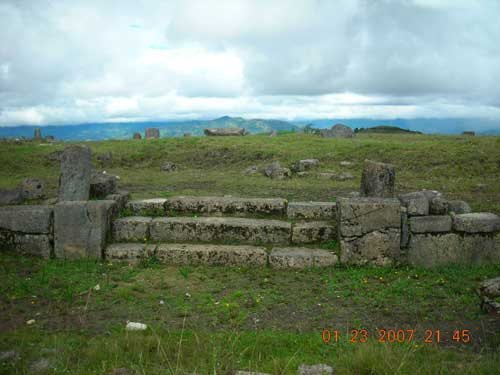
The third platform is a four-sided plaza at the top of the hill. Stairs link it to a structure at the summit. Remains of columns and polished stone blocks occur in the plaza, while other architectural elements include single-piece stone monuments and a projecting cornice decorated with deeply carved serpents.
Sculpture and smaller finds
Carved stone imagery
Pacopampa’s stone sculptures include representations of a feline deity, a divine being depicted with feline traits, also found at Chavín. Stone mortars shaped as felines include one with wings at the haunches. A statue known as the Feline of Pacopampa depicts a human-shaped figure with a feline mouth and wings, combining human, feline, and bird traits. Federico Kauffmann Doig used the term piscoruna-pumapasimin for this combination, which he described as recurring in Formative imagery. Samples of sculpture collected by Larco Hoyle are now in the Larco Museum in Lima.
Tools and pottery
Finds from the site include weapons, stone tools, pottery, and small carvings in bone and stone. The carvings carry symbolic designs in a Cupisnique-Chavín style, associated with ancient Peruvian cultural traditions.
Burials and grave goods
The Lady of Pacopampa
The Lady was buried in a deep, boot-shaped tomb that appears to predate construction of the ceremonial temple. She was about 1.55 meters tall and was estimated to have been 30 to 40 years old when she died. Her skull had been artificially deformed, and traces of cinnabar were found on it. Her grave goods included ear ornaments, gold earrings, ceramic vessels, and a necklace of marine shells. The shells were taken as evidence of contact with the distant coast.
Tombs associated with the sanctuary’s elite
Five tombs were positioned after construction of the ceremonial temple. One contained a gold pendant two centimeters in diameter, a stone bead, and ceramic vessels. Their placement has been interpreted as evidence that the people buried there belonged to the elite who administered the sanctuary.
Tomb of the two high-ranking individuals
This tomb lay about one meter below ground. The two individuals were buried together in fetal positions, facing opposite directions. Beside one was a black ceramic bottle with a stirrup handle, shaped as a serpent with a jaguar’s head. The other was associated with 25 gold beads, shaped like figure eights and strung to suggest a serpent’s movement. Pigments near a skull included red cinnabar, dark-brown hematite, shiny black magnetite, green malachite, and white calcite.
Tomb of the Conch-Trumpet Priest
This burial contained conch-shell trumpets, also known as pututos or waylla kepa, decorated with fine lines. The shells came from the coasts of Tumbes and Guayaquil. Other grave goods included necklaces made of large and small white shell beads and green malachite beads, as well as ear ornaments fashioned from semiprecious stone.