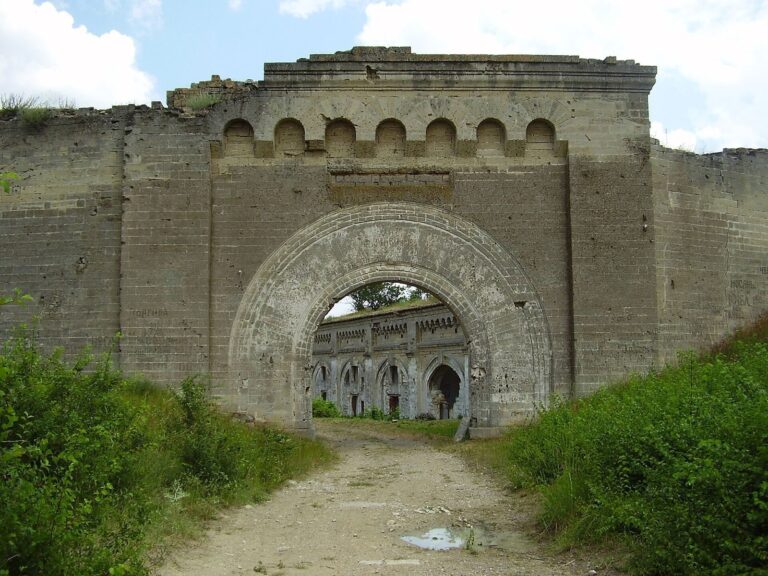
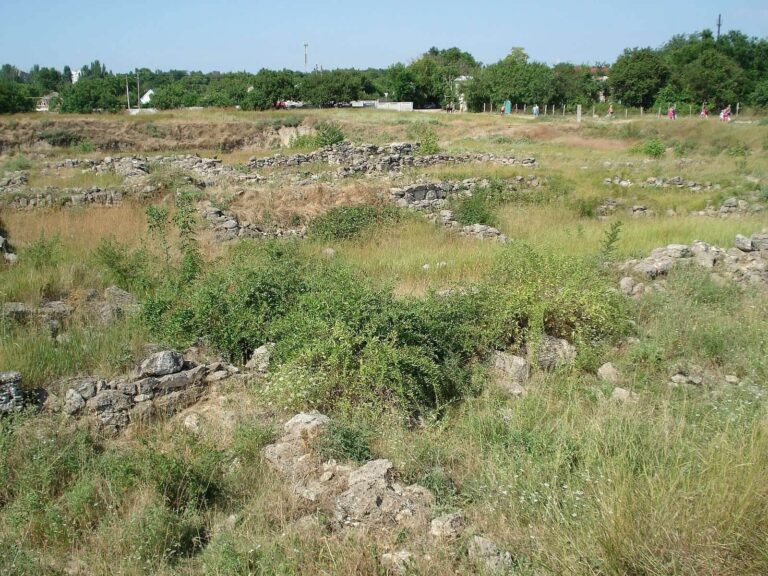
Golden Mound (Kerch): An Early Bosporan Kingdom Burial Mound
Site at a Glance
- Popularity
- Medium
- Country
- Ukraine
- Primary era
- Classical
- Eras represented
- Classical
- Civilizations
- Bosporan Kingdom
- Site type
- Burial
- Remains
- Burial Mound
On this page8 sections
History
Golden Mound is an ancient burial mound on the western outskirts of Kerch, Russia, associated with the early period of the Bosporan Kingdom, an ancient state centered on the Kerch Strait. Its construction belongs to this early period, although the traveler Edward Daniel Clarke later proposed that Greeks from Miletus built it during the early Greek settlement of the Bosporus.
Early accounts and investigation
The first known written mention comes from Peter Simon Pallas’s account of travels in 1793–1794. The mound was then regarded as the tomb of Mithridates, the Hellenistic king of Pontus who also ruled the Bosporan Kingdom. Clarke visited in 1800, describing and drawing the monument. He found it partly damaged and showing signs of looting, with the western side the only part of its stone facing still fully intact.
General Andrei Rosenberg later tried to enter the mound by detonating a large charge at its summit. The attempt failed to open the burial place but destroyed the summit and disrupted the stone facing. Paul Dubrux studied the mound during the 1820s and 1830s. From 1832, Kerch archaeologist Demyan Kareisha investigated its tombs, while Frédéric Dubois de Montpéreux visited in 1832 and 1834. Dubrux also recorded observations and discoveries from Kareisha’s work.
Dubrux proposed that the tomb had served for honoring the dead and making offerings intended to purify, after which bodies were carried through a second doorway to prepared caves. His proposed doorway probably resulted from a misreading of Kareisha’s drawings. Local stories he recorded told of a beautiful young woman in white who emerged from the mound each year on June 24 and walked beside its wall for an hour or two.
In 1848, Kerch Museum of Antiquities director Anton Ashik argued that the tomb belonged to a powerful ruler of the Bosporan Kingdom’s earliest ruling house, though he considered the ruler’s identity impossible to establish. In the 1850s, the museum’s next director, Alexander Lutsenko, excavated another tomb and found that it had already been plundered in antiquity. His work was the last field investigation at the mound.
Damage and protection
After the Russian Empire annexed the Crimean Khanate in 1783, weak official protection and the use of antiquities as building materials contributed to damage across the region. Golden Mound suffered from amateur digging and stone removal during the nineteenth century. In the 1870s, the Kerch city administration used it as a quarry, largely destroying the monument. In 1933, the mound and surviving pieces of its stone facing were marked out and placed on the state-protection list for antiquities.
Remains
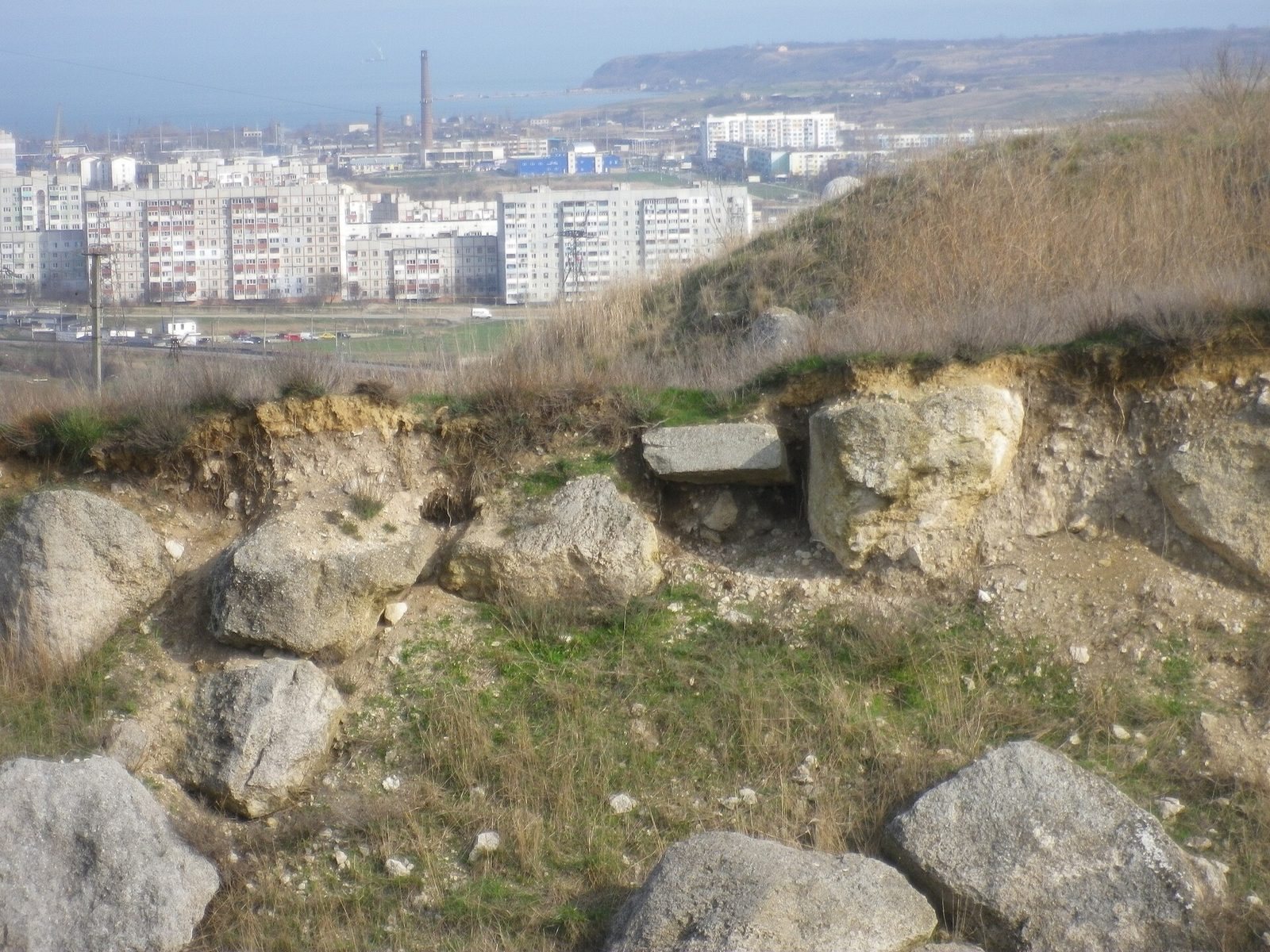
The mound occupies the principal summit of the Golden Mound ridge in the Mithridatic range, north of the Kerch–Feodosia highway. The summit is given as 112.5 m above sea level; Dubois de Montpéreux estimated the mountain itself at 100 m high. A rampart crossed the mound. Its base measures 88 m from east to west and 67 m from north to south, with a perimeter of 265 m and an area of about 3,420 m². Estimates of its original height range from 15–16 m to 20 m.
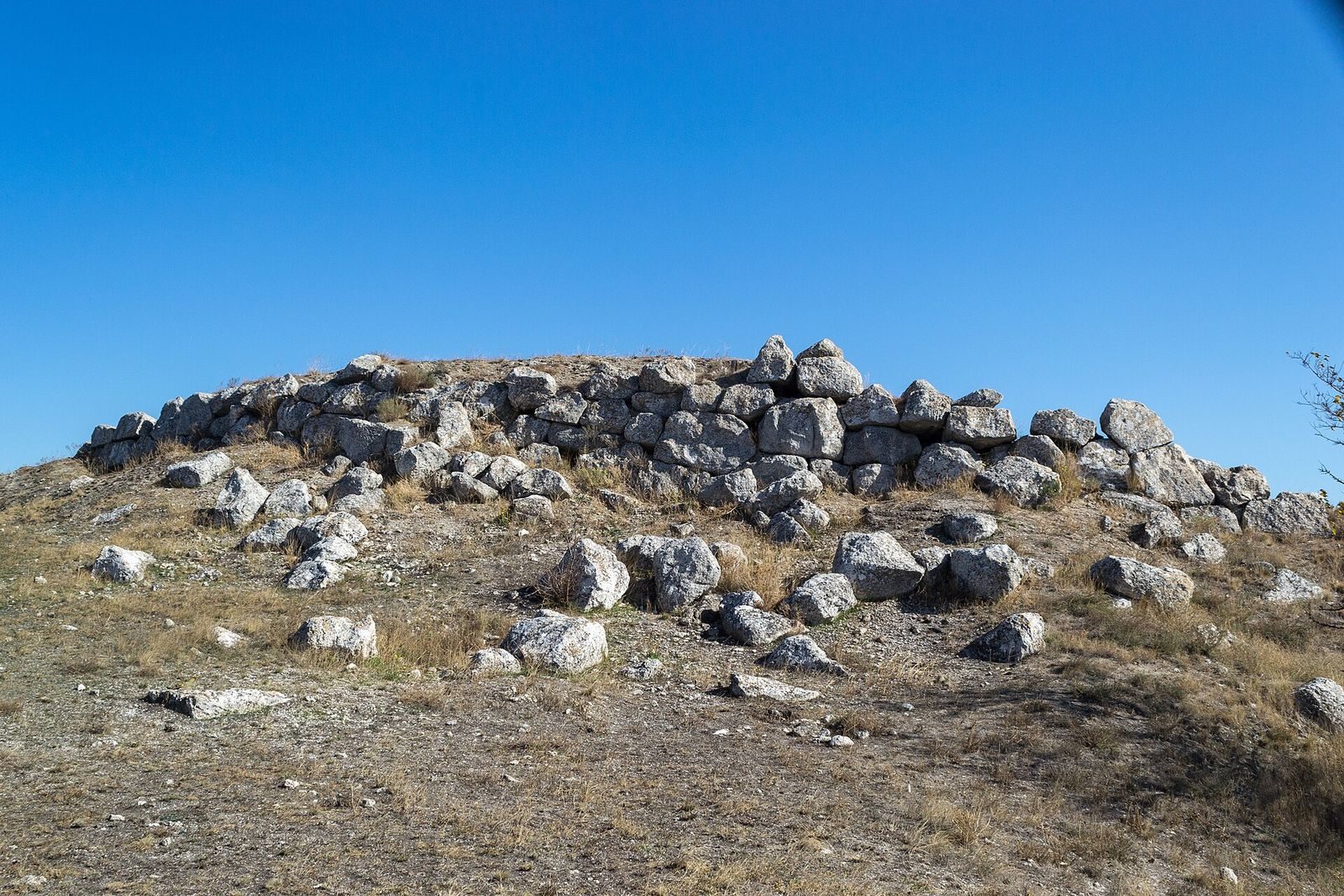
Clarke described the mound’s profile as spheroidal rather than conical. Its facing consisted of massive stones set at an incline without mortar, covering the mound from summit to base. Quarrying later reduced this facing to scattered fragments.
Burial structures
Covered-passage tomb
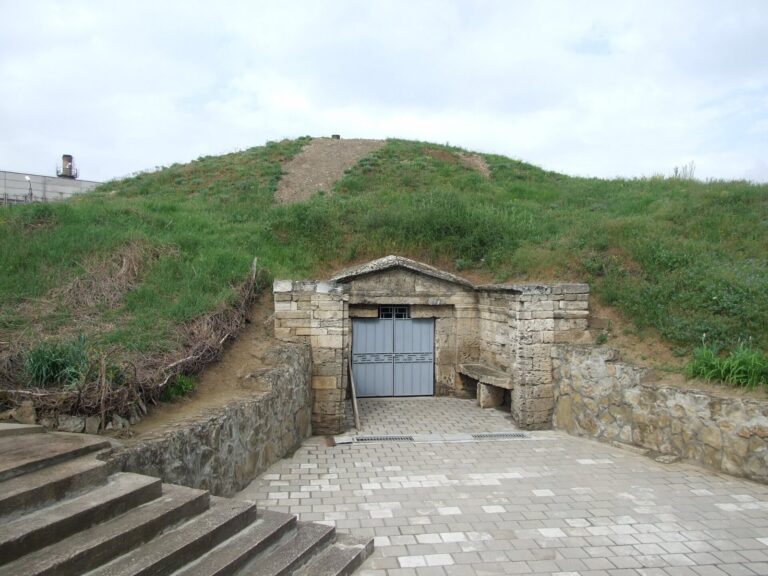
One of the three monumental tombs was domed, with a long covered passage leading northwest to southeast into a circular burial chamber. The passage is described as about 18 m long and 2.22 m wide. Its stepped roof rises from 3.65 m to 6.55 m, with six steps on each side. Kareisha gave a length of 15 m for the partly ruined eastern entrance passage.
The chamber measures 6.39 m across and has a stepped vault 12.78 m high. When Kareisha examined it, bones and pieces of decayed wood lay inside, and stones had been torn from the vault.
Western burial chamber
On the mound’s western side, excavators found the vault of another burial chamber about 12.8 m from the summit. The chamber measures 3 m by 3 m and is more than 6 m high. An ancient breach passed through the wall on the far side of the tomb.
Eastern cave
A cave lies east of the mound. Dubrux considered it a possible burial place associated with the tombs.