Sakhnivka Archaeological Sites: A Multi-Period Complex in Ukraine
Site at a Glance
- Popularity
- Medium
- Country
- Ukraine
- Primary era
- Medieval
- Eras represented
- Medieval
- Civilizations
- Kievan Rus
- Site type
- Military
- Remains
- Fort
On this page10 sections
History
The Sakhnivka Archaeological Sites form a complex near the village of Sakhnivka in Ukraine, with remains spanning the Bronze Age to the Middle Ages. Finds include early Slavic settlements and material associated with Old Rus, the medieval East Slavic sphere linked to Kyivan Rus. The site’s name also became attached to an archaeological grouping of early Slavic sites.
Early settlements and the Sakhnivka horizon
Finds from the complex include material assigned to the Zarubintsy culture, early medieval periods and Old Rus. Three early Slavic settlements date to the seventh and eighth centuries. The Sakhnivka horizon, a classification for related early Slavic sites, has been dated in several ways. Some interpretations place it in the late seventh and eighth centuries as an early stage of the Luka-Raykovets culture; others connect it with the eighth- to ninth-century Volyntsevo culture. A broader dating extends from the second half of the seventh century to the first half of the ninth, while another interpretation treats it as a transition between Prague culture and the developed Luka-Raykovets culture.
Explanations of the horizon’s origins and role also differ. Some interpretations identify Penkovka traditions in its pottery; others describe a unified horizon of Polian antiquities, associated with an East Slavic group of the Middle Dnieper region, as a basis for Old Rus culture. A further view places it between Prague and Volyntsevo cultures. One theory connects the spread of Sakhnivka- and Volyntsevo-type sites with conflicts that disrupted the Penkovka and Kolochin cultures. Proposed explanations for settlement in the Sakhnivka area include a ninth-century movement south by Volyntsevo groups, movement north from the Ros and Tiasmyn basins in the mid-to-late eighth century, or the arrival of mixed Prague- and Penkovka-culture groups from the Southern Bug region in the late seventh or early eighth century. Interpretations of the pottery differ too: some see Penkovka influence in Sakhnivka-Raykovets pottery, while others consider Sakhnivka pottery unlike Penkovka pottery and identify Penkovka traits instead at Stetsivka and Budishche.
Maiden Hill and the medieval fortress
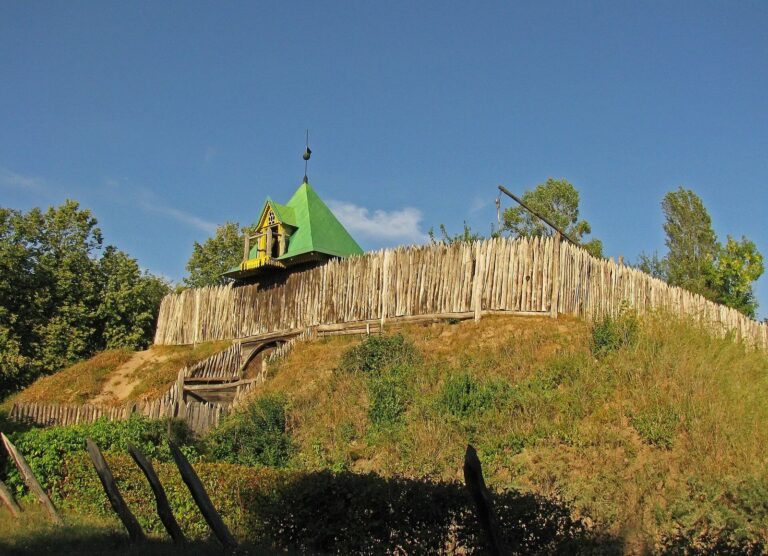
Archaeological material from the Maiden Hill hillfort dates from the twelfth century to the first half of the thirteenth. The fortress probably fell during the Mongol invasion. Fire traces, weapons and a human skeleton with an arrowhead lodged in its spine point to violent destruction. A hoard discovered on the burned hillfort in 1900 is dated to about the middle of the twelfth century on the basis of its coins. Its concealment has been linked to the Mongol invasion, an interpretation also made by archaeologist G. F. Korzukhina. The princely regalia in the hoard have led to the proposal that the hillfort was a castle occupied by a princely family.
Excavation and heritage status
Treasure seekers damaged the hillfort’s archaeological deposits in the late nineteenth century. Archaeologist V. E. Geze began excavations in 1901, cutting trenches and removing the archaeological layer, which was dumped at the foot of the hill. Archaeologist T. S. Passek identified the settlement beside the hillfort in the 1940s. In 1944, early Slavic settlement traces were identified on the hilltop, its northern slope and the saddle between Maiden Hill and Degtyarnaya Hill. The Ross Expedition, led by V. I. Dovzhenok, investigated the complex in 1949, and a detachment of the Middle Dnieper Expedition excavated the hillfort and adjacent settlement again in 1972–1973. The hillfort is a Ukrainian cultural heritage monument of national importance.
Remains
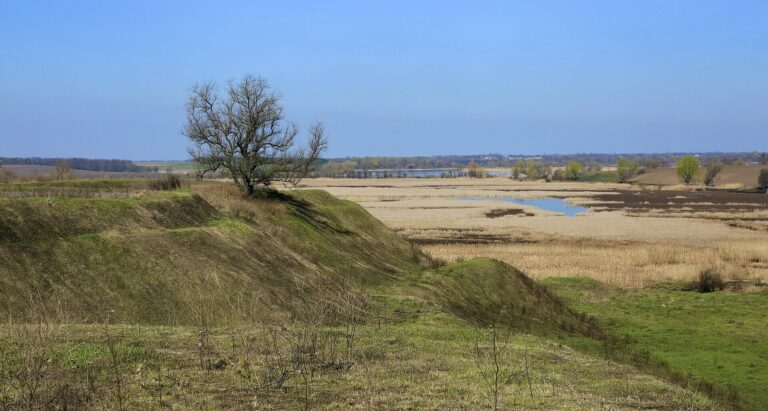
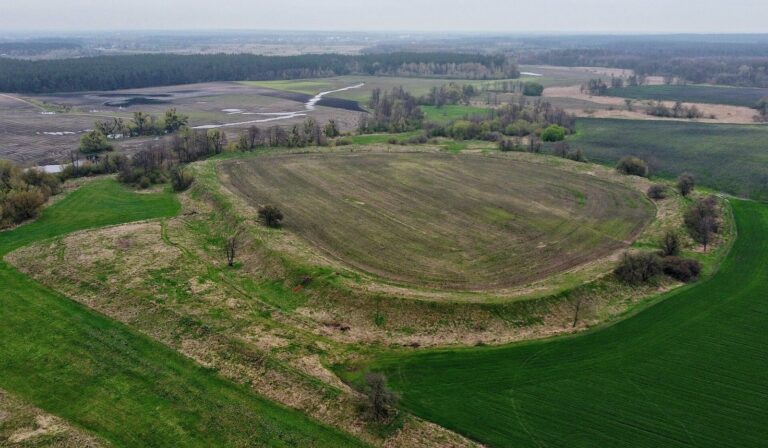
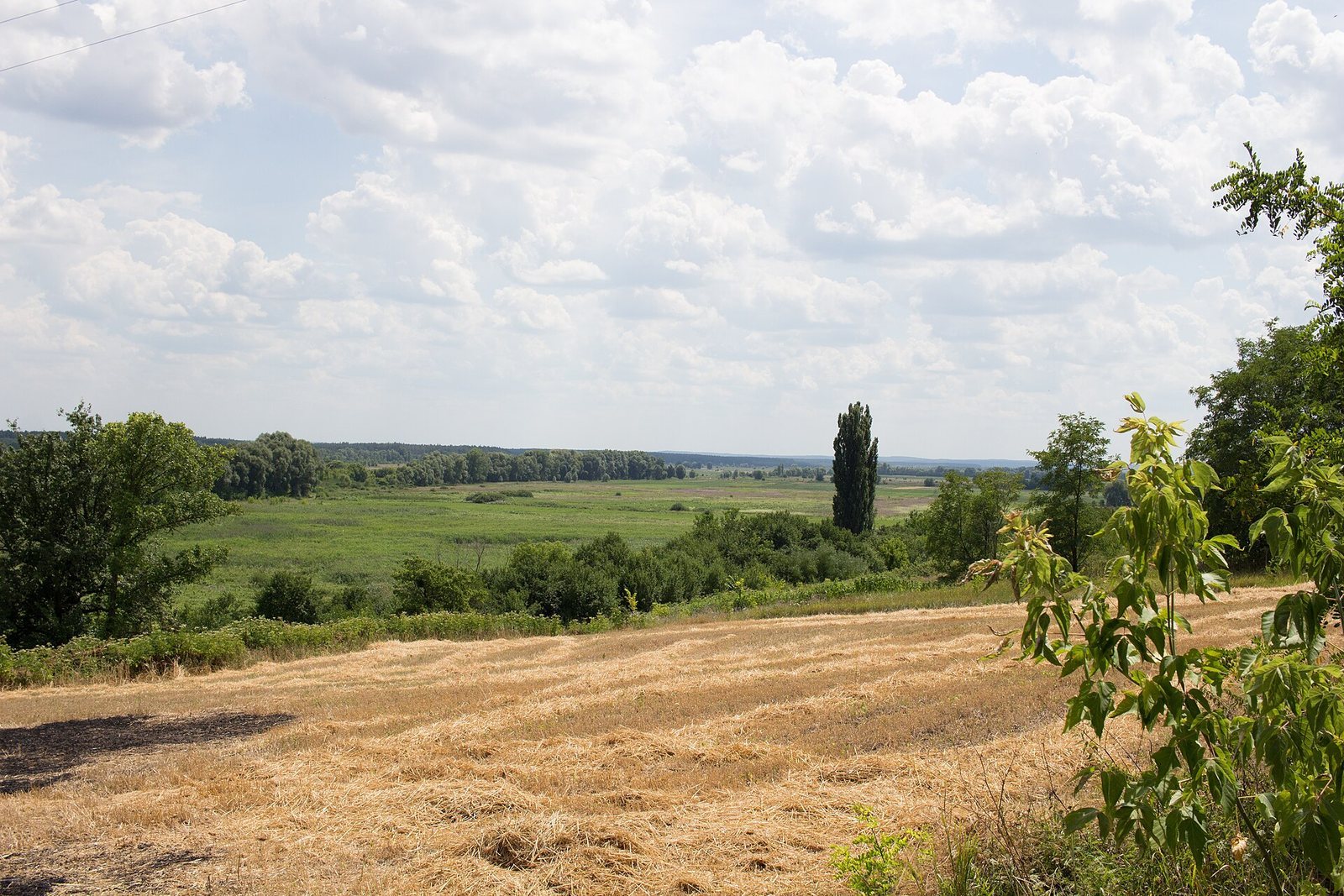
The complex lies among a series of rises on the left bank of the Ros. Maiden Hill rises 120 metres above the floodplain, and its slopes show traces of having been cut back. An oval hillfort occupies the summit. Estimates of its area vary, with figures of about 0.2 hectares, about 0.5 hectares and up to 1.5 hectares.
Hillfort slopes and settlement features
About 30 dwelling remains have been found on the slopes of Maiden Hill. Excavations there also identified a ditch and timber-built defensive structures filled with clay and sand. Two additional hoards found during Geze’s excavations contained silver and copper ornaments, including earrings of a type associated with the Polovtsians, a Turkic nomadic people also known as Cumans.
Houses and pottery
Sakhnivka-type settlements are characterized by semi-subterranean houses with a stove in one corner. Their distinctive handmade pots have an S-shaped outline, widen in the upper third and often bear impressions along the rim. The Sakhnivka-Volyntsevo horizon also includes Pastyr pottery.
The 1900 hoard
Gold diadem and headdresses
The hoard contained 500 grams of gold ingots, gold ornaments, precious and semi-precious stones, and parts of three princely women’s headdresses. Its diadem, probably part of ceremonial dress for a woman of princely rank, consists of nine gold plates decorated with cloisonné enamel, in which thin partitions separate areas of colored enamel. The central plate depicts Alexander III of Macedon, known as Alexander the Great, in a chariot drawn by griffins. Of eleven diadem finds known from modern Ukraine, only the Kyiv hoard of 1898 and the Sakhnivka hoard of 1900 contained fully preserved gold headdresses.
Other ornaments and coins
Other contents included chains, necklaces, beads, temple pendants, neck rings, headband fittings, earrings, rings worn at the temples, bracelets and Kyiv-type neck rings. Two Byzantine coins were also part of the hoard; one was issued under Emperor Manuel I Komnenos (1143–1180). Gold neck ornaments designed to be worn over clothing bear enamel images of saints. Together with the headdresses, these ornaments formed a complete set of princely regalia.