Holmul: An Ancient Maya City in Guatemala
Site at a Glance
- Popularity
- Medium
- Country
- Guatemala
- Primary era
- Classical
- Eras represented
- Iron Age, Classical, Medieval
- Civilizations
- Maya
- Site type
- Settlement
- Remains
- City
On this page19 sections
History
Holmul was an ancient Maya city in northeastern Petén, Guatemala, occupied from about 800 BCE and built in the Petén architectural style. It gained influence during the Late Preclassic, one of the broad periods used to organize Maya history, and stood on routes that linked the region with Tikal, the coast, the Guatemalan Highlands, and the Kaanul capital at Dzibanche. Its name is said to mean “Sacred Place” in Maya.
Early growth and regional power
Holmul’s early rulers are thought to have defeated the neighboring cities of Cival and Becan, strengthening their political and economic reach. Cival and smaller settlements became part of a kingdom whose ancient name is unknown. Holmul’s location helped support this growth. An east–west route connected Tikal with the coast, while a north–south route from Dzibanche toward the Guatemalan Highlands bypassed Tikal territory. The latter offered access to resources such as basalt, obsidian, and jadeite.
Control of these routes contributed to lasting competition between the Mutul and Kaanul kingdoms. In the Early Classic, Holmul came under the authority of Teotihuacan, a powerful ancient city in central Mexico. Many cities in Petén experienced this political alignment, which is described as the “New Order.”
Dynastic realignments
After Sa’al intervened in the 580s, Och-Chan-Yopaat established a Holmul dynasty that branched from the Sa’al royal line. Holmul’s rulers thereafter backed Kaanul. When Mutul defeated Kaanul in 695, however, Holmul’s kings shifted their support to their Sa’al relatives, helping Sa’al expand its regional influence. Holmul’s population at this time was about 2,000.
In 748, after Mutul had inflicted defeats on Sa’al’s forces, Holmul’s ruler Wila’an-Chak-Tok-Wahyaab led resistance. He was defeated and killed, and Holmul became dependent on Mutul. This relationship continued into the 820s, while the city’s economy began to recover under Mutul’s protection.
Regional influence and abandonment
Holmul continued to develop as Mutul weakened. Its rulers relied on diplomacy and pursued comparatively limited ambitions beyond their immediate region, maintaining peaceful relations with other states. The city reached its height between about 750 and 900 CE. As many Petén centers declined in the mid-ninth century, Holmul’s regional influence increased. Artisans, craftspeople, traders, and members of elite families may have relocated there from affected cities. Holmul may also have exercised considerable influence over neighboring communities in the region sometimes called the Holmul Domain.
The city was abandoned around 900 CE, during the period known as the Classic Maya collapse, when many Maya cities declined. Walls were built around Holmul in its final years of occupation. Similar defenses at Cival have prompted the possibility that the two cities faced a final siege near the time of their collapse, but the meaning of the walls is uncertain, as is the cause of Holmul’s abandonment.
Murals at nearby La Sufricaya have been interpreted as signs of outside involvement in the Holmul Domain, possibly by people from Teotihuacan or Tikal. A Teotihuacan connection would bear on interpretations of Maya–Teotihuacan relations, particularly during the period from 300 to 550 CE, but the proposed involvement remains uncertain.
Archaeological investigations
Holmul came to archaeological attention in the early twentieth century. Preliminary investigations took place in 1909–10, and Raymond Merwin began excavations in 1911, with Alfred M. Tozzer also associated with the early work. These were among the first scientific excavations in the Maya lowlands. The Peabody Museum expedition established the first pottery chronology for a Maya-region site based on the sequence of archaeological layers. George Vaillant later extended the investigations. The results were published about two decades after the expedition, and Holmul then received relatively little study for a time.
Carnegie Institute specialists investigated the site in 1924. Research resumed in 2000 with a project organized by Francisco Estrada-Belli of Boston University. Several inscribed monuments were found in the first season, and fieldwork continued in following years. In 2013, investigators identified a building dating to around 600 CE. An inscription associated with it says that Ajwosaj, king of Naranjo, commissioned its construction. Naranjo, on the Holmul River, was subordinate to the Kaanul dynasty of Dzibanche and Calakmul, a major rival of Tikal.
Remains
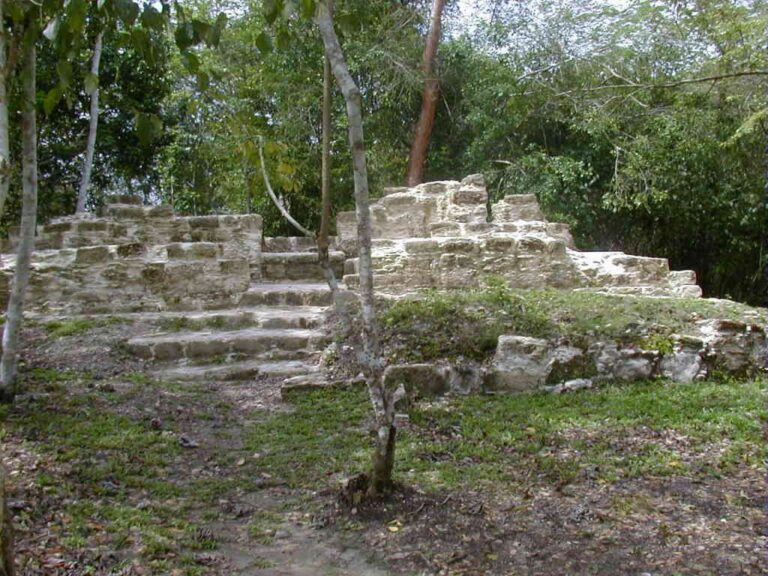
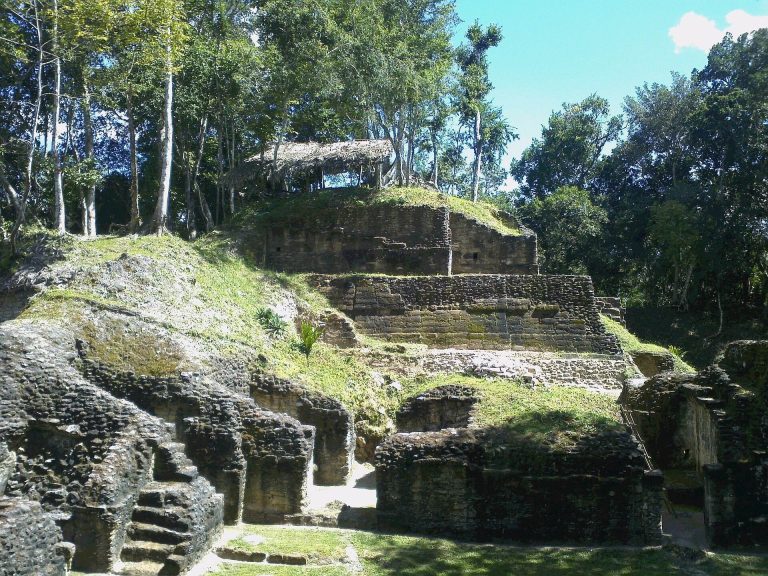
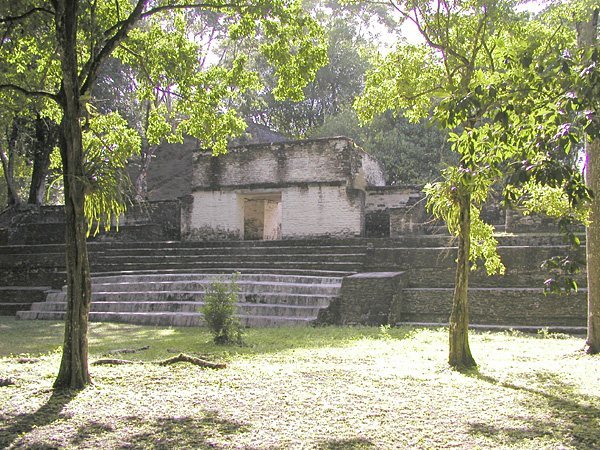
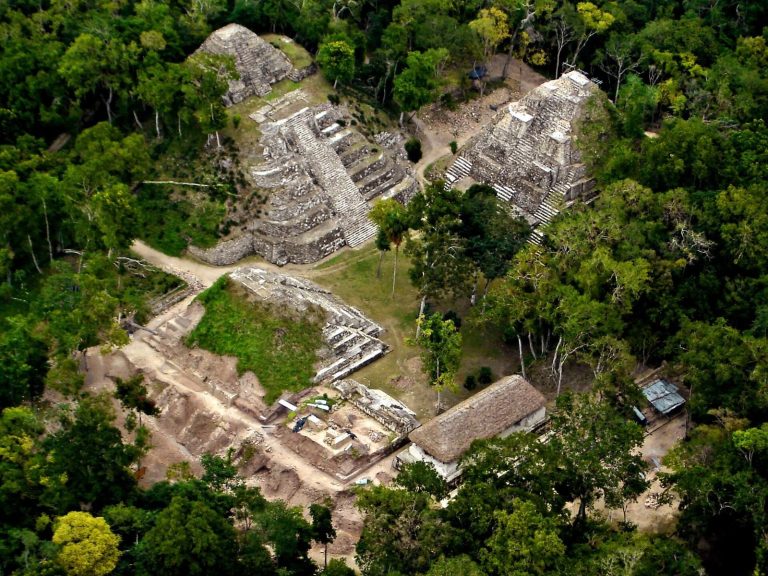
Holmul lies beside the Holmul River, near the Belize border. Its buildings follow the Petén practice of raising structures on artificial mounds. The city extends about 6 km in diameter; principal buildings lie roughly 3 km from the central ritual-administrative complex, and outlying areas reach about 5 km away. The site is arranged in Groups I, II, and III. Its central plaza adjoins Group I to the north and Group III to the south.
Group III and the East Plaza
Ruin X and the plaza
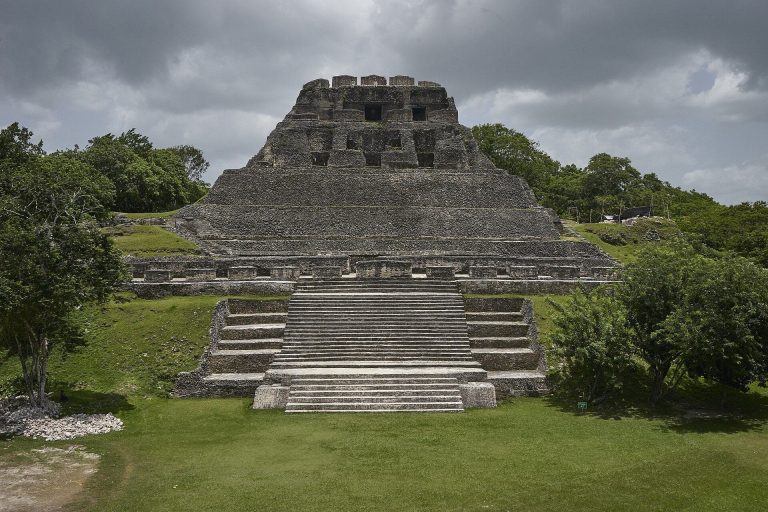
The administrative center was originally in Group III. The East Plaza, covering about 1 hectare and measuring approximately 130 by 68 m, is framed by Ruin X on the west, Structure 7 on the east, Structure 5 on the north, and Structure 46 on the south. Ruin X is a large pyramid among three substantial plazas, with the central plaza to its east. Ruin X and Structure 7 form an E-group, a plaza arrangement with a large western pyramid facing an elongated, raised eastern building. Comparable arrangements occur at Uaxactun and Tikal.
Stelae and altars
Group III yielded five Preclassic stelae, upright carved stone monuments, and four altars, stone features used for ritual or commemoration. The site’s monuments belong to more than one period, including the Early Classic. Three stelae, numbered 1, 2, and 12, and two altars were arranged around Ruin X along north–south and east–west axes. Stela 2 and Altar 2 stand before Structure 5 at the north end of the East Plaza, while small Altar 9 is in the southern part. Stela 12 stands on Structure 7 near the plaza’s center; nearby, Stela 1 and Altar 1 are aligned east to west. Graffiti also occurs on many of Holmul’s buildings.
The royal acropolis
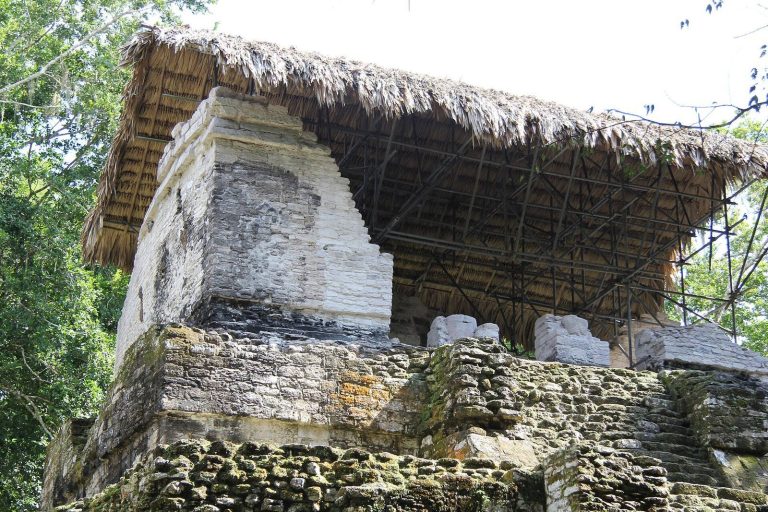
A broad causeway linked the royal acropolis with other parts of the city. The complex’s central feature, Court A, occupied a rise about 6 m high. A bridge or passage connected it with neighboring Court B. A pyramid approximately 12 m high stood west of Court A. Residential remains southeast and south of the acropolis may have housed royal relatives.
Court A and Structure 44
Structure 44, in the southern part of Court A, is 18 m long. Its narrow central room is entered through the main doorway and flanked by smaller rooms. Doorways on the east and west were blocked. Other entrances opposite the central doorway lead toward the rear of the court.
Court B
Court B stands on a rectangular platform that rises about 6 m on its eastern side and 12 m on its western side. It contains numerous rooms roofed with Maya vaulting, masonry roofs made by laying courses that project inward. A staircase on the east side of the central plaza leads to the court’s hall.
Groups I and II
Group II and its temple complex
Group II contains buildings associated with Maya elites. A temple complex was established there during the Middle Preclassic Mamom pottery horizon. It included early forms of Buildings B and F, as well as Building N, later covered by a pyramidal platform. One interpretation holds that Buildings B and N, together with a structure that no longer survives, once formed a three-part temple complex that remained in use until the Late Preclassic.
During the Late Preclassic Chicanel pottery horizon, a massive platform covered the early buildings. It rose more than 10 m, measured 110 m long and 89 m wide, and became the base for the temple complex known as Group II. The period names Mamom and Chicanel distinguish archaeological pottery horizons.
Ballcourt and burial
A large ballcourt adjoins Group II. Its eastern and western façades carried enormous molded stucco masks. A burial in Group II, dated to the first or second century CE, contained ceramic vessels set on supports shaped like female breasts.
Group I and Ballcourt I
Group I covers about 2.4 hectares and is divided into northern and southern parts by the East Plaza. Near its center is a large chultun, an underground or rock-cut storage chamber, with an opening 3.5 m across.
Ballcourt I links Groups I and II near the edge of the causeway, about 100 m from Group I. Its two facing structures, numbered 11 and 12, each measure 17 by 10 by 4 m; a stone marker stands midway along the alley between them. West of the court is an open, C-shaped court facing south. Its principal building, Structure 13, measures 32 by 7 by 3 m.
Frieze and pottery
Painted frieze
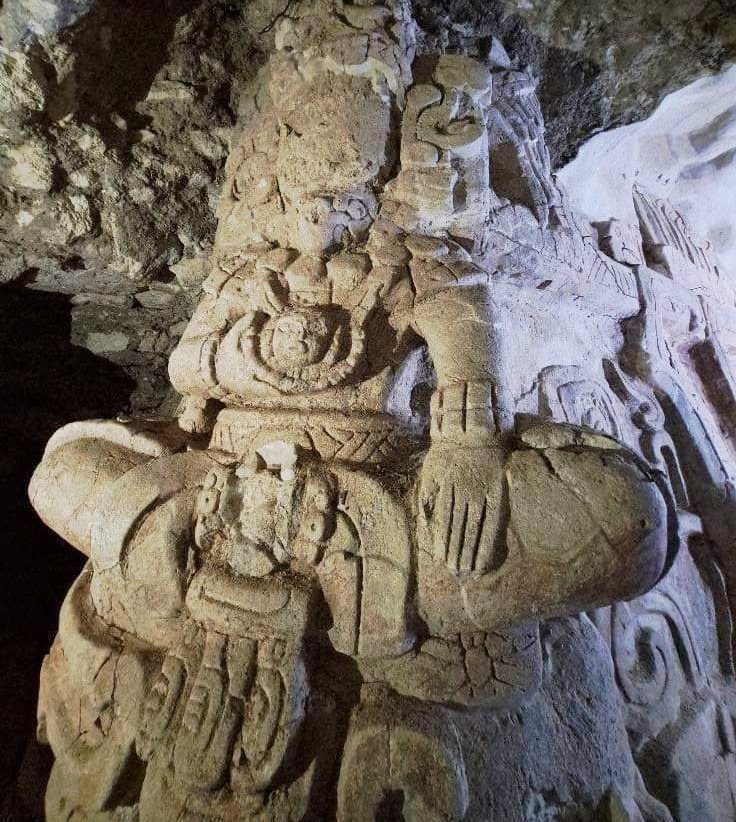
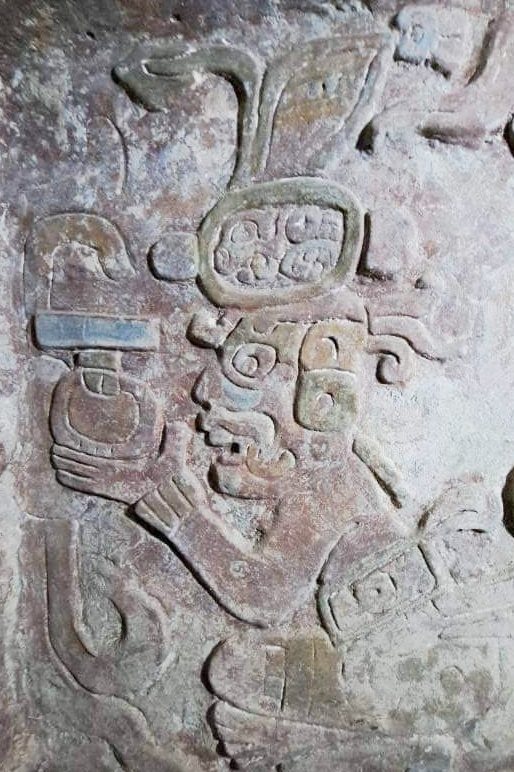
A rectangular pyramid dated to about 590 CE had a large stucco frieze beneath its base. The molded plaster relief measures about 8 m long and 2 m high. It shows human figures, possibly deified rulers, seated cross-legged above the head of a Maya mountain spirit in a mythological scene. The figures wear elaborate headdresses and jadeite jewelry, and their names appear on the headdresses. Traces of red, blue, green, and yellow pigment survive. The figures on the left have more refined proportions, while those on the right stand out through deeper relief and stronger use of painted detail. The building also contains a staircase burial, and a long inscription runs below the frieze.
Ceramic traditions
Holmul developed its own ceramic production and painting traditions, divided into five phases: Holmul I, about 100 BCE–100 CE; Holmul II, 100–400 CE; Holmul III, 400–600 CE; Holmul IV, 600–850 CE; and Holmul V, 850–950 CE. From the sixth century, the city became an important center for painted pottery. The Holmul I phase combines polished surfaces associated with the early Classic Tzakol horizon and a waxy feel characteristic of the Late Preclassic Chicanel horizon. Its multicolored pottery includes thick-walled vessels on four supports, as well as grooved decoration and orange surfaces.
Pottery of the Holmul III and IV phases often uses red and orange paint against a cream background. Dancers, including depictions of gods and people in motion, are common subjects. The earlier style shows Teotihuacan artistic influence; the later represents a highly developed Holmul style. Holmul V pottery reflects the gradual decline of the Classic period. A related Late Classic style from the wider Holmul–Naranjo region also uses red and orange on cream. Its characteristic “Holmul dancer” depicts the Tonsured Maize God, a Maya maize deity with close-cropped hair, dancing with a ceremonial rack carried on his back.