Engelberg Friary in Großheubach: A Catholic Pilgrimage Site
Site at a Glance
- Popularity
- Medium
- Country
- Germany
- Primary era
- Early Modern
- Eras represented
- Medieval, Early Modern, Modern
- Civilizations
- Electorate of Mainz, German, Holy Roman Empire, Kingdom of Bavaria
- Site type
- Religious
- Remains
- Monastery
On this page18 sections
History
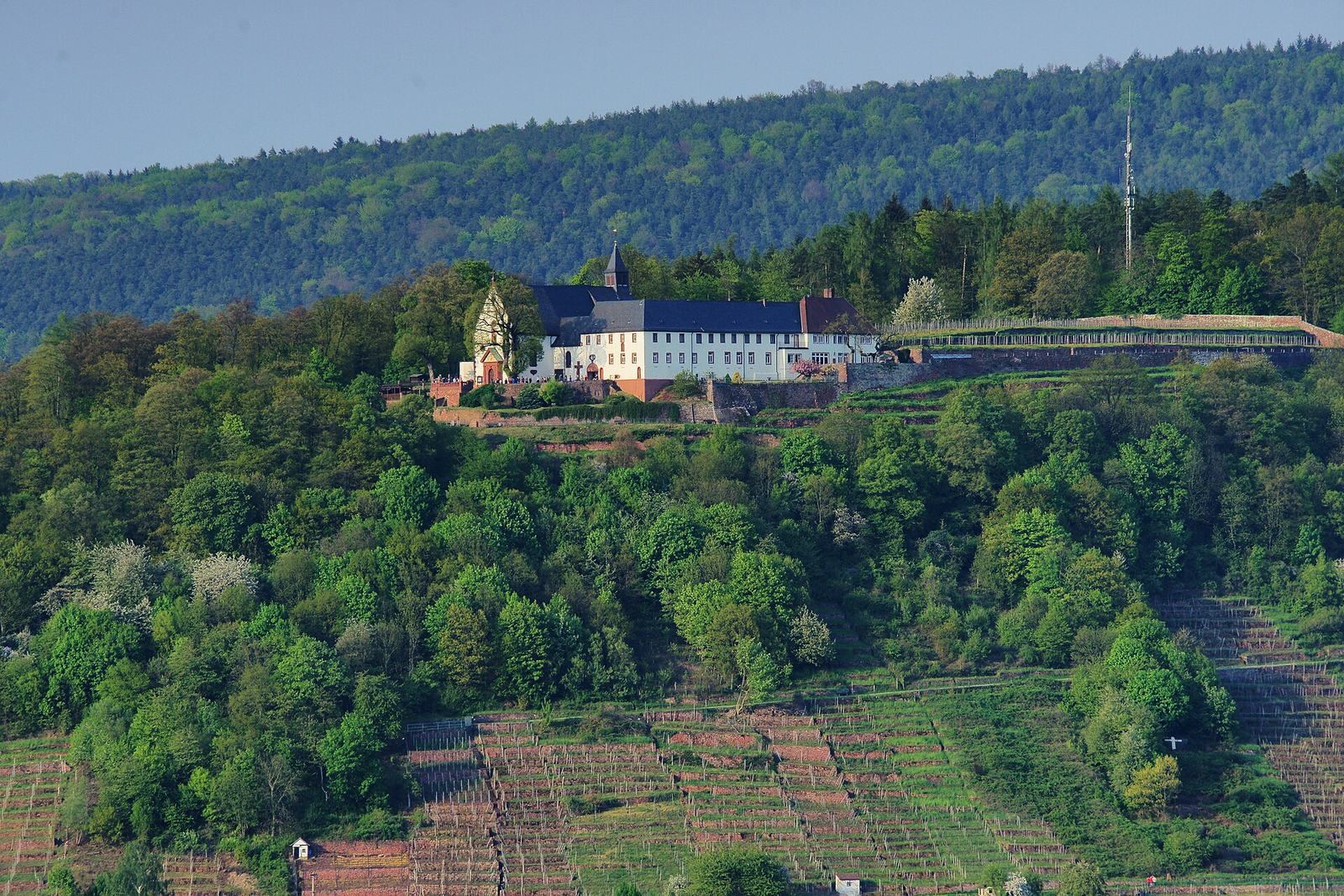
Engelberg Friary in Großheubach, Germany, is a Catholic pilgrimage monastery on a hill above the Main River. A wooden chapel dedicated to the Archangel Michael was built there around 1300, and Capuchins established a monastery in 1630, completing its buildings by 1639. The church follows the mendicant-order tradition, associated with religious communities that traditionally relied on alms and itinerant ministry. The hill became a destination for pilgrims drawn by devotion to Michael and Mary.
The shrine and pilgrimage
Before Christianity reached the area, the hill was a place of pagan worship and was known as Rulesberg. Its name gradually changed to Engelberg. A statue of the Virgin Mary was brought to Michael’s chapel in the early fourteenth century, probably around 1310. Devotion to the Marian image, together with veneration of Michael and Mary as Queen of the Angels, helped establish the pilgrimage.
The earliest surviving document about the pilgrimage, from 1406, describes a chapel that drew many pilgrims but required repairs. A brotherhood connected with the shrine was founded in 1469. As the number of pilgrims grew, Archbishop Anselm Casimir Wambolt von Umstadt of Mainz, whose ecclesiastical territory then included the area, brought Capuchins, a branch of the Franciscan religious family, to Engelberg in 1630. The new establishment began as a hospice for a small community, and became a convent in 1647.
The Capuchin monastery and shrine
The Angels’ Steps were laid out as a pilgrim route in 1637. A statue of Michael made around 1635 became associated with the renewed strength of Catholicism after Protestant Swedish forces were defeated and driven from Franconia. In 1692, General Jakob Alfons Franz Calderon d’Avila donated the first recorded Marian altar; he was buried in the church in 1695. Anna Gottlob von Nentwich endowed a chapel to Anthony of Padua, which was consecrated in 1698.
In 1701, the Marian image was moved from an earlier, small late-Gothic pilgrimage church into a new side chapel in the present church. The older church was later demolished. Engelberg became a burial place for the House of Löwenstein-Wertheim-Rosenberg in 1724. Family members were initially buried in the church, until the family established a separate crypt chapel on the monastery grounds in 1840. The Capuchins also served the family chapel at nearby Löwenstein Castle.
Closure and Franciscan return
The monastery was dissolved during the 1803 secularization, and pilgrimages were prohibited. The Capuchin community eventually left for Aschaffenburg, and the monastery school closed in 1817. At the direction of King Ludwig I of Bavaria, Franciscans reopened Engelberg as a hospice in 1828 and resumed care of pilgrims. The community first belonged to the Franciscan Province of Franconia, which joined the Bavarian Province in 1836; after the German Franciscan provinces merged, it became part of the German Franciscan Province in 2010.
Engelberg also entered nineteenth-century literature: Ida Hahn-Hahn’s two-volume story Maria Regina, published in 1865, is connected with the site. The church was enlarged westward in 1899. Pilgrims continued to climb its steps on their knees in prayer well into the period after the Second World War.
In March 2019, the German Franciscan Province decided to close Engelberg as part of a wider consolidation. The Franciscans departed on 31 July 2024, and the Oblates of St Joseph took over in November. Their community at Engelberg, founded on 3 November, was the order’s first establishment in Germany. The church is dedicated to the Archangel Michael and Mary, Queen of the Angels, and Engelberg remains a major pilgrimage site in the Diocese of Würzburg.
Remains
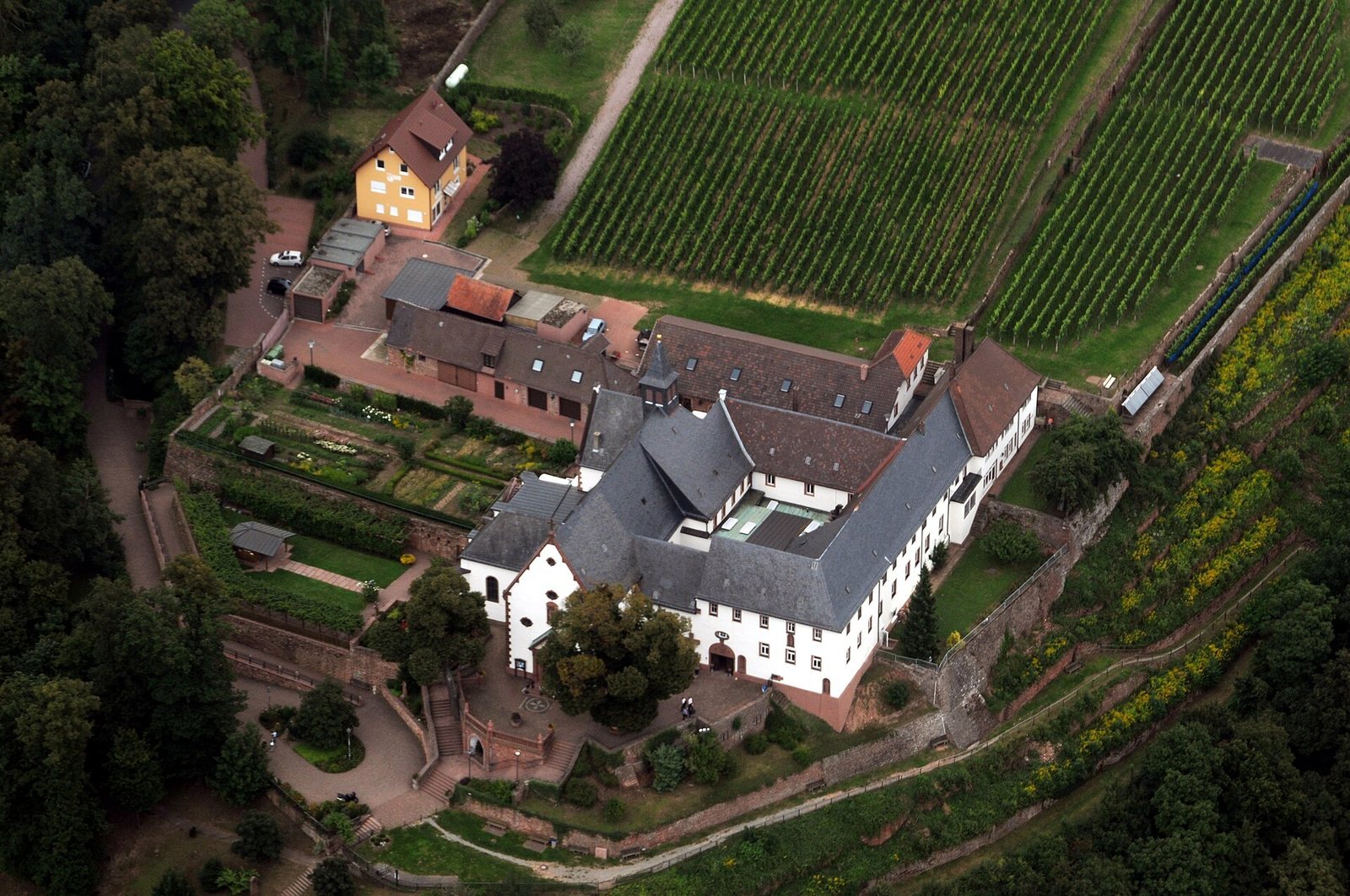
The friary stands about 250 metres above sea level on a spur of the Spessart hills, above Großheubach and the Main River. Its east-facing church and three convent wings form an almost square plan around an inner courtyard. A large boulder with a bowl-shaped hollow, called the Hünenstein or Heuneschüssel, is associated with the hill’s pre-Christian worship.
The church
Plan and west façade
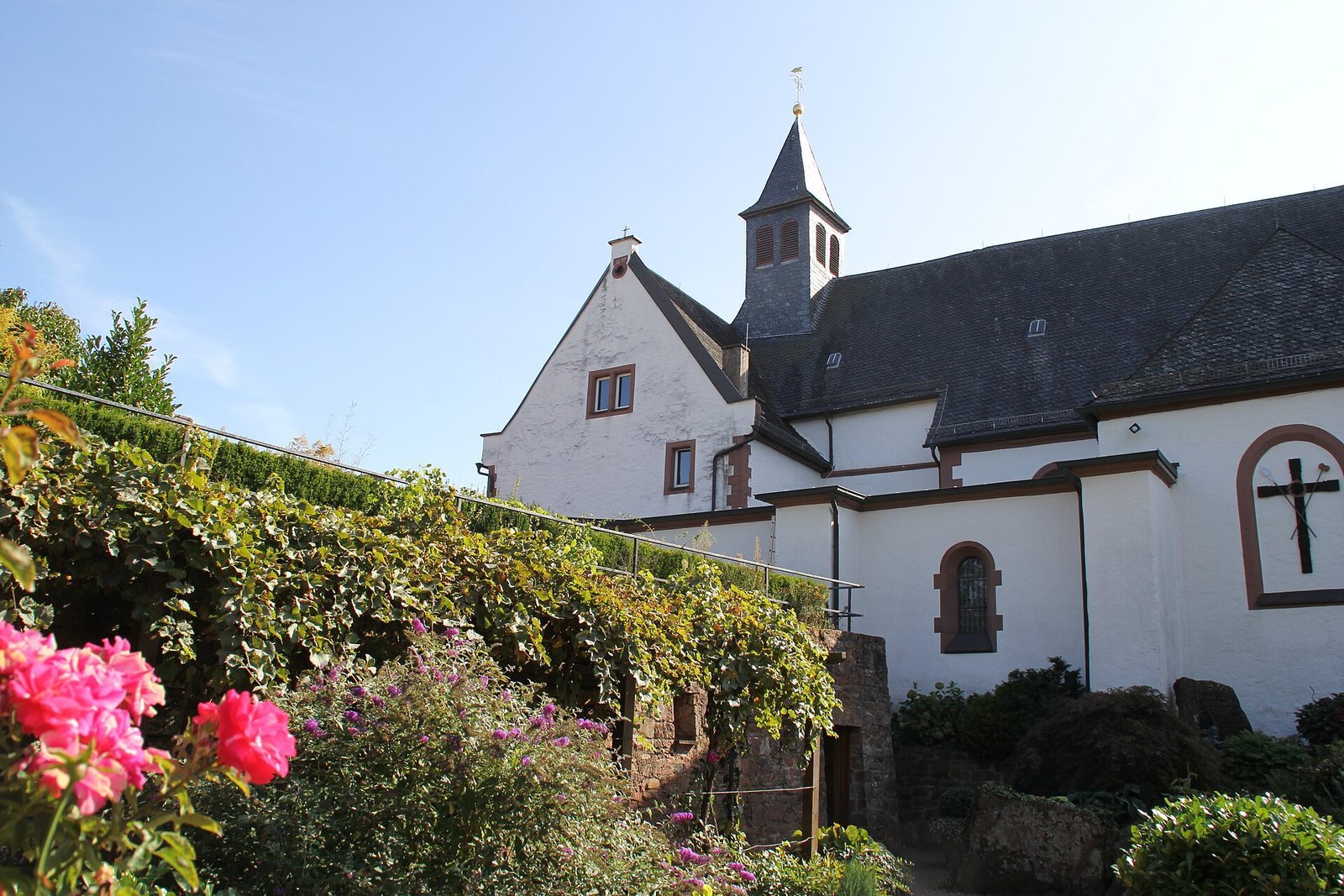
The church has a single nave and a narrower, square choir, the oldest part of the building, joined to the nave by a broad arch. It has no full crosswise arm; instead, lower chapels project from either side at the middle of the nave. The Marian Chapel is on the right and the Chapel of St Anthony of Padua on the left. A small roof turret rises above the church in place of a tower.
A stone cross tops the west façade, which also has four small round windows. In a shell-shaped recess, a three-metre stone sculpture shows Michael fighting Satan. Made around 1635 by Miltenberg sculptor Zacharias Juncker the Elder, it stands above the entrance, where a statue of Mary holding the infant Jesus is flanked by two angels. A Latin inscription below them translates as “This is the house of God and the gate of heaven.”
Nave, choir, and altars
The interior has Neo-Baroque furnishings. Differently coloured, flat wall supports carry the ceiling arches and divide the nave into three bays. Ceiling paintings show the expulsion from Paradise in the western bay, Michael’s battle with Lucifer and his followers in the middle, and the Annunciation in the bay nearest the choir. Two panels above the side-chapel entrances depict the Archangel Raphael accompanying Tobias and Christ on the Mount of Olives receiving strength from an angel.
The altars have their present forms and positions from the twentieth century. The high altar, made in 1909, stands before the choir’s end wall, with a modern altar for services in front of it. Two side altars stand at the front of the nave beside the passage to the choir. The right-hand altar has a Crucifixion group showing Jesus, Mary, and the Apostle John, probably made in the eighteenth century. Thomas Buscher made the left altar in 1907; it depicts Francis beneath the cross and refers to his imitation of Christ and to the stigmata, wounds resembling those of the crucifixion.
Marian Chapel
Consecrated in 1701, the Marian Chapel contains the carved fourteenth-century image known as Our Lady of Joy, about 75 centimetres high. Mary sits holding a sceptre and supporting the child Jesus, who presents a book that may refer to the Book of Life or to wisdom. The decorated structure behind the altar shows Mary’s coronation by the Trinity, with Joseph of Nazareth, her husband and Jesus’ earthly guardian, on one side and Anne, Mary’s mother, on the other. Four painted sections of the chapel vault take their themes from the Litany of Loreto.
Memorials on the chapel’s side walls commemorate Princess Christine Polyxena of Löwenstein, who died in 1728 aged 45 and was the mother of 13 children, and Ludwig Carl Franz Leopold of Hohenlohe-Waldenburg-Bartenstein. Ludwig died at Kleinheubach after a carriage accident in 1799. These monuments reflect the chapel’s use for burials. A confessional room adjoins it to the east.
Chapel of St Anthony of Padua
A stone plaque on the right wall commemorates Anna Gottlob von Nentwich, who endowed the chapel. Its altar, installed in 1909, has a statue of Anthony of Padua, a thirteenth-century Franciscan preacher, with the child Jesus; a Pietà is set above it. Statues of Elizabeth of Thuringia, known for charitable work, and Louis of Toulouse, a Franciscan bishop, flank the decorated altar structure. Other statues depict the Franciscan theologian Bonaventure and Conrad of Parzham, a Capuchin lay brother. Paintings in the intersecting vaults show Roch of Montpellier, associated with care for plague sufferers; Maria Crescentia Höss of Kaufbeuren and Margaret of Cortona, women of the Franciscan Third Order, a tradition inspired by Francis of Assisi; and Louis IX of France.
Organ
The church’s first recorded organ was made by Balthasar Schlimbach in 1859; its specification is unknown, and it had a plain case. In 1899, two galleries were replaced by one, where a Steinmeyer organ with ten sounding stops was installed in a Neo-Baroque case. Vleugels built the present organ in 1992, with 19 stops, two keyboards, and a pedal keyboard. Its pipes were fitted into the existing case after the earlier instrument had deteriorated through extensions and changes. The current organ has a slider chest, which distributes wind to the pipes, and mechanical key action. Parts of the Steinmeyer façade were reused. The three-part front has columns, a raised central group of pipes, a decorative urn above a broken pediment, and acanthus carvings. Würzburg auxiliary bishop Helmut Bauer consecrated the organ on 20 December 1992.
Convent and pilgrimage landscape
Convent buildings
Three wings of the convent adjoin the church on its east side, beside the Marian Chapel and confessional room. Together with the church, they enclose the inner courtyard. The buildings include accommodation for the religious community as well as spaces for pilgrim groups.
Angels’ Steps and former sanctuary
The 612 Angels’ Steps, built of red sandstone, form the shortest route from Großheubach to Engelberg. Six chapels along the path depict episodes from Christ’s Passion, and 14 Stations of the Cross, devotional markers representing events of the Passion, were installed in 1866. Beneath the terrace, the sanctuary of the former late-Gothic pilgrimage church was incorporated into the site around 1900. It now holds a Pietà dating from the middle of the seventeenth century.
Our Lady of Help path and the Eselsweg
The Our Lady of Help pilgrimage path is a forest footpath from Miltenberg, southeast of Engelberg, to the shrine. A chapel on the path probably dates from around 1690 and now holds a simple statue of Mary. The Eselsweg, or Donkey Way, also passes the friary. This long-distance trail follows a historic salt-transport route across the Spessart between Schlüchtern and Großheubach.
Monastery grounds
Francis Garden and votive-candle chapel
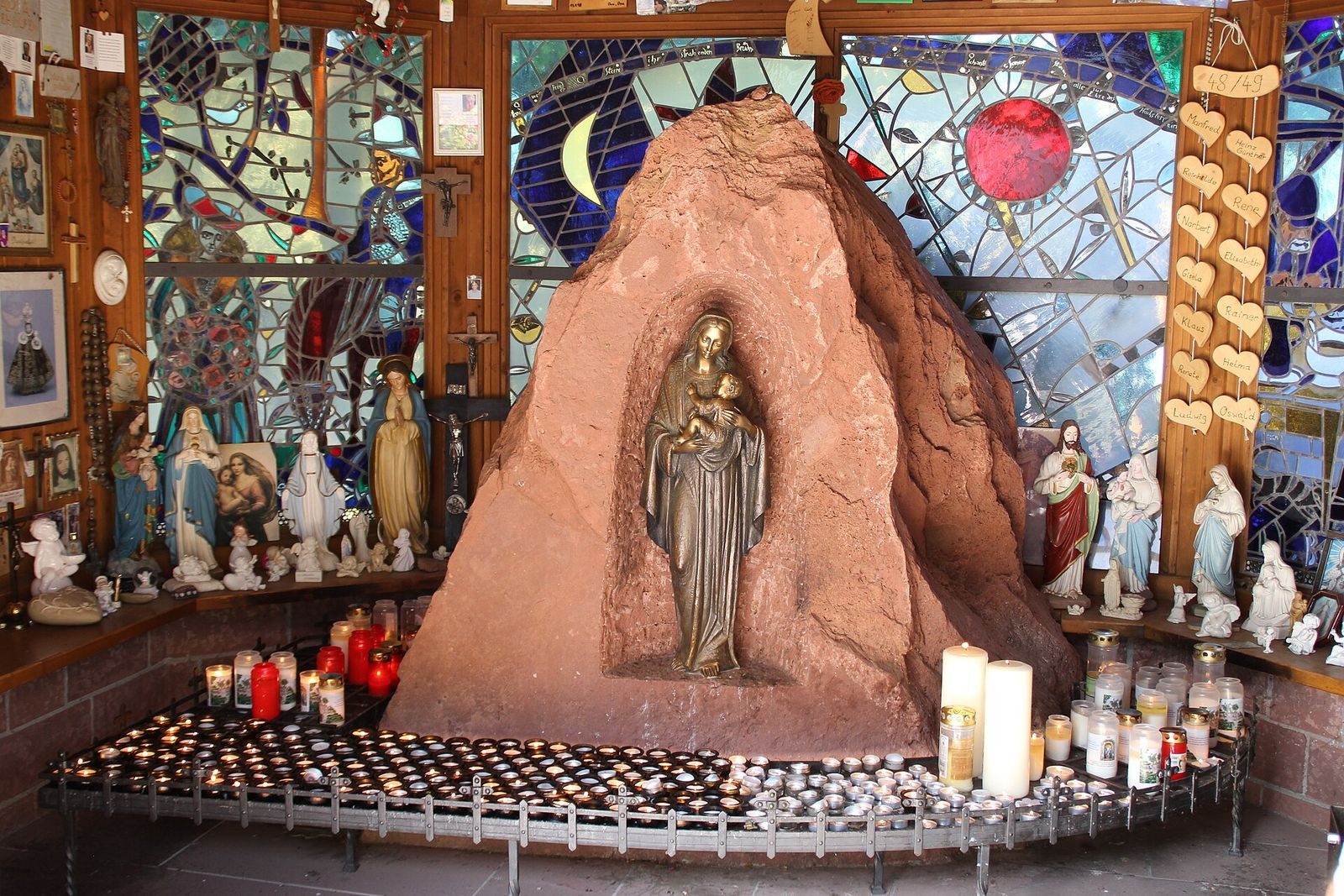
North of the church, a path passes the monastery cemetery and an arch bearing a quotation from Francis of Assisi’s Canticle of the Sun, a hymn praising God through elements of the natural world. Beyond the arch is the Francis Garden, where a bronze figure shows Francis playing the violin as “God’s minstrel.” Nearby, a chapel for votive candles has a natural sandstone block at its centre and a statue of Mary in a recess. Its three stained-glass windows show the sun, moon, and stars, along with two Franciscan saints.
Löwenstein family crypt chapel
The separate crypt chapel on the monastery grounds contains rows of graves, epitaphs beside the altar, and a monument showing Christ on the Mount of Olives. Its memorials include the grave and epitaph of Prince Karl Heinrich of Löwenstein-Wertheim-Rosenberg, and epitaphs for his two wives, Adelheid of Isenburg-Birstein and Sophie née von und zu Liechtenstein. The chapel also holds the grave of Agnes of Hohenlohe-Langenburg (1804–1835), wife of Hereditary Prince Konstantin of Löwenstein-Wertheim-Rosenberg.