Lenton Priory: A Medieval Cluniac Monastery near Nottingham
Site at a Glance
- Popularity
- Medium
- Country
- United Kingdom
- Primary era
- Medieval
- Eras represented
- Medieval
- Civilizations
- English, Norman
- Site type
- Religious
- Remains
- Monastery
On this page14 sections
History
Foundation and endowments
Lenton Priory was a Cluniac monastery founded at Lenton, about 1½ miles southwest of Nottingham in the United Kingdom. William Peverel, a Norman aristocrat, established it around 1102–1108. Dedicated to the Holy Trinity, its original buildings belonged to the Norman architectural period. The Cluniac order was a monastic network associated with Cluny Abbey in France. Lenton depended on Cluny as an alien priory, meaning a religious house under a mother house abroad, but its foundation charter required only an annual acknowledgment payment of one silver mark, a medieval unit of account.
Peverel is believed to have endowed the priory with several townships, seven mills, land and woodland, and control of churches in Nottingham and elsewhere. Its revenues also included tithes, a share of produce or income given to the Church, from his fisheries, farms and estates. These included income from livestock, lead and venison in the Peak District. The charter describing Peverel’s gifts is considered a forgery: its dates are judged implausible, and it was probably not written at the time of the foundation.
Royal confirmations issued by Henry I, Stephen, Henry II and John renewed earlier grants and recorded further gifts. Among them were Wigston church, given by Robert de Beaumont, Earl of Leicester, and Peak Forest tithes, given by William de Ferrers. Hugh de Buron and his son Hugh Meschines gave churches at Ossington and Horsley and half of Cotgrave church. Other donors provided churches, land and additional tithes. In the thirteenth century, Philip Marc, a sheriff under King John, also made a gift on condition that the monks pray for his body and soul.
Royal privileges and rebuilding
Henry II exempted Lenton from taxes, tolls and customs duties and granted it an eight-day fair beginning on 11 November, the Feast of Saint Martin. Henry III lengthened the fair to twelve days in 1232. In 1199, John allowed the monks to collect one cartload of dead wood each day from Bestwood Forest. A later grant gave them game from royal forests, lands governed by special royal laws.
The priory church tower collapsed in 1228. The following year, Henry III permitted the monks to quarry stone in a royal forest for its reconstruction. He also granted oak for dormitory roof shingles and thirty oaks for the church in 1232, then allowed further stone quarrying for the church in 1249.
Disputes and monastic life
The priory’s endowments became entangled in a prolonged dispute after the Crown seized the Peverel family estates under Henry II. The king granted lands in the Peak District to his son John, then Count of Mortain. As king, John transferred the property to the Bishop of Coventry and Lichfield, after which it passed to the dean and chapter of Lichfield Cathedral. The resulting ownership conflict lasted about 300 years and involved repeated lawsuits, including cases before the papal court.
In 1250–1251, monks armed themselves to seize wool and lambs in Tideswell, a parish controlled by Lichfield. The dean had the sheep and wool taken into the village church, but the monks broke in despite its protection as a sacred place. Eighteen lambs were killed inside, and the attackers took fourteen. During another assault, they used violence to seize geese, hay and oats. Pope Innocent IV appointed a commission that met at St Mary’s Church in Leicester in 1252. It fined the priory 100 marks, as well as the £60 already paid in compensation, and assigned it a share of tithes from some disputed parishes in an effort to halt further violence. The settlement brought fewer than 25 years of peace. The conflict flared again in 1275 and continued intermittently until the priory’s dissolution.
Most of the monks were French until the late fourteenth century. During the severe winter of 1257–1258, Pope Alexander IV allowed them to wear caps during services. The priory was heavily indebted by 1262: an inspection found 22 monks and debts of about £1,000, roughly three times its gross annual income. A 1291 tax assessment put annual income at £339 1s. 2½d. Financial difficulties persisted. In 1313, Edward II described the house as poor and indebted, placed it under his protection and appointed a keeper to supervise its affairs.
Because Lenton remained subject to a French mother house, the Crown repeatedly seized its income during wars between England and France. In 1392 the priory became denizen, meaning it was released from Cluny’s control. It received visits from Henry III in 1230, Edward I in 1302 and 1303, Edward II in 1307 and 1323, and Edward III in 1336. In 1316, Edward II transferred the Chapel of Saint James, previously controlled by Lenton, to the Carmelites, also known as Whitefriars.
The fair and the priory’s final years
The Lenton fair was an important source of income and a recurring point of friction with Nottingham’s mayor and burgesses. Under an agreement made around 1300, Nottingham held no markets during the fair. In return, its residents received reduced booth-hire rates and exemption from tolls owed to the priory. The fair’s booths measured 8 feet by 8 feet. In 1387 the fair brought in £35 of the priory’s £300 annual income.
The 1535 Valor Ecclesiasticus, a survey of the property and income of English religious institutions under Henry VIII, recorded Lenton’s gross income as £387 10s. 10½d. and noted substantial outgoings. Nicholas Heath, the last prior, or head of the priory, was appointed in 1535 through his connection with Thomas Cromwell, a leading royal minister. Letters Heath sent to Cromwell survive from this period.
In February 1538, Heath and many of the monks were imprisoned on charges of high treason, apparently under the Verbal Treasons Act of 1534. In March, Heath, eight monks and four Lenton labourers were indicted and executed. The monks were Ralph Swenson, Richard Bower, Richard Atkinson, Christopher Browne, John Trewruan, John Adelenton, William Berry and William Gylham. Cromwell’s private notes indicate that Heath’s execution had been decided before his trial. Heath and Swenson were executed first. Gylham and the labourers were sentenced to be hanged, drawn and quartered, a punishment for treason. Executions took place in Nottingham and its surroundings, including outside the priory, where some victims’ quarters were displayed.
The priory was dissolved in 1538 as part of Henry VIII’s Dissolution of the Monasteries, the suppression and closure of English religious houses. Since Heath and the monks had been executed, none received a pension. The priory’s servants also received no payments, and five paupers living there were expelled without money.
After the dissolution
The fair continued after the priory closed, though it gradually became shorter. It was described as a horse fair in 1584, when servants of Mary, Queen of Scots, attended. By the seventeenth century it was known for horses of all kinds; in the nineteenth, farmers and horse dealers formed its main clientele. The fair ended in the early twentieth century.
After passing through several owners, the former priory property was bought by William Stretton in 1802. He built a large house called The Priory and removed old architectural material during construction. He left the house to his son, Sempronius. When Colonel Sempronius Stretton died in 1842, it passed to his brother, Severus William Lynam Stretton, who later sold it. The Sisters of Nazareth bought the property in 1880 and sold it in the early twenty-first century, after which the site was redeveloped for housing.
Remains
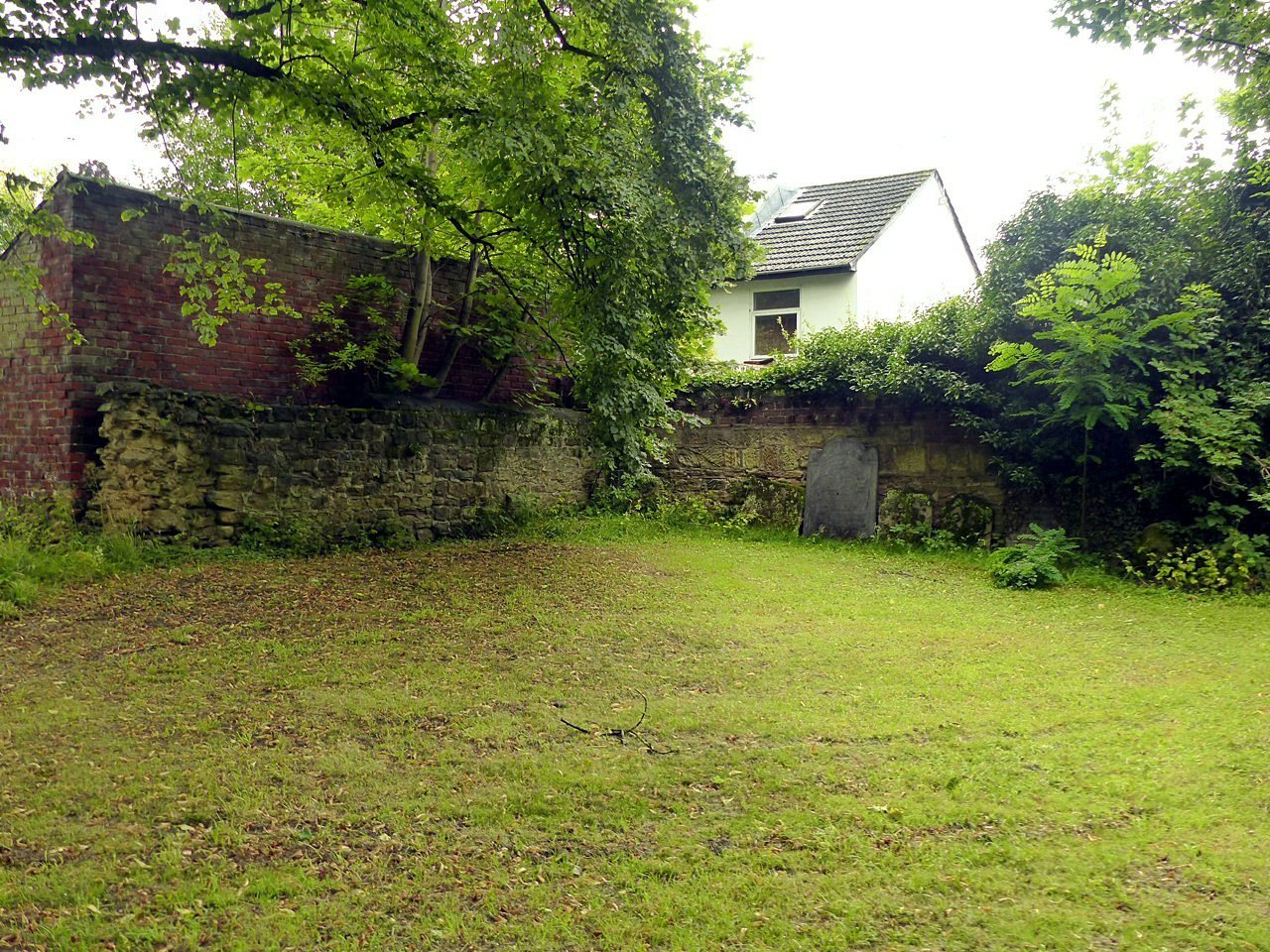
The surviving physical evidence includes medieval stonework at the site and architectural objects preserved at nearby churches and museums. A medieval wall lies at the eastern end, while the lower courses of a substantial stone column remain at a nearby street junction. The Priory Church of St Anthony at Lenton may incorporate elements of the chapel belonging to the priory’s monastic hospital.
Medieval masonry and church fabric
Eastern wall
Excavation in 2020 revealed a medieval wall at the eastern end of the priory. It has been interpreted as part of a previously unknown Lady Chapel, a chapel dedicated to the Virgin Mary, added to the original Norman building.
Stone column
The lower courses of a substantial stone column survive in their original position at the junction of Old Church Street and Priory Street.
Priory Church of St Anthony
The church may contain elements of the chapel once associated with the priory’s monastic hospital.
Preserved objects and later artworks
Font, tiles and stained glass
A twelfth-century baptismal font from the priory is preserved at Holy Trinity Church, Lenton, about half a mile away. Priory floor tiles are held at Nottingham Castle Museum, and stained glass from the priory is at Nuthall Church.
Sculpture park
Part of the site became a sculpture park in 2018, with three public artworks commissioned by Nottingham Council. James Winnet’s Lenton Priory Stone takes the size and carving style of the twelfth-century font as its model. A series of metal columns by Adrian Riley stands around trees on the site. Their patterns and accompanying texts refer to the priory’s architecture and history.