Lisht: A Royal Necropolis of Egypt’s Twelfth Dynasty
Site at a Glance
- Popularity
- High
- Country
- Egypt
- Primary era
- Bronze Age
- Eras represented
- Bronze Age, Classical
- Civilizations
- Egyptian, Roman
- Site type
- Burial
- Remains
- Necropolis
On this page12 sections
History
Lisht is an ancient Egyptian necropolis beside the village of el-Lisht in Egypt, on the west bank of the Nile about 60–65 km south of Cairo. Its royal cemeteries are associated with Amenemhet I, the first king of the Twelfth Dynasty, and his son Senusret I. The site was probably near their capital, Itj-tawy.
The Twelfth Dynasty royal cemetery
Amenemhet I moved Egypt’s capital from Thebes to Itj-tawy to strengthen his control over Upper and Lower Egypt. Reclaiming land and increasing agricultural production near the Fayyum may also have influenced the decision. The capital has not been conclusively located. Pottery found east of Lisht has been proposed as a clue to its position, while the pyramids identify the nearby royal burial ground.
The earliest monuments at Lisht include rock-cut tombs, some of which are earlier than the Middle Kingdom. The necropolis remained important through the Thirteenth Dynasty. After Senusret I’s reign, burials there were mainly placed in simple shaft tombs. Tombs for royal family members and high officials accumulated around the kings’ funerary complexes over successive generations.
Later use of the necropolis
During the Second Intermediate Period, parts of Amenemhet I’s pyramid precinct were adapted as a settlement. Lisht later became less important as a cemetery, though tombs and agricultural buildings were constructed there in the Roman period. An Islamic cemetery to the east of Amenemhet I’s funerary temple continues to be used.
Investigation and recent discoveries
John Shae Perring documented Lisht in 1839, and he and Richard William Howard Vyse published material about it in 1842. Karl Richard Lepsius visited during his Egyptian expedition in 1843. Gaston Maspero entered both pyramids in 1882; further work followed in 1884–85, and Joseph-Étienne Gautier and Gustave Jéquier led the first systematic excavations in 1894–95.
The Metropolitan Museum of Art excavated at Lisht in 14 campaigns between 1906 and 1934, under the direction of Albert M. Lythgoe, Ambrose Lansing, and Arthur C. Mace. Dieter Arnold led renewed investigations from 1984 to 1991, and his 1988 publication provided the first complete excavation report on Senusret I’s pyramid. Later studies examined the pyramid complex, workers’ inscriptions, tombs, architecture, and reliefs. Ahmed Abdel-Hamid also excavated at the site from 1991 to 1994.
Illegal digging caused extensive damage during the political upheaval of Egypt’s 2011 revolution. Satellite surveys and fieldwork identified damage and shaft tombs exposed by looting. In February 2016, a tomb south of Senusret I’s pyramid was discovered belonging to Intef, an official responsible for the royal seal, treasury, and army. In 2018, a cemetery of more than 800 tombs, over 4,000 years old, was discovered in the Lisht area.
Remains
The necropolis occupies two limestone plateaus, separated by a valley about 500 m wide. Smaller valleys run northeast from the southern plateau toward the modern village, and the steep southern slopes of that plateau were quarried during the Middle Kingdom. The two royal pyramids stand in separate cemetery areas, among smaller royal pyramids, tombs, and shaft graves.
The royal pyramid complexes
Amenemhet I’s pyramid and temple
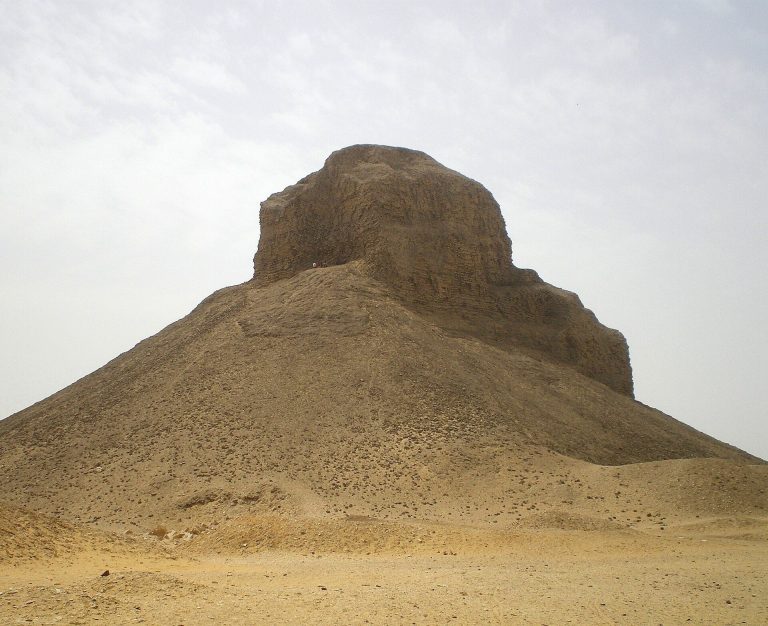
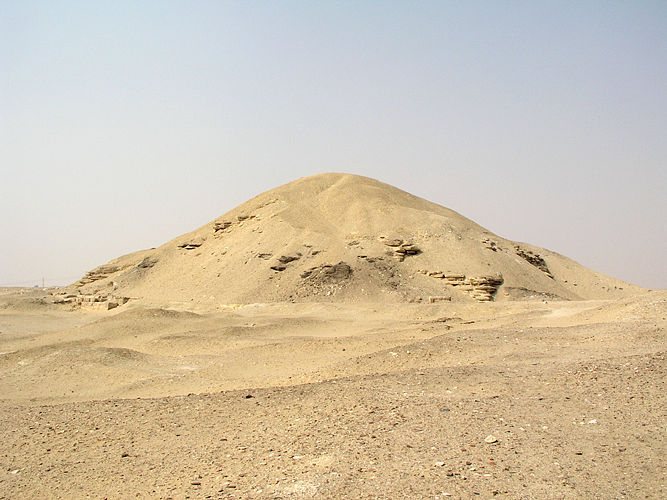
Amenemhet I’s pyramid was originally about 55 m high and now rises about 20 m above the ground. Its core was built with unfired mudbrick, sand, debris, and stone taken from earlier monuments. Reused blocks from monuments of Khufu, Khafre, Unas, and Pepi II, or possibly Pepi I, have been identified in the complex.
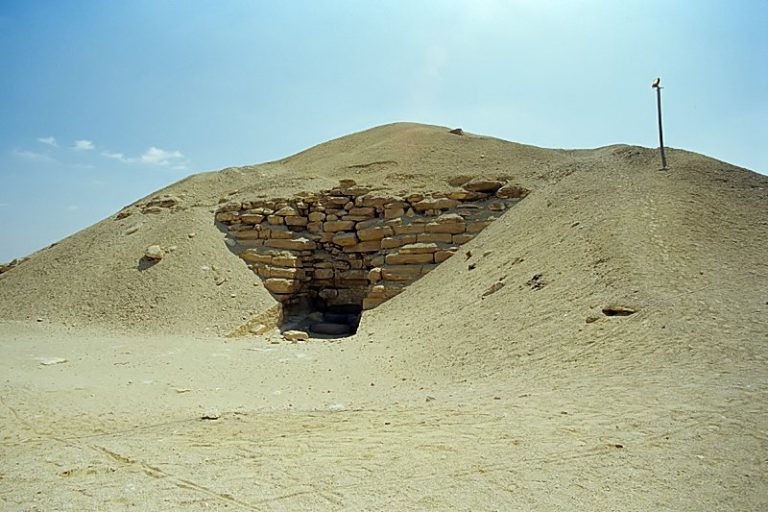
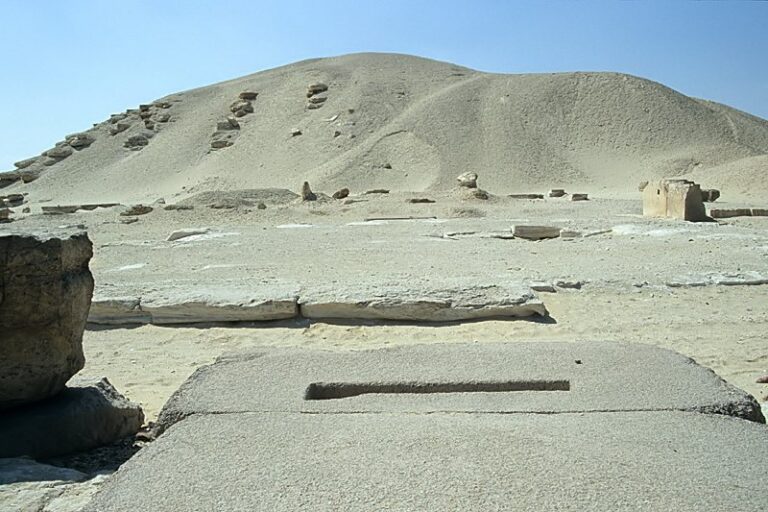
The entrance lies on the pyramid’s north side. A pink-granite-lined corridor leads to a small chamber in the core, while a shaft connects it to the burial chamber, which is flooded by seepage from the Nile. The surviving remains of Amenemhet I’s funerary temple are carved fragments, including images of the Nile god and provincial deities. A granite altar from the offering hall shows provincial representatives bringing gifts to the king. A limestone statuette head thought to portray Amenemhet I was also found in the complex.
Senusret I’s pyramid and temple
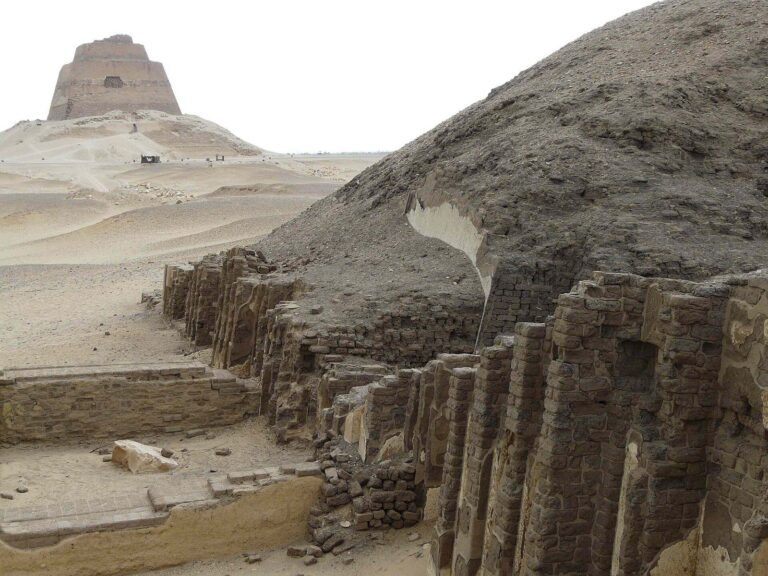
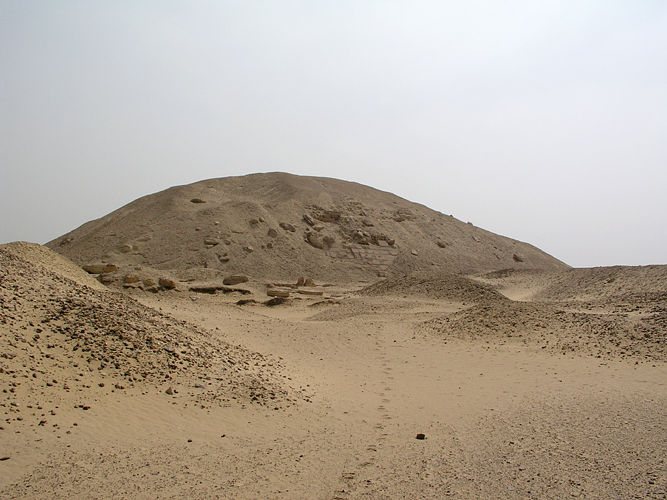
About a mile south of his father’s complex, Senusret I built a pyramid named “Senusret Looks Down on Both Lands.” Its base measured 105 m across and it originally stood 61.25 m high. Coarse limestone blocks formed its core, which was packed with mudbrick and debris, then faced with heavy blocks and a smooth casing of white Tura limestone. Some of the inner framework survives, but the pyramid itself is now almost entirely rubble.
The complex is described as the best-preserved pyramid complex of its period. Its unroofed causeway had alcoves for large limestone statues of the king and was flanked by mudbrick buildings used by priests in funerary rites. Some causeway statues are now in the Metropolitan Museum of Art in New York and the Museum of Egyptian Antiquities in Cairo; other statues found during excavation are also held in Cairo. A small chapel stood before the pyramid’s north side and contained an alabaster false-door stela, a carved feature representing a doorway, decorated with offering scenes.
The funerary temple stood to the east, at the head of the valley causeway. Its plan included a courtyard, a portico (a roofed walkway supported by columns), and an offering hall with storerooms on either side. A central passage in the pyramid led to a burial chamber, where sculpted lion heads directed water into a drain. A second tunnel carried funerary equipment toward the chambers; objects from the king’s burial were found there. The burial chamber is flooded by Nile seepage, and the tomb had been robbed soon after it was sealed. Relief blocks, fragments, and small shrines from the complex reflect Middle Kingdom art.
Tombs and burials
The northern cemetery
Rock-cut tombs occupy the south-facing slopes of the northern plateau. Their burial chambers are nearly square, and one chamber contained four pits. Finds from one pit included a round alabaster table, a copper basin, and a ceramic jar dating to the Old Kingdom; the same tomb also held Roman-period burials. A second tomb’s forecourt yielded an offering table and a stela weathered by salt.
Northern tombs include Grave 384, belonging to the treasurer Rehuerdjersen, and Mastaba 400, the tomb of Antefiqer, a vizier and mayor of the pyramid town. A mastaba is a substantial, generally rectangular tomb structure. Other examples include the graves of the seal-bearer Senimeru and the administrator Nakht, as well as Grave 758, belonging to Senusret, a vizier, chief lector priest, and overseer of works. The cemetery also contains numerous shaft tombs, including burials of officials, a king’s son, a military scribe, and an overseer of faience workers.
The southern cemetery
The southern cemetery includes mastabas belonging to Senwosretanch, a high priest of Ptah, and Mentuhotep, a vizier and treasurer. Other named tombs include those of Imhotep, an overseer of fields; Djehuti, a magazine administrator; and Sehetepibreanch, also a high priest of Ptah. The area also contains the South-Khor Tombs A and B, Tombs A, B, C, D, and F, and the East Tomb. Tomb E is known from an enclosure wall alone.
Beside pyramid 5, the undisturbed tomb of Anchet contained a coffin with texts, a mummy mask, a mirror, a necklace, a model vessel, and pottery. Shaft LS 5305 held Henut, a cosmetician of the royal harem. Other shafts include the multiple burials in LS 5115 and the tombs of Ameni and Cheti. The unrobbed shaft tomb of Hapy retained rich jewelry, and the southern cemetery also includes the rock-cut tomb of General Ameni.
Burial objects and funerary texts
The undisturbed tomb of Senebtisi yielded a group of jewelry. Coffin texts from the tomb of the priest Sesenebnef include an early version of the Book of the Dead, a collection of funerary writings intended to assist the dead in the afterlife.