St. Stanislaus and St. Wenceslaus Cathedral: A Late Gothic Cathedral in Świdnica
Site at a Glance
- Popularity
- High
- Country
- Poland
- Primary era
- Medieval
- Eras represented
- Medieval, Early Modern
- Civilizations
- Habsburg, Habsburg Austria, Holy Roman Empire, Kingdom of Bohemia
- Site type
- Religious
- Remains
- Cathedral
On this page32 sections
History
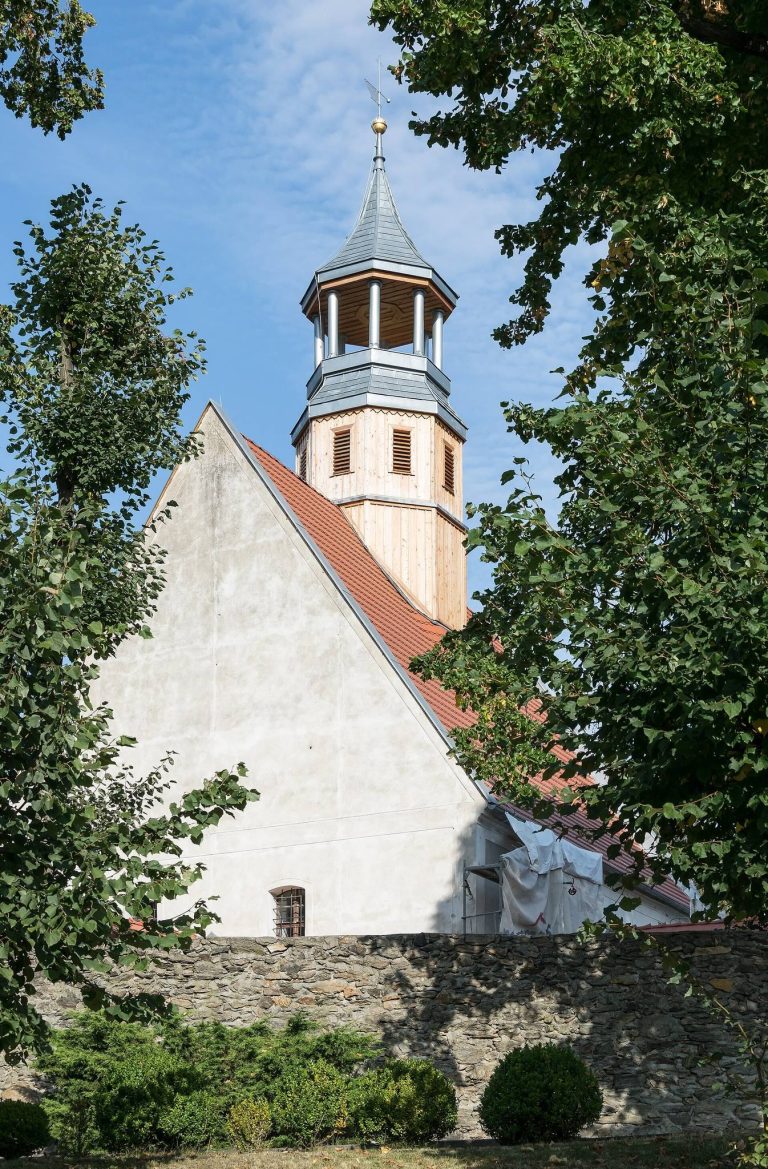
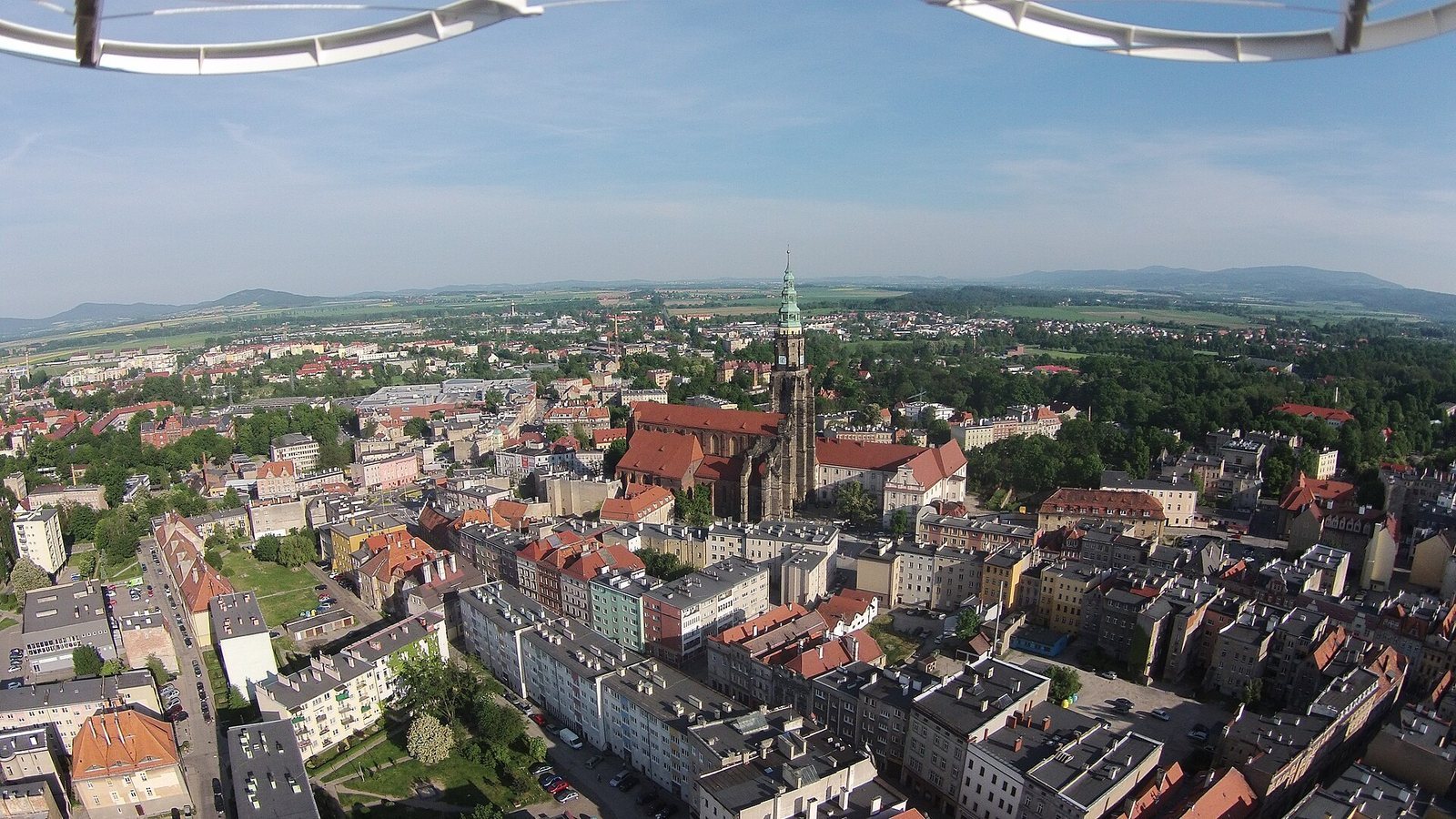
St. Stanislaus and St. Wenceslaus Cathedral is a large late Gothic church in Świdnica, Poland, begun in 1330 on the order of Duke Bolko II after a wooden church on the site burned down. It is among the largest churches in Lower Silesia. Tradition holds that Bolko II laid the foundation stone himself. The church is dedicated to Stanislaus, a Polish bishop and martyr, and Wenceslaus, a Bohemian ruler venerated as a Christian martyr.
Medieval construction and rebuilding
Work on the church began in the fourteenth century, and it was enlarged around 1400–1410. A fire in 1532 destroyed its original Gothic interior. The rebuilding was completed in 1546, beginning a new phase in the church’s appearance and use.
Changes in religious use
Protestant congregations used the church from 1561 to 1629. Jesuit patronage began in 1662, and around the turn of the seventeenth and eighteenth centuries the Jesuits remodeled the interior in Baroque style.
Secular use and restoration
With Prussian approval, the building served as a grain store from 1757 to 1772 and was later used as a hospital. Restorations took place in 1832 and 1893–1895; the latter removed many original architectural elements. Further renovations followed in 1908 and 1959.
Cathedral of the Diocese of Świdnica
In 1949 the church was entered in the register of immovable monuments, and in 2017 it received Poland’s national Historic Monument designation. On 25 March 2004, after Pope John Paul II established the Diocese of Świdnica by papal decree, the church became its cathedral, the principal church of the diocese. It continues to serve both as a Roman Catholic parish church and as the cathedral.
Remains
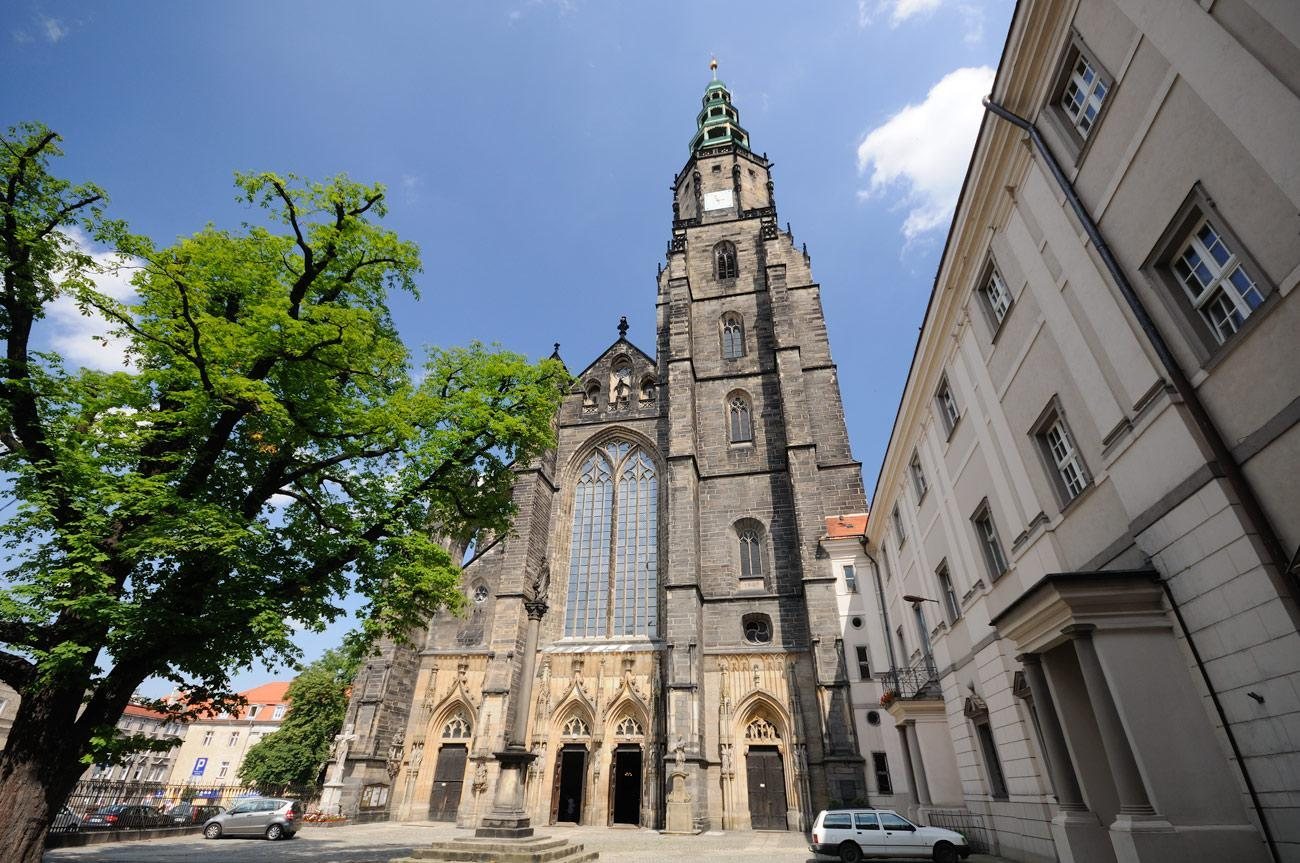
The cathedral stands on John Paul II Square in the southeastern part of Świdnica’s medieval town centre. It is an east-facing, three-aisled basilica, a church with a central nave higher than its side aisles, built of brick, including hard-fired brick, and dressed stone. Its chancel, the part of the church around the main altar, ends in a polygon shaped from seven of twelve sides; the side aisles have ends shaped from three of eight sides.
Exterior and west façade
Towers
The southern tower dominates the west façade and rises about 103 metres, making it the tallest tower in Silesia. It has five storeys, an upper storey that changes to an eight-sided form, and a Renaissance spire added in 1613. Figures of Saints Stanislaus and Wenceslaus, Mary, Hedwig of Silesia, Peter, Paul, John the Baptist, and John the Evangelist stand on columns at the corners of the upper storey. The northern tower rises only to the height of the side aisles.
Portals and sculpture
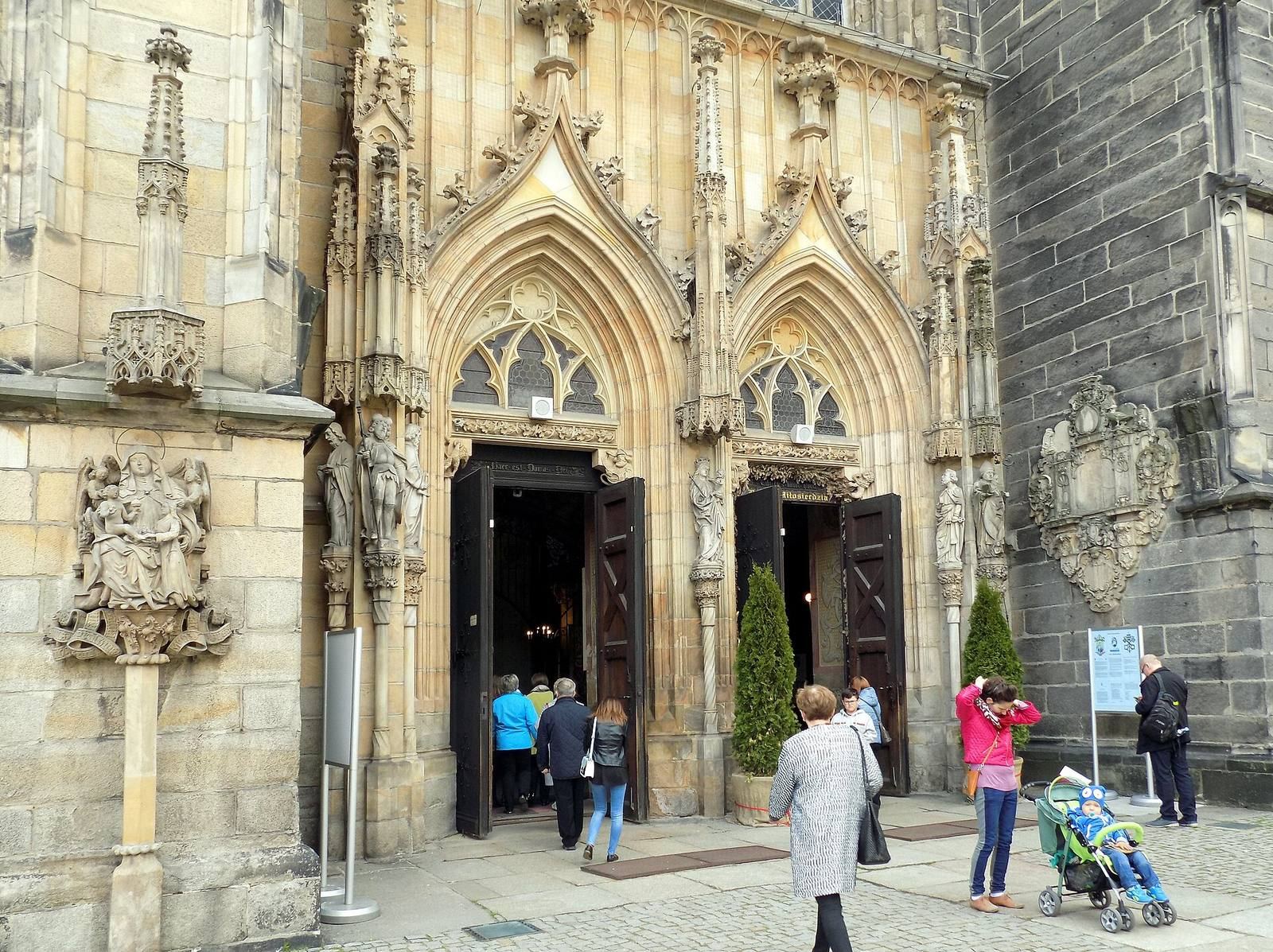
Four portals pierce the west façade. Their sandstone sculpture includes the Virgin and Child, the Twelve Apostles asleep in the Garden of Gethsemane, and figures of Saints Stanislaus and Wenceslaus dated 1427. Symbols of the four Evangelists appear outside the portals: an eagle and a lion on the north side, and a bull and a winged human figure on the south. Between the northern and central portals stands a late Gothic sculpture of Saint Anne with the Virgin Mary and the Christ Child.
Nave and chancel
Nave
The main nave measures 71 metres long, 10 metres wide, and 25 metres high; the three aisles together are 27 metres wide. A lower vault was added over the nave during the Baroque remodeling. Niches in the nave’s piers hold sculptures of saints, including John the Baptist, Nicholas, and Wolfgang. Seventeenth-century oil paintings on canvas hang on the walls.
Chancel chapel
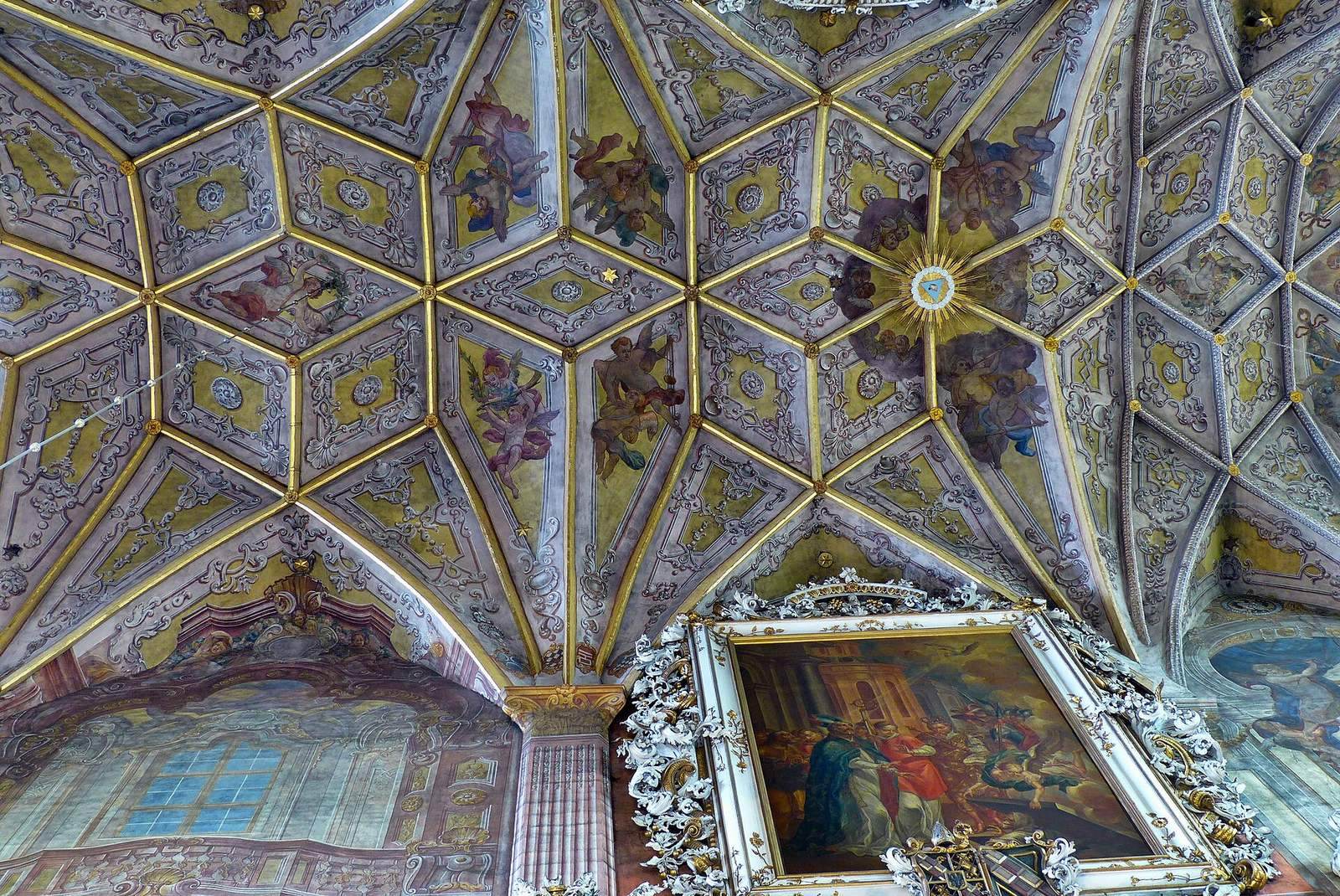
A twelve-sided chapel resembling a crypt lies beneath the chancel and raises the chancel and high altar above the church floor. Its plan is close to elliptical. A star vault, a ribbed ceiling whose ribs form a star pattern, rests on a round central pier where the ribs meet. Carved bosses and wall shafts support the ribs at their ends.
Chapels on the north side
Chapel of Our Lady of Częstochowa
Formerly dedicated to Saint Ignatius of Loyola, the Chapel of Our Lady of Częstochowa has a polygonal end.
Baptismal Chapel
The Baptismal Chapel, once the Barbers’ Chapel, dates to the mid-fifteenth century. It has two bays, a three-sided end, and a star vault. Its furnishings include a Renaissance grille dated 1591 and a font dated 1586. A painting in the chapel depicts the expulsion of the Jews from Świdnica in 1453.
Hedwig Chapel
The Hedwig Chapel, formerly the Tailors’ Chapel, has a polygonal end and a Jesuit crypt. Its altar is dedicated to Saint Hedwig, the medieval duchess and saint, and includes a painting by Heigel from the late seventeenth century. A painted wooden epitaph for the Nauck family was probably made after 1584.
Chapel of Saint John the Baptist
Dating to around 1474, the former Clothmakers’ Chapel has a star vault. Its furnishings include an altar dedicated to John the Baptist, dated 1682, and a painting from around 1700 of Saint Stanislaus admonishing Bolesław the Bold.
Chapels and former church spaces on the south side
Heart of Jesus Chapel
The Heart of Jesus Chapel, formerly dedicated to Saint Francis Xavier, has a polygonal end. Its altar includes a depiction of the Last Supper by Riedel.
Chapel of the Three Kings
The patrician Nikolaus Löwe endowed the Chapel of the Three Kings in 1395. Its cross-rib vault has intersecting ribs beneath the ceiling. A late-seventeenth-century altar depicts the Adoration of the Magi, and a stone tomb commemorates Wilhelm Heinrich Oberg, dating from after 1646.
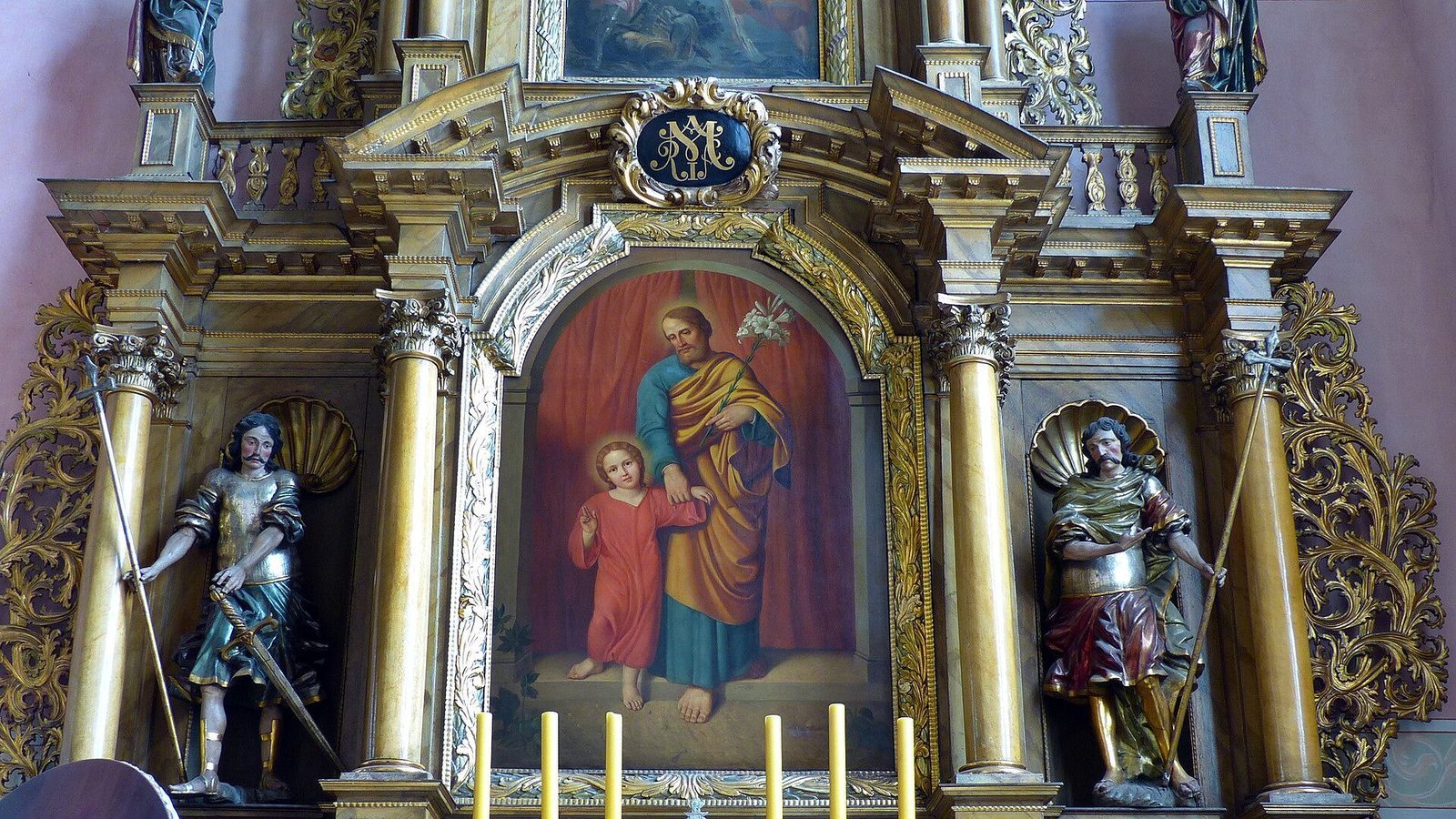
Chapel of Saint Joseph
The former Merchants’ Chapel dates to 1487 and has a star vault. Its furnishings include an altar with Saints Joseph, George, and Christopher, and a painting from around 1695 of the Madonna before a view of Świdnica.
Chapel of Our Lady of Świdnica
The former Butchers’ Chapel dates to around 1459 and was remodeled in the early eighteenth century with a domed vault. Paintings by Johann Hiebel of Prague depict Duke Bolko II and a view of Świdnica. The chapel’s altar, made by Johann Sigrist, holds the Madonna of Świdnica, a specially venerated image dated to around 1460 or 1480. The image is also known as the Sun Lady or Madonna in the Sun.
Sacristy and choir spaces
Sacristy
The present sacristy was originally a chapel endowed by Konrad von Sachenkirch in 1342. It received a Baroque interior in the seventeenth or eighteenth century.
Chapel of Saint Thomas and Citizens’ Choir
The present Chapel of Saint Thomas formerly served as the sacristy. It has four bays and a ribbed vault supported by a central pier bearing a coat of arms. Above it is the choir of the Marian Brotherhood, a lay religious group devoted to the Virgin Mary, also called the Citizens’ Choir. Dating to around 1468, the choir has a star vault and arcades. A double staircase lies beneath it, and the gallery balustrade has late Gothic tracery. The choir contains a Gothic multi-panel altarpiece dated 1492, with a scene of the Death of the Virgin. It was probably made by a pupil of the sculptor Veit Stoss and is described as a copy of the altar in St Mary’s Church.
Altars, paintings, and sculpture
Main altar and pulpit
Johann Riedel’s main altar shows the Virgin and Child surrounded by saints beneath a canopy supported by seven columns. It is described as his most important work in the church. Riedel made most of the church’s sculptures and altars, and carved the pulpit on the left side of the main nave in 1698.
Paintings
A painting dated 1668 by Michael Willmann depicts the death of Saint Wenceslaus. Johann Jacob Eybelwieser painted Jesuit saints with Christ and the Virgin Mary, as well as a separate scene of the death of Saint Stanislaus. Six paintings in the main nave, dating to the early eighteenth century, show episodes from the lives of the cathedral’s patron saints.
Sculptures and metalwork
A highly realistic Pietà is dated to around 1420, although proposed dates also include around 1422 and 1499. A late Gothic metal door leads to the former library. Its diamond-shaped panels bear figures of Mary and the Archangel Gabriel, together with the Silesian eagle and Bohemian lion. In the church courtyard, a column of Saint Florian dates to 1684.
Organ and memorials
Organ
Johann David Sieber designed the large organ case, dated 1705. Georg Leonhard Weber made its carved Heavenly Orchestra between 1704 and 1710. Weber also created the altar in the Chapel of Our Lady of Świdnica and statues of the city’s patron saints on consoles of the piers between the aisles. The present organ was made by Schlag & Söhne in 1911. It has 41 stops, three keyboards, and a pedal keyboard.
Epitaphs and tombs
A sandstone epitaph on a church wall commemorates Martin Früauf, the last Catholic parish priest before Protestant congregations took over the church. Its central relief shows him kneeling before the Trinity represented as the Throne of Grace. The inscription gives his age at death as 99 years, three months, and six days. Before the sacristy entrance, a floor slab marks the tomb of parish priest Hugo Simon, who died in 1897. Its inscription, Voluit Quiescit, expresses his wish to rest there. Other epitaphs in the church date from the sixteenth to eighteenth centuries.