Langheim Abbey: A Cistercian Monastery in Bavaria
Site at a Glance
- Popularity
- Medium
- Country
- Germany
- Primary era
- Medieval
- Eras represented
- Medieval, Early Modern
- Civilizations
- Holy Roman Empire
- Site type
- Religious
- Remains
- Monastery
On this page16 sections
History
Langheim Abbey was a male Cistercian monastery at Klosterlangheim, now part of Lichtenfels in Germany. Founded in 1132-1133, it was a daughter house of Ebrach Abbey, established under another monastery’s authority, and belonged to a Catholic monastic order rooted in the Benedictine tradition. Langheim became a powerful landholder and held pastoral responsibilities for numerous parishes.
Foundation and growth
Three brothers serving the Bamberg church, associated with the families later known as Rotenhan and Redwitz, gave the Langheim estate to Otto I, Bishop of Bamberg. Otto entrusted it to Adam, Abbot of Ebrach, to establish a new monastery. The first stone was laid on 1 August 1132, and the buildings were finished in 1142. Adam served as Langheim’s first abbot from 1141 to 1180. The abbey was dedicated to Mary, John the Evangelist, and Saint Nicholas.
Pope Eugene III and emperors granted the monastery privileges, while Bamberg’s bishops and local nobles supported it. Langheim acquired extensive estates and responsibility for the spiritual care of many parishes. It founded Plasy Abbey in 1144-1145 and Schlägl Abbey in 1202-1203. In 1422, its abbot held a senior position in the Cistercian order. Gifts of land and villages from the Dukes of Merania during the thirteenth and fourteenth centuries helped make Langheim one of the region’s wealthiest monasteries. It later joined the Upper German Cistercian Congregation, a regional association of monasteries.
Political pressure, destruction, and reform
Plague and financial difficulties weakened Langheim around 1380, forcing it to sell some land and income to the Diocese of Bamberg. During the following decade, Bishop Lambrecht von Brunn took control of the abbey’s administration, and its property passed to the Bamberg cathedral chapter. Langheim sought to escape the authority of Bamberg’s prince-bishops, church leaders who also ruled a territory, and become directly subject to the emperor. These efforts to gain imperial immediacy, or independence from an intervening territorial ruler, continued for centuries before the abbey abandoned them in 1741 after political circumstances changed.
Around 1430, Hussite forces, followers of the religious reformer Jan Hus associated with a movement in Bohemia, burned and destroyed the abbey buildings. The monastery rebuilt and recovered economically, but it was burned again in 1525 during the German Peasants’ War, a series of uprisings in German-speaking lands. The Reformation, which led to the formation of Protestant churches, deprived Langheim’s monks of spiritual authority over many settlements under their care. Some monks became Protestant and left; Abbot Friedrich Marschalk was deposed in 1562.
War and Baroque rebuilding
In 1632, Swedish forces destroyed the rebuilt abbey during the Thirty Years’ War, a major European conflict that lasted from 1618 to 1648. Recovery took about a century. Abbot Mauritius Knauer, who led Langheim from 1649 to 1664, became known for work in mathematics and astronomy, as well as writings on natural science and religious devotion. Langheim’s literary work also included Engelrich’s account of the life of Mechtilde, Abbess of Edelstetten, and Simon Schreiner’s seventeenth-century writing on the Fourteen Holy Helpers and Apologia contra Lutheranos.
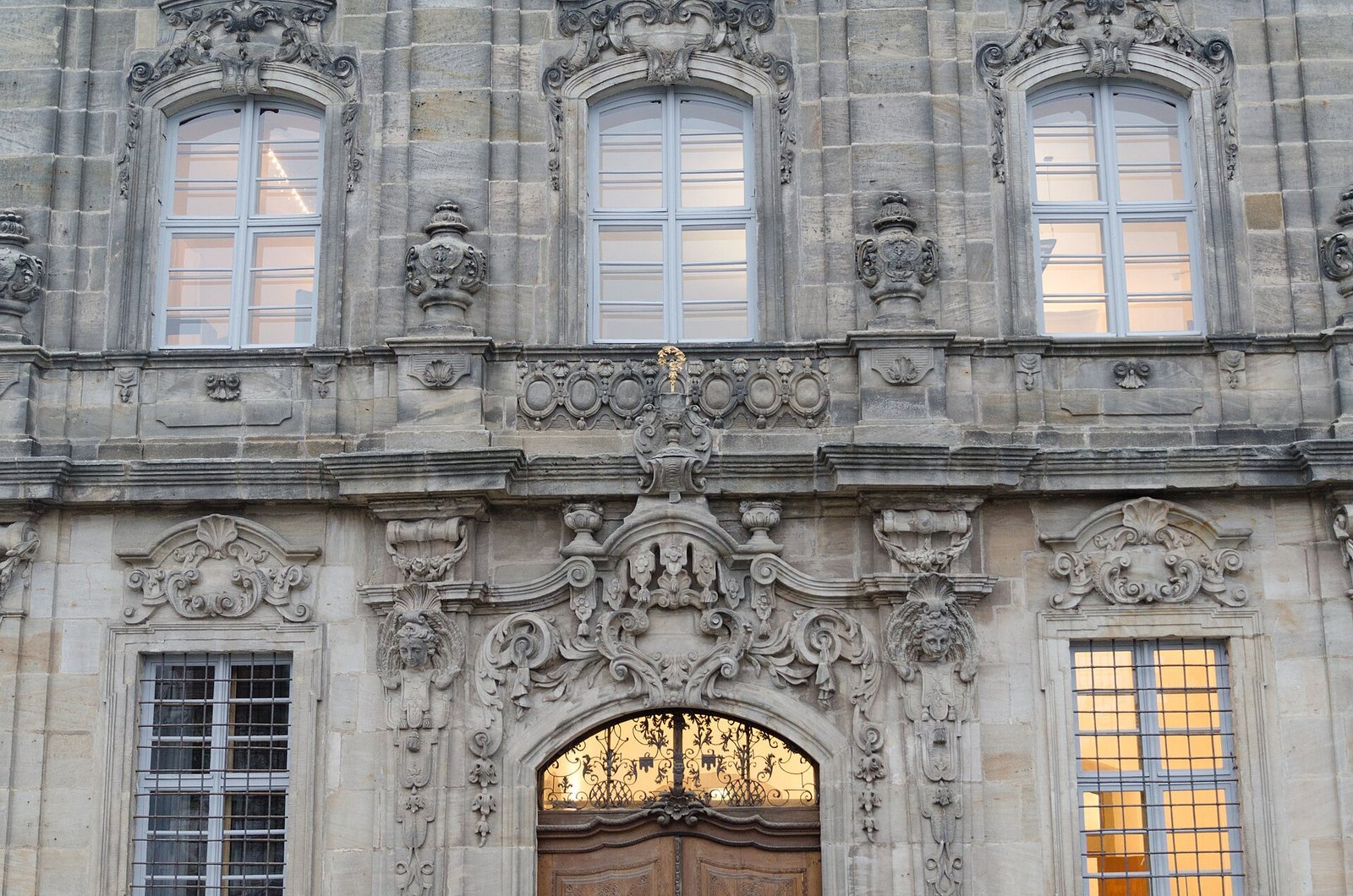
Between 1680 and 1792, a major rebuilding campaign reshaped Langheim in the Baroque style, an ornate European style associated particularly with the seventeenth and eighteenth centuries. The plans involved Johann Leonhard Dientzenhofer, Gottfried Heinrich Krohne, Balthasar Neumann, and Lorenz Fink. Abbot Stephan Mösinger, in office from 1734 to 1751, pursued especially costly construction, overestimating the abbey’s resources and attracting severe criticism. Langheim also had to contribute heavily to the costs of the Seven Years’ War, a global conflict involving European powers and their empires from 1756 to 1763. In the late 1780s, the Bishop of Bamberg intervened in the abbey’s finances and suspended Abbot Johann Nepomuk Pitius because of debts from building work.
Fire and dissolution
A major fire in May 1802 devastated the complex. It destroyed part of the convent building and one of the abbey’s two libraries, and badly damaged the church and other buildings. In 1803, during Bavarian secularization, the state takeover and dissolution of religious institutions, Langheim was nationalized and closed. Its usable possessions were sold, and the damaged buildings and abbey church were demolished. The community of 49 members was dispersed. At the time of dissolution, the abbey held about 1,700 farms in 230 places, along with 34 farmsteads, four mills, four breweries, six sheep farms, and roughly 5,700 hectares of fields, meadows, woods, and fishponds. Tenants and paid or forced laborers worked its properties. After the abbey’s dissolution, Joachim Jaeck published extensive research on Bamberg and the surrounding region.
Remains
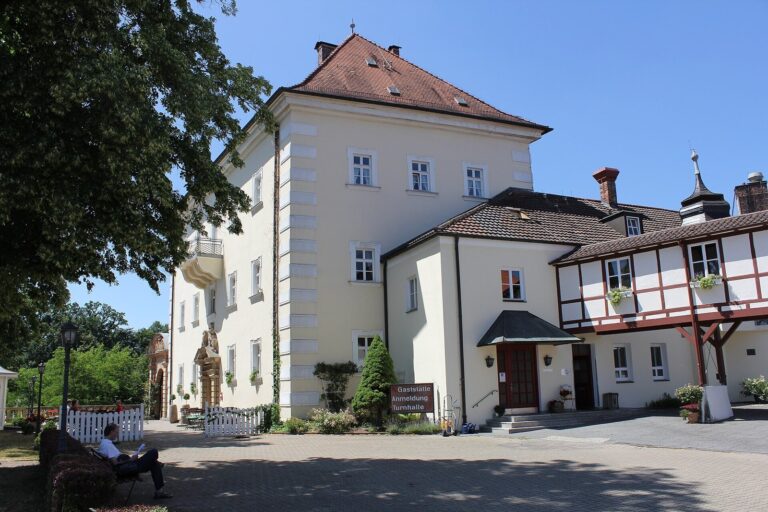
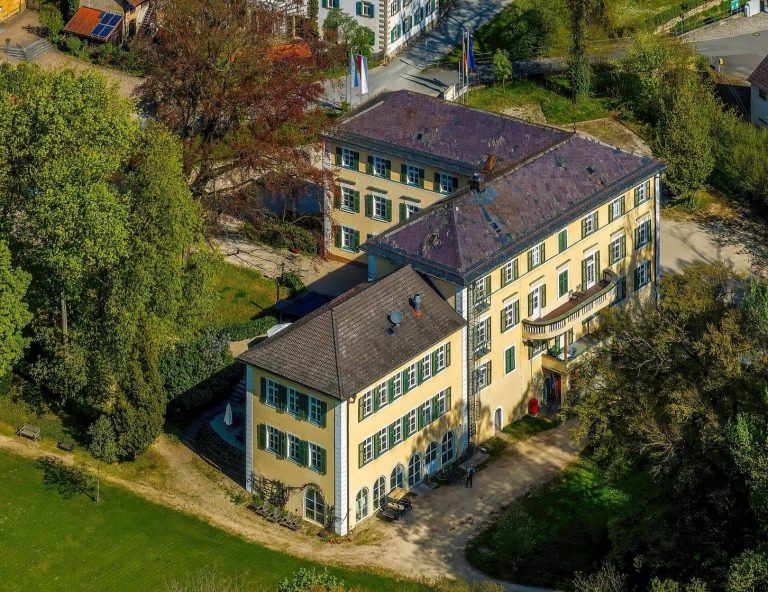
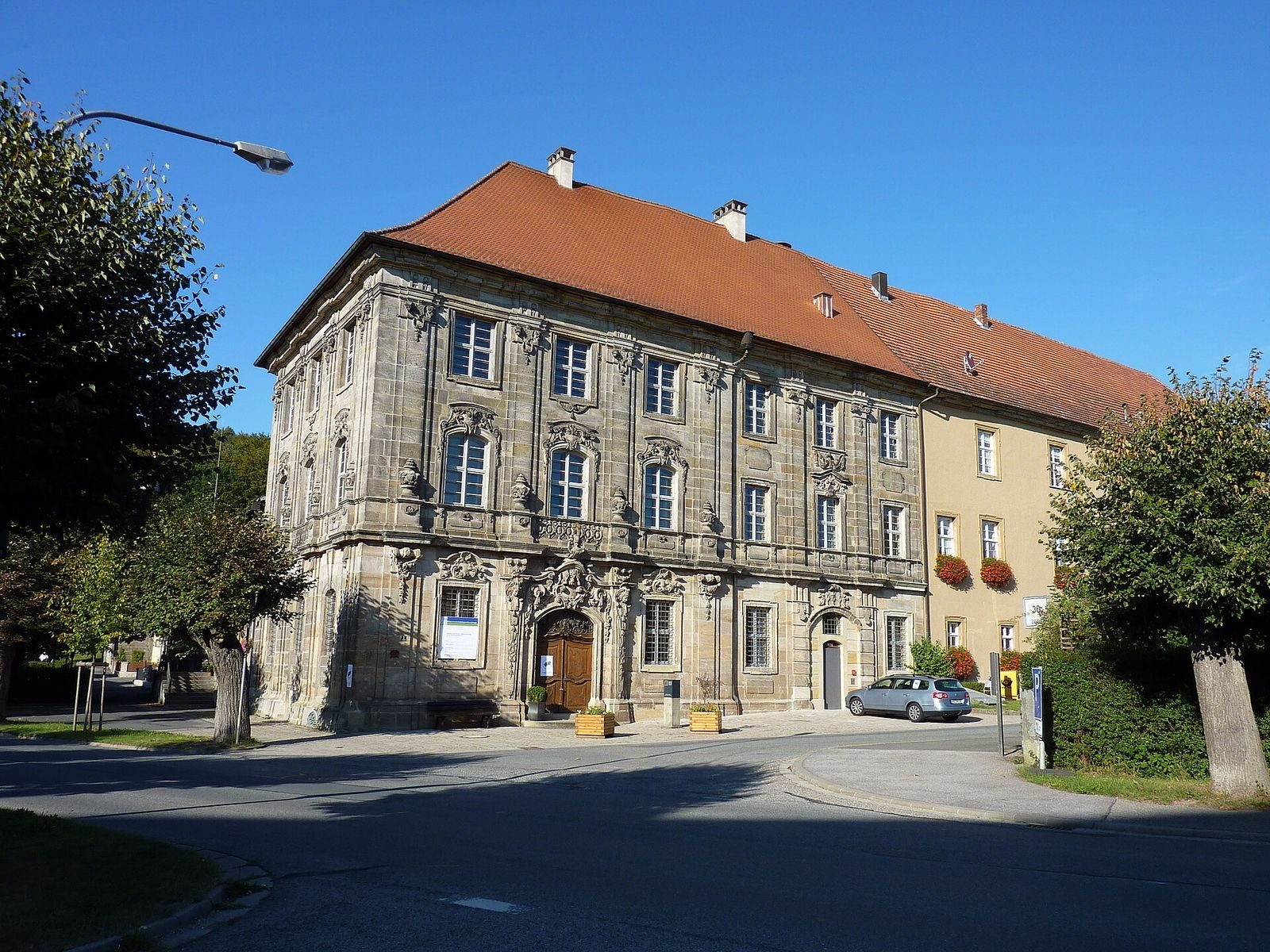
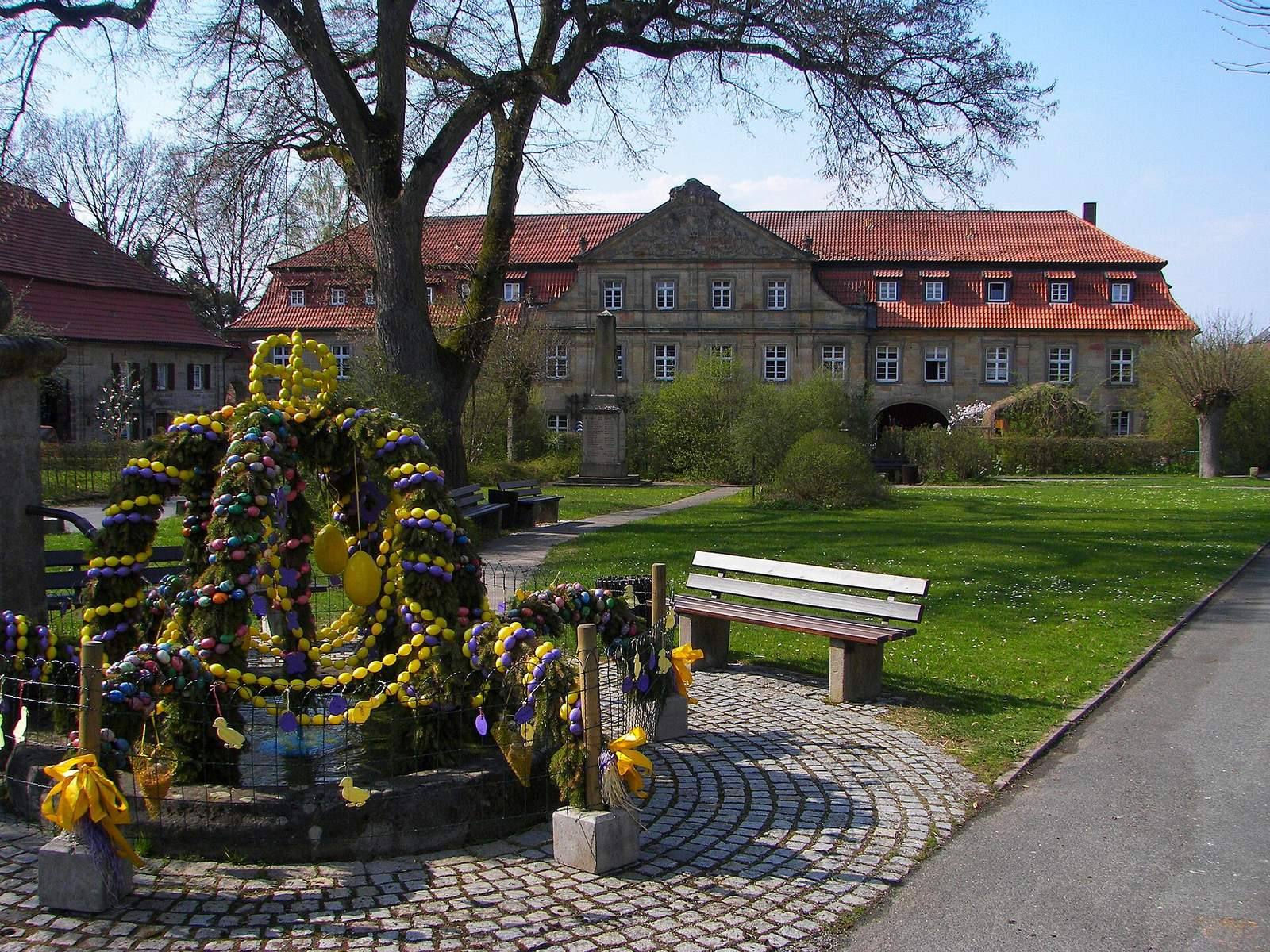
Several former abbey buildings remain incorporated into the center of Klosterlangheim. Surviving features include medieval and later religious buildings, while other former monastic properties survive as estate and administrative structures in the surrounding area.
Abbey buildings and churches
Chapel of Saint Catherine
Built around 1220 near the abbey’s northern entrance, the Chapel of Saint Catherine served as a gate chapel and is the oldest surviving monastic building. After secularization it was used as a barn. Its Romanesque portal, with the rounded arches characteristic of that medieval style, was sold in 1908 and is now in Berlin’s Sculpture Collection.
Burial chapel
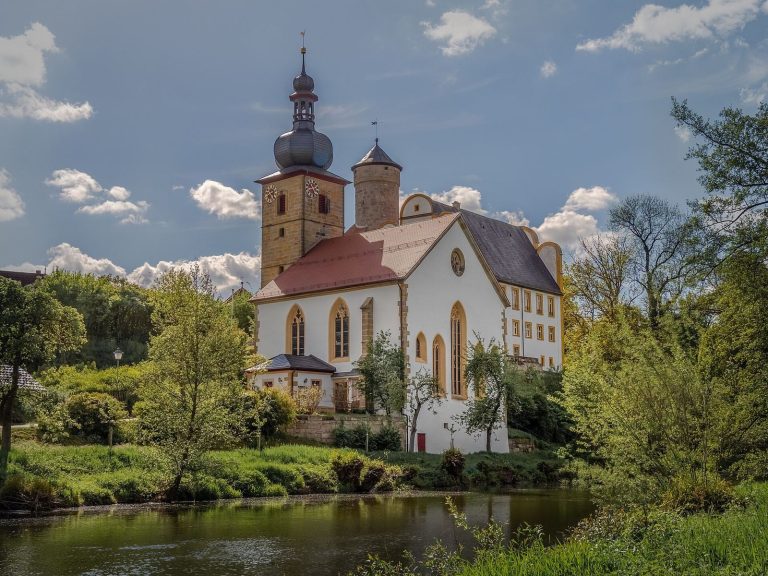
Consecrated around 1624, the burial chapel was later converted into a branch church dedicated to Saint Mary, Saint Peter, and Saint Bernard of Clairvaux.
Vierzehnheiligen pilgrimage church
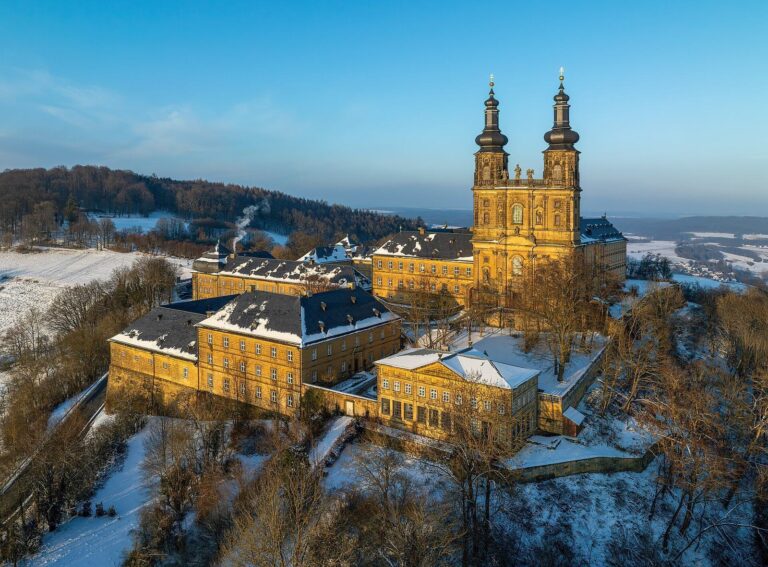
Near Bad Staffelstein, the abbey’s dependent pilgrimage church of Vierzehnheiligen was first built in 1445 under Abbot Frederick Hengelein. Abbot Stephan Mösinger commissioned Balthasar Neumann to rebuild it in the Baroque style, and the work was completed in 1772. The church survived the abbey’s dissolution and was entrusted to the Franciscans.
Outlying estates and agricultural sites
Altenhof and Tambach
Langheim maintained an outpost at Altenhof from the twelfth century. The monks created fishponds there, which survive, and raised carp. Beside the ponds, the abbey established the Tambach monastic farm, later used as an administrative office. From 1698, the Tambach complex also served as the abbots’ summer residence and estate. Its buildings, like those of the abbey’s administrative estates at Tambach, Kulmbach, and Trieb, were refurbished in the Baroque style.
Kulmbach administrative estate
Leonhard Dientzenhofer built Langheim’s administrative estate at Kulmbach in the late seventeenth century.
Nassanger farmstead
At Trieb, the Nassanger farmstead was built in 1693 as a circular structure. Abbot Gallus Knauer commissioned the building to plans by Leonhard Dientzenhofer.
Berghof at Trieb
Abbot Gallus Knauer commissioned a replacement Berghof building in 1727, designed by Johann Georg Brückner, a master builder from Coburg. Abbot Martin Wolf enlarged it in 1733.
Hochstadt administrative office and inn
The former monastic office and inn at Hochstadt am Main was built in 1605. Its sandstone ashlar walls, made from dressed stone blocks, support a gabled roof, and the building has corner turrets. It is now used as a district clinic.