Prinknash Abbey: A Benedictine Monastery in Gloucestershire
Site at a Glance
- Rating
- 4
- Popularity
- Very Low
- Country
- United Kingdom
- Primary era
- Early Modern
- Eras represented
- Medieval, Early Modern, Modern
- Civilizations
- British, English
- Site type
- Religious
- Remains
- Monastery
On this page7 sections
History
Prinknash Abbey, formally the Abbey of Our Lady and St Peter at Prinknash, is a Benedictine monastery near Cranham in Gloucestershire, United Kingdom. Benedictine communities follow the Rule of Saint Benedict, a guide to communal religious life. The estate’s monastic history reaches back to a dependent house of Gloucester Abbey, while the present community took shape through major religious and institutional changes in the 20th century.
Medieval estate and later use
A Benedictine community under Gloucester Abbey’s authority probably existed at Prinknash in the 11th century. In 1096, the Giffard family gave the land to Serlo, Abbot of Gloucester. The abbey retained it until the mid-16th-century dissolution of the monasteries, when the English Crown suppressed monastic houses and took their property. The Crown leased Prinknash to Sir Anthony Kingston, who was required to provide King Henry VIII with 40 deer each year.
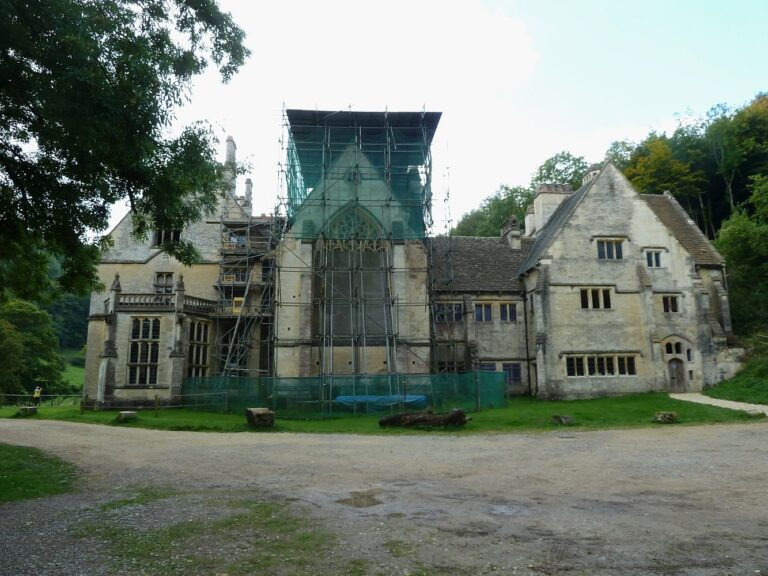
After the transfer from monastic ownership, Prinknash Park served as a hunting lodge and as a residence and meeting place for Gloucestershire’s gentry and nobility. Successive generations altered the property. The older building is now known as St Peter’s Grange and is a Grade I listed building, England’s highest listing category for buildings of exceptional architectural or historic interest.
The community at Prinknash
The monastic community that later settled at Prinknash began in 1896 within the Anglican Communion, a fellowship of churches in the Anglican tradition. In 1913, monks from Caldey Island converted to Roman Catholicism under Abbot Ælred Carlyle. Carlyle left monastic life in 1921 to work as a missionary priest in Vancouver, returned to the community in 1950, and died in 1955.
On 1 August 1928, Malcolm Leslie, the 20th Earl of Rothes, made a covenant transferring Prinknash to the Benedictine monks of Caldey. After Caldey passed to Cistercian monks, members of another Catholic order that also follows the Rule of Saint Benedict, six Benedictines arrived at Prinknash on 26 October, with the rest of the community following later. After years of financial difficulty, the monks bought the surrounding land. The Roman Catholic community belongs to the English Province of the Subiaco Cassinese Congregation, a congregation within the Benedictine Order.
Wilfrid Upson, who had become prior after Carlyle’s departure, was elected Prinknash’s first abbot in 1937. In 1939, Cardinal Hinsley laid the foundation stone for a new abbey. The Second World War delayed construction, and Frank Broadbent redrew the building plans after the original design proved impractical.
Expansion and change
Prinknash sent monks to support and refound St Michael’s Abbey at Farnborough in 1947, and refounded Pluscarden Priory in Scotland the following year. In 1989, working with Pluscarden and St Augustine’s Abbey at Ramsgate, it established Kristo Buase Monastery in Ghana. Prinknash also preserves relics, remains or objects kept for their association with a revered religious figure, of Blessed Richard Whiting, the last Abbot of Glastonbury.
In the early 1940s, Asaph Harris experimented with clay from the foundations of the new abbey. Other monks, particularly Thomas Morey, developed the work, and Prinknash Pottery began commercial production after the Second World War. Made with red clay from the foundations of the abbey occupied in 1972, its pots are now collectible. The pottery prospered for about fifty years, then declined and closed in 2003.
The monks moved into the newer abbey, but as their community became smaller they returned to St Peter’s Grange. The newer buildings were sold for conversion into apartments.
Remains
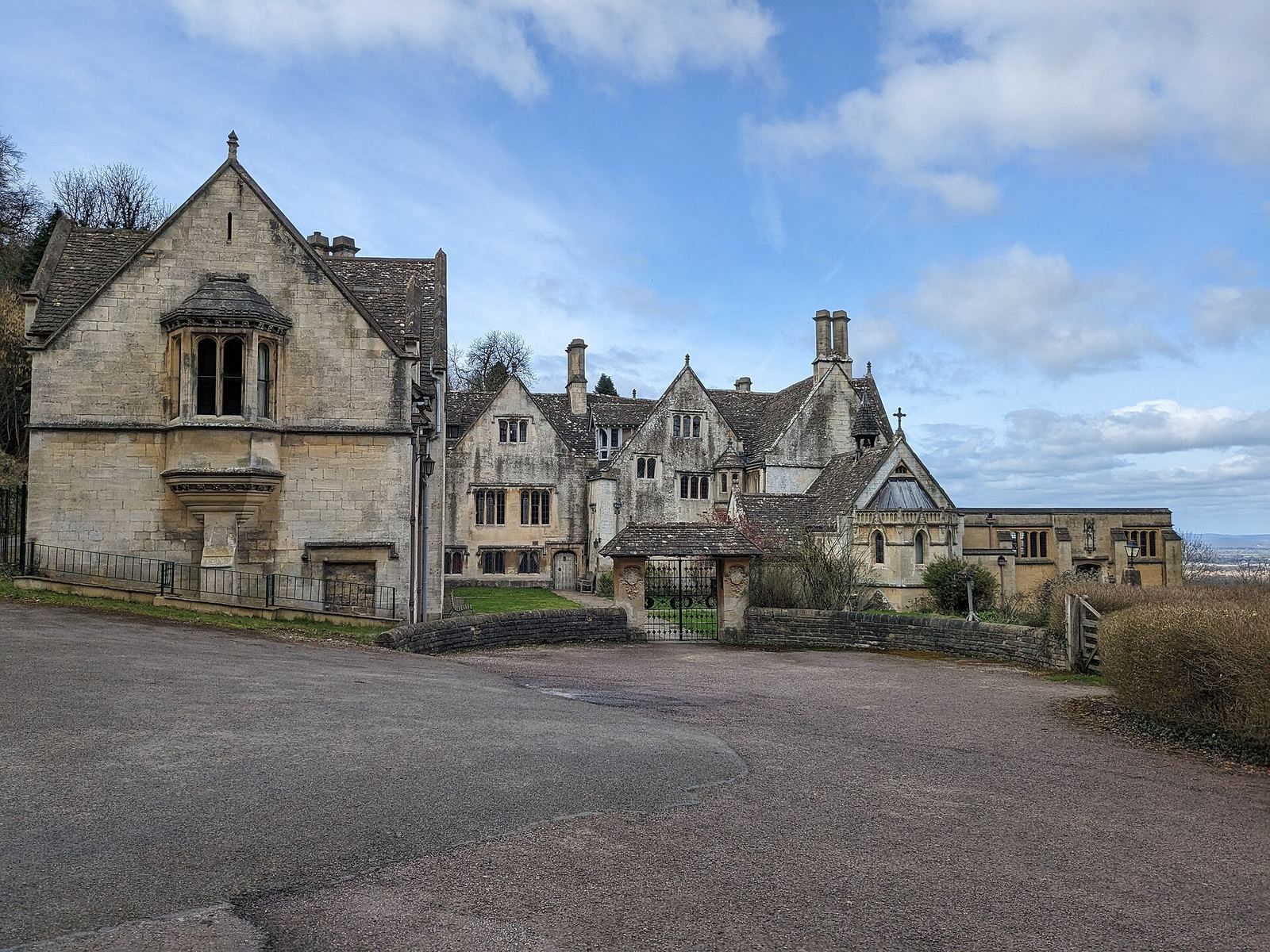
The principal buildings at Prinknash are the older manor house, now St Peter’s Grange, and a separate, larger abbey beside it. The older structure and the later complex reflect distinct phases in the site’s use.
St Peter’s Grange
Parts of the older building date to the 14th century, and an abbot’s manor with a chapel probably stood on the site. Much of the surviving structure was built around 1520 as a hunting lodge, during the abbacy of William Parker, the last Abbot of Gloucester. The manor house was adapted for monastic life in 1928. After the monks moved to the new abbey in 1972, it was re-roofed and refurnished as a retreat and conference centre called St Peter’s Grange. The community returned to the older building in 2008.
The newer abbey
The larger abbey beside St Peter’s Grange was occupied by the monks from 1972. Its buildings were sold in 2008 for conversion into apartments.