Hofgut Retters in Kelkheim: A Former Monastery and Estate
Site at a Glance
- Popularity
- Medium
- Country
- Germany
- Primary era
- Modern
- Eras represented
- Medieval, Early Modern, Modern
- Civilizations
- Electorate of Mainz, German, Holy Roman Empire
- Site type
- Domestic
- Remains
- Manor House
On this page13 sections
History
Hofgut Retters in Kelkheim, Germany, developed from a medieval religious community into an agricultural estate. Its monastic history began in the 12th century, and the property later passed through noble, ecclesiastical, and state ownership before becoming a modern farm and cultural venue. The name Retters is understood to mean God’s counsel; the surrounding district was also called Retters and Braubach, and later the Valley of the Holy Cross.
Foundation and monastic growth
Around 1136, canonesses, women religious living in a canonical community, moved to Retters from Steinbach Monastery in the Westerwald. Steinbach belonged to Rommersdorf Abbey, and economic considerations prompted the move. In 1146, Count Gerhard of Nürings, the last member of his noble family, donated land at Retters for a monastery. By 1162 at the latest, the new house had become a daughter monastery under Rommersdorf’s authority.
Retters initially served as a double monastery, with communities of both women and men. From about 1200 it functioned as a nunnery, whose members were generally women of the lower nobility. A charter from 1245 called it an Augustinian monastery, referring to the Rule of Saint Augustine, a set of guidelines for monastic life. Premonstratensians, a Catholic religious order that developed in the 12th century, were present by 1272 at the latest. Since they followed Augustine’s rule but belonged to a distinct order, the earlier description may have confused the rule with the institution.
The monastery church was dedicated to the Virgin Mary. A 17th-century historian also reported a dedication to Saint Nicholas. The Archbishop of Mainz was responsible for the monastery’s protection. Donations and trade helped Retters grow from what may have been a modest foundation into a substantial landholder. In 1191, Archbishop Conrad I of Wittelsbach protected 22 of its estates in the Taunus foothills and Wetterau. Over time, the monastery sold or exchanged more distant properties to gather its lands nearer the Taunus foothills.
By 1221, Retters held property in 40 settlements between Wiesbaden, Frankfurt, and Butzbach, including Münster, Hornau, Beidenau, Schneidhain, and Liederbach. Its holdings included 24 farms, two mills, 67 Hufen, a locally variable measure of land, amounting to about 407 hectares, mostly woodland and meadows. It also held 66 Morgen, another locally variable land measure, or about 13 hectares of fields cultivated directly, as well as 20 vineyards. Other farms owed it ground rent. From 1191 to 1559, the monastery also held the right to appoint the priest at the parish church in Dornheim.
In 1275, King Rudolf I placed Retters under the protection of the Empire. Rudolf was a Habsburg ruler elected as Roman-German king, the title used for the elected king of the Holy Roman Empire, a medieval central European polity. During the monastery’s prosperous period, it limited admissions to 50 canonesses because more women sought entry than it could support. Christina of Retters, born in 1269 and dead in 1291 or 1292, was a religious mystic later beatified, meaning the Catholic Church recognized her as blessed. Her reputation added to the monastery’s renown, although it is uncertain whether she lived or worked there.
A later tradition credited Gerhard of Nürings with founding the monastery in gratitude for his release after two years of captivity near Edessa during the Second Crusade, a major Christian military expedition to the eastern Mediterranean. The story said he had been captured with 100 followers. It conflicts with the monastery’s foundation endowment of 13 November 1146, which came about a year before the crusade began.
Lordship, decline, and dissolution
In 1272, Gottfried the Elder of Eppstein gave Retters land at Treisberg and Seelenberg, and in 1297 Archbishop Gerhard II of Eppstein remitted its dues. During the 14th century, the Eppstein lords gained increasing control and treated the monastery as part of their own lordship. They exercised secular lordship, while Rommersdorf retained the right to appoint its leaders and direct its religious life.
The monastery’s finances began to deteriorate in the mid-14th century amid plague, population loss, warfare, and feuds. In 1369, it sold its Treisberg holdings to Frank VIII of Cronberg. Retters was repeatedly drawn into regional conflicts, and raiders from Reifenberg plundered it in 1374. It then cultivated most of its remaining nearby lands directly, retaining no dependent farms apart from Beidenau. From 1350 to 1507, it also owed military service to Frankfurt, a Free Imperial City, or self-governing city within the Empire that answered directly to the emperor. In wartime, the monastery was expected to help defend Frankfurt and the surrounding area.
In 1433, the Eppstein family split into the Eppstein-Münzenberg and Eppstein-Königstein lines, which jointly administered Retters. Their disputes compounded its financial problems, hunger, and neglect. Around 1500, only about 20 people remained at the monastery.
When Eberhard IV, the last Count of Eppstein and Retters’s protector, died without heirs in 1535, the monastery and its lands passed to the House of Stolberg under an arrangement connected with his sister Anna’s marriage to Botho of Stolberg. After Botho died in 1538, an inheritance settlement assigned Retters to Ludwig of Stolberg-Königstein. His brother Christoph, a senior cleric at Halberstadt, had converted Ludwig to Lutheranism.
From 1540, Ludwig introduced the Reformation, the 16th-century religious movement that led to Protestant churches, throughout his county and began dissolving monasteries. Plague struck Retters in 1542 and 1544, killing more than half the nuns. The Stolbergs took over some of the monastery’s best lands, while debt, poor management, departures, recurring illness and hunger, and a lack of money for repairs further weakened the community. After a dispute with the tenant at Beidenau, Ludwig seized the estate and granted it to the tenant as a fief, land held under specified obligations. Retters thereby lost its last major holding.
The last abbess, Anna of Riedesel, died on 27 September 1559, after which the convent was dissolved in Ludwig’s name. His bailiff at Königstein, Christof von Hattstein, took its seals and papers and pressured the canonesses to sign the monastery over to the House of Stolberg. He cleared the convent on 23 October, while Rommersdorf was still arranging to appoint a new abbess. The three remaining nuns had to leave, with promises of annual life pensions of 25 gulden. Rommersdorf later tried, without success, to recover the monastery, arguing that the nuns had not been entitled to agree to the transfer.
Estate ownership and modern use
The Stolbergs turned Retters into a tenant farm. After Ludwig’s death in 1574, his younger brother Christoph inherited his property. In 1581, Christoph left his holdings in the Taunus foothills, including Retters, to the Collegiate Foundation of St Bartholomew in Frankfurt, a church institution associated with a community of clergy. The foundation soon sold the lands to the Electorate of Mainz, an ecclesiastical territory ruled by an archbishop who also helped elect the Holy Roman Emperor. The Königstein district administered the estate, and the Counter-Reformation, the Catholic Church’s response to Protestant expansion, pushed Lutheranism back in the area.
During the Thirty Years’ War, imperial troops plundered and burned the farm. It was later rebuilt and worked by successive tenants. French forces took Mainz in 1792 and occupied the left bank of the Rhine in 1797. In 1803, secularization, the transfer of church lands and institutions to secular political authorities, dissolved the ecclesiastical electorate and transferred Retters, along with much of Mainz’s property in the Taunus foothills, to the Principality of Nassau-Usingen. Nassau-Usingen and Nassau-Weilburg united as the Duchy of Nassau in 1806, and Retters remained a state domain. When the duchy was dissolved in 1866, the estate passed to Prussia.
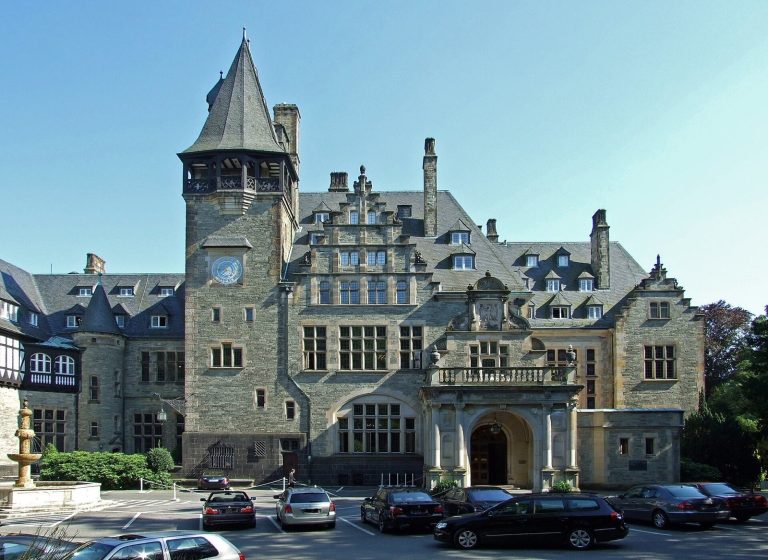
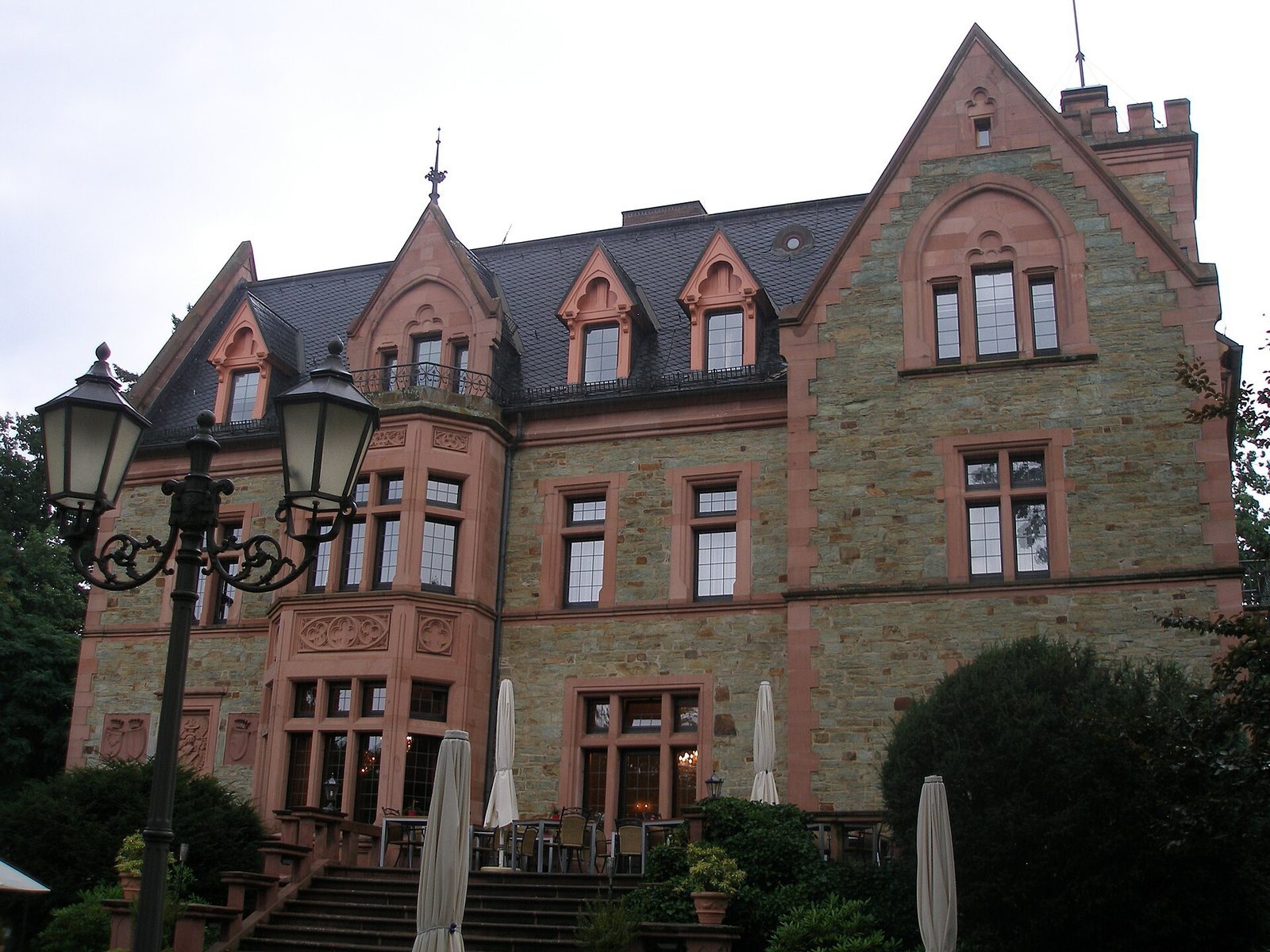
In 1883, Frederik Arnold Rodewald zu Feldheim bought Rettershof from Prussia and ended its hereditary leasehold arrangements. In the mid-1880s, he had a residence built for his daughter Alice and her husband, Oskar Baron von Dieskau, in the English Tudor style, a revival of forms associated with Tudor England. Oskar died in 1885, and Alice then married his brother Leopold. After Rodewald zu Feldheim’s death in 1886, Alice and Leopold managed the property. Its reduced acreage could not cover the costs of a luxury estate, and its owners sold it in 1903 to Baron von Vincke and his wife Sibylle von Hessen.
Felix von Richter bought the estate in 1924 as his family’s ancestral home; the family thereafter used the name Richter-Rettershof. A riding school for women, with a boarding school, opened in 1928, and a nearby restaurant followed in the 1930s. Felix and his wife Hertha oversaw extensive changes to the estate during the 1920s and 1930s.
After the Second World War, the U.S. Army requisitioned the residence and used it as a representative office until 1953. The Gehlen Organization, a postwar intelligence service that preceded Germany’s Federal Intelligence Service, occupied it briefly, and a private language school was based there from the mid-1950s. The family continued to run the farm, with Felix’s daughter Felicitas Bienzle taking over after his death. From 1973 to 1980, the German headquarters of the Hare Krishna movement, a modern Hindu religious movement, and a temple occupied the residence as tenants.
On 1 January 1980, the city of Kelkheim acquired the estate, residence, and about 110 hectares of land. The city renovated the farm and converted the residence into a hotel, and established a municipal company to operate the property. Since then, the estate has been used for equestrian activities and cultural events. The residence has been listed as a cultural monument in Hesse since 1983. A major fire on the night of 3–4 July 2018 damaged the property; its cause remained unknown.
Remains
Setting and layout
The estate lies in a broad valley at the edge of Retters Forest, about two kilometres northeast of Kelkheim’s town centre. The valley extends west between Ruppertshain and Fischbach. The Rettersbach runs near the farm and joins the Krebsbach, which feeds the Fischbach and then the Schwarzbach. Farmland borders the property to the west, while extensive woodland lies to the east. The present farmstead is a half-timbered, four-sided courtyard complex in the historicist style, an approach that revives forms from earlier periods.
Traces of the monastery
Chapel and foundations
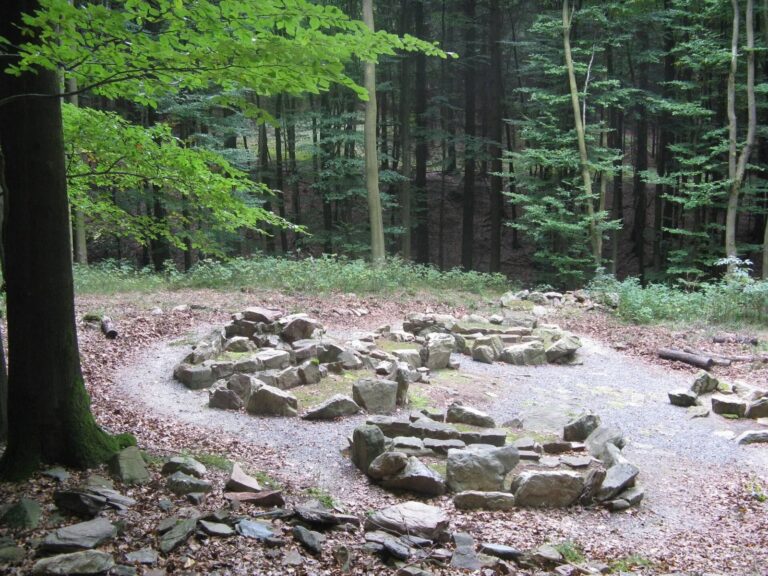
The medieval monastery included a farm and a small chapel. Finds made during construction work in 1939 point to a chapel site north of the present riding arena, opposite the farm gate. The buildings were destroyed during the Thirty Years’ War, leaving foundation walls. Most of those foundations were later removed, and some were incorporated into new buildings. A cellar vault beneath the farm may date from the monastery period.
Enclosure wall
In the forest east of the farm, remains of an old wall follow the course of the former monastery wall. A map from 1592 also shows an oval enclosure southeast of the monastery, estimated to have measured about 250 metres across.
Farmstead and residence
Courtyard and gate
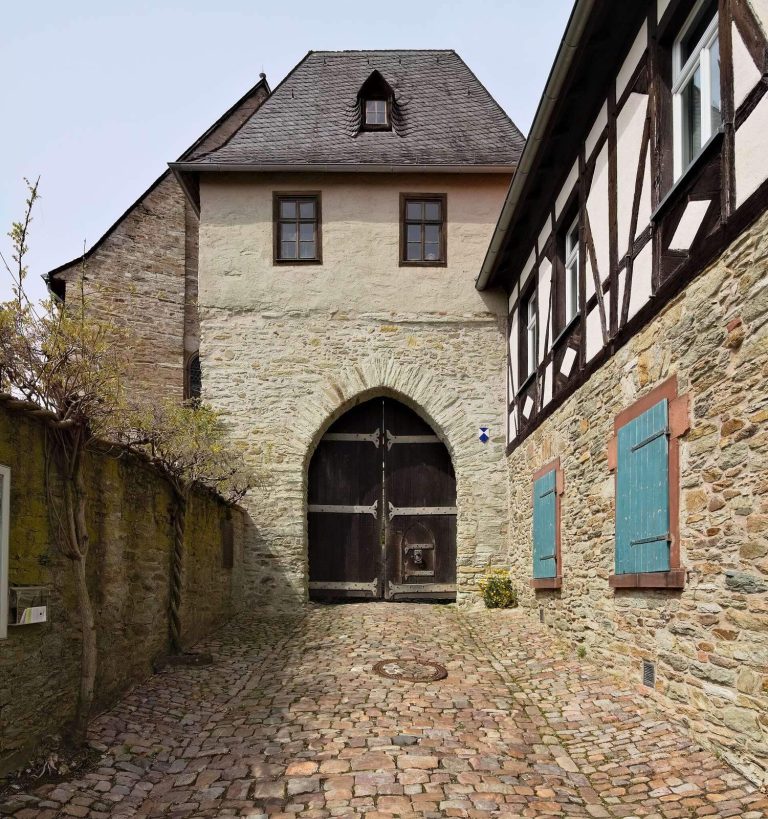
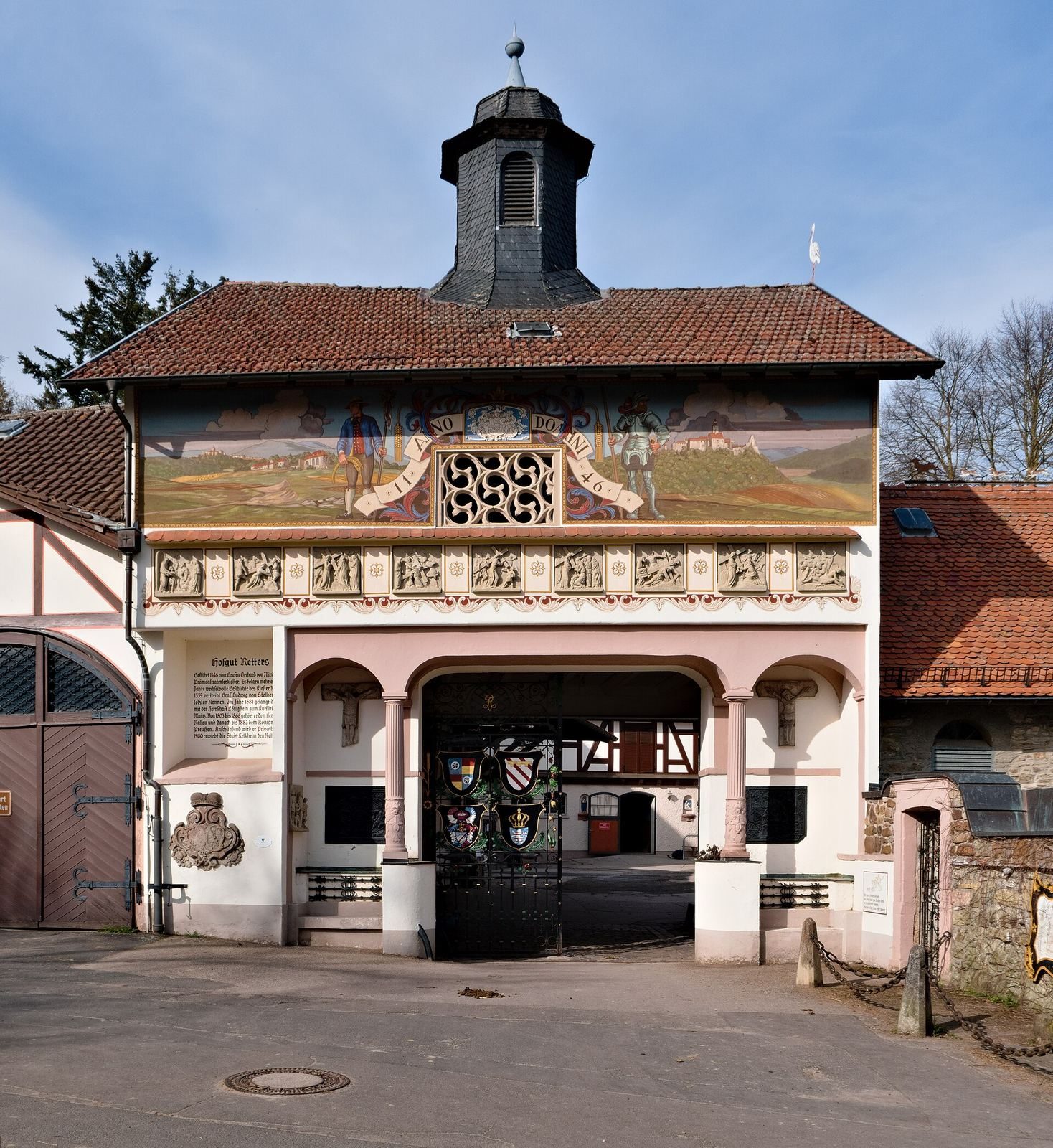
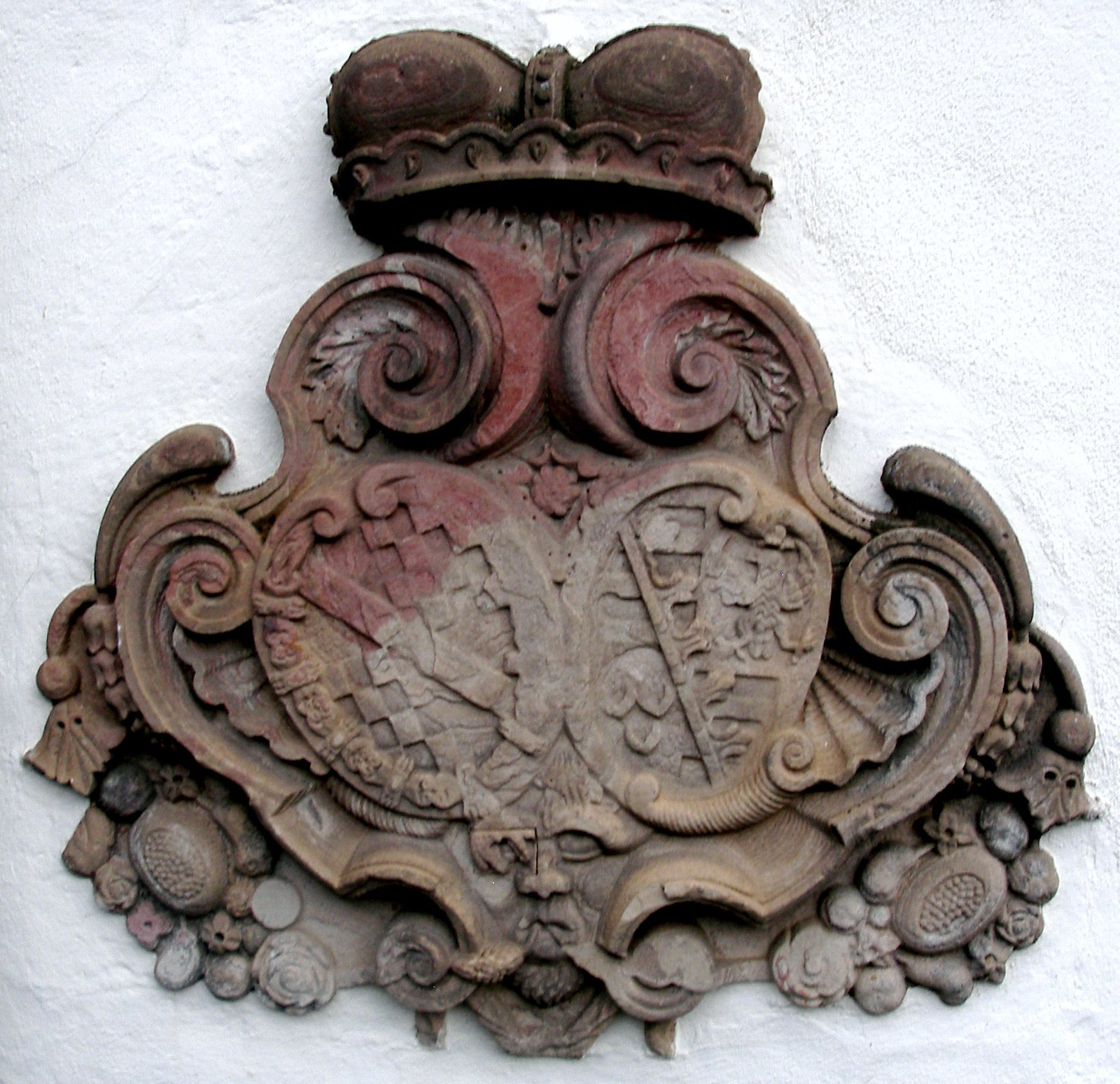
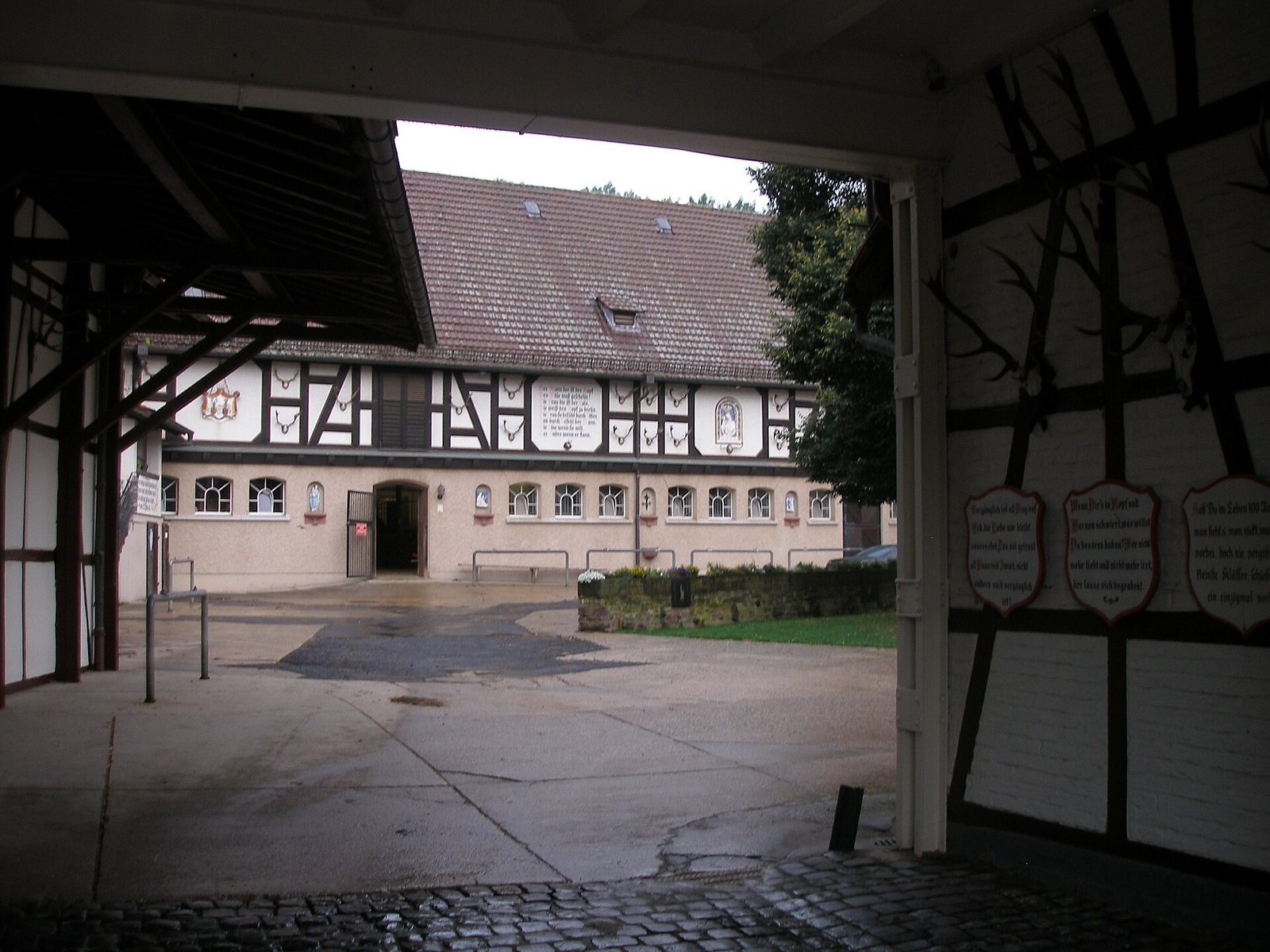
The Richter-Rettershof family established the farmstead’s present form during the 1920s and 1930s. Its half-timbered buildings enclose a four-sided courtyard. The gatehouse, built in 1936, has a richly decorated facade. An iron gate from 1932 bears the coats of arms of historical rulers and noble families associated with Retters. Many surviving wall decorations also date from the 1930s, including facade inscriptions about horses and riding, hunting trophies, figures of saints, heraldic stones, and other ornaments. Additional agricultural outbuildings stand apart from the main complex.
Riding facilities
The riding arena built for the school that opened in 1928 remains in use. A large indoor riding hall was added east of the stud farm in 2000. The fire in July 2018 destroyed part of the stable buildings and sections of the roof structure.
Residence
The residence stands on a hill north of the farmstead. Built in the mid-1880s in the English Tudor style, it incorporates sandstone and stone from the Taunus foothills. During its conversion into a hotel in the early 1980s, a bronze-clad wing containing 35 guest rooms was added on the south-facing slope. A glass passage connects the wing to the main building, and the hotel opened in 1984.