Noirmoutier Abbey: A Benedictine Monastery on Noirmoutier Island
Site at a Glance
- Popularity
- Medium
- Country
- France
- Primary era
- Medieval
- Eras represented
- Medieval, Early Modern
- Civilizations
- Duchy of Aquitaine, French, Merovingian
- Site type
- Religious
- Remains
- Monastery
On this page5 sections
History
Noirmoutier Abbey, also known as the Abbey of Saint Philibert, was a Catholic Benedictine monastery on the island of Noirmoutier in France, founded in 674 by the Frankish abbot Philibert of Jumièges, later also called Philibert of Tournus. Benedictine monks followed the Rule of Saint Benedict. Philibert died at the monastery on 20 August 684, and his grave soon drew pilgrims from the surrounding region.
Foundation and first destruction
Before settling on Noirmoutier, Philibert had founded Jumièges Abbey. Conflict with Ebroin, a powerful chief administrator in the Frankish kingdom of Neustria, led him to leave. Bishop Ansoald of Poitiers, the senior church authority in his diocese (church district), welcomed him. Philibert helped spread Christianity there before withdrawing to the island with several monks from Jumièges.
On 1 July 677, Ansoald granted the monks his villa at Déas, now Saint-Philbert-de-Grand-Lieu near Lake Grand-Lieu, along with other lands to support the monastery’s growth. The community’s name changed from Herio to Hermoutier and then Noirmoutier, a name associated with the monks’ black habits. Its members worked the salt marshes and farmland and traded with the mainland through the island’s port. The monastery flourished until 732, when Muslim forces, called Saracens in medieval European usage, destroyed it.
Raids and relocation of the monks
A Scandinavian fleet attacked and plundered the monastery in 799. Louis the Pious, then king of Aquitaine, re-established the abbey in 804. Scandinavian raiders known as Normans plundered it several times from 814 to 819. In 819, after Louis, by then emperor, authorized the diversion of the Boulogne River, Abbot Arnulf led the monks in building another abbey at Déas beside Lake Grand-Lieu. They used it as a refuge during the summer raiding season.
Viking attacks in 824, 830 and 835, alongside pressure from Breton attacks, led Abbot Hibold to begin moving Saint Philibert’s relics, his remains revered as holy, in 836. On 7 June that year, the monks left Noirmoutier carrying the saint’s body in a reliquary (a container for religious relics). The abbey was burned in 846, and the island then served as a Viking base for operations along the Loire. Driven from Déas in 847, the monks took refuge at Cunault, a property granted to them in 845, and brought the relics there in 857.
In 862, the monks fled the Normans again, taking refuge at Messais in Poitou on an estate given to them by Charles the Bald, king of West Francia and later emperor. They were at Saint-Pourçain-sur-Sioule in 870, then reached Tournus in 875 and founded the Abbey of Saint Philibert there. By around 1000, the Noirmoutier monastery had become a priory (a smaller monastic house) dependent on Tournus. It was not rebuilt after its destruction.
The Cistercians and Abbey of La Blanche
A separate community of Cistercians, a monastic reform order within the Benedictine tradition, settled on nearby Île du Pilier around 1172. In 1205, local lord Pierre IV de Beauvoir granted them a charter (a formal written grant of rights or permission) to establish a house on Noirmoutier. They built the Abbey of La Blanche in the north of the island; its name referred to the white clothing worn by the monks. This distinct abbey belonged to the diocese of Luçon and remained in existence until the French Revolution of 1789.
Remains
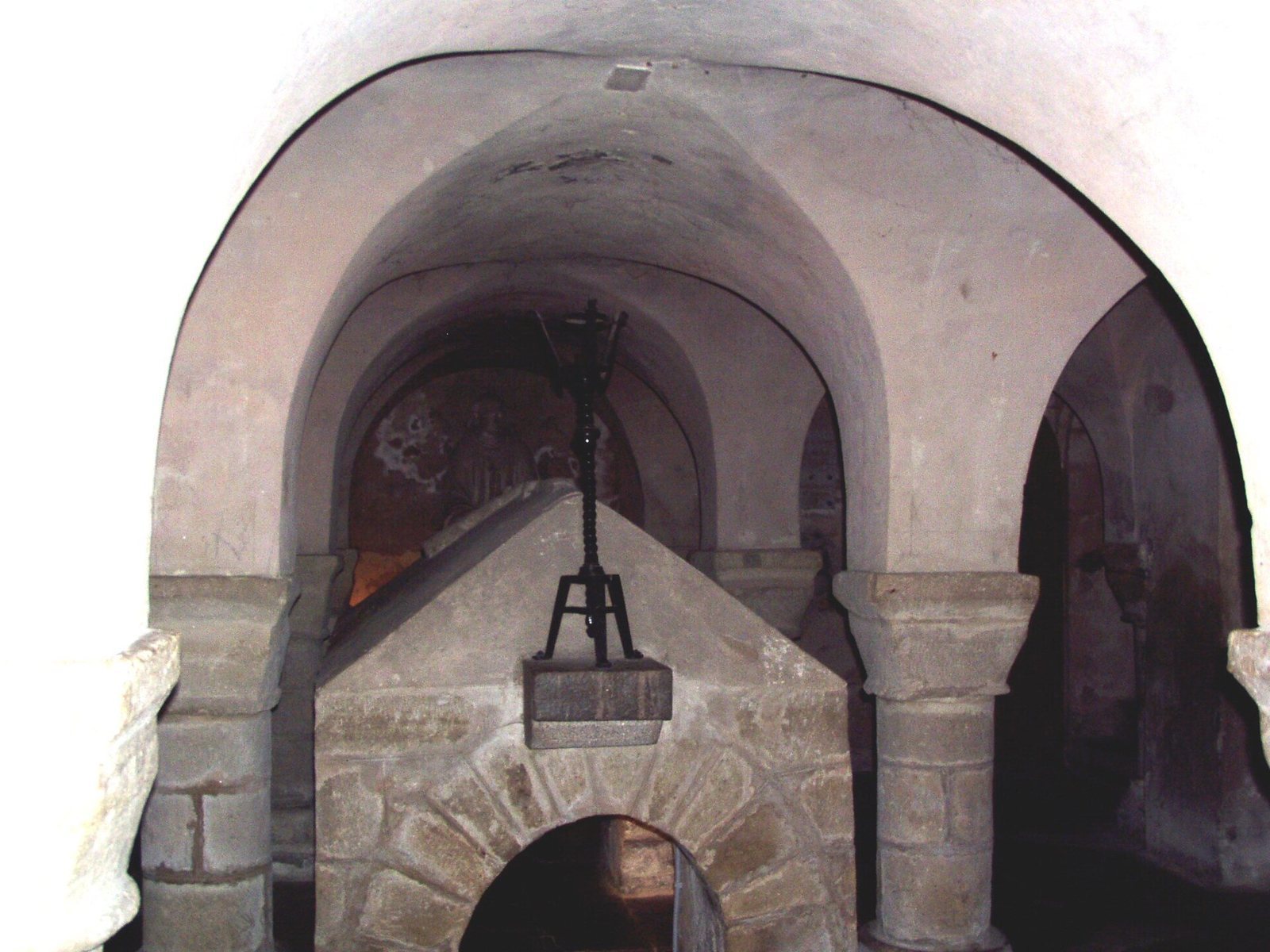
The only surviving remnant of the original monastic buildings is a crypt (a chamber beneath a church) under the parish church of Saint-Philbert in Noirmoutier-en-l’Île. It belongs to the Merovingian period, when a Frankish dynasty ruled from the fifth to the eighth centuries, and parts of it date to the abbey’s foundation phase. Above it, the church’s choir (the area around the altar) and nave (the main central worship space) date to the late eleventh century. Its side aisles (passages alongside the nave) date to the fourteenth and sixteenth centuries. The bell tower burned in 1848 and was rebuilt in 1875.