Koblenz Charterhouse: A Carthusian Monastery on Beatusberg
Site at a Glance
- Popularity
- Medium
- Country
- Germany
- Primary era
- Medieval
- Eras represented
- Medieval, Early Modern
- Civilizations
- Electorate of Trier, Holy Roman Empire
- Site type
- Religious
- Remains
- Monastery
On this page10 sections
History
Koblenz Charterhouse was a monastery of the Carthusian order on Beatusberg in Koblenz, Germany. Carthusian communities combined shared worship with an austere, secluded way of life. The monastery’s foundation date is uncertain: it may have followed a grant of Koblenz to Archbishop Poppo of Babenberg in 1018, or it may have been established around 1143. Its later church and rebuilding belonged to the Baroque period.
Benedictine origins and institutional change
A chapel stood on Beatusberg before a Benedictine monastery was founded. The proposed date around 1143 connects its establishment with the transfer of Saint Beatus’s relics from Trier’s monastery of St. Maria ad martyres. Archbishop Hillin of Falmagne confirmed a donation to the house in 1153, its earliest known written reference.
A Benedictine nuns’ house on Oberwerth was affiliated with the monastery as part of a double community. Archbishop Theoderic II of Wied separated the two in 1215 after disputes, and their documents were destroyed to prevent further conflict. Pope Gregory IX placed the monastery under his protection in 1233 and confirmed its possessions. In 1241, Bishop Henry of Ösel consecrated its church on behalf of the Archbishop of Trier to the Virgin Mary and Saints Beatus and Servatius.
During the thirteenth and fourteenth centuries, the monks faced accusations of serious breaches of their rule, excessive worldliness, and weak discipline. Archbishop Boemund I of Warsberg appointed Walram, an abbot from Trier’s St. Maria ad martyres, to administer the house. Walram resigned on 30 May 1314 without reversing its decline. In 1315, Archbishop Baldwin of Luxembourg reorganized it as a collegiate house, a religious community of canons. The canons later departed, considering the location too remote.
The Carthusian community
On 13 August 1331, Baldwin brought the Carthusian order to Koblenz and established its community in the former Benedictine monastery. Johannes von Echternach, who had come from the Charterhouse of Seitz and previously led houses at Mainz and Trier, served as its first prior, the head of a Carthusian house, until about 1335. The new community was probably incorporated into the order in 1337 and became part of its Rhine province in 1440.
Theodoric of Güls, a subordinate rural church official and president of the Trier chapter, its governing body, gave his property to the Charterhouse and entered as a novice. Cardinal Nicholas of Cusa contributed 100 florins toward establishing a Carthusian cell, an individual monk’s dwelling, and granted the prior perpetual patronage of the hospital at Cuës on the Moselle. The community’s strict observance, care for the sick, and effective management helped shape Koblenz’s religious life for almost five centuries.
The monks initially struggled with debts inherited from the Benedictines, but donations from wealthy Koblenz residents supported the house’s growth. In 1355 they purchased an estate at Moselweiß, later called the Kemperhof, and they held other farms in Koblenz. Their principal urban estate, Vogelsang, served repeatedly as a refuge during wartime.
Wartime damage and rebuilding
Swedish forces captured and plundered Koblenz in 1632, during the Thirty Years’ War, a major European conflict fought from 1618 to 1648. The monastery was damaged; some religious were killed, while others took refuge at Vogelsang. During the 1688 siege of Koblenz, French bombardment badly damaged the complex. The siege formed part of the Nine Years’ War, fought between France and a coalition of European powers from 1688 to 1697. The old church was later demolished, and the monastery was rebuilt.
Dissolution and military use
On 9 October 1794, before French Revolutionary troops entered Koblenz on 23 October, the monks left for Vogelsang. The former monastery buildings were first used as barracks. On 9 June 1802, French authorities abolished religious orders in the occupied territories and nationalized church property. The remaining Koblenz monks signed the handover record on 10 September.
Private ownership and Prussian occupation
Innkeeper Wilhelm Sauer soon leased the property, turning the prior’s building into an inn and dance hall. On 10 October 1805, the French state domain administration auctioned the monastery and its land to Sauer and Nikolaus Krieger, a coppersmith and wine merchant. They sold their shares in 1810–1811 to merchant Christian Seidensticker, who had also bought the Carthusian Berghof in 1810.
During the Wars of Liberation, campaigns against Napoleonic French rule from 1813 to 1815, the former monastery housed first a French and then a Russian military hospital. In September 1816 it was adapted as barracks for Prussian military engineers working on the Koblenz fortress system. On 23 June 1818, the Prussian state acquired the former monastery, the Berghof, and their associated land from Seidensticker, with the purchase effective from 11 November 1816.
Historical memory
Records and parts of the Charterhouse library survive in the Koblenz State Main Archive and Koblenz City Archive. The state archive holds 13 charters from the Benedictine period. Saint Beatus’s veneration continued in the dedication of a parish church established in the late 1940s in the growing Karthause district. The names Beatusberg and Karthause both recall the Carthusian community.
Remains
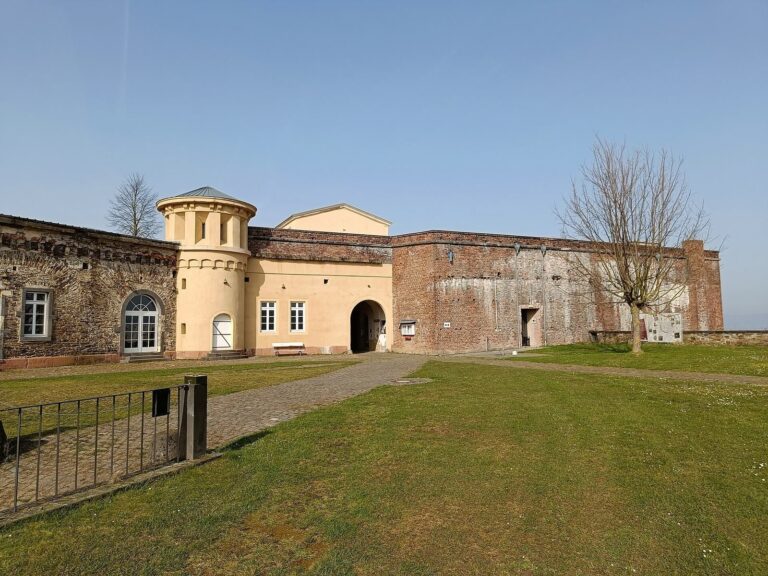
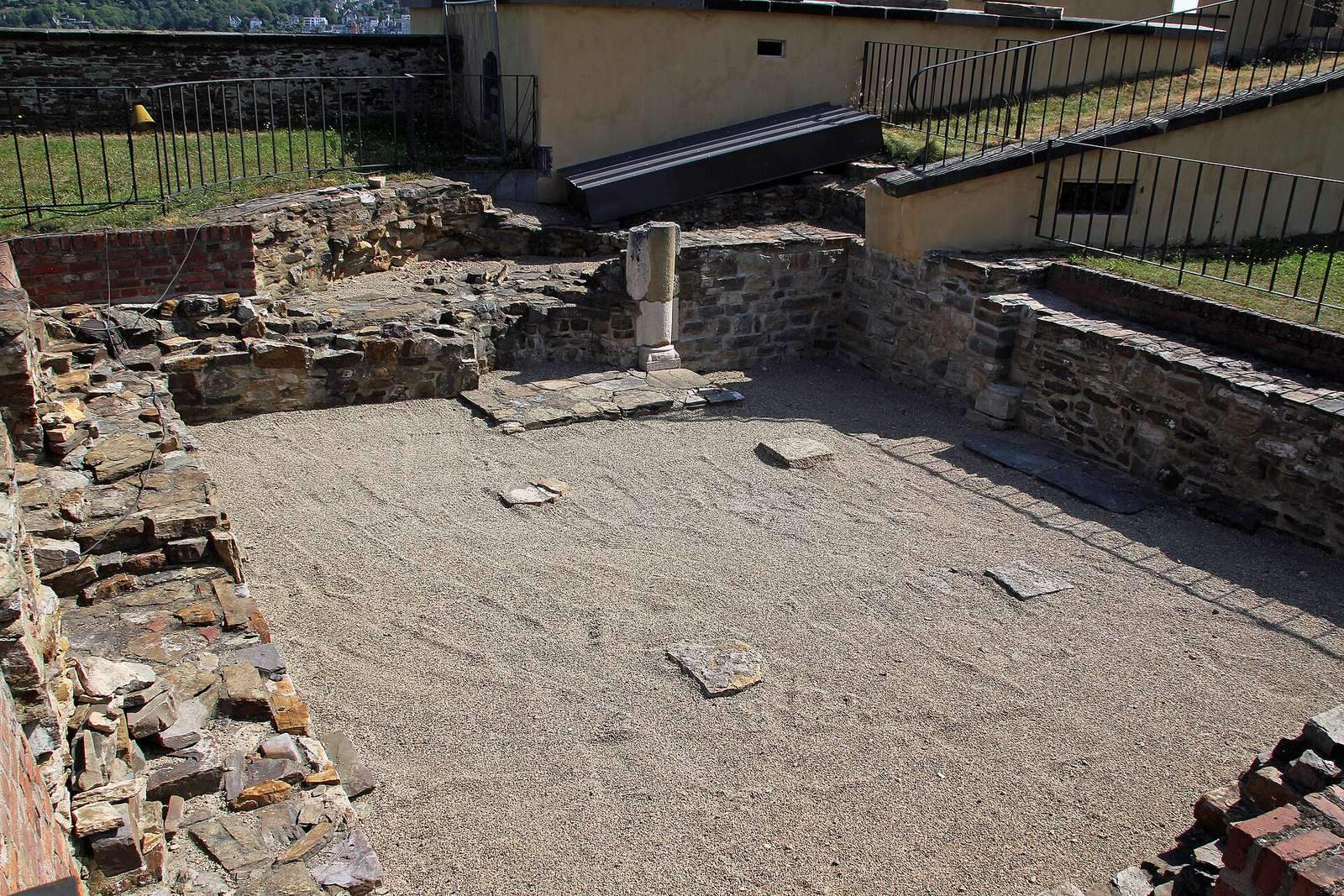
The monastery occupied Beatusberg on the Rhine’s left bank, at the northeastern edge of the Hunsrück highlands and overlooking Koblenz. Fort Großfürst Konstantin was later built over the monastic site. The church and a group of residential, administrative, and working buildings made up the complex; the excavated church crypt lies in the fort’s courtyard.
Church and crypt
Excavation in the courtyard in 1997 exposed part of a crypt, a chamber beneath a church, belonging to a twelfth-century building, as well as remains of a smaller, earlier crypt. The chamber was cut into rock and enclosed by rubble-stone walls. Its plan included a square choir bay with four free-standing columns and six supports attached to the walls. At the eastern end, an apse, a projecting space at the end of a church, contained an altar foundation; part of the western entrance area and foundations for its stairs were also found. The crypt was demolished and filled during the late seventeenth century, probably after war damage, and foundations for the replacement church were laid into the fill. Erected between 1720 and 1737, the new church was a three-aisled basilica, a long form divided into a central aisle and two side aisles, with an angular-ended choir.
Other monastic buildings
The complex included an entrance building, a two-storey residence, a bakery and brewery, a wagon-maker’s workshop, an estate office, the prior’s building, a chapter house for meetings of the community’s governing body, and a washhouse with a kitchen and stables. The estate office was already in ruins, though its cellar remained in use. An engraving by C. Dupuis dated 1789 depicts the Koblenz Charterhouse.